You may already know that a vibration plate can make familiar exercises such as squats and lunges feel noticeably different. However, simply standing on a vibrating platform is not the same as following a structured vibration plate workout. Exercise selection, body position, intensity, duration, and progression all influence how you train.
A well-designed vibration plate workout can complement traditional strength, aerobic, balance, and mobility exercises. In this guide, you’ll learn what vibration plate training is, how it works, the best vibration plate exercises for beginners, how to create a 10–15 minute routine at home, how vibration training relates to weight management, and how to use a vibration plate safely.
What Is a Vibration Plate Workout?
A vibration plate workout is a form of exercise performed on a vibrating platform, often combining whole-body vibration with movements such as squats, lunges, calf raises, bridges, or static holds.
The platform produces rapid mechanical oscillations that travel through the body while you stand or exercise on it. For example, performing a bodyweight squat on a vibration plate combines a familiar lower-body movement with the mechanical stimulation created by the vibrating platform.
Whole-body vibration can create additional muscle, balance, stability, and coordination demands during certain exercises. However, the response varies depending on several factors, including:
- Vibration frequency
- Vibration amplitude
- Body position
- Exercise selection
- Exercise speed
- Individual fitness level
For this reason, vibration plate training is best viewed as an addition to a broader exercise program, not as a replacement for conventional exercise. For example, short vibration sessions can be combined with walking, resistance training, or low-impact workouts to create a more balanced weekly routine.
Why Does a Vibration Plate Workout Matter?
A vibration plate workout can add muscle, balance, stability, and coordination challenges to movements that you may already know. This makes the platform potentially useful for people who want to introduce another training stimulus without relying exclusively on high-impact exercise.
Research in older adults suggests that whole-body vibration may improve lower-limb strength and physical performance, although outcomes vary according to the population, exercise protocol, and vibration parameters.
A 2023 meta-analysis included 18 randomized controlled studies and found significant improvements in knee strength and several physical-performance measures.
Source: Archives of Physical Medicine and Rehabilitation, 2023.
Furthermore, a 2024 meta-analysis involving 14 randomized controlled trials found improvements in lower-limb strength, mobility, gait, balance, and physical performance among nursing-home residents older than 80.
Source: Physical Therapy, 2024.
These findings are encouraging, but they should be interpreted in context. Vibration training does not automatically provide the same cardiovascular, strength, or overall health benefits as a complete exercise program.
Should a Vibration Plate Replace Regular Exercise?
No. A vibration plate workout should complement rather than replace conventional strength and cardiovascular exercise.
Adults should still work toward at least 150 minutes of moderate-intensity aerobic activity each week and muscle-strengthening activity on at least 2 days, according to current CDC guidance.
Source: CDC, 2025.
A practical approach is to use vibration training as one component of a weekly fitness plan that also includes aerobic activity, resistance training, mobility, and balance work.
How Does a Vibration Plate Workout Work?
A vibration plate workout works by exposing your body to mechanical oscillations while you stand, hold a position, or perform a movement on the platform.
The platform’s settings influence how quickly and how far it moves. Because machines can differ in their vibration patterns and specifications, the same numerical setting does not necessarily produce an identical training experience across different devices.
What Do Frequency and Amplitude Mean?
Frequency describes how rapidly the platform vibrates, while amplitude describes the size of the platform’s movement.
These two variables are important because vibration machines can use different combinations of frequency and amplitude. Therefore, frequency should not be treated as a universal measure of workout difficulty.
A 2025 systematic review and network meta-analysis included 27 randomized controlled trials involving 1,608 older adults. It found that different vibration frequencies produced different rankings for balance and gait, while traditional training ranked highest for muscle-strength improvement.
Source: Archives of Physical Medicine and Rehabilitation, 2025.
For beginners, the goal should not be to automatically select the highest available frequency. Instead, follow the manufacturer’s recommended settings and increase the challenge gradually.
More vibration is not automatically better.
Why Does Body Position Matter?
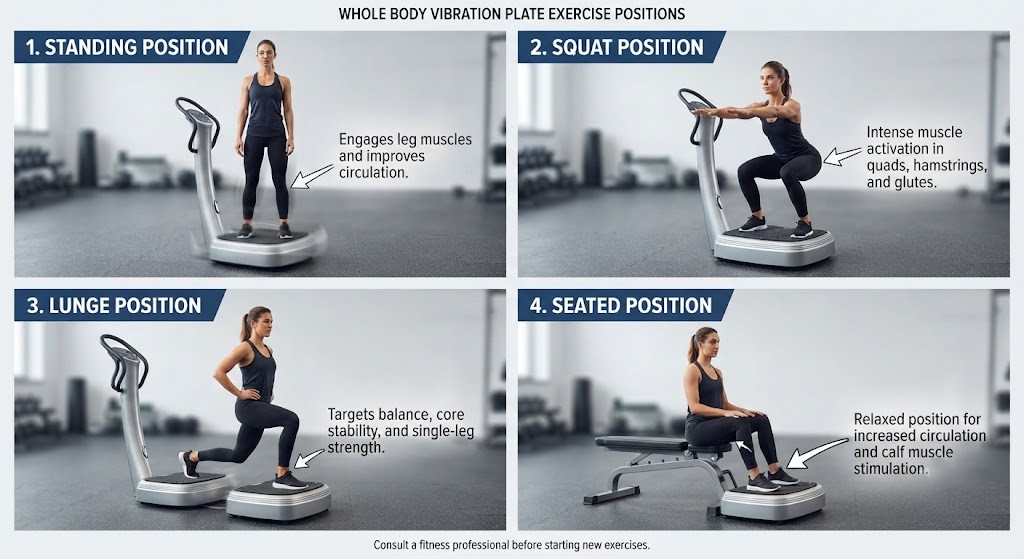
Your body position can change how a vibration plate workout feels and how you respond to the mechanical oscillations.
For example, standing with slightly bent knees creates a different position from standing rigidly with locked knees. Your stance width, knee angle, hand position, and movement speed can also influence the exercise.
Controlled positioning is particularly important for beginners. Stable footing and deliberate movement allow you to focus on the exercise rather than simply reacting to the vibration.
What Are the Best Vibration Plate Exercises for Beginners?
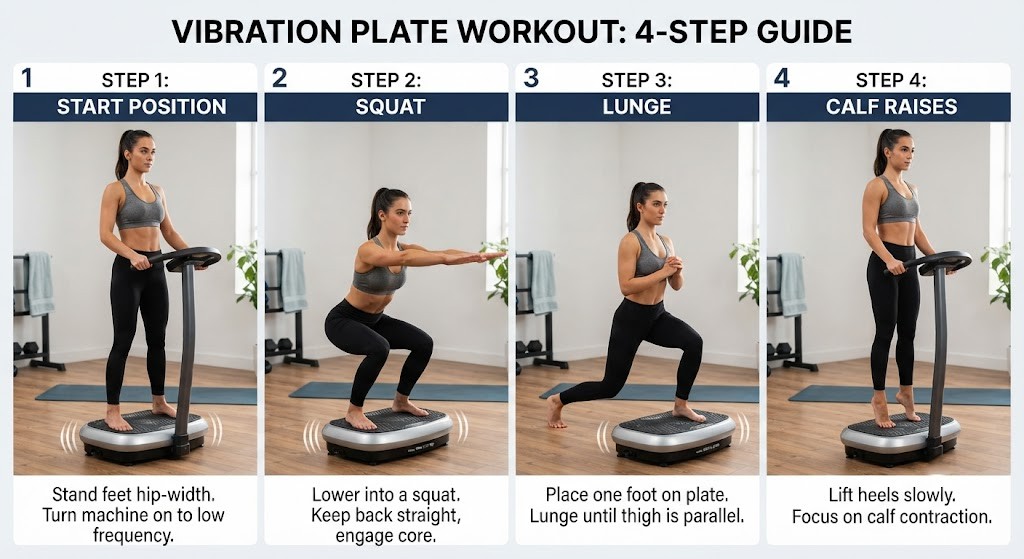
The best beginner vibration plate exercises are controlled movements that are relatively easy to modify. These include squats, calf raises, glute bridges, supported lunges, standing holds, incline push-ups, and selected core exercises.
Before adding vibration, make sure you can perform the basic movement with good technique. The platform should make the exercise more challenging without causing you to lose control.
| Exercise | Beginner Dose | Main Focus | Key Cue |
|---|---|---|---|
| Squat | 8–12 reps | Legs and glutes | Keep knees controlled |
| Calf raise | 10–15 reps | Calves | Rise slowly |
| Glute bridge | 10–12 reps | Glutes | Squeeze at the top |
| Supported lunge | 6–10/side | Legs and balance | Hold stable support |
| Standing hold | 20–30 sec | Stability | Maintain soft knees |
| Incline push-up | 6–10 reps | Upper body | Keep body aligned |
| Dead bug | 6–10/side | Core control | Keep movement slow |
How Do You Do Vibration Plate Squats?
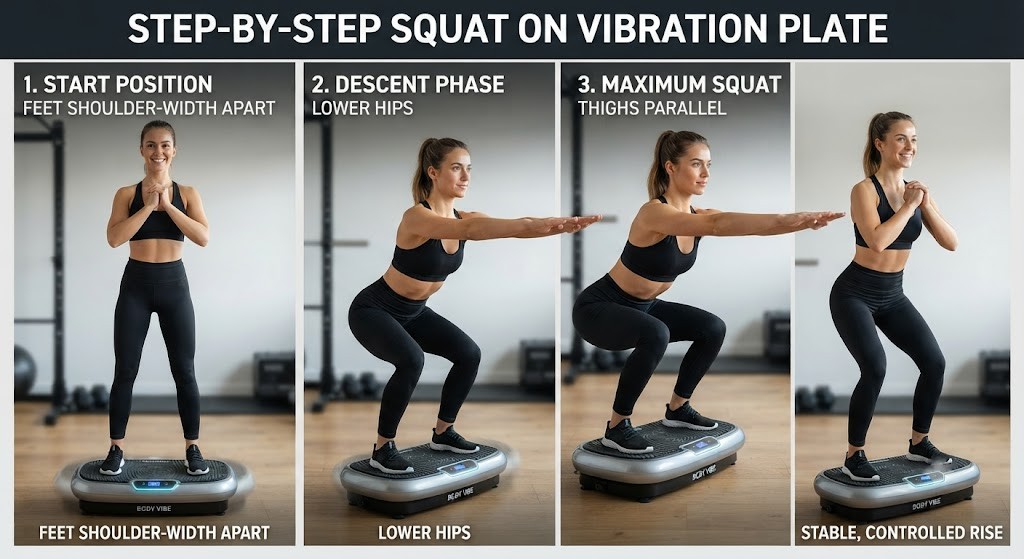
A vibration plate squat is performed by standing securely on the platform, bending at the hips and knees, and returning to standing with control.
Keep your chest comfortably upright and maintain controlled knee alignment. Avoid allowing your knees to collapse inward as you lower and rise.
A good starting point is 8–12 slow repetitions at a manageable intensity. If you feel unstable, use a stable support rather than immediately increasing the vibration level.
How Do You Do Vibration Plate Calf Raises?
Vibration plate calf raises target the lower legs by moving from a stable foot position onto the balls of your feet.
Start with a secure stance and move through a comfortable range of motion. Rise slowly, pause briefly, and lower under control instead of bouncing quickly.
How Do You Do Glute Bridges on a Vibration Plate?
Glute bridges target the glutes and hips as you lift your pelvis from the floor.
Place your feet securely according to your machine’s instructions. Lift your hips under control, briefly squeeze the glutes at the top, and lower slowly.
For more targeted quadriceps training, you can also explore a VMO workout focused on strengthening the quadriceps region.
Can You Do Ab Exercises on a Vibration Plate?
Yes, selected core exercises can be performed on or around a vibration plate, but stability and technique should take priority over intensity.
A controlled dead bug can be a useful option because it challenges coordination and core control without requiring an unstable plank position.
A Dead Bug Workout can provide a useful starting point for readers who want to train abdominal control while keeping movement deliberate. Stop if vibration causes discomfort or makes it difficult to maintain proper form.
How Do You Do a Vibration Plate Workout at Home?
A beginner vibration plate workout at home should use manageable intensity, controlled exercises, short intervals, and gradual progression.
Before stepping onto the platform, spend a few minutes preparing your joints and muscles. Once you begin, prioritize technique rather than trying to complete as many repetitions as possible.
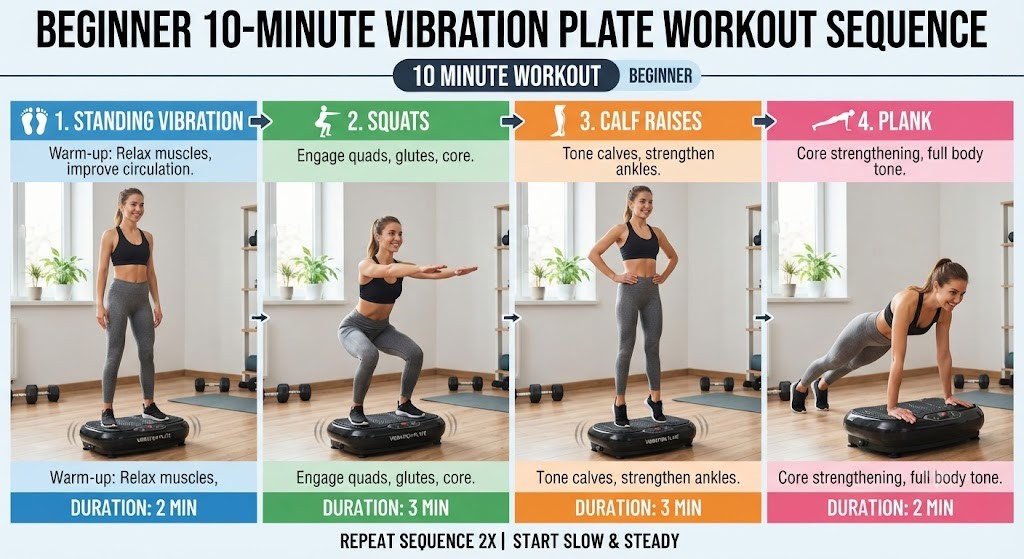
10–15 Minute Beginner Vibration Plate Workout
This beginner routine uses short intervals to help you become familiar with vibration training without making the session unnecessarily difficult.
- Warm-up — 2 minutes: March gently, move your ankles, and perform easy bodyweight squats away from the plate.
- Supported squat — 10 reps: Use a comfortable stance and maintain controlled knee and hip movement.
- Calf raise — 12 reps: Rise slowly, pause, and lower with control.
- Glute bridge — 10 reps: Lift and lower your hips smoothly.
- Supported reverse lunge — 6 reps per side: Use stable support if balance is limited.
- Standing stability hold — 20 seconds: Keep a slight knee bend and maintain relaxed breathing.
- Incline push-up — 6–10 reps: Use an appropriate stable surface or machine position recommended by the manufacturer.
- Core exercise — 6 reps per side: Try a controlled dead bug variation.
- Rest — 30–60 seconds: Recover between exercises or rounds.
- Cool-down — 2 minutes: Step off the plate and perform gentle mobility movements.
How Long Should You Use a Vibration Plate for a Workout?
Beginners can start with a short 10–15 minute vibration plate workout and gradually increase duration as technique and tolerance improve.
There is no universal ideal vibration duration because research protocols differ substantially. Instead of copying an advanced routine, follow your machine’s instructions and increase the workload gradually.
One controlled circuit with good technique is more useful than extending the workout while your form deteriorates.
Can Vibration Plate Workouts Help With Weight Loss?
Vibration plate workouts may contribute to a broader weight-management strategy, but they should not be presented as a standalone fat-burning solution.
Weight loss is influenced by sustained energy balance, nutrition, overall physical activity, and adherence to an appropriate exercise program. A vibration plate can therefore be viewed as one tool within a larger lifestyle approach.
A 2025 systematic review and meta-analysis examined 20 randomized controlled trials involving 585 participants and evaluated whole-body vibration for body mass, BMI, and fat mass.
Source: Systematic Review and Meta-Analysis, 2025.
Earlier evidence also found that whole-body vibration could contribute to reductions in fat mass, particularly when combined with conventional diet and exercise interventions.
Source: Journal of Physical Therapy Science, 2019.
The practical takeaway is simple: use vibration training as a complement to an active lifestyle rather than as a shortcut for weight loss.
For nutrition support, a high satiety diet plan can complement a structured exercise routine.
What Exercises Can You Do on a Vibration Plate for Your Legs and Glutes?
Effective vibration plate exercises for legs and glutes include squats, calf raises, glute bridges, supported lunges, and controlled static holds.
Start with exercises that allow you to maintain stable alignment throughout the movement. Once the basic exercises feel comfortable, you can gradually adjust repetitions, duration, resistance, or exercise variations.
A simple lower-body circuit could include:
- 10 squats
- 12 calf raises
- 10 glute bridges
- 6 supported lunges per side
Rest as needed and repeat only if you can maintain consistent technique.
For broader strength development, combine vibration exercises with conventional resistance training. A vibration plate can provide variety and another training stimulus, but progressive resistance remains important for developing strength.
How Can You Use a Vibration Plate for Different Fitness Goals?
Vibration plate training can be adapted to different fitness goals by changing the exercises and training structure rather than relying solely on stronger vibration.
For Strength
Pair the platform with controlled movements such as:
- Squats
- Lunges
- Glute bridges
- Other resistance exercises
Focus on maintaining technique as you gradually increase the training challenge.
For Balance
Use supported standing holds and, when appropriate, controlled single-leg variations. Stability should come before complexity.
For Mobility
Combine gentle movement with a normal warm-up and mobility routine. The objective is controlled movement rather than maximum vibration.
For Conditioning
Use short exercise circuits while keeping the intensity appropriate for your current fitness level. Rest between exercises when necessary.
For Low-Impact Exercise
A vibration plate can be incorporated into controlled movements instead of jumping or other high-impact drills.
For example, a balance-focused session may emphasize supported holds, while a strength-focused workout may emphasize squats and lunges.
Similarly, mind-body approaches such as NeuroYoga can complement balance and coordination work. High-intensity formats such as a Tabata Workout should only be adapted to a vibration platform when the movements remain technically safe.
What Tools and Settings Should You Use?
The most useful vibration plate features include adjustable intensity, stable footing, clear controls, a timer, and settings that align with the manufacturer’s exercise guidance.
Before beginning a workout, check the machine’s specifications and understand the controls.
Useful features include:
- Adjustable intensity: Helps support gradual progression.
- Stable, non-slip footing: Provides a secure surface for controlled movement.
- Simple timer controls: Useful for interval-based routines.
- Clear frequency information: Helps you understand which setting you are using.
- Manufacturer guidance: Provides recommendations for positions and exercises.
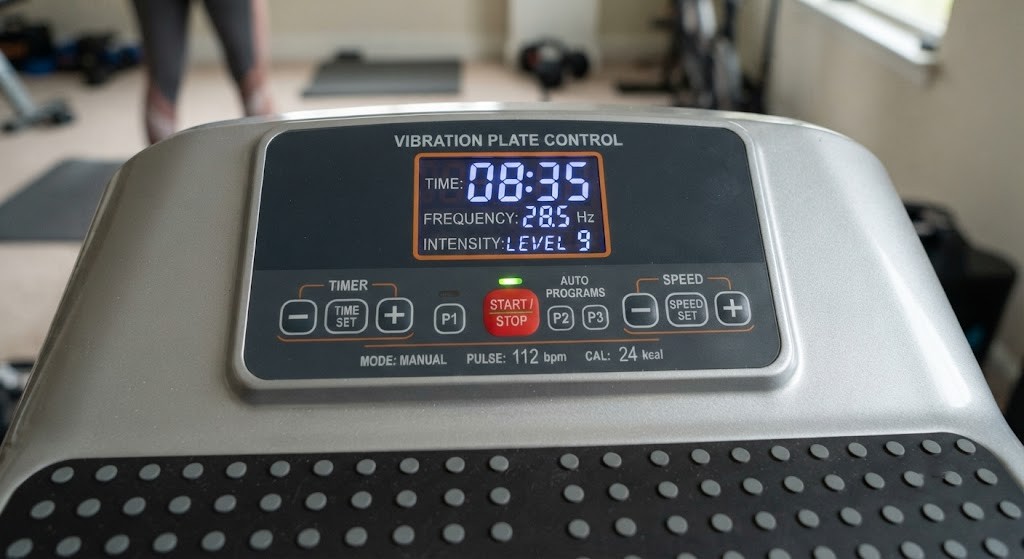
Different vibration plates can use different vibration patterns and specifications. Therefore, do not assume that a particular frequency or intensity setting will feel identical on every machine.
Is a Vibration Plate Safe for Everyone?
Safe vibration plate exercise depends on stable positioning, controlled technique, gradual progression, and appropriate use of the equipment.
Beginners should use manageable settings and stop if they experience pain, dizziness, unusual shortness of breath, or other concerning symptoms.
People with medical conditions, recent injuries, significant balance limitations, pregnancy-related concerns, or implanted medical devices should ask an appropriate healthcare professional whether vibration training is suitable for them.
Someone who needs exercise modifications should not rely on a generic vibration plate routine simply because an exercise appears low impact.
The CDC also recommends that adults with chronic conditions or disabilities consult a healthcare professional or physical-activity specialist about appropriate physical activity when needed.
Source: CDC, 2025.
Readers with specific bone-health concerns can also review guidance on yoga for osteoporosis, while remembering that individualized medical advice should come from a qualified professional.
What Are the Most Common Vibration Plate Workout Mistakes?
The most common vibration plate workout mistakes involve using excessive intensity, locking the knees, rushing repetitions, ignoring balance, and treating vibration training as a substitute for a complete exercise program.
Avoid these common mistakes:
- Starting too aggressively: Begin with manageable settings.
- Locking your knees: Maintain comfortable, controlled leg positioning.
- Rushing repetitions: Slow movement makes technique easier to monitor.
- Ignoring balance: Use stable support when needed.
- Skipping warm-ups: Prepare your body before exercising.
- Doing only vibration workouts: Continue regular aerobic and strength training.
- Chasing weight-loss claims: Use vibration as a complement, not a shortcut.
Recent research also demonstrates why there is no single vibration setting that works for everyone.
A 2024 review of local vibration studies found frequencies ranging from 1 to 272 Hz and amplitudes from 0.2 to 3.0 mm, illustrating how widely vibration protocols can differ.
Source: Gait & Posture, 2024.
This variation reinforces the importance of following equipment-specific guidance instead of assuming that the highest setting is necessarily the most effective.
How Often Should You Do Vibration Plate Workouts?
Beginners can treat vibration plate sessions as a supplement to their existing weekly exercise routine rather than assuming they need to use the platform every day.
Start with short sessions and give your body time to adapt before increasing the frequency, duration, or complexity of your workouts.
For example, you might use a vibration plate 2–3 times per week alongside walking and conventional strength training, provided the workload is appropriate for your fitness level.
The most important factor is consistency. A simple routine that you can perform safely and repeatedly is generally more useful than constantly changing exercises or chasing higher vibration settings.
For people who enjoy structured challenges, a 75 Soft Challenge Workout can provide additional accountability without making vibration training the entire fitness program.
What’s Next? Build a Consistent Vibration Plate Routine
The next step is to build a routine that gradually increases exercise complexity, duration, or resistance while maintaining good technique.
During the first few weeks, focus on learning the basic positions and exercises rather than immediately attempting advanced movements.
A Simple 6-Week Progression
- Weeks 1–2: Use 10–15 minute sessions with basic movements.
- Weeks 3–4: Add another round or a few repetitions if your form remains strong.
- Weeks 5–6: Introduce more challenging variations or additional resistance.
- Beyond six weeks: Continue progressing while maintaining regular aerobic and conventional strength training.
This progression gives you multiple ways to increase the challenge without relying solely on higher vibration intensity.
Moreover, you can use the structure of a 3-2-1 Workout Routine to organize broader weekly training rather than relying entirely on vibration sessions.
Don’t Forget Nutrition and Recovery
Exercise is only one part of a balanced fitness strategy. Adequate protein intake, overall dietary quality, hydration, sleep, and recovery can all support your ability to maintain a consistent routine.
For practical nutrition ideas, options such as cottage cheese protein recipes can fit into a balanced eating pattern when they suit your nutritional needs.
Conclusions
A vibration plate workout can add variety, muscle activation, balance challenges, and new movement options to a conventional exercise routine. Beginners can start with controlled movements such as squats, calf raises, glute bridges, supported lunges, and core exercises before gradually increasing the challenge.
Ultimately, vibration plate training works best as a complement to regular strength, aerobic, mobility, and balance exercise. Start with manageable settings, follow your equipment’s instructions, prioritize proper form, and progress gradually.
The goal is not simply to make the platform vibrate more. The goal is to use it strategically to support a consistent, well-rounded fitness routine.
FAQs
What is a vibration plate workout?
It combines whole-body vibration with exercises like squats, lunges, calf raises, and bridges.
Does a vibration plate actually benefit you?
It may support muscle activation, balance, stability, strength, and physical performance.
Do vibration plates help lose belly fat?
They may support overall fat loss but cannot specifically target belly fat.
What is 10 minutes on a vibration plate equal to?
There is no established exercise equivalent for 10 minutes on a vibration plate.
What are the negatives of vibration plates?
They may cause discomfort, balance issues, or excessive vibration when used incorrectly.
Is a vibration plate workout good for beginners?
Yes, beginners can start with simple exercises at a comfortable intensity.
How long should a beginner use a vibration plate?
Beginners can start with 10–15 minutes and gradually increase the duration.
Can you lose weight with a vibration plate workout?
It may support weight management when combined with regular exercise and a balanced diet.
What are the best vibration plate exercises?
Squats, calf raises, glute bridges, lunges, standing holds, and core exercises are good choices.
How often should you do a vibration plate workout?
Beginners can start with 2–3 sessions per week alongside regular exercise.
Can you do squats on a vibration plate?
Yes, keep your feet stable, knees controlled, and movements slow.
Does a vibration plate build muscle?
It may support muscle activation and strength but should complement resistance training.
Is a vibration plate workout low impact?
Many exercises can be performed without jumping or high-impact movements.
Is a vibration plate safe for everyone?
No, people with certain conditions or injuries should seek professional guidance first.
Can you do ab exercises on a vibration plate?
Yes, controlled core exercises such as dead bugs can be suitable options.
Is a higher vibration setting better?
No, higher intensity is not necessarily better, so increase settings gradually.