

Most people understand that regular exercise, healthy eating, hydration, and daily movement can improve overall fitness. The real challenge is maintaining those habits consistently for weeks or months without becoming overwhelmed, exhausted, or discouraged.
That is where the 75 Soft Challenge Workout can offer a more flexible approach. Instead of treating fitness as a test of extreme discipline, 75 Soft focuses on building repeatable habits that can fit into everyday life.
In this guide, you’ll learn what the 75 Soft Challenge is, how its rules work, which exercises to include, how to create a beginner-friendly 75-day workout schedule, how to progress safely, what equipment you need, and how to stay consistent through busy days, travel, low-energy periods, and setbacks.
What Is the 75 Soft Challenge Workout?
The 75 Soft Challenge is a 75-day fitness and lifestyle challenge focused on developing consistent healthy habits through exercise, nutrition, hydration, personal development, and sustainable daily routines.
Unlike a rigid fitness program, 75 Soft is flexible and can be customized around your fitness level, schedule, preferences, and recovery needs. The goal is not to complete 75 extreme workouts in a row. Instead, the challenge encourages participants to create manageable habits they can realistically maintain.
Importantly, there is no single universally standardized 75 Soft rulebook. Different versions commonly include daily movement, healthier eating, hydration, reading or personal development, and limiting alcohol, while the exact requirements can vary by creator or community.
For example, the version described by Cleveland Clinic includes 45 minutes of exercise daily, one active-recovery day each week, three liters of water, generally healthy eating, limited alcohol, and 10 pages of reading.
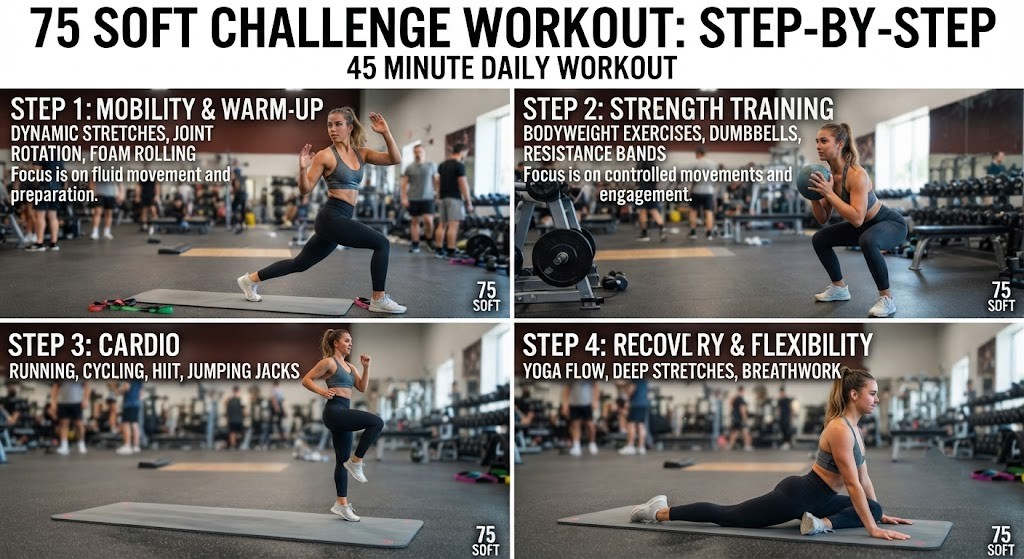
The 75 Soft Challenge Workout can therefore combine strength training, cardio, walking, mobility, stretching, and recovery instead of requiring the same high-intensity workout every day.
Why Does the 75 Soft Challenge Workout Matter?
The 75 Soft Challenge Workout provides a structured framework for practicing healthy behaviors consistently without making extreme exercise or rigid perfectionism the focus.
Regular physical activity supports cardiovascular health, muscular fitness, and overall well-being. The CDC recommends that adults get at least 150 minutes of moderate-intensity aerobic activity per week and muscle-strengthening activity on at least two days.
Source: CDC, 2025.
For example, three 30-minute strength or cardio sessions combined with several brisk walks can create a realistic weekly activity pattern without requiring high-intensity exercise every day.
Similarly, WHO recommends 150–300 minutes of moderate aerobic activity per week for adults, alongside muscle-strengthening activities on two or more days.
Source: WHO, 2021.
This makes it possible to build a 75 Soft routine around established physical-activity guidelines rather than arbitrary daily punishment.
What Are the Rules of the 75 Soft Challenge?
The 75 Soft Challenge rules are generally based on daily movement, nutritious eating, hydration, personal development, and reduced alcohol intake. However, the exact requirements depend on the version of 75 Soft you choose to follow.
One widely circulated version includes:
- 45 minutes of exercise each day
- One active-recovery day each week
- Three liters of water
- Generally healthy eating
- Limited alcohol
- 10 pages of reading each day
Other versions use different workout frequencies, hydration targets, meditation requirements, progress photos, or nutrition guidelines. For example, another established version recommends working out four times per week for 30 minutes rather than exercising for 45 minutes every day.
Because the challenge is not standardized, define your version of the rules before Day 1. Having clear expectations makes it easier to handle busy schedules, travel, fatigue, and other disruptions.
| Common Habit | Practical Interpretation |
|---|---|
| Daily movement | Walk, cycle, strength train, stretch, or perform another suitable activity |
| Exercise | Use structured workouts several days each week |
| Active recovery | Choose walking, gentle yoga, mobility, or stretching |
| Nutrition | Prioritize balanced, minimally processed meals |
| Hydration | Follow a suitable daily water target |
| Personal development | Read, journal, meditate, or learn |
| Alcohol | Limit or avoid it according to your chosen rules |
How Does the 75 Soft Challenge Workout Work?
The 75 Soft Challenge Workout works by repeating manageable fitness and lifestyle habits for 75 consecutive days while allowing flexibility in exercise selection and intensity.
Rather than deciding what to do every morning, create a weekly structure that can be repeated and adjusted when necessary. This reduces decision fatigue and makes the challenge easier to maintain.
A balanced week can include:
- Strength training
- Cardio
- Walking
- Mobility
- Active recovery
- Restorative movement
- Flexible recovery options when needed
The emphasis should be on consistency rather than making every workout difficult.
How Many Days a Week Should You Strength Train During 75 Soft?
Strength training two to three days per week is a practical starting point for many beginners participating in 75 Soft. This frequency also aligns with public-health recommendations to perform muscle-strengthening activities at least two days weekly.
Source: CDC, 2025.
For example, a beginner could perform full-body strength workouts on Monday, Wednesday, and Friday, with walking or mobility sessions between them.
Beginners should prioritize movement quality and consistency before attempting heavier resistance or high training volume. A [full-body strength workout] can train major movement patterns without requiring excessive volume.
Can Walking Count as a 75 Soft Challenge Workout?
Walking can count as physical activity within a 75 Soft routine, particularly when it is performed at an appropriate intensity and fits the specific challenge rules being followed.
WHO recognizes walking, cycling, transportation, household tasks, and recreational movement as forms of physical activity.
Source: WHO, 2021.
A 30–45 minute brisk walk can therefore be a practical option on a busy day, a lower-impact training day, or a recovery-focused day.
Walking is also useful for beginners who are not ready for running or other high-impact activities. A [walking workout] can help build consistency while keeping training accessible.
What Exercises Should You Do for the 75 Soft Challenge?
The best 75 Soft Challenge exercises are movements that develop strength, cardiovascular fitness, mobility, and functional movement while matching your current ability.
A balanced program can include:
- Squats
- Lunges
- Pushing movements
- Pulling movements
- Hip-hinge exercises
- Core exercises
- Aerobic activity
- Mobility exercises
- Stretching and recovery work
The specific exercises matter less than creating a routine that you can perform consistently and progress gradually.
Beginner-Friendly Strength Exercises
Beginner-friendly strength exercises include:
- Bodyweight squats
- Reverse lunges
- Glute bridges
- Incline push-ups
- Resistance-band rows
- Dumbbell rows
- Romanian deadlifts
- Shoulder presses
- Planks
- Dead bugs
For example, a beginner can start with two sets of 8–12 repetitions of squats, glute bridges, incline push-ups, rows, and dead bugs. As technique improves, resistance or repetitions can gradually increase.
Cardio and Low-Impact Exercises
Cardio exercises for the 75 Soft Challenge can include:
- Brisk walking
- Cycling
- Jogging
- Swimming
- Dancing
- Rowing
- Low-impact aerobic workouts
Choose activities based on your fitness level, preferences, available equipment, and recovery needs.
For example, a beginner might perform a 30-minute brisk walk, while an intermediate participant could combine cycling intervals with a short strength workout.
Mobility and Recovery Exercises
Mobility exercises are controlled movements that help maintain or improve usable joint range of motion.
Useful mobility exercises include:
- Hip circles
- Thoracic rotations
- Ankle mobility drills
- Cat-cow movements
- Gentle stretching
A 15–30 minute mobility session can replace a demanding workout on a recovery-focused day. This approach keeps movement in the routine without turning every day into a hard training session.
What Is a Good 75 Soft Workout Schedule for Beginners?
A good beginner 75 Soft workout schedule alternates strength, cardio, lighter movement, and recovery so that training remains manageable throughout the 75 days.
The following schedule is a useful framework:
| Day | Workout | Beginner Option |
| Monday | Full-body strength | 30–45 minutes |
| Tuesday | Cardio | Brisk walking or cycling |
| Wednesday | Full-body strength | 30–45 minutes |
| Thursday | Mobility + walking | 20–45 minutes |
| Friday | Full-body strength | Bodyweight or dumbbells |
| Saturday | Cardio | Walking, cycling, or jogging |
| Sunday | Active recovery | Gentle walking + stretching |
This schedule is a framework rather than a mandatory prescription.
For example, if Friday becomes extremely busy, you can move the strength workout to Saturday and use Friday for walking or mobility. The objective is to maintain a sustainable pattern rather than force the original schedule at all costs.
Can You Do the 75 Soft Challenge at Home?
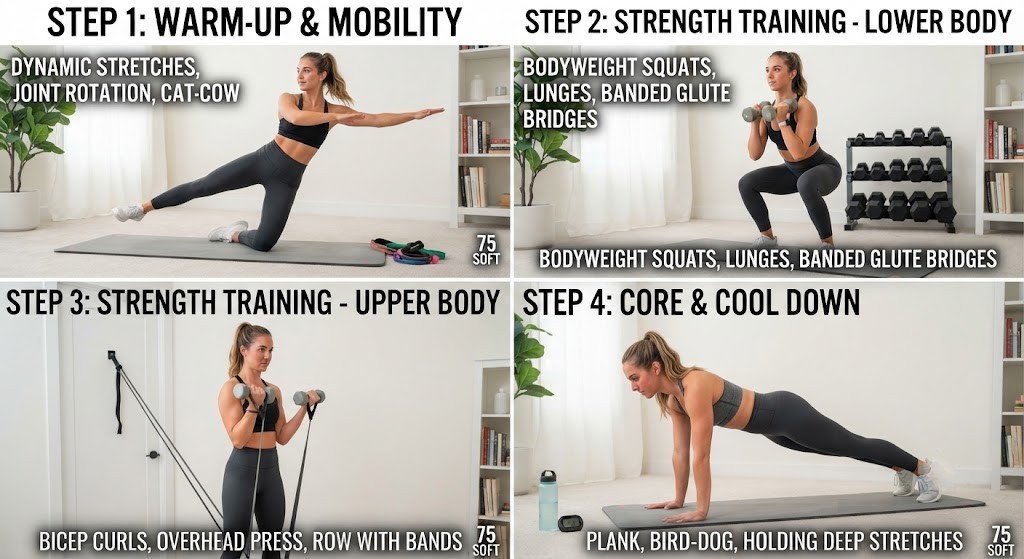
Yes. You can do the 75 Soft Challenge at home using bodyweight movements, walking, mobility exercises, and simple equipment.
A [home workout routine] can provide enough variety for beginners without requiring a gym membership.
A basic home workout might include:
- Bodyweight squats
- Glute bridges
- Incline push-ups
- Resistance-band rows
- Reverse lunges
- Planks
How Do You Progress During a 75 Soft Workout Plan?
Progression means gradually increasing the training challenge through repetitions, resistance, duration, exercise difficulty, or improved technique.
For beginners, gradual progression is more practical than trying to maximize intensity from the beginning. Your workouts should become more challenging as your fitness and confidence improve.
For example, you might begin with two sets of 10 bodyweight squats and later progress to three sets of 12 squats while holding dumbbells.
A practical 75-day progression can be divided into three phases.
Days 1–25: Habit Building
Focus on learning proper technique, establishing your weekly schedule, and making exercise a consistent part of your routine.
The primary objective during this phase is not maximum performance. It is creating a routine you can repeat.
Days 26–50: Progressive Training
Once the routine feels established, gradually increase repetitions, resistance, duration, or exercise difficulty.
For example, you could add resistance bands, increase dumbbell weight, extend a cardio session, or progress from an easier variation to a more challenging one.
Days 51–75: Consolidation
During the final phase, focus on maintaining consistency while refining performance and recovery.
Instead of continually adding intensity, determine which habits are sustainable enough to continue after Day 75.
Beginners can modify the 75 Soft Challenge by reducing workout intensity, choosing low-impact exercises, and gradually increasing duration or resistance as fitness improves.
What Is the Difference Between 75 Soft and 75 Hard?
75 Soft is a flexible 75-day wellness challenge, while 75 Hard is a much more rigid program with strict daily requirements and restart rules.
The biggest distinction is flexibility versus strict adherence, although individual 75 Soft versions can vary substantially.
| Feature | 75 Soft | 75 Hard |
| Flexibility | Generally higher | Very strict |
| Exercise approach | Adaptable | Structured daily requirements |
| Recovery | Can include active recovery | Daily requirements remain strict |
| Missed habit | Often adjusted or continued | Traditional rules require restarting |
| Main emphasis | Sustainable habits | Discipline and strict compliance |
Because 75 Soft is not an official standardized program, always check the rules of the specific version you are following.
Cleveland Clinic notes that missing a 75 Soft habit does not necessarily require restarting the entire challenge.
What Equipment Do You Need for the 75 Soft Challenge?
The 75 Soft Challenge requires no specific equipment. Walking, bodyweight training, and mobility exercises can provide the foundation of the routine.
However, a few simple pieces of equipment can make home workouts more versatile:
- Resistance bands
- Exercise mat
- Pair of dumbbells
- Timer
A resistance band can add pulling and lower-body exercises, while dumbbells can increase resistance for movements such as squats, Romanian deadlifts, rows, and shoulder presses.
How Can You Track the 75 Soft Challenge?
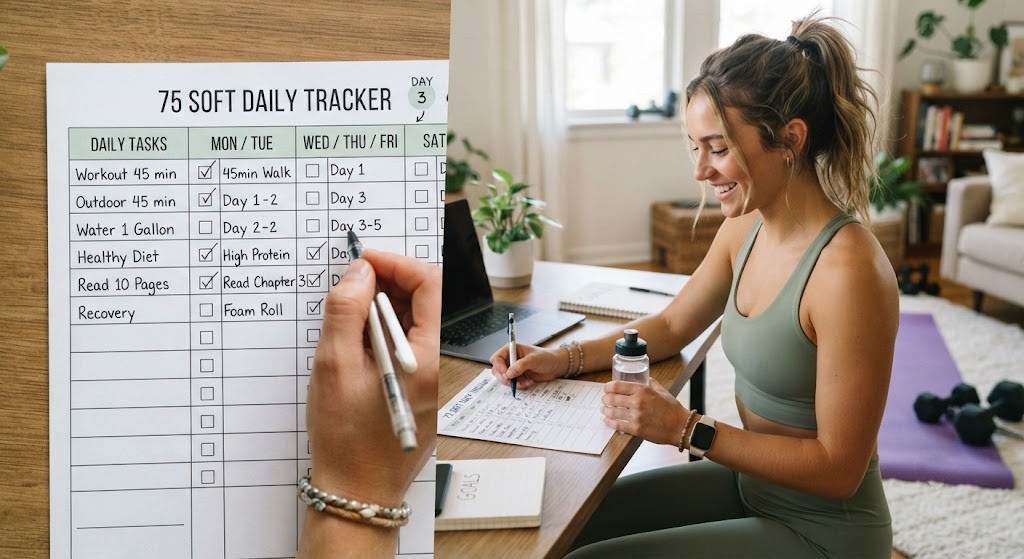
Tracking the 75 Soft Challenge can make daily habits more visible and measurable. A calendar, notes app, spreadsheet, fitness watch, or paper tracker can help you record workouts, walking, hydration, nutrition, reading, and recovery.
A simple daily tracker can include five fields:
- Movement
- Nutrition
- Hydration
- Personal development
- Recovery
Useful tracking tools include:
- Calendar or habit tracker
- Workout log
- Step counter
- Phone timer
- Fitness watch
- Resistance bands
- Dumbbells
- Exercise mat
How Do You Stay Consistent for All 75 Days?
Staying consistent for 75 days requires a realistic routine, flexible expectations, and a plan for disruptions.
The best 75 Soft Challenge Workout is not necessarily the hardest one. It is the routine that fits your fitness level, schedule, recovery needs, and ability to maintain healthy habits over the entire challenge.
Prepare alternatives for common obstacles before they happen.
Busy Days
If your schedule becomes packed, use a shorter walk or home workout rather than abandoning movement completely.
Travel
During travel, walking, hotel-room exercises, and mobility work can help you remain active without requiring a full gym setup.
Low Energy
When energy is low, choose gentle movement instead of forcing high-intensity exercise. A walk, mobility session, or stretching routine may be more appropriate.
Missed Workouts
If you miss a workout, resume your routine instead of assuming the entire challenge has failed.
Plateaus
If progress slows, change repetitions, resistance, duration, or exercise variation rather than automatically increasing intensity.
Motivation Drops
Instead of focusing on all 75 days at once, concentrate on completing the habit for the current day. Small, repeatable actions are easier to manage than thinking about the entire challenge.
Why Recovery Matters During the 75 Soft Challenge
Recovery should be treated as part of the training plan rather than an obstacle to progress.
Alternating demanding workouts with walking, mobility, stretching, and active recovery can help make the overall routine more manageable. The challenge should not encourage exhaustion or perfectionism.
If pain, unusual fatigue, dizziness, or other concerning symptoms occur, stop the activity and seek appropriate professional guidance.
The CDC also recommends consulting a healthcare professional before vigorous-intensity activity if you have been inactive, have a disability, or have overweight, and advises people with chronic conditions to discuss suitable activity with a healthcare professional.
Source: CDC, 2025.
Deload Week for Better Recovery
How Can Beginners Modify the 75 Soft Challenge Workout?
One of the advantages of the 75 Soft approach is its adaptability.
Beginners do not need to start with advanced exercises or intense sessions. Instead, they can modify the workout according to current fitness and gradually build capacity.
Helpful modifications include:
- Use bodyweight exercises before adding weights.
- Choose incline push-ups instead of floor push-ups.
- Walk instead of jogging if high-impact exercise feels too difficult.
- Reduce workout duration when necessary.
- Use lower-impact cardio options.
- Practice mobility when recovery is needed.
- Increase resistance or duration gradually.
- Prioritize technique before intensity.
This approach can make the challenge more accessible while still creating opportunities for measurable progress.
How Do You Build a Sustainable 75 Soft Challenge Workout?
A sustainable plan starts with realistic expectations.
Before beginning Day 1, consider your current activity level, available workout time, preferred activities, equipment, schedule, and recovery needs.
Then build your routine around a few principles:
- Start at your current fitness level.
- Use a consistent weekly schedule.
- Combine strength and cardio.
- Include walking and mobility.
- Allow active recovery.
- Progress gradually.
- Track your habits.
- Adjust the plan when circumstances change.
The purpose is not to make every day harder than the previous one. Instead, the challenge should help you develop habits that remain useful after the 75 days are finished.
Conclusion
The 75 Soft Challenge Workout is a flexible 75-day approach to building consistent exercise, nutrition, hydration, personal-development, and wellness habits.
Rather than requiring extreme workouts every day, a balanced plan can combine strength training, cardio, walking, mobility, and active recovery. Beginners can start with simple bodyweight exercises and gradually increase resistance, repetitions, duration, or exercise difficulty as their fitness improves.
The most important part is sustainability. A realistic schedule, simple tracking system, flexible mindset, and adequate recovery can make it easier to stay consistent through busy days, travel, low energy, and other challenges.
Ultimately, the goal of 75 Soft is not perfection. The goal is to build habits you can continue after Day 75.
FAQs
What is the 75 Soft Challenge Workout?
It is a flexible 75-day fitness and lifestyle challenge focused on exercise and healthy habits.
What is a 75 Soft workout?
It is a manageable workout that can include strength training, cardio, walking, mobility, or stretching.
Can I lose weight on 75 Soft?
Yes, you can lose weight with consistent exercise and a suitable calorie-controlled diet.
What is a good diet for 75 Soft?
It is a balanced diet focused on protein, vegetables, fruits, whole grains, healthy fats, and hydration.
What are the 5 rules of 75 Hard?
They include following a diet, completing two daily workouts, drinking one gallon of water, reading 10 pages, and taking a progress photo.
Can beginners do the 75 Soft Challenge?
Yes, beginners can adjust workout intensity and duration to their fitness level.
Can walking count as a 75 Soft workout?
Yes, walking can be included as a low-impact workout or daily physical activity.
Can I do the 75 Soft Challenge at home?
Yes, you can complete the challenge at home with bodyweight exercises or simple equipment.
How many days a week should I work out for 75 Soft?
You can do structured workouts several days a week and use lighter activities for recovery.
What equipment do I need for the 75 Soft Challenge?
You need no equipment, although dumbbells, resistance bands, and a workout mat can help.
How should I progress during the 75 Soft Challenge?
You can gradually increase repetitions, resistance, workout duration, or exercise difficulty.
Is recovery important during the 75 Soft Challenge?
Yes, recovery helps manage fatigue and supports consistent exercise.
What happens if I miss a 75 Soft workout?
Rules vary, but many versions allow you to continue without restarting the challenge.
What is the difference between 75 Soft and 75 Hard?
75 Soft is generally more flexible, while 75 Hard has stricter daily requirements.
How can I stay consistent with the 75 Soft Challenge?
You can stay consistent by following a realistic schedule, tracking habits, and focusing on one day at a time.