
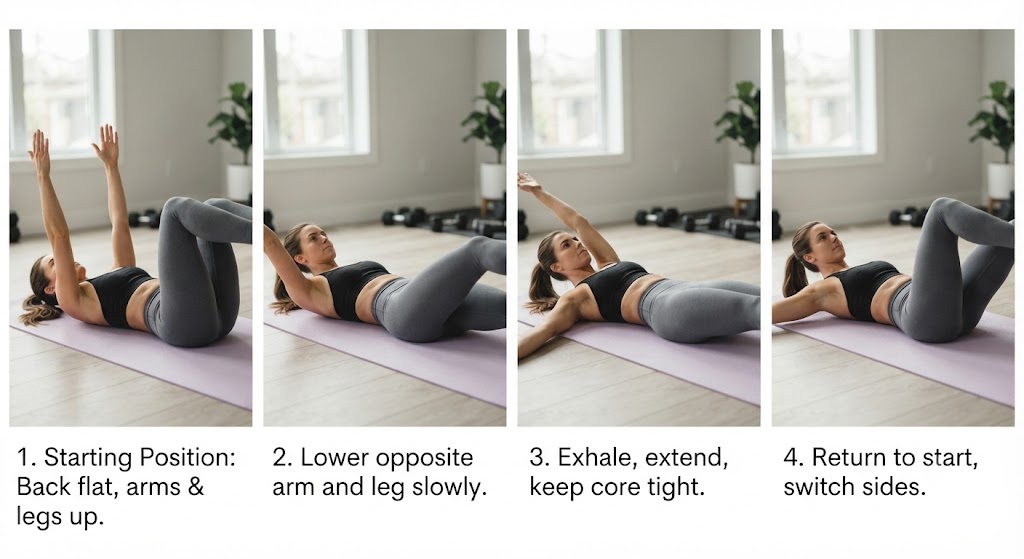
If you already do crunches, planks, or other core exercises, you may think you know how to train your abs. However, one important piece is often overlooked: controlled core stability while your arms and legs move independently.
That is where the Dead Bug workout comes in. This low-impact core exercise teaches you to brace your abdominal muscles, control your pelvis and rib cage, and move opposite limbs without losing stability.
In this guide, you’ll learn what the Dead Bug exercise is, which muscles it works, how to perform it correctly, how many repetitions beginners should do, the best variations, common mistakes to avoid, and practical ways to add it to your workout routine.
What Is the Dead Bug Workout?
The Dead Bug workout is a core-stability exercise performed on your back. It trains your trunk to remain controlled while your arms and legs move independently.
The exercise gets its unusual name from its starting position, which resembles a bug lying on its back with its limbs raised.
The Dead Bug exercise involves bracing the abdominal muscles, maintaining a stable torso, and slowly extending opposite limbs without losing control of the spine. For example, you might lower your right arm and left leg together while keeping your ribs and pelvis controlled.
Rather than focusing on speed or a high number of repetitions, the Dead Bug emphasizes resisting unwanted movement. This makes it useful for anyone looking for a controlled deep core exercise that develops stability and coordination.
Why Is the Dead Bug Exercise Good for Core Stability?
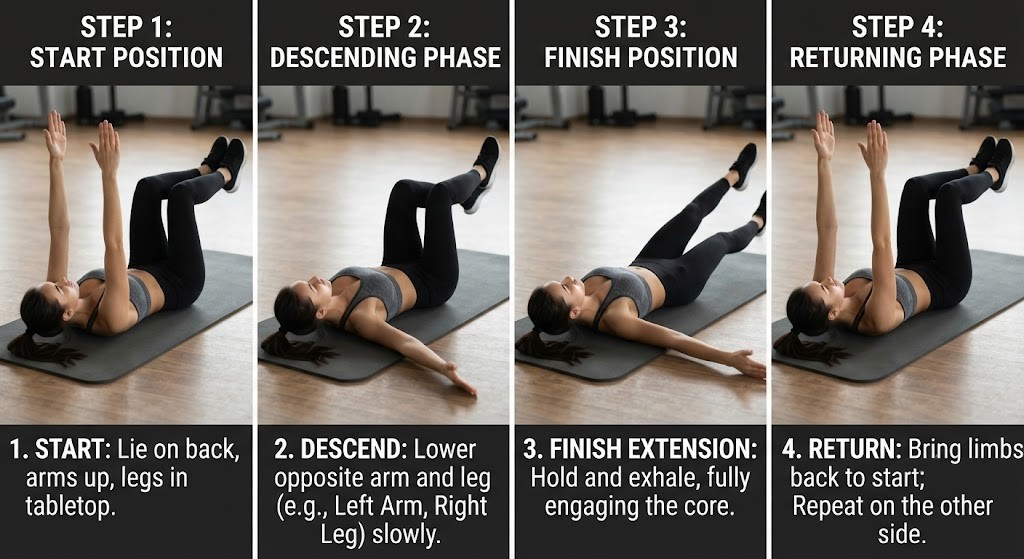
The Dead Bug exercise is effective for practicing core stability because it teaches your trunk to resist movement while your limbs move. For example, your abdominal muscles must help keep your pelvis and rib cage controlled as one leg extends away from your body.
Research examining the “Dying Bug” variation found that the exercise predominantly recruited the abdominal musculature, although overall muscle activation levels were relatively modest in healthy participants. — Source: Archives of Physical Medicine and Rehabilitation, 2001
The main purpose of the Dead Bug is to improve core stability, coordination, and control during movement. These qualities can complement exercises that require your trunk to remain stable while your arms or legs produce force.
What Muscles Does the Dead Bug Exercise Work?
The Dead Bug exercise primarily works the abdominal and deep core muscles while also involving the hip flexors and muscles responsible for controlling limb movement.
Unlike exercises that focus mainly on repeatedly flexing the spine, the Dead Bug challenges your muscles to stabilize the trunk while movement occurs around it.
A 2023 study involving 44 healthy women found that the Dead Bug produced a significantly greater increase in transversus abdominis thickness than the other Pilates exercises tested. — Source: Journal of Physical Therapy Science, 2023
The main muscles involved include:
| Muscle group | Role during the Dead Bug |
|---|---|
| Transversus abdominis | Helps stabilize the trunk and abdomen |
| Rectus abdominis | Helps control the trunk and pelvis |
| Internal and external obliques | Assist with trunk stability and rotational control |
| Hip flexors | Control leg movement |
| Spinal stabilizers | Help maintain a controlled trunk position |
The Dead Bug can also complement ab exercises for beginners because it emphasizes controlled movement instead of aggressive spinal flexion. It can therefore fit alongside exercises such as planks, bridges, and other core-strengthening movements.
How Do You Do a Dead Bug Exercise Correctly?
The Dead Bug exercise starts with you lying on your back with your arms and legs raised. You then brace your core and slowly move opposite limbs while keeping your torso stable.
Proper Dead Bug form requires slow, controlled movements, steady breathing, and maintaining core tension throughout each repetition.
Step-by-Step Dead Bug Exercise Form
Follow these steps to perform a basic Dead Bug correctly:
- Set your starting position. Lie on your back with your knees bent to approximately 90 degrees and your feet lifted from the floor. Raise your arms toward the ceiling and position your knees above your hips.
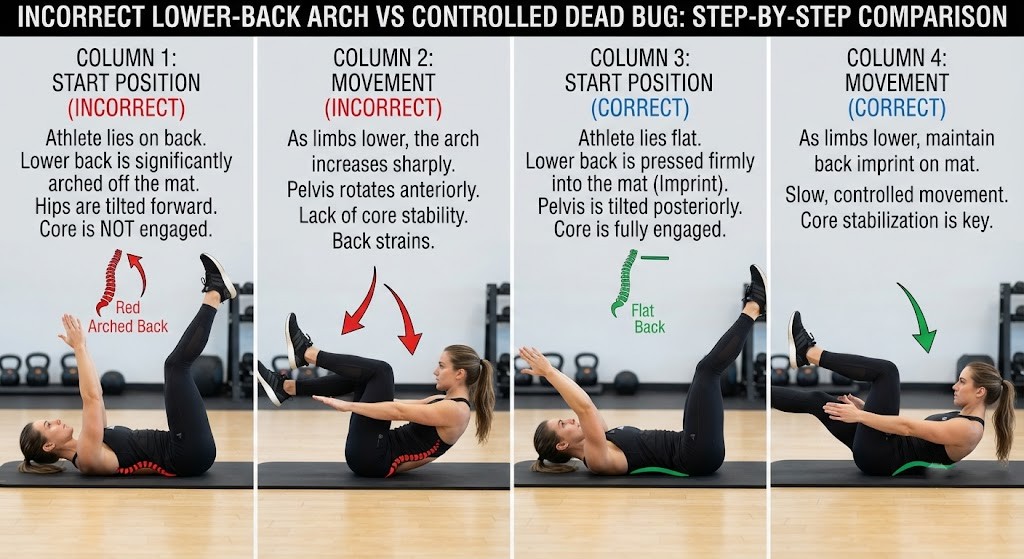
- Brace your core. Gently tighten your abdomen as though preparing for a light punch. Keep your ribs controlled and avoid allowing your lower back to excessively arch away from the floor.
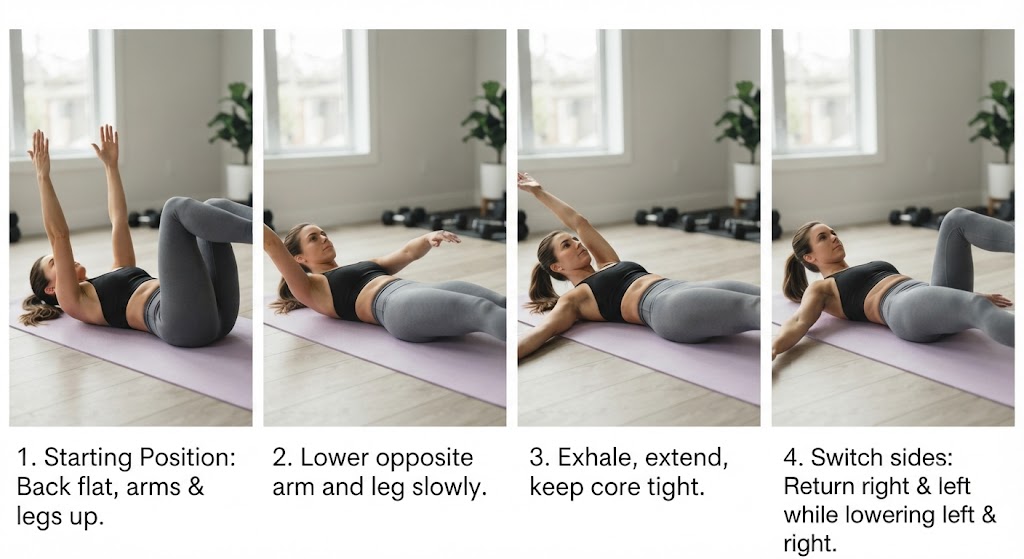
- Extend opposite limbs. Slowly extend your right arm and left leg toward the floor. Only move as far as you can while keeping your torso controlled.
- Return to the starting position. Bring the arm and leg back without rushing or relaxing your abdominal brace.
- Switch sides. Repeat the same movement with your left arm and right leg.
- Continue alternating. Perform each repetition slowly while breathing normally.
A useful breathing cue is to exhale during the extension and inhale as you return. However, comfortable and controlled breathing is more important than forcing a particular breathing pattern.
How Long Should You Hold a Dead Bug?
A Dead Bug repetition is generally performed as a slow, controlled movement rather than as a long static hold. Beginners can pause for approximately 1–2 seconds when the arm and opposite leg are extended.
The pause should only last as long as you can maintain proper positioning. If your lower back begins arching during a two-second pause, reduce the limb range instead of forcing the position.
How Many Dead Bugs Should Beginners Do?
Beginners can start with 2–3 sets of 5–8 controlled repetitions per side. This provides enough practice to learn the movement without making fatigue the primary goal.
As your technique improves, gradually increase repetitions. A simple beginner target is 8–10 repetitions per side for 2–3 sets, provided you can maintain abdominal tension and spinal control throughout the set.
The quality of each repetition matters more than simply completing a larger number. If your back begins arching or your torso starts moving excessively, shorten the range of motion or reduce repetitions.
What Are the Best Dead Bug Variations for Beginners?
Dead Bug variations modify the movement to make it easier, harder, or simply different while maintaining the same fundamental goal of core stability.
For beginners, reducing the range of motion can make the exercise more manageable. As strength and coordination improve, you can gradually increase the range, add resistance, or introduce more demanding variations.
Here are several options:
- Heel-Tap Dead Bug: Lower one foot toward the floor instead of extending the entire leg.
- Alternating Leg Extension: Keep your arms stationary while slowly extending one leg at a time.
- Basic Alternating Dead Bug: Move the opposite arm and leg together.
- Straight-Leg Dead Bug: Extend the leg farther while maintaining trunk control.
- Stability-Ball Dead Bug: Press your hands and knees into a stability ball to create additional resistance and coordination demands.
- Weighted Dead Bug: Hold light dumbbells when the basic version becomes easy.
How Should Beginners Choose a Dead Bug Variation?
Use the simplest variation that allows you to maintain control. You should be able to keep your torso stable, breathe normally, and maintain abdominal tension throughout the movement.
Progress to a more difficult version when the current variation feels controlled rather than simply because you can complete more repetitions.
What Are the Benefits of the Dead Bug Workout?
The Dead Bug workout can support core stability, movement coordination, trunk control, and low-impact fitness. Because it is performed on the floor without jumping or running, it can also be incorporated into routines that emphasize controlled, low-impact movements.
1. Builds Core Stability
The Dead Bug teaches your abdominal muscles to maintain tension while your limbs move. Your torso stays relatively stable while an arm and the opposite leg extend.
This makes the exercise particularly useful for practicing the ability to stabilize your trunk during movement.
2. Improves Movement Coordination
The exercise requires opposite-side limb coordination. You must control the right arm with the left leg and then switch sides while maintaining your core position.
This provides practice with controlled movement patterns that can complement many functional fitness exercises.
3. Offers Low-Impact Core Training
The Dead Bug is performed on the floor and does not involve jumping, running, or impact. As a result, it can be a practical option when you want a low-impact workout.
It can also be used as part of a broader workout rather than serving as a complete training program on its own.
4. Supports Controlled Exercise Practice
The Dead Bug encourages you to slow down and focus on breathing, abdominal tension, pelvis position, and limb range.
That makes technique easier to monitor than during fast abdominal exercises. You can immediately reduce the range of motion if you notice your torso losing stability.
5. Can Complement Core-Stabilization Training
Research on core-stabilization exercise suggests potential benefits for adults with nonspecific low back pain, although these findings apply to broader exercise programs rather than the Dead Bug alone.
A 2022 systematic review included five moderate-quality studies supporting core stabilization exercise for reducing pain, improving function, and increasing core strength. — Source: Malaysian Journal of Medical Sciences, 2022
Therefore, the Dead Bug can be viewed as one movement within a broader approach to core training rather than a standalone solution for back pain.
What Are the Most Common Dead Bug Exercise Mistakes?
The most common Dead Bug mistakes include arching the lower back, moving too quickly, holding the breath, extending the limbs too far, and losing abdominal tension.
In most cases, the solution is simple: reduce your range of motion and slow down.
Lower Back Arching
Excessive lower-back arching usually indicates that the limb movement is beyond your current level of control.
If this happens, reduce how far you lower your arm or leg. Gradually increase the range as you become better at maintaining a stable torso.
Moving Too Quickly
Fast repetitions can turn a stability exercise into a momentum-driven movement.
Instead, use slow and deliberate repetitions. Think about controlling both directions of the movement rather than simply getting the limbs from one position to another.
Holding Your Breath
Holding your breath can make the movement unnecessarily tense.
Continue breathing while maintaining a firm but controlled abdominal brace. If you struggle to breathe normally, the exercise may currently be too difficult.
Extending Too Far
Touching the floor is not the goal of the Dead Bug.
If reaching the floor causes your lower back to arch, stop the limb higher. As your control improves, you can gradually increase the range.
Losing Core Tension
Another common mistake is relaxing the abdomen as soon as the limbs begin moving.
Before every repetition, establish your brace and then maintain it throughout the extension and return.
Is the Dead Bug Exercise Better Than Crunches for Core Training?
The Dead Bug exercise is not universally better than crunches because the two movements train the core through different demands.
The Dead Bug emphasizes trunk stability while the limbs move, whereas crunches emphasize repeated trunk flexion.
For example, someone focused on movement control may benefit from Dead Bugs, while someone looking for a dynamic abdominal-flexion exercise may choose crunches. Neither movement needs to replace every other type of core exercise.
| Dead Bug | Crunch |
| Emphasizes trunk stability | Emphasizes trunk flexion |
| Uses opposite-limb movement | Uses repeated torso movement |
| Low-impact | Low-impact |
| Strong focus on coordination | Strong focus on abdominal contraction |
| Easy to regress or progress | Easy to modify with resistance |
Therefore, the better choice depends on your training goal, experience, and ability to maintain good technique.
How Can You Add Dead Bugs to a Workout?
Dead Bugs can be incorporated into a warm-up, core circuit, home workout, or strength-training session. Because the exercise is controlled and low-impact, it can be used without requiring a large amount of equipment or space.
Adults are generally advised to perform muscle-strengthening activities on at least two days per week, with gradual progression over time. — Source: Physical Activity Guidelines for Americans, 2nd edition
Beginner Core Routine
Try this simple sequence:
- Dead Bug — 2 × 6 per side
- Glute Bridge — 2 × 10
- Forearm Plank — 2 × 15–20 seconds
- Rest — 45–60 seconds
Focus on technique rather than rushing through the sequence. If the Dead Bug becomes difficult, reduce the range of motion before reducing your attention to form.
Core Circuit
You can also combine Dead Bugs with other controlled core movements:
- 8 Dead Bugs per side
- 10 Bird Dogs per side
- 20-second plank
- 10 glute bridges
- Rest 60 seconds
- Repeat for 2–3 rounds
This structure gives you a combination of core stability, controlled limb movement, and hip-focused work.
Using Dead Bugs as a Warm-Up
You can perform 5–6 controlled Dead Bugs per side before strength training when you want a low-fatigue core-control drill.
Keep the intensity moderate. The goal is to prepare your movement and core control rather than exhaust your abdominal muscles before the main workout.
What’s Next: How to Progress Your Dead Bug Workout
Dead Bug progressions increase the challenge by changing the limb range of motion, adding resistance or instability, or introducing more demanding movement patterns.
However, progression should follow one simple principle: better control first, more difficulty second.
Progress in This Order
Start by mastering the basic Dead Bug with consistent breathing and a stable torso. Then gradually increase the challenge through:
- More controlled repetitions
- Greater arm or leg range
- Longer pauses
- Straight-leg variations
- Stability-ball variations
- Light external resistance
For example, if you can perform 3 sets of 10 repetitions per side without your lower back arching, you can test a longer leg extension or light resistance.
Progression should never require you to sacrifice form.
Research on graded lumbar stabilization exercises has specifically examined Dead Bug movements alongside other stabilization exercises, supporting the broader principle of scaling exercise difficulty rather than treating one fixed version as universally appropriate. — Source: Journal of Physical Therapy Science, 2016
strength training for beginners
Dead Bug Workout: Beginner Form Checklist
Use this quick checklist before each set:
- Lie comfortably on your back.
- Position your knees around 90 degrees.
- Raise your arms toward the ceiling.
- Brace your abdominal muscles.
- Keep your ribs controlled.
- Maintain a stable pelvis and torso.
- Move opposite limbs slowly.
- Keep breathing throughout the repetition.
- Reduce the range if your lower back arches.
- Prioritize controlled repetitions over speed.
If you cannot maintain these positions, choose an easier variation or shorten the movement range.
Who Can Benefit From the Dead Bug Exercise?
The Dead Bug can be useful for beginners, recreational exercisers, and experienced trainees who want to practice controlled core stability.
It is particularly suitable for people who prefer floor-based, low-impact movements and want an exercise that emphasizes coordination rather than simply performing repeated abdominal contractions.
At the same time, the Dead Bug should be considered one component of a balanced exercise program. Different exercises train different movement patterns, so combining core stability work with strength, mobility, and other forms of physical activity can provide a more comprehensive routine.
Conclusion
The Dead Bug workout is a simple but highly controllable core exercise that trains your trunk to remain stable while your arms and legs move. Its primary value comes from abdominal bracing, controlled movement, breathing, coordination, and maintaining torso stability, rather than simply completing a high number of repetitions.
Beginners can start with heel taps or shorter ranges of motion before progressing to the basic Dead Bug, straight-leg variations, stability-ball exercises, or light resistance. The key is to increase difficulty only when you can maintain good technique.
When performed consistently, the Dead Bug can be a practical addition to warm-ups, home workouts, core circuits, and strength-training sessions. Start with control, progress gradually, and let your form—not the number of repetitions—determine when you are ready for the next challenge.
FAQs
What is the Dead Bug workout?
It is a low-impact core exercise that trains stability while your arms and legs move.
What does the Dead Bug exercise do?
It improves core stability, coordination, and abdominal control.
What muscles does the Dead Bug workout?
It works the abdominal muscles, obliques, hip flexors, and deep core muscles.
Will Dead Bugs flatten your stomach?
They strengthen your core but do not specifically burn belly fat.
How long should I hold a Dead Bug?
Hold the extended position for about 1–2 seconds while maintaining proper form.
How many Dead Bugs should a beginner do?
Start with 2–3 sets of 5–8 repetitions per side.
Is the Dead Bug good for core stability?
It helps improve trunk stability and controlled movement.
Is the Dead Bug better than crunches?
Neither is universally better because they train the core differently.
What is the easiest Dead Bug variation?
Heel taps are an easy variation for beginners.
Can you do Dead Bugs every day?
You can do them regularly while allowing adequate recovery.
Why does my lower back arch during Dead Bugs?
It usually means the movement range is too large for your current core control.
Should you breathe during Dead Bugs?
Yes, breathe normally and avoid holding your breath.
Can Dead Bugs help with core strength?
They can help improve core strength, stability, and coordination.
Are Dead Bugs good for beginners?
Yes, they are beginner-friendly and easy to modify.
1 thought on “Dead Bug Workout: Strengthen Your Core & Improve Stability”