You’ve probably heard that Pilates workouts can strengthen your core, improve flexibility, and help you feel more toned. However, many people don’t realize that the true effectiveness of Pilates depends on understanding proper technique, choosing the right workout style, and following a structured progression plan.
Whether you’re a complete beginner, an athlete looking to improve performance, or someone searching for a sustainable low-impact fitness routine, Pilates offers a unique approach to building strength, improving mobility, and enhancing overall body awareness.
In this comprehensive guide, you’ll learn what Pilates workouts are, how they work, their major benefits, the different styles available, beginner-friendly routines, and how to create a long-term Pilates practice that delivers lasting results.
Summarize this blog post with: ChatGPT | Perplexity | Claude | Grok
What Are Pilates Workouts and How Do They Work?
Pilates workouts are low-impact exercises designed to improve core strength, flexibility, posture, balance, coordination, and controlled movement.
Developed by Joseph Pilates in the early 20th century, Pilates was created as a complete movement system focused on strengthening the body while enhancing movement efficiency. Unlike traditional gym training that often emphasizes heavy resistance and muscle isolation, Pilates prioritizes precision, breathing, alignment, and full-body control.
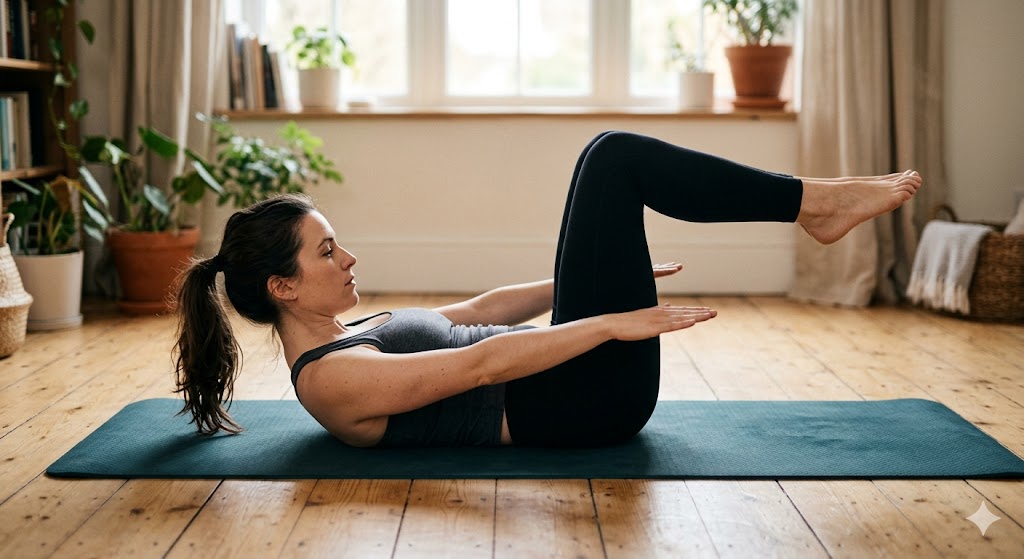
The method trains both large and small stabilizing muscles through deliberate, controlled exercises. Popular movements such as the Hundred, Roll-Up, and Single-Leg Stretch target deep core muscles that support spinal health and everyday movement.
According to industry reports, Pilates participation has increased significantly worldwide as more individuals seek sustainable fitness solutions and low-impact exercise options.
Source: Sports & Fitness Industry Association, 2024.
Core Principles of Pilates
Every Pilates workout is built around several foundational principles:
- Breathing control
- Core engagement
- Precision
- Concentration
- Flow of movement
- Alignment
- Control
For beginners, mastering these principles is often more important than increasing workout intensity.
Why Are Pilates Workouts So Popular for Fitness and Wellness?
Pilates workouts have become one of the most popular forms of exercise because they improve multiple aspects of fitness simultaneously.
Rather than focusing on a single fitness component, Pilates develops strength, flexibility, balance, posture, mobility, and body awareness at the same time.
Modern lifestyles often involve extended periods of sitting, poor posture, reduced mobility, and chronic muscular imbalances. Pilates directly addresses these issues by strengthening postural muscles and restoring efficient movement patterns.
Another major advantage is accessibility. Pilates can be modified for nearly every fitness level, making it suitable for beginners, older adults, athletes, and individuals returning from injury.
Research consistently shows that regular physical activity helps improve quality of life and reduce numerous health risks.
Source: World Health Organization, 2024.
Key Reasons People Choose Pilates
- Low-impact on joints
- Beginner-friendly
- Supports rehabilitation programs
- Improves posture and movement quality
- Can be performed at home or in a studio
- Complements strength training and sports
- Enhances flexibility and mobility
- Helps develop mind-body awareness
What Are the Different Types of Pilates Workouts?
Not all Pilates workouts are the same. Different styles use varying techniques, equipment, and training goals.
Mat Pilates
Mat Pilates is the most accessible form of Pilates and relies primarily on bodyweight resistance.
Exercises are performed on a mat using gravity and controlled movement to challenge muscles. Popular movements include:
- Leg Circles
- Planks
- Roll-Ups
- Side Leg Series
- Teasers
Mat Pilates is ideal for beginners and home workouts because it requires minimal equipment.
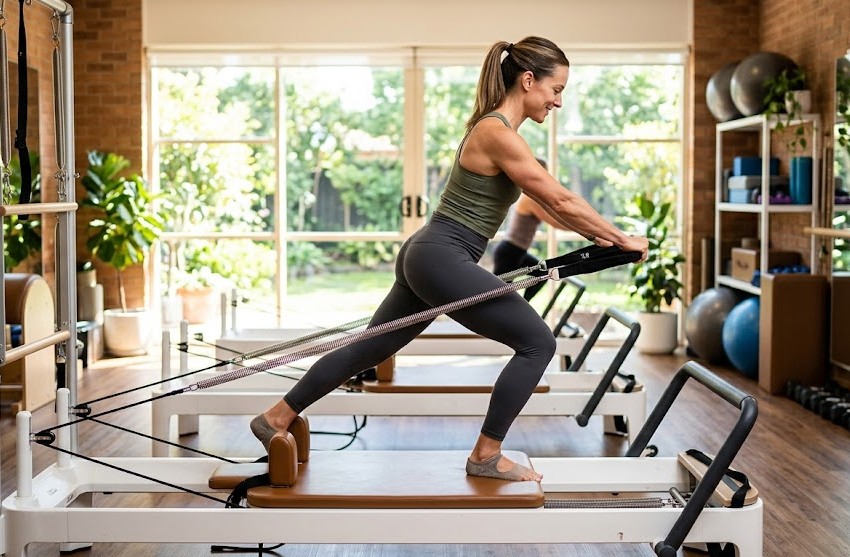
Reformer Pilates
Reformer Pilates uses a specialized machine equipped with springs, pulleys, and a moving carriage.
This equipment provides adjustable resistance, allowing practitioners to increase or decrease workout intensity based on their fitness level.
Benefits of Reformer Pilates include:
- Greater exercise variety
- Enhanced resistance training
- Improved movement feedback
- Better progression opportunities
Clinical Pilates
Clinical Pilates focuses on rehabilitation and injury recovery.
Healthcare professionals and physical therapists often use this method to help individuals restore movement quality, improve posture, and recover safely from musculoskeletal issues.
Contemporary Pilates
Contemporary Pilates combines traditional Pilates principles with modern exercise science.
This style often incorporates:
- Functional movement training
- Mobility exercises
- Strength development techniques
- Athletic performance principles
Pilates Types Comparison
| Pilates Type | Equipment | Best For |
|---|---|---|
| Mat Pilates | Mat | Beginners, home workouts |
| Reformer Pilates | Reformer machine | Strength and progression |
| Clinical Pilates | Specialized equipment | Rehabilitation |
| Contemporary Pilates | Mixed tools | Functional fitness |
What Are the Main Benefits of Pilates Workouts?
Pilates workouts offer a wide range of physical and functional benefits that extend far beyond the gym.
Improved Core Strength
Core strength forms the foundation of every Pilates workout.
Rather than focusing only on visible abdominal muscles, Pilates targets deeper stabilizing muscles that support the spine and pelvis.
Benefits include:
- Better posture
- Improved balance
- Reduced lower back stress
- Enhanced athletic performance
For additional guidance, explore our core strengthening exercises.
Better Flexibility and Mobility
Pilates improves flexibility through active stretching and controlled movement.
Unlike passive stretching routines, Pilates teaches the body to move efficiently through a full range of motion while maintaining strength and control.
Consistent Pilates workouts can help improve flexibility, mobility, balance, and functional strength when practiced regularly.
For more information, see our mobility training exercises.
Enhanced Posture
One of the most noticeable Pilates benefits is improved posture.
By strengthening postural muscles and correcting movement imbalances, Pilates helps counteract the effects of prolonged sitting and screen use.
Common posture improvements include:
- Reduced rounded shoulders
- Better spinal alignment
- Improved neck positioning
- Increased body awareness
Better Balance and Coordination
Pilates challenges stabilizing muscles while improving neuromuscular control.
This results in:
- Improved balance
- Better movement efficiency
- Enhanced coordination
- Reduced risk of falls
Research indicates that balance-focused exercise programs can improve functional movement and reduce fall risk.
Source: National Institute on Aging, 2024.
How Do Pilates Workouts Improve Core Strength and Posture?
Pilates workouts strengthen the deep stabilizing muscles responsible for maintaining spinal alignment and efficient movement.
These muscles include:
- Transverse abdominis
- Pelvic floor muscles
- Diaphragm
- Multifidus
Together, these muscles create a natural support system for the spine.
Proper breathing is another fundamental Pilates principle. Coordinated breathing helps improve stability, movement control, and exercise effectiveness.
For example, exercises such as the Hundred and Dead Bug variations require maintaining core engagement while controlling breathing patterns.
What Is the Best Pilates Workout for Beginners?
The best beginner Pilates workout focuses on learning movement quality before increasing intensity.
Many newcomers make the mistake of rushing through exercises. In Pilates, precision always produces better results than speed.
Beginner Pilates Routine
- Diaphragmatic Breathing – 2 minutes
- Pelvic Tilts – 10 repetitions
- The Hundred – 30 seconds
- Single-Leg Stretch – 10 repetitions each side
- Glute Bridge – 12 repetitions
- Bird Dog – 10 repetitions each side
- Child’s Pose Stretch – 60 seconds
This routine provides an excellent foundation for building long-term Pilates skills.
Can Pilates Workouts Help With Weight Loss?
Pilates workouts can support weight loss, although they are not typically considered the highest calorie-burning exercise option.
Pilates contributes to weight management by:
- Increasing physical activity
- Building lean muscle
- Improving exercise consistency
- Enhancing movement efficiency
- Supporting healthy lifestyle habits
The best results typically occur when Pilates is combined with:
- Balanced nutrition
- Cardiovascular exercise
- Daily movement
- Consistent training habits
For example, three Pilates sessions per week combined with regular walking and proper nutrition often produce better outcomes than relying on a single exercise method.
Explore additional weight loss workout strategies.
According to health authorities, combining exercise with dietary management remains one of the most effective strategies for sustainable weight management.
Source: Centers for Disease Control and Prevention, 2024.
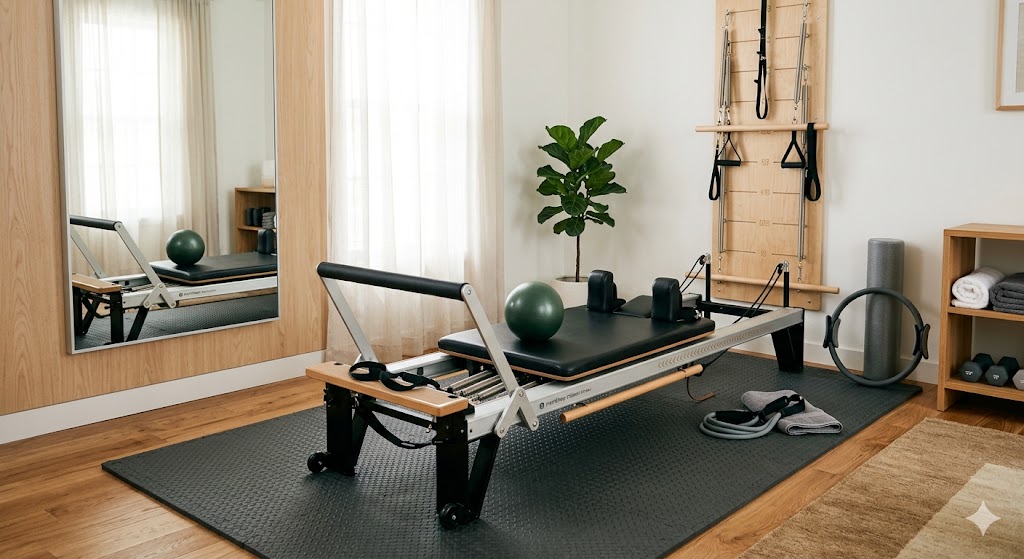
What Equipment Do You Need for Pilates Workouts?
One of the biggest advantages of Pilates is that beginners can start with very little equipment.
Essential Pilates Equipment
- Exercise mat
- Resistance bands
- Pilates ring
- Stability ball
- Foam roller
Advanced Pilates Equipment
- Reformer machine
- Cadillac
- Pilates chair
- Barrel
Starting with a quality exercise mat is often all that’s needed to begin practicing Pilates effectively.
Can You Do Effective Pilates Workouts at Home?
Yes, effective Pilates workouts can absolutely be performed at home.
Many people achieve excellent results without ever stepping into a Pilates studio.
Benefits of Home Pilates Training
- Saves travel time
- Reduces costs
- Increases consistency
- Allows flexible scheduling
- Provides privacy
Home Pilates Success Tips
- Create a dedicated workout space
- Follow structured video lessons
- Focus on technique before intensity
- Track your progress
- Progress gradually
What Are the Most Common Pilates Mistakes Beginners Make?
Avoiding common mistakes can dramatically improve your results.
Common Pilates Mistakes
- Holding your breath
- Overarching the lower back
- Using momentum instead of control
- Ignoring posture alignment
- Progressing too quickly
- Focusing on repetitions instead of technique
Pilates rewards precision. A smaller number of well-executed repetitions is often more effective than performing many repetitions with poor form.
Recording workouts occasionally can help identify technique issues before they become long-term habits.
Pilates vs Yoga: Which Workout Is Right for Your Goals?
Pilates and yoga share similarities but emphasize different outcomes.
Pilates vs Yoga Comparison
| Factor | Pilates | Yoga |
| Primary Focus | Core strength | Flexibility and mindfulness |
| Equipment | Sometimes required | Usually minimal |
| Movement Style | Controlled repetitions | Static poses and flows |
| Rehabilitation Use | Common | Moderate |
| Strength Development | High | Moderate |
Pilates generally emphasizes movement efficiency, muscular control, and core strength, while yoga often focuses more heavily on flexibility, breathing, and mindfulness.
Many people successfully combine both practices for comprehensive physical and mental wellness.
How Long Does It Take to See Results From Pilates Workouts?
Most people begin noticing measurable improvements within four to eight weeks of consistent practice.
Early improvements typically include:
- Better posture
- Improved flexibility
- Enhanced body awareness
- Increased mobility
- Reduced muscle tension
Visible muscle definition and significant strength gains generally take longer and depend on training frequency, intensity, and lifestyle factors.
Research suggests that consistency remains one of the strongest predictors of long-term fitness success.
Source: American College of Sports Medicine, 2024.
For additional support, explore our flexibility training program.
What Does a Weekly Pilates Workout Plan Look Like?
A balanced Pilates schedule combines strength, recovery, mobility, and progression.
Sample Weekly Pilates Workout Plan
| Day | Activity |
| Monday | Full-body Pilates workout |
| Tuesday | Walking and stretching |
| Wednesday | Pilates core workout |
| Thursday | Recovery and mobility |
| Friday | Reformer or advanced mat Pilates |
| Saturday | Flexibility-focused Pilates |
| Sunday | Rest or light movement |
Following a structured plan typically produces better long-term results than exercising sporadically.
Best Tools, Apps, Classes, and Online Resources for Pilates Training
Quality instruction often matters more than expensive equipment.
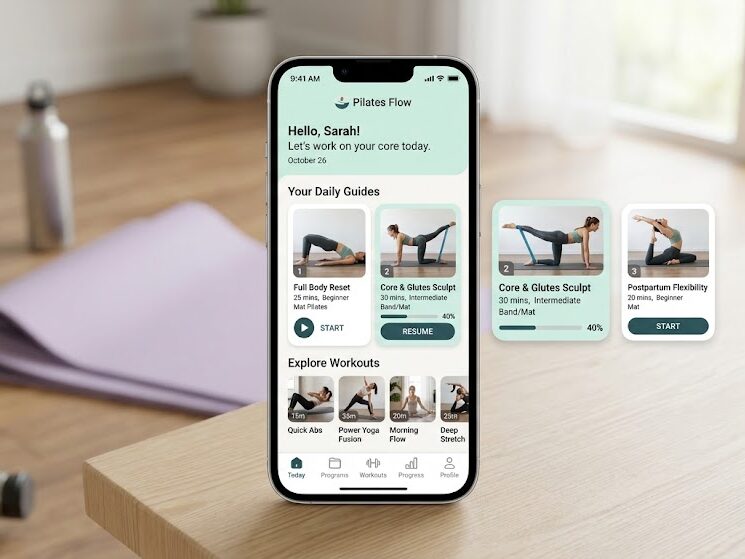
Fortunately, modern technology provides numerous ways to learn Pilates effectively.
Recommended Pilates Resources
- Pilates Anytime
- FitOn
- Nike Training Club
- Local Pilates studios
- Certified Pilates instructors
- Online video platforms
These resources can help improve consistency, provide guidance, and support long-term progression.
What’s Next: How to Progress Your Pilates Practice
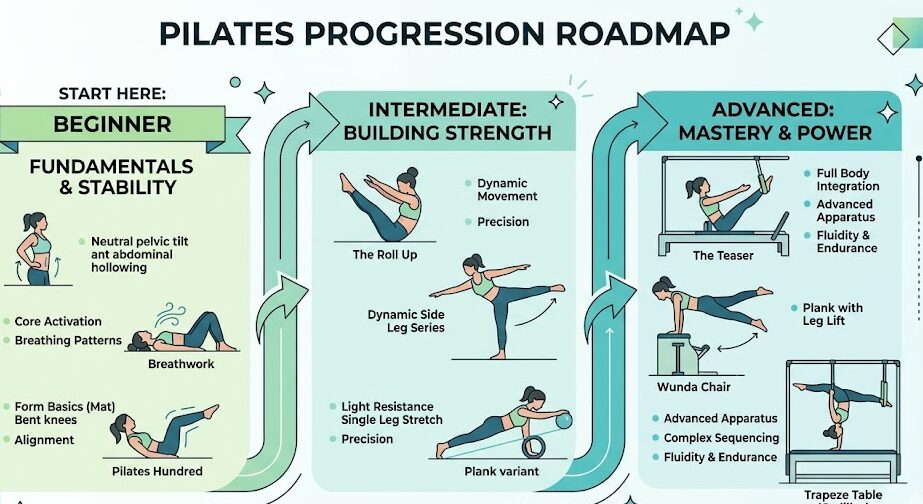
Long-term success with Pilates comes from gradual progression rather than rapid intensity increases.
Effective Pilates Progression Strategy
- Master beginner exercises.
- Improve breathing control.
- Increase workout duration.
- Add resistance tools.
- Explore reformer Pilates.
- Track mobility improvements.
- Challenge balance and coordination.
Aiming for at least three sessions per week provides a strong foundation for consistent progress.
Recovery remains equally important. Muscles adapt and strengthen during rest periods, making recovery a critical component of any successful fitness plan.
Moreover, recovery remains essential for continued progress. Explore our fitness recovery techniques.
Conclusion
Pilates workouts are among the most effective low-impact fitness methods for improving strength, flexibility, posture, balance, and long-term wellness.
Unlike many fitness trends that focus on short-term results, Pilates emphasizes sustainable movement patterns that support everyday health and performance. Whether you’re a beginner looking to build a fitness habit, an athlete aiming to improve movement quality, or someone seeking relief from the effects of a sedentary lifestyle, Pilates offers a practical and proven solution.
By practicing consistently, mastering proper breathing techniques, and progressing gradually, you can develop stronger muscles, better posture, enhanced flexibility, and greater body awareness. Most importantly, Pilates workouts provide a sustainable path to lifelong fitness that can adapt to your goals and abilities over time.
FAQs
What are Pilates workouts good for?
Pilates workouts are effective for improving core strength, flexibility, posture, balance, mobility, coordination, and overall body awareness. They are also commonly used for rehabilitation support and injury prevention because of their low-impact nature.
Can beginners do Pilates workouts at home?
Yes. Beginners can successfully perform Pilates workouts at home using a mat and basic bodyweight exercises. Starting with guided routines helps ensure proper form and safe progression.
How many times a week should I do Pilates?
Most beginners benefit from practicing Pilates two to four times per week. Consistent training typically delivers better results than occasional sessions.
Is Pilates better than gym workouts?
Pilates and gym workouts serve different purposes. Pilates excels at improving posture, movement quality, flexibility, and core strength, while traditional gym training is often better suited for maximizing muscle growth and heavy strength development.
Can Pilates flatten your stomach?
Pilates can strengthen abdominal muscles and improve core engagement, contributing to a firmer midsection. However, visible stomach fat loss requires a combination of exercise, proper nutrition, and maintaining an overall calorie deficit.
Do Pilates workouts help improve posture?
Yes. Pilates strengthens the muscles responsible for supporting spinal alignment and postural control, making it one of the most effective exercise methods for posture improvement.
How long should a Pilates workout be?
A Pilates workout can range from 15 to 60 minutes depending on your fitness level and goals. Beginners often start with shorter sessions and gradually increase duration as they gain experience.
Can Pilates replace strength training?
Pilates can build strength, particularly in the core and stabilizing muscles, but individuals seeking maximum muscle growth or heavy strength gains may benefit from combining Pilates with traditional resistance training.