
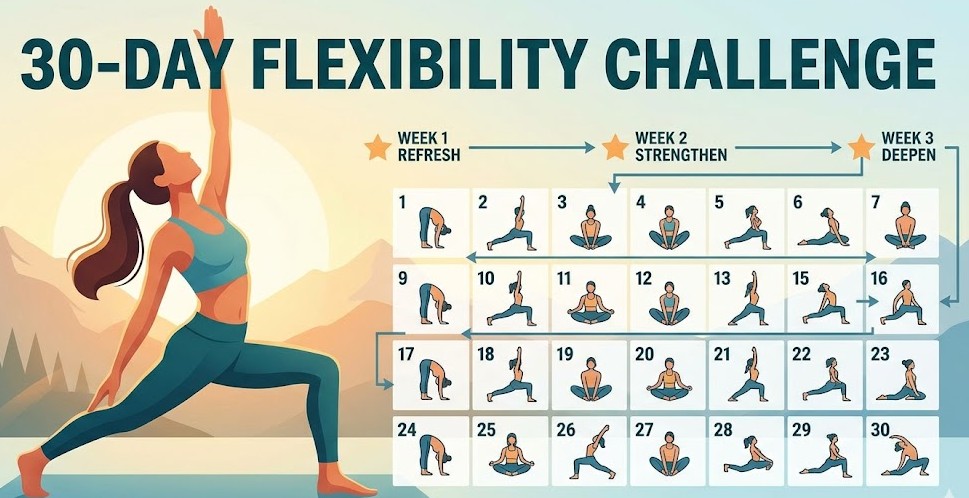
Most people know stretching feels good after a workout or after spending hours sitting at a desk. However, occasional stretching sessions rarely produce lasting results. If you want noticeable improvements in mobility, posture, and overall movement quality, consistency matters more than intensity.
That’s where a Flexibility Challenge can make a significant difference.
A structured flexibility challenge provides a clear roadmap for improving range of motion, reducing muscle stiffness, and developing healthier movement habits over time. Whether you’re a beginner looking to touch your toes, an athlete seeking better performance, or someone hoping to move more comfortably throughout the day, a well-designed flexibility challenge can help you achieve your goals.
In this guide, you’ll learn what a flexibility challenge is, how flexibility training works, its health benefits, the best exercises to include, common mistakes to avoid, and a complete 30-day flexibility challenge plan to help you improve safely and effectively.
What Is a Flexibility Challenge?
A flexibility challenge is a structured stretching program designed to improve mobility, range of motion, and muscle flexibility over a specific period.
Unlike random stretching sessions, a challenge provides a daily framework that encourages consistency and gradual progress. For example, a beginner might spend just 10 minutes per day stretching key muscle groups such as the hamstrings, hips, shoulders, and calves over a 30-day period.
Through repeated practice, muscles and connective tissues gradually adapt, allowing joints to move more freely and comfortably.
If you’re new to movement training, pairing this challenge with a beginner yoga routine can accelerate flexibility improvements while building body awareness.
What Is the Difference Between Flexibility and Mobility?
Many people use flexibility and mobility interchangeably, but they are not the same thing.
| Flexibility | Mobility |
|---|---|
| Refers to a muscle’s ability to lengthen | Refers to a joint’s ability to move through its full range of motion |
| Focuses on muscles and connective tissues | Focuses on joint movement and control |
| Improved through stretching | Improved through movement-based exercises |
For example, touching your toes primarily depends on hamstring flexibility. Performing a deep squat comfortably requires coordinated mobility in the hips, knees, and ankles.
The best movement programs improve both flexibility and mobility because they work together to support healthy movement patterns.
For deeper training strategies, consider adding a mobility workout routine alongside your stretching plan.
Why Is Flexibility Important for Overall Health and Fitness?
Flexibility plays a critical role in how your body moves, performs, and recovers.
Modern lifestyles often involve prolonged sitting, limited movement, and repetitive daily habits that can contribute to muscle tightness and reduced mobility. According to the World Health Organization, physical inactivity remains one of the leading risk factors for global health issues.
Source: WHO, 2024.
Improving flexibility can support:
- Better posture
- Improved movement efficiency
- Reduced muscle stiffness
- Enhanced athletic performance
- Greater comfort during daily activities
- Improved recovery after exercise
Better Posture and Reduced Muscle Tension
Poor posture is often linked to tight muscles and movement restrictions.
For example, prolonged sitting can tighten hip flexors and contribute to lower back discomfort. Regular stretching can help restore balance and improve overall posture.
Support for Injury Prevention
Flexible muscles generally tolerate movement stresses more effectively than chronically tight muscles.
Runners, cyclists, gym-goers, and recreational athletes often benefit from maintaining healthy flexibility levels because movement patterns become smoother and more efficient.
What Are the Benefits of Completing a Flexibility Challenge?
A flexibility challenge provides benefits that extend far beyond simply becoming more flexible.
Research shows that regular stretching can improve range of motion and functional movement performance.
Source: American College of Sports Medicine, 2024.
Physical Benefits
Completing a flexibility challenge may help:
- Increase range of motion
- Reduce muscle stiffness
- Improve circulation
- Enhance posture
- Support workout recovery
- Improve daily movement comfort
Additionally, incorporating daily stretching exercises can further support long-term movement health.
Performance Benefits
Athletes and fitness enthusiasts often use flexibility training to improve movement efficiency.
Examples include:
- Greater hip mobility for deeper squats
- Improved shoulder flexibility for overhead movements
- Better running mechanics
- Enhanced exercise technique
Mental Wellness Benefits
Stretching isn’t only beneficial for the body.
Many people find that daily stretching sessions encourage relaxation, mindfulness, and stress reduction.
A simple 10-minute evening stretching routine can help release tension accumulated throughout the day and improve body awareness.
Can Beginners Successfully Complete a Flexibility Challenge?
Absolutely.
One of the biggest misconceptions about flexibility training is that you need to be naturally flexible to get started. In reality, flexibility improvements depend more on consistency than starting ability.
Most beginner-friendly programs include simple stretches such as:
- Seated hamstring stretch
- Child’s pose
- Butterfly stretch
- Standing calf stretch
- Chest opener stretch
According to the American Heart Association, regular movement habits significantly improve physical function over time.
Source: AHA, 2024.
How Long Does It Take to Improve Flexibility?
Most people begin noticing measurable flexibility improvements within two to six weeks of consistent practice.
Early progress often occurs because the nervous system becomes more comfortable allowing greater movement ranges.
Typical Flexibility Progress Timeline
| Time Period | Expected Improvement |
|---|---|
| 1 Week | Reduced stiffness |
| 2 Weeks | Better movement comfort |
| 3 Weeks | Increased range of motion |
| 4 Weeks | Noticeable flexibility gains |
| 8+ Weeks | Significant long-term progress |
For example, many participants find they can reach closer to their toes after just two weeks of daily stretching.
How Does Flexibility Training Work? The Science Behind Stretching
Flexibility training works by gradually increasing the tolerance and adaptability of muscles, tendons, and connective tissues.
When you stretch consistently:
- Muscles learn to relax more effectively.
- Connective tissues adapt over time.
- The nervous system becomes less resistant to movement.
- Joints can move through larger ranges safely.
As flexibility improves, movements that once felt difficult become more comfortable and controlled.
According to the American College of Sports Medicine, regular stretching programs can improve joint range of motion when performed consistently.
Source: ACSM, 2024.
The Best 30-Day Flexibility Challenge Plan
A 30-day flexibility challenge helps establish sustainable habits while progressively improving movement quality.
Week 1: Foundation Phase
Focus Areas
- Hamstrings
- Calves
- Shoulders
- Neck
Goal
Build consistency and develop a daily stretching habit.
Week 2: Mobility Development
Focus Areas
- Hips
- Ankles
- Thoracic spine
Goal
Improve movement quality and joint mobility.
Week 3: Full-Body Integration
Focus Areas
- Dynamic flexibility
- Balance
- Functional movement patterns
Goal
Combine mobility and flexibility into everyday movement.
Week 4: Performance Phase
Focus Areas
- Advanced stretches
- Longer hold durations
- Personal flexibility weaknesses
Goal
Maximize progress and reinforce long-term habits.
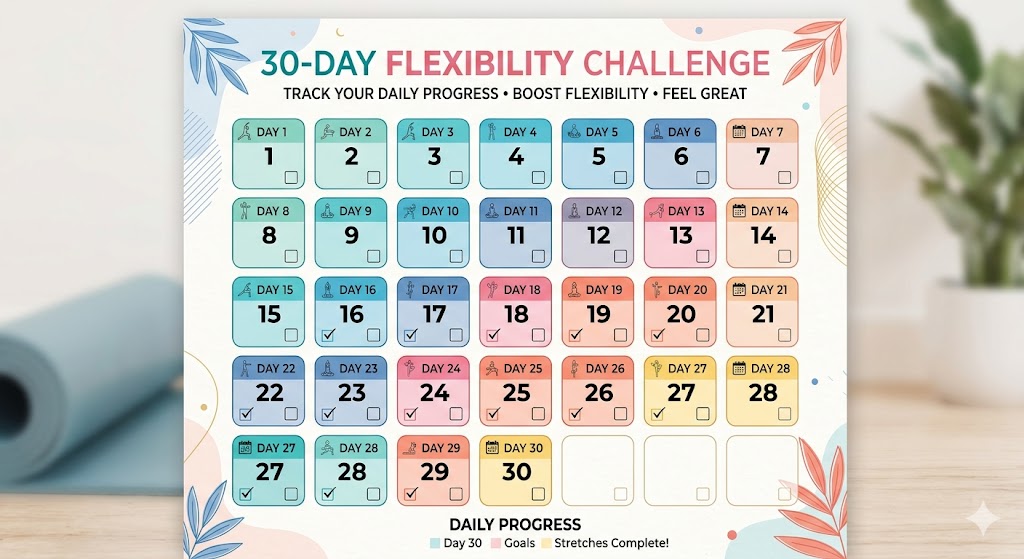
Best Daily Exercises for a Flexibility Challenge
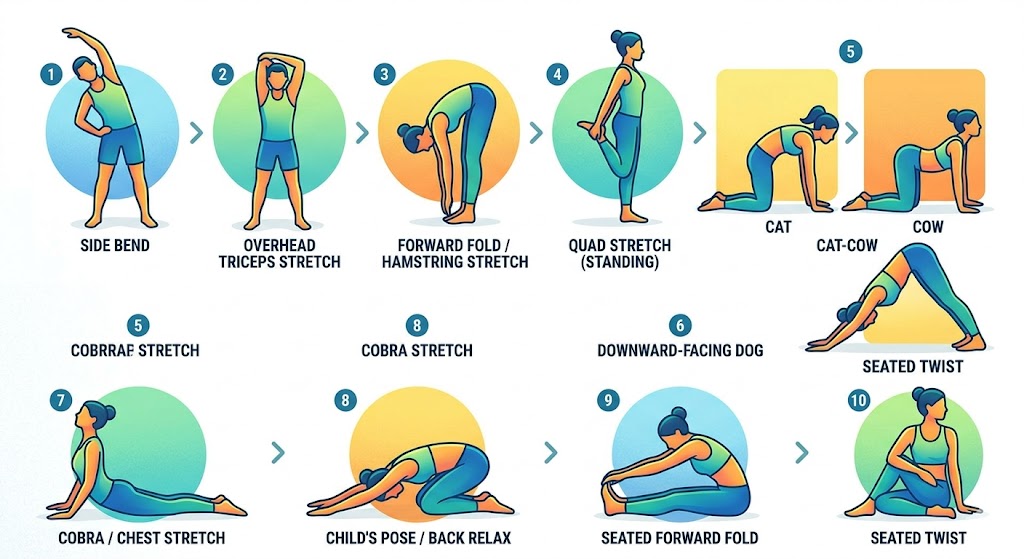
A successful flexibility challenge should target all major muscle groups.
Lower Body Stretches
- Hamstring Stretch
- Hip Flexor Stretch
- Butterfly Stretch
- Calf Stretch
Upper Body Stretches
- Chest Opener
- Shoulder Stretch
- Triceps Stretch
- Neck Stretch
Full-Body Movements
- Cat-Cow
- Child’s Pose
- Downward Dog
- World’s Greatest Stretch
For more advanced routines, check out best yoga poses for flexibility
Should You Use Dynamic or Static Stretching?
The most effective flexibility challenge includes both dynamic and static stretching.
Dynamic Stretching
Dynamic stretching prepares the body for activity through controlled movement.
Examples include:
- Leg swings
- Arm circles
- Walking lunges
- Torso rotations
Dynamic stretches are generally best performed before exercise.
Static Stretching
Static stretching involves holding a stretch position for 20–60 seconds.
Examples include:
- Seated hamstring stretch
- Butterfly stretch
- Quad stretch
- Hip flexor stretch
Static stretching is generally most effective after exercise or during dedicated flexibility sessions.
Common Mistakes That Slow Flexibility Progress
Even the best flexibility challenge can be less effective if common mistakes are made.
Stretching Too Aggressively
Many people assume harder stretching leads to faster results.
In reality, forcing a stretch often causes discomfort and muscle guarding, which can reduce effectiveness.
Inconsistent Practice
Flexibility gains depend heavily on consistency.
Ten minutes of stretching every day typically produces better results than one long session each week.
Ignoring Recovery
Recovery plays a major role in flexibility improvements.
Important recovery habits include:
- Getting adequate sleep
- Staying hydrated
- Managing stress
- Maintaining balanced nutrition
Tools and Apps That Support Flexibility Training
Several tools can help improve consistency and technique during a flexibility challenge.
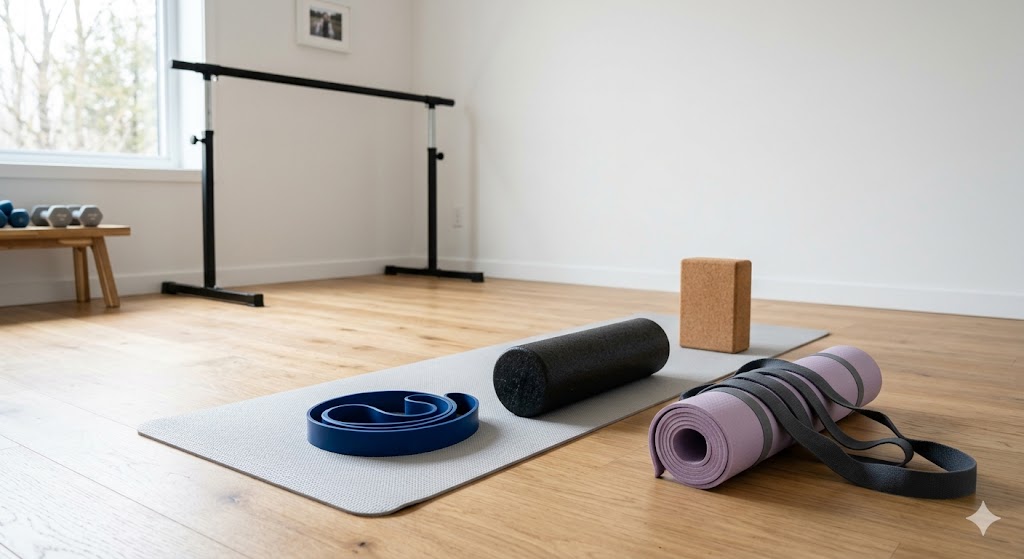
Useful Equipment
- Yoga mats
- Stretch straps
- Foam rollers
- Mobility balls
- Resistance bands
Recommended Apps
- StretchIt
- Down Dog
- Nike Training Club
- FitOn
Many people also use simple timer apps or free stretching videos to stay on track.
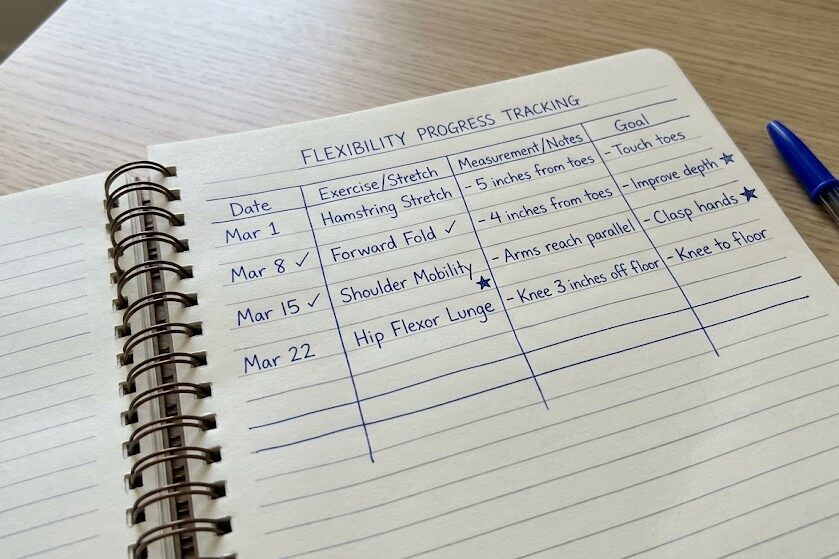
How to Track Progress During a Flexibility Challenge
Tracking progress helps maintain motivation and provides measurable evidence of improvement.
Useful metrics include:
- Toe-touch distance
- Squat depth
- Shoulder mobility
- Stretch duration
- Weekly progress photos
Many posture improvements happen gradually, making weekly photos especially valuable.
Is a Flexibility Challenge Safe for Older Adults?
In most cases, yes.
A flexibility challenge can be highly beneficial for older adults when exercises are modified appropriately.
Benefits may include:
- Improved mobility
- Better balance
- Increased independence
- Enhanced daily function
- Reduced stiffness
Chair-assisted stretches and gentle movement routines can make flexibility training safer and more accessible.
However, individuals with medical conditions should consult a healthcare professional before starting any new exercise program.
What Happens After Completing a 30-Day Flexibility Challenge?
Completing a flexibility challenge is only the beginning.
Without continued practice, flexibility improvements may gradually decline. Most people can maintain their progress by performing stretching sessions two to four times per week.
Many participants move on to:
- Yoga programs
- Mobility training
- Strength training
- Athletic performance programs
- Functional fitness routines
Athletes may benefit from adding mobility exercises for athletes for sport-specific performance improvements.
What’s Next After Completing a Flexibility Challenge?
The ultimate goal is to transform stretching into a lifelong habit.
To maintain and build upon your results:
- Establish a realistic maintenance routine.
- Continue practicing mobility exercises.
- Add strength training to support joint stability.
- Include cardiovascular exercise for overall fitness.
- Track progress regularly.
Third, continue building healthy fitness habits to support long-term health and mobility.
Additionally, pairing stretching with a regular home workout routine creates a balanced fitness program.
Conclusion
A Flexibility Challenge is one of the most effective ways to improve mobility, increase range of motion, and develop healthier movement habits. By following a structured plan, practicing consistently, and gradually progressing over time, you can reduce stiffness, improve posture, and move more comfortably in everyday life.
The key to success isn’t extreme stretching sessions—it’s consistency. Small daily efforts performed over weeks and months often deliver far greater results than occasional intense workouts.
Start your flexibility challenge today, stay patient with the process, and enjoy the long-term benefits of improved movement, better posture, enhanced fitness, and greater overall wellness.
FAQs
What is a flexibility challenge?
A flexibility challenge is a structured stretching program designed to improve mobility, range of motion, and muscle flexibility through consistent daily or weekly stretching sessions.
Can beginners do a flexibility challenge?
Yes. Most flexibility challenges are beginner-friendly and start with simple stretches that gradually become more challenging as flexibility improves.
How often should I stretch during a flexibility challenge?
Most programs recommend stretching daily or at least five days per week to achieve the best results and build sustainable habits.
How long should each stretching session last?
Most flexibility challenge sessions last between 10 and 30 minutes, depending on the program structure and individual goals.
Will a flexibility challenge improve posture?
Yes. Improved flexibility can reduce muscle tightness and movement restrictions that contribute to poor posture, especially for people who spend long hours sitting.
Is flexibility training the same as mobility training?
No. Flexibility refers to a muscle’s ability to lengthen, while mobility refers to a joint’s ability to move through its full range of motion. Both are important for healthy movement and overall fitness.