
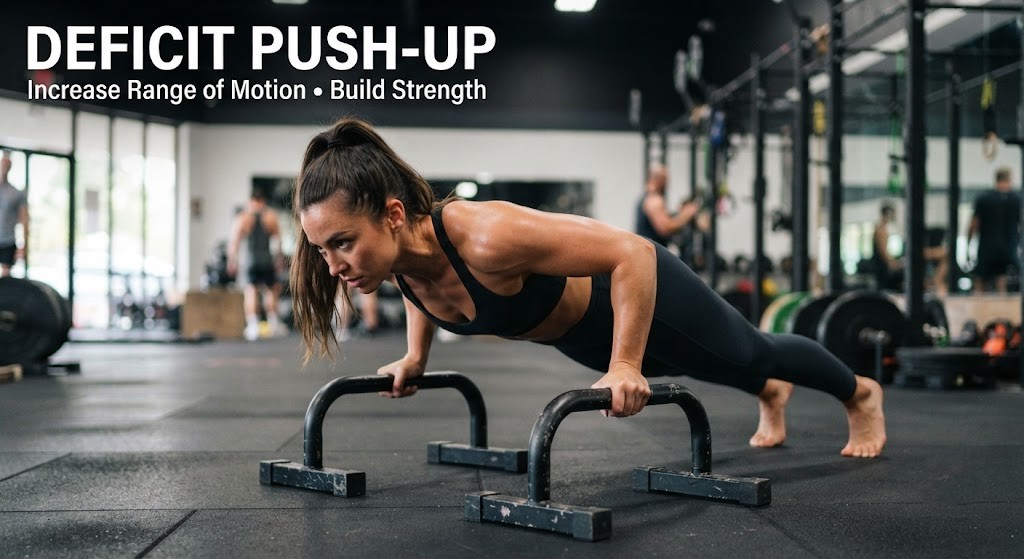
If regular push-ups have become too easy, simply adding more repetitions is not your only option. A deficit push-up increases the potential range of motion by placing your hands on stable elevated supports, creating a more demanding variation of the classic push-up.
This makes the deficit push-up particularly useful for people who want to build upper-body strength, improve bodyweight training, and introduce progressive overload without immediately relying on weights or machines.
In this guide, you’ll learn what a deficit push-up is, which muscles it works, its benefits, how to perform it with proper form, how deep you should go, which equipment to use, common mistakes to avoid, and how to progress safely.
What Is a Deficit Push-Up?
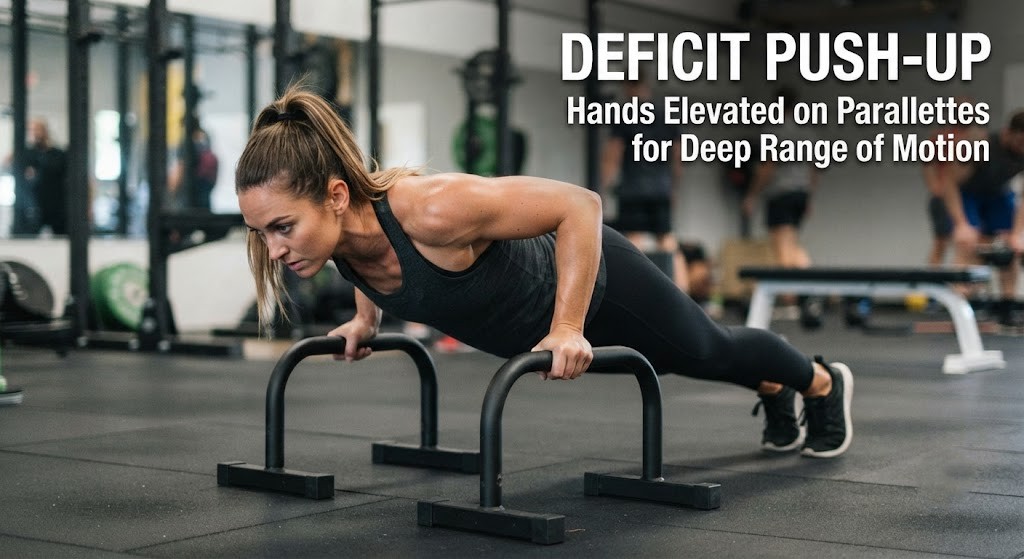
A deficit push-up is a push-up performed with the hands elevated on stable supports, allowing the chest to move through a greater range of motion than in a standard push-up. Unlike a regular push-up, your hands are positioned on platforms, handles, parallettes, or other secure supports while your chest can travel lower between them.
For example, placing your hands on two sturdy push-up handles creates additional space below your hands, allowing your chest to move farther toward the floor.
The increased range of motion can make each repetition more demanding because you must control a deeper descent and press through a larger movement. Research comparing push-up variations found that changing hand or foot elevation can substantially alter the forces involved in the exercise. — Source: PubMed, 2011
Why Do Deficit Push-Ups Matter?
Deficit push-ups provide a practical way to make bodyweight training more challenging without immediately adding external weight. Instead of simply performing more and more repetitions, you can manipulate the range of motion and make each repetition more demanding.
For example, someone who can comfortably perform 20 standard push-ups may introduce a small deficit as a new progression rather than continuing to increase repetitions indefinitely.
Deficit push-ups can also complement progressive overload. Progressive overload does not necessarily require plates or dumbbells. You can gradually manipulate several variables, including:
- Range of motion
- Repetitions
- Tempo
- Leverage
- External resistance
Push-ups are also recognized as muscle-strengthening activity within general physical-activity guidance. Adults are advised to perform muscle-strengthening activities on at least two days each week. — Source: U.S. Office of Disease Prevention and Health Promotion, 2026
What Muscles Do Deficit Push-Ups Work?
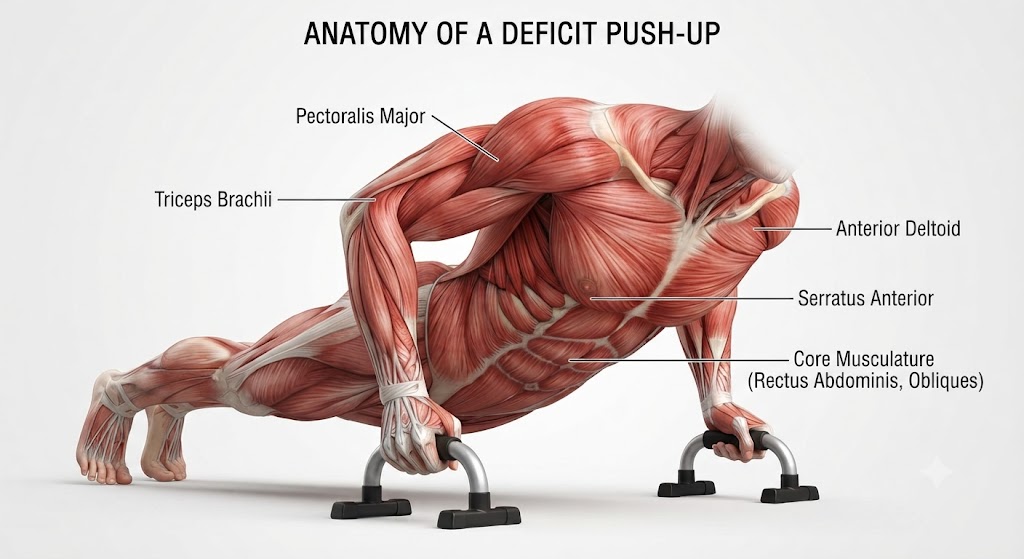
The primary muscles involved in deficit push-ups are the pectorals, triceps, and anterior shoulders. Your core and other stabilizing muscles also contribute by helping maintain a rigid body position throughout the movement.
Because the hands are elevated, the chest can travel farther downward than during a standard floor push-up. This deeper movement can increase the challenge, particularly when you maintain control throughout the entire repetition.
Research on conventional push-up variations has also found that changing hand position can influence muscle activation. For example, a narrow hand position can increase pectoral and triceps activation compared with a wider hand position. — Source: PubMed, 2005
Chest and Triceps
The pectoralis major plays an important role in pressing your upper body away from the floor, while the triceps extend the elbows during the upward phase.
As a result, deficit push-ups can fit well into a chest-focused or upper-body workout. They can also complement Long Head Triceps Workout.
However, the exact muscular emphasis can vary according to hand position, elbow path, body angle, individual anatomy, and technique.
Shoulders, Serratus Anterior, and Core
The anterior deltoids assist with shoulder movement during the push-up. The serratus anterior and other muscles also contribute to controlling the shoulder blades.
Research on push-up variations shows that changing hand and lower-body positions can influence scapular and stabilizing-muscle activity. — Source: PubMed, 2019
Meanwhile, your core works isometrically throughout the exercise. Your abdominal and other trunk muscles help prevent your hips from dropping or your lower back from excessively arching.
What Are the Benefits of Deficit Push-Ups?
The main deficit push-up benefits include increased potential range of motion, greater exercise variety, progressive bodyweight training, and a challenging pressing movement that requires relatively little equipment.
Instead of immediately adding weight, you can use a small deficit to increase the difficulty while continuing to train with your own body weight.
Greater Range of Motion
One of the defining characteristics of a deficit push-up is the additional space created beneath the hands.
This allows your chest to travel below the level of your hands. However, more depth is not automatically better. The additional range should only be used when you can maintain control and perform the movement without painful motion.
Progressive Bodyweight Training
Deficit push-ups give you another variable for progressive overload.
You can begin with a small elevation and gradually increase the challenge as your strength and technique improve. Other progression options include increasing repetitions, slowing the eccentric portion of the movement, or eventually adding external resistance.
Convenient Home Training
Deficit push-ups require relatively little equipment and can be incorporated into No Equipment Home Workout when appropriate stable supports are available.
Interestingly, a 2024 U.S. national estimate found that 32.9% of adults performed muscle-strengthening activities on at least two days per week. — Source: Healthy People 2030, 2026
How Do You Do a Deficit Push-Up With Proper Form?
A proper deficit push-up involves lowering the chest below the level of the hands under control, maintaining a straight body line, and pressing back to the starting position without losing alignment.
Before starting, place two sturdy supports slightly wider than shoulder width. Check that they are secure and cannot slide, tip, or collapse during the exercise.
Follow these steps:
- Set your hands: Place or grip your palms firmly on the supports.
- Create a straight body line: Keep your head, shoulders, hips, and ankles aligned.
- Brace your core: Tighten your abdominal and glute muscles before beginning the descent.
- Position your elbows: Keep them at a comfortable angle rather than aggressively flaring them outward.
- Lower slowly: Bend your elbows and lower your chest between the supports.
- Reach your comfortable depth: Descend only as far as you can control without painful movement.
- Pause briefly: Maintain tension at the bottom rather than relaxing.
- Press upward: Push through the supports while extending your elbows.
- Finish with control: Return to the starting position without allowing your hips to sag.
Breathing should also remain controlled. Inhale during the descent and exhale as you press upward.
How Should Your Body Position Look?
Your body should remain relatively straight from head to heels during a floor-based deficit push-up.
Your hips should move together with your torso rather than dropping toward the floor. If your hips sag during the descent, reduce the deficit or switch to an easier push-up variation until you can maintain proper alignment.
Your hands should also remain stable throughout the repetition.
A recent 2026 study found that wrist position changes force transfer through the elbow and shoulder during push-ups, highlighting the importance of selecting a wrist position that suits the individual. — Source: PubMed, 2026
How Deep Should You Go on a Deficit Push-Up?
The appropriate deficit depth is the deepest range of motion you can perform with stable equipment, controlled technique, and no painful movement.
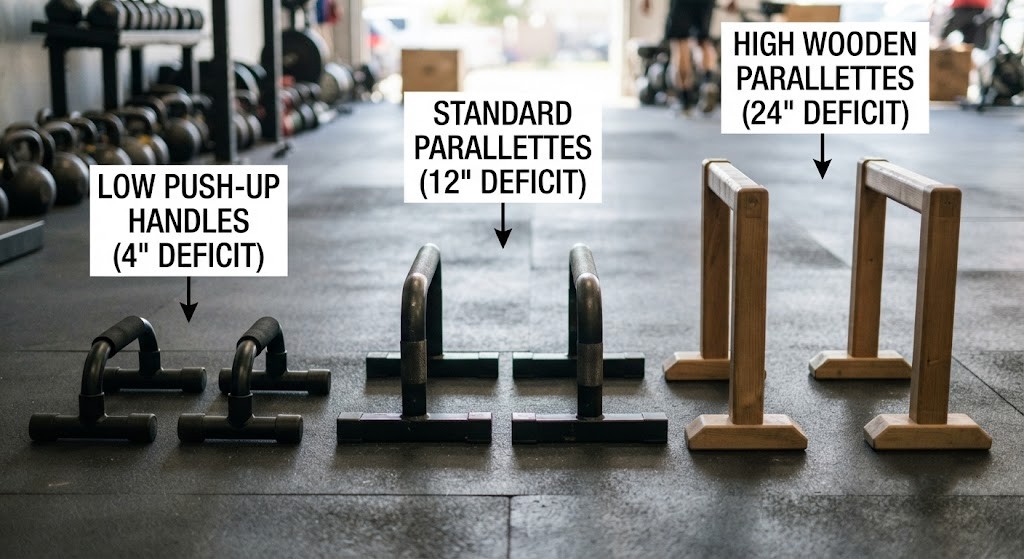
For example, a beginner may start with a small 2–5 cm elevation, while a stronger trainee may comfortably use taller parallettes.
There is no universal deficit height that every person should use. Individual mobility, strength, body proportions, equipment, and shoulder comfort can all influence the appropriate depth.
More range of motion should be treated as a progression, not a requirement.
If increasing the deficit causes you to lose shoulder control, change your body alignment, or experience painful movement, return to a lower elevation.
What Equipment Can You Use for Deficit Push-Ups?
Deficit push-up equipment can include push-up handles, parallettes, sturdy aerobic platforms, and other stable supports designed to bear your body weight.
Parallettes are particularly useful because they provide a stable elevated surface and can allow a neutral hand position while creating space for your chest to travel below your hands.
| Equipment | Main Use | Beginner Consideration |
|---|---|---|
| Push-up handles | Small-to-moderate deficit | Easy to set up |
| Low parallettes | Controlled deep push-ups | Excellent for progression |
| Sturdy platforms | Adjustable elevation | Must remain stable |
| Weight plates | Small elevation | Should not slide or tilt |
| High supports | Larger range of motion | Better suited to experienced trainees |
Most importantly, stability matters more than height.
Never use loose furniture, unstable boxes, stacked objects, or slippery household items as supports. A higher deficit is not useful if the equipment itself is unsafe or unstable.
What Are the Most Common Deficit Push-Up Mistakes?
The most common deficit push-up mistakes include using excessive depth, losing body alignment, using unstable equipment, and progressing too quickly.
Avoiding these mistakes can help you get more from the exercise while keeping your technique consistent.
Using Too Much Deficit
Excessive elevation can force you into a range of motion that you cannot control.
Start with a small deficit and increase it only when you can consistently perform the movement with stable shoulders and proper body alignment.
Flaring the Elbows
Aggressively flaring your elbows can change shoulder mechanics and make the movement less controlled.
Instead, keep your elbows in a comfortable path that allows you to lower and press smoothly without forcing them either tightly against your body or excessively outward.
Sagging or Overarching
A sagging hip position reduces full-body tension, while excessive arching can shift your body away from the intended position.
Brace your core and glutes throughout the movement. Think about maintaining a strong, controlled line from your head through your torso and legs.
Rushing the Descent
Dropping quickly into the bottom position reduces your ability to control the deeper portion of the exercise.
A slower eccentric phase can make the exercise harder without immediately increasing the deficit.
How Can Beginners Progress to Deficit Push-Ups?
Deficit push-up progression involves starting with a manageable range of motion and gradually increasing the deficit, repetitions, tempo, or external resistance as strength and technique improve.
A beginner-friendly progression can look like this:
- Wall push-ups
- Incline push-ups
- Knee or modified push-ups
- Standard push-ups
- Low-deficit push-ups
- Moderate-deficit push-ups
- Weighted deficit push-ups
The goal is not to rush through these stages. Instead, move forward when you can perform your current variation consistently with good control.
Beginners can also use calisthenics exercises for beginners to develop the pressing strength and core control needed for more advanced bodyweight movements.
How to Progress Deficit Push-Ups Safely
A useful progression principle is to change one major difficulty variable at a time.
For example, if you increase the deficit, keep the repetitions and tempo manageable rather than increasing the deficit, repetitions, and resistance simultaneously.
Possible progression methods include:
- Increase repetitions while maintaining form.
- Increase the deficit gradually.
- Slow down the lowering phase.
- Add a controlled pause at the bottom.
- Improve consistency and technique.
- Introduce external resistance after developing sufficient strength.
This approach makes it easier to identify which change is increasing the challenge and helps prevent unnecessary jumps in difficulty.
What Is the Difference Between Deficit Push-Ups and Regular Push-Ups?
The primary difference between deficit push-ups and regular push-ups is the elevated hand position and resulting additional space for the chest to travel downward.
| Feature | Regular Push-Up | Deficit Push-Up |
|---|---|---|
| Hand position | On floor | Elevated on supports |
| Range of motion | Standard | Potentially greater |
| Equipment | Usually none | Usually supports required |
| Difficulty | Baseline | Generally more demanding |
| Progression | Reps, tempo, leverage | ROM, reps, tempo, resistance |
| Best starting point | Beginners | Trainees with push-up experience |
Research on push-up variations demonstrates that changing hand or foot elevation can alter force demands.
One study examined six variations in 23 recreationally fit participants, including hands elevated to 30.48 and 60.96 cm. — Source: PubMed, 2011
Therefore, deficit push-ups should not be viewed simply as regular push-ups with higher hands. The additional available range of motion changes the mechanical demands of the movement.
How Many Deficit Push-Ups Should You Do in a Workout?
A practical starting point is 2–4 sets of 5–12 controlled repetitions, provided you can maintain consistent technique throughout every set.
For example, a beginner-to-intermediate trainee could perform 3 sets of 6–8 low-deficit repetitions after warming up.
Stronger trainees may progress toward 3–4 sets of 8–12 repetitions before increasing the deficit or introducing additional resistance.
The appropriate amount of volume depends on your current strength, training experience, overall workout volume, and ability to recover.
Sample Deficit Push-Up Chest Workout
A simple chest-focused session could include:
- Deficit push-ups: 3 × 6–10
- Standard push-ups: 3 × 8–15
- Incline or decline push-ups: 2–3 × 8–12
- Optional chest accessory movement: 2–3 × 10–15
You can also combine deficit push-ups with a Chest Workout Exercises as long as your total pressing volume remains manageable.
What’s Next: How to Add Deficit Push-Ups to Your Workout
Deficit push-ups work best when they are treated as one progression within a complete training program rather than as an isolated exercise.
Because the movement can be more demanding than a standard push-up, placing it earlier in a workout can make sense when strength and technique are the main priorities. Easier push-up variations can then be used for additional volume.
A simple weekly structure could look like this:
- Chest day: 3 sets of deficit push-ups
- Upper-body day: 3 sets paired with pulling exercises
- Calisthenics day: Deficit push-ups followed by other bodyweight movements
- Home workout: Deficit push-ups combined with squats, rows, and core exercises
For a broader routine, combine them with Oblique Workout for Beginners.
Furthermore, adults are generally advised to perform muscle-strengthening activities at least two days per week. — Source: U.S. Office of Disease Prevention and Health Promotion, 2026
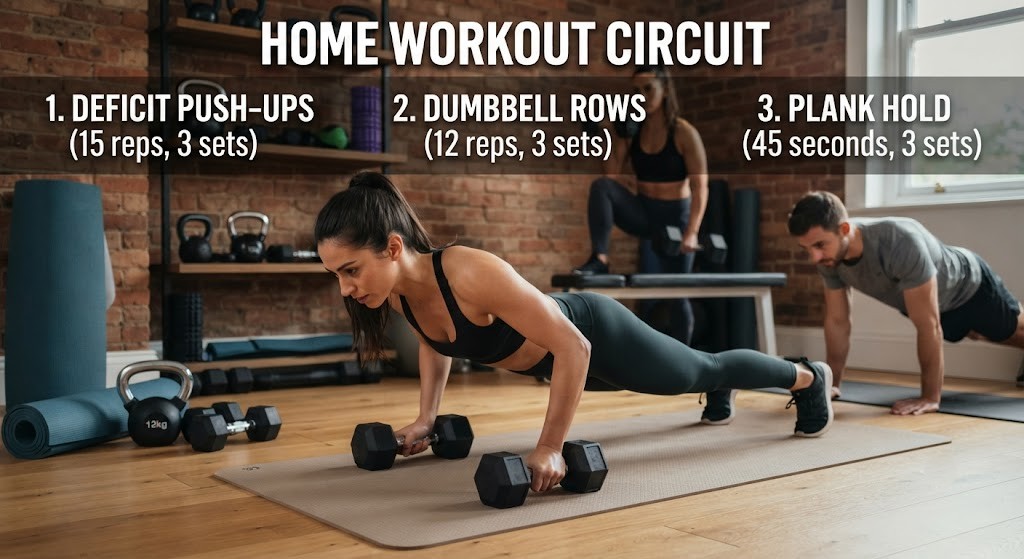
Deficit Push-Up Form Checklist
Before adding more repetitions or increasing the deficit, use this quick checklist:
- Supports are stable and secure.
- Hands are positioned firmly on the supports.
- Head, torso, hips, and legs remain aligned.
- Core and glutes remain engaged.
- Elbows follow a comfortable path.
- Descent is controlled.
- Chest reaches only a comfortable, controlled depth.
- No painful movement occurs.
- Hips do not sag during the repetition.
- The upward phase remains controlled.
- Technique remains consistent from the first repetition to the last.
If your form starts breaking down, reduce the deficit, lower the repetitions, or switch to an easier variation.
Conclusion
The deficit push-up is an advanced push-up variation that uses elevated hand supports to create a greater potential range of motion. It primarily trains the chest, triceps, and anterior shoulders while the core and stabilizing muscles help maintain body position.
The goal is not to use the highest possible deficit. Instead, focus on using a manageable range of motion that you can control consistently.
If you are still developing basic pressing strength, start with standard push-ups and build a reliable foundation first. Once your technique is consistent, introduce a small deficit and gradually progress through repetitions, slower tempo, increased range of motion, or carefully added resistance.
For more progression ideas, you can also explore 100 Pushup Challenge.
A deficit push-up becomes useful when increased range of motion adds challenge without sacrificing control.
FAQs
What is a deficit push-up?
A deficit push-up uses elevated hand supports to create a greater range of motion than a regular push-up.
Are deficit push-ups effective?
Yes, deficit push-ups can improve upper-body strength and increase the challenge of regular push-ups.
Which is the hardest type of push-up?
One-arm and planche push-ups are among the most difficult advanced push-up variations.
What is the difference between a decline push-up and a deficit push-up?
A decline push-up elevates the feet, while a deficit push-up elevates the hands.
What muscles do deficit pushups target?
Deficit push-ups mainly target the chest, triceps, shoulders, and core.
Are deficit push-ups harder than regular push-ups?
Yes, the greater range of motion generally makes them more challenging.
How deep should you go on a deficit push-up?
Go as deep as you can while maintaining control, alignment, and comfortable movement.
How high should the hands be for deficit push-ups?
A small 2–5 cm elevation can be a practical starting point for beginners.
Can beginners do deficit push-ups?
Beginners should first develop strength with modified and standard push-ups.
What equipment is best for deficit push-ups?
Push-up handles and parallettes are useful for creating a stable deficit.
Can you do deficit push-ups at home?
Yes, you can perform them at home with stable and secure supports.
How many deficit push-ups should I do?
Start with 2–4 sets of 5–12 controlled repetitions.
Are deficit push-ups good for chest development?
Yes, they can challenge the chest through an increased range of motion.
How can I make deficit push-ups harder?
Increase the range of motion, repetitions, tempo, or resistance gradually.
Are deficit push-ups safe?
They can be safe when performed with stable equipment and controlled technique.
Can deficit push-ups build upper-body strength?
Yes, they can strengthen the chest, triceps, shoulders, and core.
Should I do deficit push-ups before or after regular push-ups?
Do deficit push-ups earlier when they are a priority in your workout.