
Pushups have long been considered one of the most effective bodyweight exercises for developing upper-body strength and muscular endurance. However, there is a significant difference between doing a few pushups occasionally and training to complete 100 consecutive pushups with proper form.
The 100 Pushup Challenge is a structured fitness goal that helps individuals progressively build the strength, endurance, discipline, and consistency required to reach this impressive milestone. Whether you’re a complete beginner who can only perform a few pushups or an experienced athlete looking to improve endurance, this challenge provides a clear roadmap toward measurable progress.
In this guide, you’ll learn exactly how the 100 Pushup Challenge works, its benefits, the best training plan to follow, common mistakes to avoid, nutrition recommendations, and what to do after achieving your goal.
What Is the 100 Pushup Challenge?
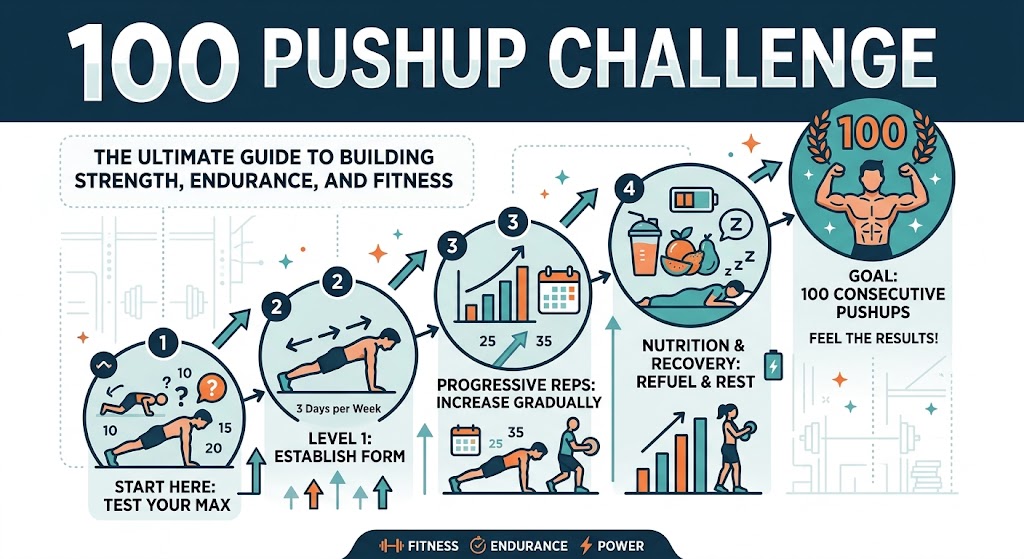
The 100 Pushup Challenge is a progressive bodyweight training program designed to help individuals develop the strength and muscular endurance necessary to perform 100 consecutive pushups.
Rather than attempting 100 pushups immediately, participants gradually increase training volume and repetition capacity over several weeks or months. The challenge typically begins with a maximum-repetition test that establishes a starting point and determines the appropriate training progression.
The ultimate goal is not simply completing 100 pushups throughout a workout. Instead, the objective is to perform 100 pushups in a single uninterrupted set while maintaining proper technique from start to finish.
For example, someone who can currently perform 15 pushups may require 8–12 weeks of structured training before reaching 100 consecutive repetitions.
Basic Rules of the Challenge
Most successful 100 Pushup Challenge programs follow a few fundamental principles:
- Perform pushup workouts 3–5 times per week
- Prioritize proper form over repetition count
- Gradually increase training volume
- Schedule recovery days between intense sessions
- Track workout performance consistently
- Retest maximum pushups every 2–4 weeks
Why Is the 100 Pushup Challenge So Popular?
One reason the 100 Pushup Challenge has become so popular is its simplicity. Unlike many fitness programs, it requires no gym membership, expensive equipment, or complicated workout routines.
Anyone can start with minimal space and a willingness to improve.
Furthermore, bodyweight training continues to gain popularity worldwide. According to fitness trend reports, bodyweight exercises remain among the most widely practiced forms of exercise due to their accessibility and effectiveness.
Source: ACSM, 2025.
Why Does the 100 Pushup Challenge Matter?
The challenge offers far more than just an impressive fitness achievement.
The 100 Pushup Challenge matters because it develops:
- Muscular endurance
- Upper-body strength
- Workout discipline
- Mental resilience
- Consistency and habit formation
Unlike isolation exercises that target a single muscle group, pushups engage multiple muscles simultaneously, making them one of the most efficient bodyweight movements available.
Full-Body Muscle Engagement
Pushups primarily train:
| Muscle Group | Function During Pushups |
|---|---|
| Chest (Pectorals) | Primary pushing force |
| Triceps | Elbow extension |
| Shoulders | Stabilization and pressing |
| Core | Body alignment |
| Glutes | Hip stabilization |
| Lower Back | Postural support |
Pushup progression involves gradually increasing training volume and repetition capacity over time while maintaining proper exercise form.
For example, increasing weekly volume by just 5–10 repetitions can create substantial endurance improvements over several months.
Mental Toughness and Discipline Benefits
One of the most overlooked benefits of the 100 Pushup Challenge is its effect on mental resilience.
Working toward a demanding goal requires consistency, patience, and perseverance. Research suggests that goal-oriented fitness programs improve long-term exercise adherence compared to unstructured training routines.
Source: Journal of Sports Science, 2024.
Benefits of Completing the 100 Pushup Challenge
Successfully completing the 100 Pushup Challenge can produce numerous physical and psychological benefits.
Increased Chest Development
Pushups effectively target the pectoral muscles and can stimulate muscle growth when combined with progressive overload and proper nutrition.
Stronger Triceps
The triceps contribute significantly to every pushup repetition. Higher training volumes often result in noticeable arm development and improved pressing strength.
Improved Shoulder Endurance
Pushups strengthen the anterior deltoids and supporting shoulder stabilizers, helping improve performance in sports and daily activities.
Better Core Stability
Pushups are often thought of as a chest exercise, but every repetition requires substantial core engagement.
Your:
- Abdominals
- Obliques
- Lower back
- Glutes
work together to maintain proper body alignment throughout the movement.
Cardiovascular Conditioning
High-repetition pushup workouts can elevate heart rate significantly, especially when incorporated into circuits or endurance sessions.
This can improve cardiovascular fitness while simultaneously building muscular endurance.
Greater Confidence and Consistency
Few fitness milestones provide the same sense of accomplishment as completing 100 consecutive pushups. Reaching this goal often boosts confidence and reinforces long-term exercise habits.
How Many Pushups Should Beginners Be Able to Do Before Starting?
One of the best aspects of the 100 Pushup Challenge is that almost anyone can begin.
Although performing 5–10 proper pushups provides a useful starting foundation, even complete beginners can participate by using modified pushup variations.
Self-Assessment Test
Perform one set of pushups until technical failure.
Use the table below to determine your starting level:
| Pushups Completed | Fitness Level | Recommended Starting Plan |
|---|---|---|
| 0–5 | Beginner | Incline pushups |
| 6–15 | Novice | Standard progression |
| 16–30 | Intermediate | Accelerated progression |
| 31–50 | Advanced | High-volume training |
| 50+ | Experienced | Endurance specialization |
Setting Realistic Expectations
Most beginners require between 8 and 16 weeks to reach 100 consecutive pushups.
Most beginners can achieve this milestone through:
- Structured training
- Progressive overload
- Adequate recovery
- Consistent practice
For example, someone starting with 10 pushups may reach 50 repetitions within two months before progressing toward 100.
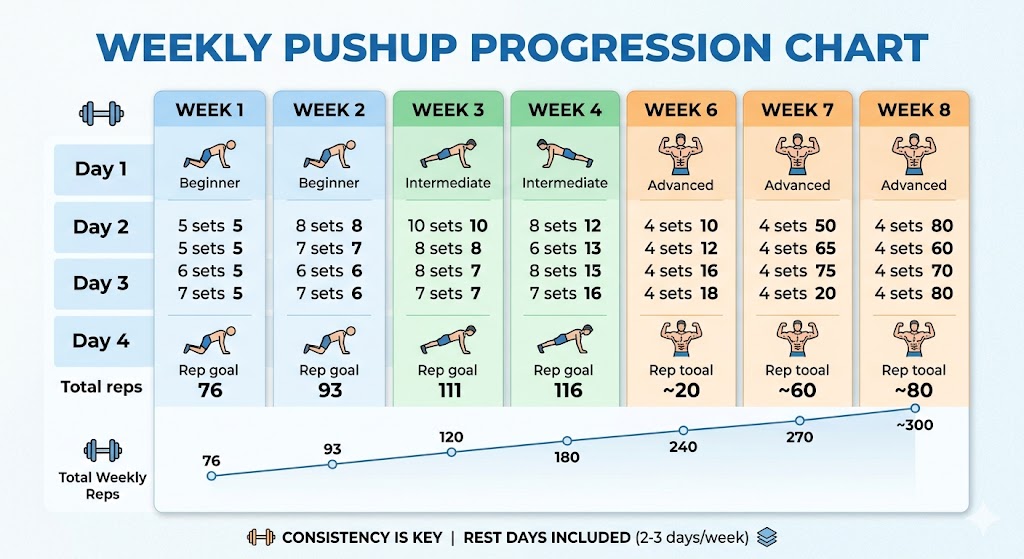
The Best 100 Pushup Challenge Training Plan
A successful 100 Pushup Challenge program balances progressive overload with adequate recovery.
Week 1–2: Foundation Phase
Focus on learning proper technique and establishing consistency.
- 4 sets of 50% of maximum repetitions
- Train 3 days per week
- Rest 60–90 seconds between sets
Week 3–4: Volume Phase
Increase total training volume.
- 5 sets of 60–70% of maximum repetitions
- Train 4 days per week
- Add one maximum-effort set weekly
Week 5–8: Endurance Phase
Begin developing repetition capacity.
Recommended methods include:
- Ladder training
- Pyramid sets
- Extended endurance sets
Example workout:
- Set 1: 20 reps
- Set 2: 25 reps
- Set 3: 30 reps
- Set 4: 25 reps
- Set 5: 20 reps
Week 9–12: Peak Phase
Train specifically for the 100-rep goal.
Include:
- One maximum-repetition test weekly
- High-volume endurance sessions
- Reduced training volume before testing day
Recovery Guidelines for Better Results
Recovery is one of the most important factors in challenge success.
Recovery plays a critical role in pushup performance because muscles adapt and become stronger between training sessions.
Effective recovery strategies include:
- Sleeping 7–9 hours nightly
- Staying hydrated
- Managing training volume
- Taking rest days seriously
- Consuming adequate protein
Research suggests adults should accumulate at least 150 minutes of moderate physical activity weekly for overall health.
Source: World Health Organization, 2025.
full body calisthenics workout
How Long Does It Take to Reach 100 Consecutive Pushups?
The timeline varies based on starting fitness level, training consistency, and recovery quality.
| Fitness Level | Typical Timeline |
|---|---|
| Beginner | 12–24 weeks |
| Intermediate | 8–12 weeks |
| Advanced | 4–8 weeks |
Completing 100 pushups requires a combination of:
- Muscular endurance
- Efficient technique
- Consistent training
- Recovery management
Strength alone is rarely enough.
Can Doing 100 Pushups a Day Build Muscle?
Doing 100 pushups daily can build muscle initially, especially for beginners.
However, muscle growth ultimately depends on:
- Progressive overload
- Training intensity
- Recovery
- Nutrition
According to strength-training research, progressive resistance remains one of the primary drivers of muscular development.
Source: NSCA, 2024.
Benefits of Daily Pushups
- Improved muscular endurance
- Increased training consistency
- Better movement efficiency
- Enhanced upper-body conditioning
Potential Limitations
- Recovery challenges
- Plateau risk
- Overuse injuries
- Limited progression opportunities
Because of these limitations, many coaches recommend structured progression rather than simply performing 100 pushups every day.
Common Mistakes During the 100 Pushup Challenge
Avoiding common mistakes can dramatically improve results.
Poor Pushup Technique
Common form errors include:
- Sagging hips
- Partial repetitions
- Excessive elbow flare
- Forward head posture
Overtraining
Performing maximum-effort pushups daily often leads to accumulated fatigue and slower progress.
Skipping Recovery
Muscles require recovery time to repair and adapt.
Without sufficient rest, performance often declines rather than improves.
Ignoring Mobility Work
Improving shoulder and chest mobility can enhance movement quality and reduce discomfort during training.
Is the 100 Pushup Challenge Safe for Beginners?
Yes, the challenge is generally safe when proper progression and technique are followed.
Beginners should first master:
- Proper pushup mechanics
- Controlled movement
- Full range of motion
Modified variations such as incline pushups and knee pushups can reduce joint stress while building foundational strength.
Safety Tips
- Warm up before every session
- Increase volume gradually
- Stop if pain occurs
- Prioritize recovery
- Focus on proper technique
What Should You Eat While Training for the Challenge?
Nutrition supports recovery, performance, and muscular adaptation throughout the challenge.
Prioritize Protein Intake
Research suggests active individuals often benefit from consuming approximately 1.4–2.0 grams of protein per kilogram of body weight daily.
Source: International Society of Sports Nutrition, 2025.
Nutrition Priorities
- Lean protein sources
- Fruits and vegetables
- Whole grains
- Healthy fats
- Adequate hydration
Sample Foods
- Chicken breast
- Eggs
- Greek yogurt
- Fish
- Lentils
- Oats
- Rice

Different Variations of the 100 Pushup Challenge
The challenge can be adapted for different goals and experience levels.
Beginner Pushup Challenge
Uses incline or knee pushups to build foundational strength.
30 Day Pushup Challenge
Gradually increases daily pushup volume over a month.
100 Pushups a Day Challenge
Focuses on accumulating 100 repetitions daily.
Weighted Pushup Challenge
Adds resistance using a weighted vest or backpack.
Military-Style Pushup Challenge
Combines pushups with running, conditioning, and bodyweight circuits.
Best Tools and Apps to Track Progress
Tracking progress improves accountability and motivation.
Recommended Tracking Methods
- Fitness journals
- Workout spreadsheets
- Mobile fitness apps
- Smartwatch activity logs
Helpful Apps
- Strong
- Hevy
- FitNotes
- Google Fit
Metrics to Track
Monitor:
- Maximum consecutive pushups
- Weekly training volume
- Body measurements
- Workout consistency
What Results Can You Expect From the 100 Pushup Challenge?
Consistent training often produces noticeable improvements in both performance and fitness.
Strength Gains
Most participants notice strength improvements within 4–8 weeks.
Endurance Improvements
Pushup capacity frequently doubles or even triples during the first few months of structured training.
Body Composition Changes
When paired with proper nutrition and overall calorie management, pushups can contribute to fat loss and muscle development.
Expected Timeline
| Timeframe | Typical Results |
|---|---|
| 2 Weeks | Improved technique |
| 4 Weeks | Better endurance |
| 8 Weeks | Noticeable strength gains |
| 12 Weeks | Significant repetition increases |
| 16+ Weeks | Potential 100-pushup milestone |
What Should You Do After Completing 100 Pushups?
Reaching 100 pushups is an outstanding achievement, but it should serve as a stepping stone toward even greater fitness goals.
Progress to Advanced Pushup Variations
Examples include:
- Diamond pushups
- Archer pushups
- Decline pushups
- Explosive pushups
- One-arm pushup progressions
Add Full-Body Training
Create a more balanced program by incorporating:
- Squats
- Pull-ups
- Lunges
- Core exercises
Follow a Calisthenics Roadmap
Structured progression helps prevent plateaus and promotes long-term development.
calisthenics progression roadmap
A well-designed 100 Pushup Challenge program balances training intensity, recovery time, and gradual progression to reduce injury risk while improving results.
Conclusion
The 100 Pushup Challenge is one of the most rewarding bodyweight fitness goals you can pursue. It builds strength, muscular endurance, discipline, confidence, and consistency while requiring little more than your body weight and commitment.
By following a structured progression plan, focusing on proper technique, prioritizing recovery, and maintaining consistent training habits, you can steadily work toward performing 100 consecutive pushups with confidence.
Remember that success isn’t about perfection. It’s about showing up, improving gradually, and trusting the process. Whether your goal is better health, improved athletic performance, or proving to yourself that you can accomplish something difficult, the journey toward 100 pushups can be transformative.
FAQs
What is the 100 Pushup Challenge?
The 100 Pushup Challenge is a progressive bodyweight fitness program designed to help individuals develop the strength and muscular endurance required to perform 100 consecutive pushups with proper form.
How long does it take to reach 100 pushups?
Most people reach 100 consecutive pushups within 8 to 24 weeks depending on their starting fitness level, consistency, recovery habits, and training program.
Can beginners do the 100 Pushup Challenge?
Yes. Beginners can start with incline pushups, knee pushups, or low-repetition training and gradually increase volume over time.
Will doing 100 pushups a day build muscle?
Doing 100 pushups a day can build muscle initially, especially for beginners. However, long-term muscle growth requires progressive overload, proper nutrition, and adequate recovery.
What muscles do pushups work?
Pushups primarily target the chest, shoulders, triceps, and core while also engaging stabilizing muscles throughout the body.
Is the 100 Pushup Challenge good for weight loss?
The challenge can support weight loss by increasing physical activity and calorie expenditure, especially when combined with a healthy diet and full-body exercise program.
What should I do after completing 100 pushups?
After reaching 100 pushups, consider progressing to advanced pushup variations, weighted pushups, or a full-body calisthenics program to continue improving strength and fitness.