
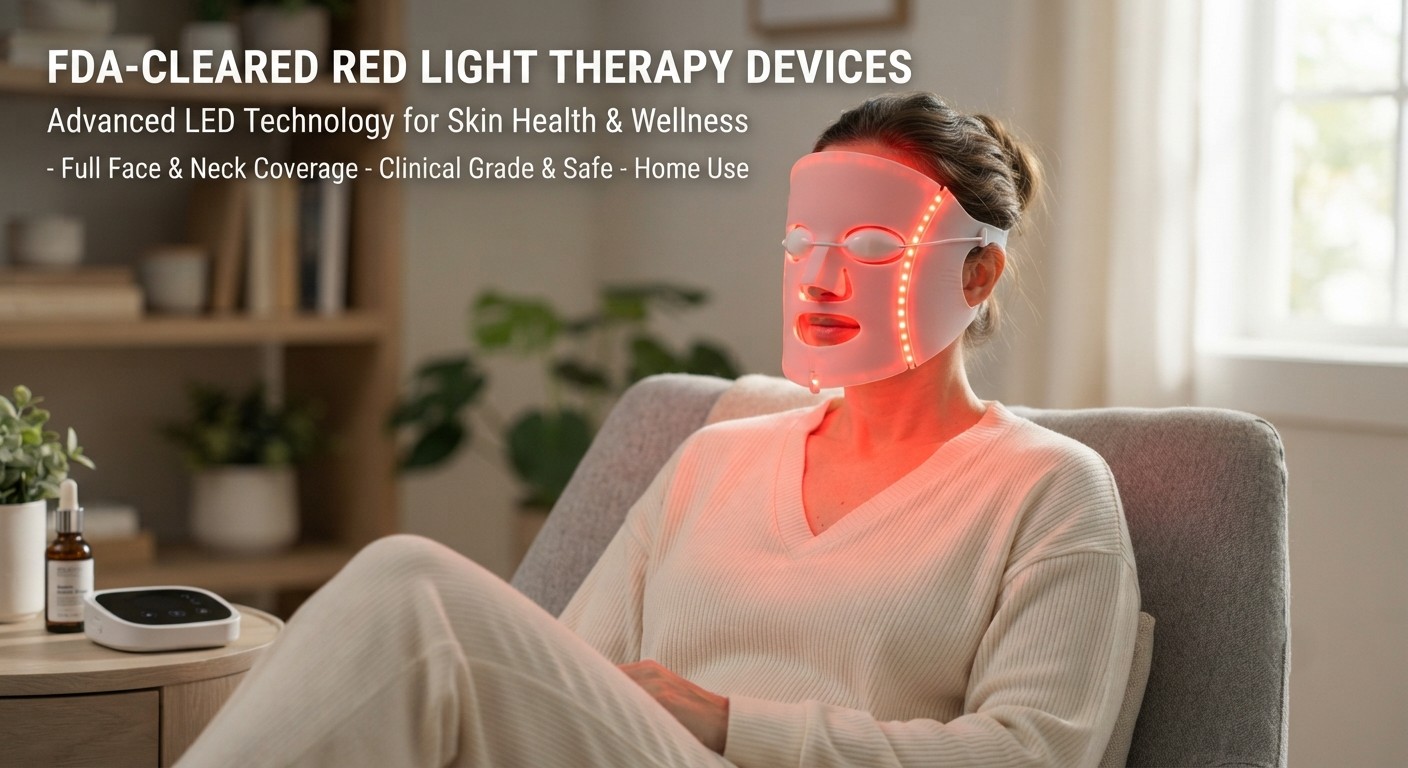
Plenty of red light masks, caps, and panels carry an “FDA-cleared” label, yet the label says less than most shoppers assume. It confirms the FDA reviewed the device for a specific use and considers it low risk, and it says nothing about how well the device works. This guide covers what clearance includes, how to verify it in the FDA’s own database, and how to match a device to your goal.
What are FDA-cleared red light therapy devices?
FDA-cleared red light therapy devices are LED or low-level laser products that completed the FDA’s 510(k) premarket notification process for a specific, stated use. To earn clearance, a manufacturer must show the device is substantially equivalent to a legally marketed device, which includes having the same intended use (Source: U.S. Food and Drug Administration).
The treatment itself is called photobiomodulation. Red light spans roughly 620 to 700 nm, and near-infrared spans roughly 700 to 1,440 nm (Source: Hernández-Bule et al., 2024).
Words on a product box can mean very different things, so it helps to see them side by side:
| Term on the box | What it means | Has the FDA reviewed this specific device? |
|---|---|---|
| FDA cleared (510(k)) | The device was found substantially equivalent to a legally marketed device for stated uses | Yes |
| FDA approved | Premarket approval, the route for life-sustaining devices or those with a potential unreasonable risk of illness or injury | Yes |
| FDA registered | A company or facility is registered with the FDA | No |
| FDA certified | A phrase the FDA warns may be used to mislead | No |
For red light products, the American Academy of Dermatology says phrases like “FDA approved” and “FDA certified” carry no meaning, because the FDA clears these devices.
Best red light therapy devices
Why does FDA clearance matter when you buy a device?
Clearance tells you the FDA reviewed the device for a defined use and considers it low risk, which is more than an unreviewed product can claim. It still leaves several questions open.
- The AAD says an FDA-cleared device is considered to pose a low risk to the public.
- A cleared device has a name and number you can look up in an FDA database.
- Clearance helps you screen out listings that lean on “FDA registered” or “FDA certified” wording, which the FDA says may mislead buyers.
- Clearance does not measure effectiveness. The AAD states that it says nothing about how well a device works.
Many people also buy these devices for muscle recovery. Before taking that claim at face value, check whether the device’s cleared indications actually mention it.
Heat Therapy for Muscle Recovery
Which conditions are FDA-cleared red light devices used for?
The best-documented cleared at-home uses are signs of skin aging and hair regrowth in hereditary hair loss, and each device is cleared only for the uses written in its paperwork.
- Wrinkles and other signs of skin aging: the AAD notes that study results led the FDA to clear several at-home red light devices for this purpose (Source: American Academy of Dermatology, 2024).
- Hair regrowth in androgenetic alopecia (hereditary hair loss): FDA-cleared caps, combs, and helmets are on the market (Source: American Academy of Dermatology, 2024).
- Acne: some multi-color devices are cleared for mild to moderate inflammatory acne using blue light. One over-the-counter LED device in the FDA’s records lists red light for wrinkles and blue light for acne.
That last example shows why the indications matter. A single device can carry several light colors, and each color can be cleared for a different job.
How well do FDA-cleared red light devices work?
They produce subtle to noticeable results for some people, but the evidence on at-home devices is thin and outcomes vary.
- Studies suggest red light LED devices can improve fine lines, dark spots, rough-feeling skin, redness, and loose skin (Source: American Academy of Dermatology, 2024).
- In one study of 90 patients who had eight LED red light treatments over four weeks, more than 90% said they noticed some improvement (Source: American Academy of Dermatology, 2024).
- For hereditary hair loss, large randomized controlled trials found some regrowth, with increased hair thickness and length. It will not bring back a full head of hair (Source: American Academy of Dermatology, 2024).
- A systematic review of LED treatments for skin conditions identified 31 randomized controlled trials (Source: Lasers in Surgery and Medicine, 2018).
Comparing results is hard. Researchers study different devices, for different lengths of time, to answer different questions, and standardized treatment recommendations are still missing (Source: American Academy of Dermatology, 2024; Hernández-Bule et al., 2024). In-office devices are also more powerful than the ones sold for home use.
How do you check that a device is really FDA-cleared?
Search the FDA’s Devices@FDA database by device or company name, then compare the entry with the product you plan to buy.
- Look for “FDA cleared” or “FDA 510(k) cleared” on the packaging or product page.
- Search Devices@FDA, the FDA’s catalog of cleared and approved devices, using the device name or the company name.
- Open the entry and note the 510(k) number and the indications for use.
- Confirm that the model on your box matches the model in the entry.
- Compare the uses printed in the entry with the claims on the box. If the marketing promises more than the clearance covers, ask the seller why.
- Treat “FDA registered” or “FDA certified” as a reason to keep checking, because neither means the FDA cleared the device.
What should you look for when choosing a device?
Pick a device cleared for the concern you want to treat, then check the practical details like eye protection and usage instructions. The AAD advises choosing a device made for what you want to treat, so a hair-loss cap and a wrinkle mask are not interchangeable (Source: American Academy of Dermatology, 2024).
| Device type | Common use | What to check on the listing |
|---|---|---|
| Face mask | Wrinkles and other signs of skin aging | Cleared indication for your concern, and whether eye shields are included |
| Wand | Targeted skin areas | Cleared indication that matches the area you want to treat |
| Panel | Skin concerns | Cleared indication, and the maker’s distance and session instructions |
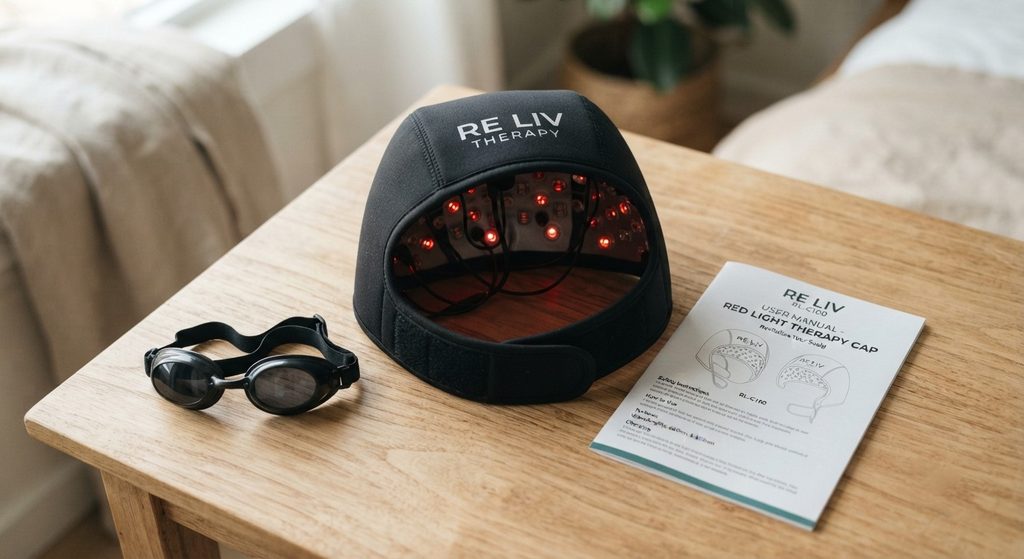
| Cap, comb, or helmet | Hereditary hair loss | Cleared specifically for hair regrowth |
A few more points to weigh:
- Price: at-home devices often cost from about $100 to more than $1,000 (Source: American Academy of Dermatology, 2024).
- Wavelength information: reputable listings state the wavelengths they use, usually within the red or near-infrared ranges above.
- Instructions: look for clear directions on session length and how often to use the device.
Is red light therapy safe, and who should be careful?
In the short term it appears safe, and the most common side effects are mild, such as temporary pain or irritated skin. Some groups should be more careful.
- Cancer risk: unlike UV light, research has not found that red light causes any type of cancer.
- Long-term effects: they are not known yet, so more research is needed.
- Light-sensitive conditions: a condition such as lupus can worsen with red light exposure.
- Medications: drugs that raise your skin’s light sensitivity may make red light a poor fit.
- Darker skin tones: skin that is more sensitive to visible light can develop hyperpigmentation, and the dark spots can last longer than those caused by sunlight. Talk with a dermatologist before using a home device.
- Eyes: wear the eye protection the directions call for, and do not swap in sunglasses for protective goggles.
The AAD recommends seeing a board-certified dermatologist before starting at home. The exam can show whether a device is likely to help or could worsen an existing problem.
How do you use an FDA-cleared device at home?
Follow the manufacturer’s directions exactly and use the device regularly, because results build slowly and not everyone sees them (Source: American Academy of Dermatology, 2024).
- Read the indications and instructions before the first session.
- Use the session length and schedule printed in the directions. They vary from device to device.
- Put on the recommended eye protection every time.
- Take baseline photos in the same lighting and compare them monthly, so you can judge progress honestly.
- Stop and contact a clinician if irritation or pain persists.
If your main goal is training recovery, remember that the best-documented cleared uses are skin and hair. Compare any device with the rest of your routine.
Conclusion
FDA clearance tells you a red light therapy device went through the 510(k) process for a stated use and is considered low risk. It does not prove the device works, and “FDA approved,” “registered,” and “certified” are different claims or no claim at all. Before you buy, look the device up in Devices@FDA, read its indications, and make sure they match your goal. If you have darker skin, a light-sensitive condition, or take medication that raises light sensitivity, see a dermatologist first.
FAQs
Are there FDA-approved red light therapy devices?
Not in the way most shoppers mean it. The FDA clears these devices through the 510(k) process rather than approving them, and the AAD says “FDA approved” carries no meaning for red light products.
What does “FDA 510(k) cleared” mean?
It means the manufacturer showed the FDA that the device is substantially equivalent to a legally marketed device with the same intended use, and the FDA agreed.
Is “FDA registered” the same as FDA cleared?
No. The FDA states that registration is not the same as approval, clearance, or authorization, and it warns that words like “FDA registered” and “FDA certified” may be used to mislead.
Does FDA clearance prove a red light device works?
No. The AAD says clearance does not show how effective a device is. It means the FDA considers the device low risk.
How often should I use a cleared red light device?
Follow the schedule in the manufacturer’s directions, since session length and frequency differ by device. The AAD notes that results need regular use and take time.
Is red light therapy safe for darker skin tones?
Talk with a dermatologist first. The AAD reports that darker skin is more sensitive to visible light, and the resulting dark spots can be more intense and longer-lasting than those from sunlight.
Do I need eye protection?
Yes, whenever the directions call for it, and use the type the maker recommends. The AAD says sunglasses are not a substitute for protective goggles.
Sources
- American Academy of Dermatology. (2024). Is red light therapy right for your skin?
- U.S. Food and Drug Administration. Are There “FDA Registered” or “FDA Certified” Medical Devices? How Do I Know What Is FDA Approved?
- U.S. Food and Drug Administration. Premarket Notification 510(k).
- U.S. Food and Drug Administration. 510(k) K253086: LED Light Therapy Device (Models SG-FM, SG-FE), Indications for Use.
- Hernández-Bule, M. L., Naharro-Rodríguez, J., Bacci, S., & Fernández-Guarino, M. (2024). Unlocking the Power of Light on the Skin: A Comprehensive Review on Photobiomodulation. International Journal of Molecular Sciences.
- Lasers in Surgery and Medicine. (2018). Light-emitting diodes in dermatology: A systematic review of randomized controlled trials.
Disclaimer: This article is for informational and educational purposes only and is not a substitute for personalized medical advice. Consult a qualified healthcare professional before making significant changes to your diet, exercise routine, or supplement use.