
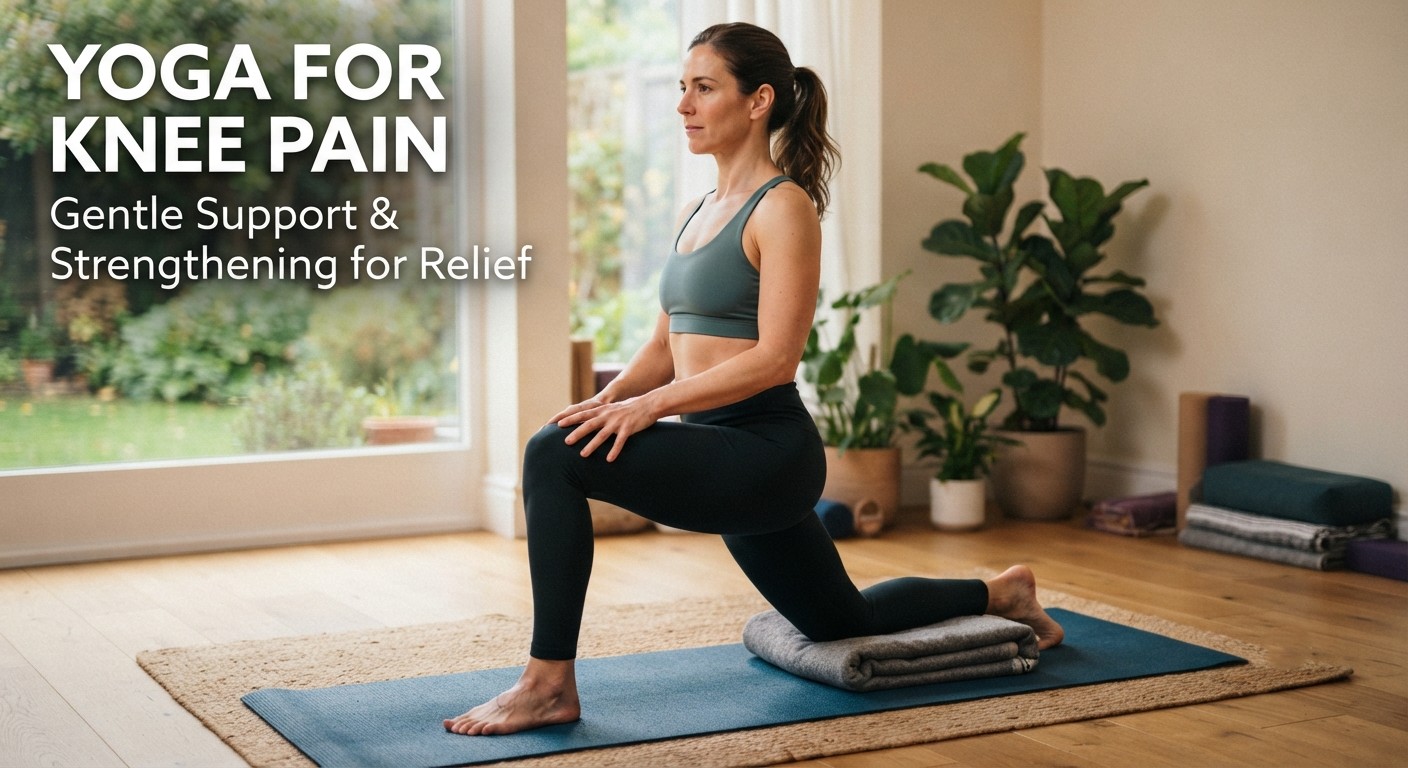
Sore knees make most exercise feel risky, and yoga can seem like the riskiest of all with its deep bends and floor work. With shallow poses, props, and a slow pace, though, yoga can build strength and mobility around the joint without pounding it. This guide covers which poses to try, which to skip, and what studies show so far.
What is yoga for knee pain?
Yoga for knee pain is a gentler, modified approach to yoga that uses controlled movement, supported poses, and slow breathing to ease stiffness and strengthen the muscles around the knee. People use it for knee osteoarthritis and for general soreness that builds up after long days of sitting or past activity.
A typical session looks like this:
- Standing and reclined poses held for short periods, with a small range of motion
- Props such as blocks, straps, bolsters, and folded blankets to take pressure off the joint
- Slow breathing and regular check-ins on how the knee feels
- Chair versions for days when floor work is uncomfortable
New to the practice? Start with Iyengar Yoga for Beginners and try a seated routine such as chair yoga.
Why does yoga for knee pain matter?
Yoga for knee pain matters because staying active is one of the most widely recommended ways to manage joint pain, and many people stop moving once their knees start to hurt. The CDC says physical activity can reduce joint pain and improve function and mood in people with arthritis, and it advises against inactivity.
Yoga fits that advice in a few ways:
- It moves the joint gently, with no jumping or pounding
- It combines postures, breathing, and mindfulness, which researchers suggest may ease pain through better flexibility, lower stress, and more body awareness
- It can sit alongside other exercise. The CDC recommends that adults, including those with arthritis, aim for at least 150 minutes of moderate aerobic activity a week plus muscle strengthening on at least two days
Body weight also changes how much load the knees carry, so some people pair yoga with a weight management plan. A BMI calculator can give you a quick starting reference.
What does the research say about yoga for knee pain?
Research suggests yoga may reduce knee osteoarthritis pain and improve function, but the overall evidence is still low in quality. Here is what the main studies found:
- A 2025 randomized trial followed 117 adults aged 40 and over with knee osteoarthritis. Yoga and a strengthening program each ran for 12 weeks, and both groups reported less knee pain, with no significant difference between them. The authors described yoga as noninferior to strengthening exercise. (Source: JAMA Network Open, 2025)
- By 24 weeks, the yoga group showed modestly larger gains in function, stiffness, and walking speed, though the authors say those secondary results should be treated as exploratory.
- No serious adverse events occurred. Program-related side effects were more common in the yoga group (about 16% vs 7%), which the authors partly link to unfamiliar poses.
- A 2019 meta-analysis found yoga may improve pain, function, and stiffness in knee osteoarthritis. The included studies were low in quality, so the authors could support only a weak recommendation.
- A 2016 review of six studies and 372 patients found possible pain and mobility benefits that showed up within about two weeks. Programs usually ran 40 to 90 minutes per session for at least eight weeks. (Source: Evidence-Based Complementary and Alternative Medicine, 2016)
The 2025 trial used a program built for people with arthritis and led by trained instructors, so its results may not apply to a general drop-in class.
Best yoga poses for knee pain
The best yoga poses for knee pain are standing, seated, and reclined poses that work the thighs and hips or stretch the hamstrings without deep knee bending. Use this table as a starting menu:
| Pose | What it works | Knee-friendly adjustment |
|---|---|---|
| Mountain pose (Tadasana) | Posture and thigh engagement | Keep a soft bend in the knees so they never lock |
| Supported bridge pose (Setu Bandhasana) | Glutes, hamstrings, low back | Rest the hips on a block and keep knees over ankles |
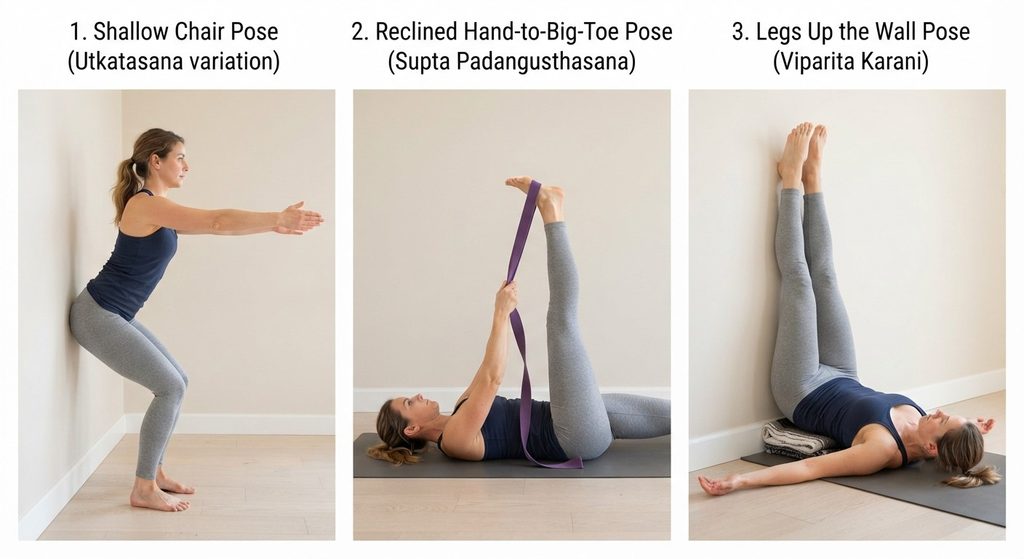
| Shallow chair pose (Utkatasana) | Thighs and glutes | Bend only to a pain-free depth and stay near a wall |
| Warrior II with a short stance (Virabhadrasana II) | Thighs, hips, balance | Keep the front knee over the ankle and in line with the second toe |
| Reclined hand-to-big-toe pose (Supta Padangusthasana) | Hamstring flexibility | Loop a strap around the foot and keep the knee soft |
| Reclined figure-four stretch | Hips and outer glutes | Keep the bottom foot on the floor and flex the top foot |
| Legs up the wall (Viparita Karani) | Gentle release for tired legs | Slide the hips away from the wall so the knees stay relaxed |
Tight hamstrings often pull on the knee, so regular hamstring stretches pair well with the reclined poses above. For the thigh and hip strength that supports the joint, add leg workouts for beginners on non-yoga days.
How to do supported bridge pose
- Lie on your back with knees bent and feet flat, hip-width apart.
- Press into your feet and lift your hips a few inches.
- Slide a yoga block under your sacrum, the flat bone at the base of your spine, on its low or medium height.
- Keep your knees stacked over your ankles and pointing straight ahead.
- Breathe slowly for 5 to 8 breaths, then lower your hips to the floor.
How to do shallow chair pose
- Stand with your back a few inches from a wall and your feet hip-width apart.
- Send your hips back as if sitting into a chair.
- Bend your knees only as far as feels comfortable. A small bend is enough.
- Keep your knees in line with your toes and rest your hands on your thighs.
- Hold for 3 to 5 breaths, then press through your feet to stand tall.
Which yoga poses should you avoid with knee pain?
Poses that bend the knee deeply, twist it under load, or put weight directly on the kneecap are the ones to modify or skip first. Common examples:
- Hero pose (Virasana) and other deep kneeling poses: sit on a block or bolster, or skip them
- Full squat (Malasana): place a block under the hips so the knees open without a deep fold
- Lotus and half lotus: these can twist the knee when the hips are tight, so choose an easy cross-legged seat with cushions under the knees
- Upright pigeon pose: lie on your back for the reclined version instead
- Kneeling lunges: pad the knee with a folded blanket or switch to a standing lunge
- Full child’s pose: rest your torso on a bolster and tuck a rolled blanket behind the knees
Which poses cause trouble depends on what is behind the pain, so let your own response guide you. Sharp or stabbing pain is a signal to stop. If tight hips are limiting your poses, Hip Opening Yoga can help you work on them separately.
How to practice yoga with knee pain safely
Safe practice with knee pain starts with a medical check, a short warm-up, and props that reduce pressure on the joint. Keep these points in mind:
- Talk to a doctor or physical therapist first, especially after an injury or surgery. The CDC notes that people with arthritis may benefit from seeing a physical therapist when they begin exercising. (Source: CDC, 2024)
- Warm up with 3 to 5 minutes of easy walking or gentle ankle and hip circles.
- Keep a soft bend in standing poses so the knees never lock.
- In lunges and warrior poses, keep the knee over the ankle and lined up with the second toe.
- Start with 10 to 15 minutes, two or three times a week. The 2025 trial used three sessions a week. (Source: JAMA Network Open, 2025)
- Expect some stiffness early on. The CDC says mild pain, stiffness, or swelling after starting a new routine is normal, but joint pain should ease over time, and if it does not, contact your health care provider. (Source: CDC, 2024)
Props do much of the work here. A pair of blocks, a strap, a bolster, and a folded blanket cover most modifications, and the right yoga blocks, straps, and bolsters make poses easier to hold with good alignment.

After a session, some people add easy recovery work for the thighs and calves, such as foam rolling for recovery. Keep the roller off the knee joint itself.
Which type of yoga is best for sore knees?
Gentle, slower styles such as chair yoga, restorative yoga, and Iyengar yoga usually suit sore knees best because they allow props and long pauses. A quick comparison:
- Chair yoga: seated or supported poses, useful during flare-ups or when balance is a concern
- Restorative yoga: long holds on bolsters and blankets with very little muscular effort
- Iyengar yoga: precise alignment and heavy use of props, and it has been used in knee osteoarthritis research (Source: Evidence-Based Complementary and Alternative Medicine, 2016)
- Gentle hatha: basic poses at a slow pace
- Fast vinyasa or hot yoga: more transitions and repeated deep lunges, so approach with caution and modify
Look for an instructor who has experience adapting poses for arthritis or past injuries, and tell them about your knees before class starts.
What else helps sore knees besides yoga?
Regular low-impact activity and leg strength work help sore knees alongside yoga. The CDC lists brisk walking, cycling, swimming, tai chi, and dancing as joint-friendly options. (Source: CDC, 2024)
- low-impact cardio workouts for steady aerobic activity
- knee strengthening exercises for the muscles that support the joint
When should you see a doctor about knee pain?
See a healthcare professional if knee pain follows an injury, keeps getting worse, or comes with swelling, warmth, or instability. These signs call for prompt attention:
- Sudden swelling, redness, warmth, or fever
- A knee that locks, catches, or gives way
- Trouble putting weight on the leg
- Pain at night or at rest that keeps increasing
- Joint pain that does not ease as you stay active
Yoga does not replace a diagnosis, so get new or unexplained knee pain checked before you build a routine around it.
Conclusion
Yoga can be a reasonable low-impact option for sore knees when the poses are shallow, supported, and paced slowly. A 2025 randomized trial found it comparable to a strengthening program for knee osteoarthritis pain over 12 weeks, though the wider evidence base is still small and uneven. Start with two or three short sessions a week, keep props within reach, and check with your doctor or physical therapist first. Try supported bridge and shallow chair pose this week, then add one new pose at a time.
FAQs
Is yoga good for knee pain?
Yoga may help some people with knee pain, especially knee osteoarthritis. A 2025 trial found it comparable to strengthening exercise over 12 weeks, though overall evidence quality is still limited.
What is the best yoga pose for knee pain?
No single pose is best for everyone. Supported bridge pose and the reclined hand-to-big-toe pose with a strap are common starting points because they work the legs without bearing weight through the knee.
Can yoga make knee pain worse?
Yes, if poses involve deep knee bends, twisting under load, or pressure on the kneecap. In the 2025 trial, aggravated knee pain was reported in both the yoga and strengthening groups.
How often should I do yoga for knee pain?
Start with two or three short sessions a week and build up gradually. The 2025 trial used three sessions a week, two supervised and one at home.
Is yoga safe for knee arthritis?
Yoga is generally considered low risk when it is adapted for arthritis. The 2025 trial reported no serious adverse events, but mild program-related issues were more common in the yoga group, so go slowly and use props.
Should I do yoga when my knee is swollen or injured?
Get the knee assessed first. Swelling after an injury needs medical evaluation, and a healthcare professional can tell you when and how to return to movement.
Sources
- Abafita, B. J., et al. (2025). Yoga or Strengthening Exercise for Knee Osteoarthritis: A Randomized Clinical Trial. JAMA Network Open.
- Lauche, R., Hunter, D. J., Adams, J., & Cramer, H. (2019). Yoga for Osteoarthritis: A Systematic Review and Meta-analysis. Current Rheumatology Reports.
- Kan, L., Zhang, J., Yang, Y., & Wang, P. (2016). The Effects of Yoga on Pain, Mobility, and Quality of Life in Patients with Knee Osteoarthritis: A Systematic Review. Evidence-Based Complementary and Alternative Medicine.
- Centers for Disease Control and Prevention. (2024). About Physical Activity and Arthritis.
Disclaimer: This article is for informational and educational purposes only and is not a substitute for personalized medical advice. Consult a qualified healthcare professional before making significant changes to your diet, exercise routine, or supplement use.