
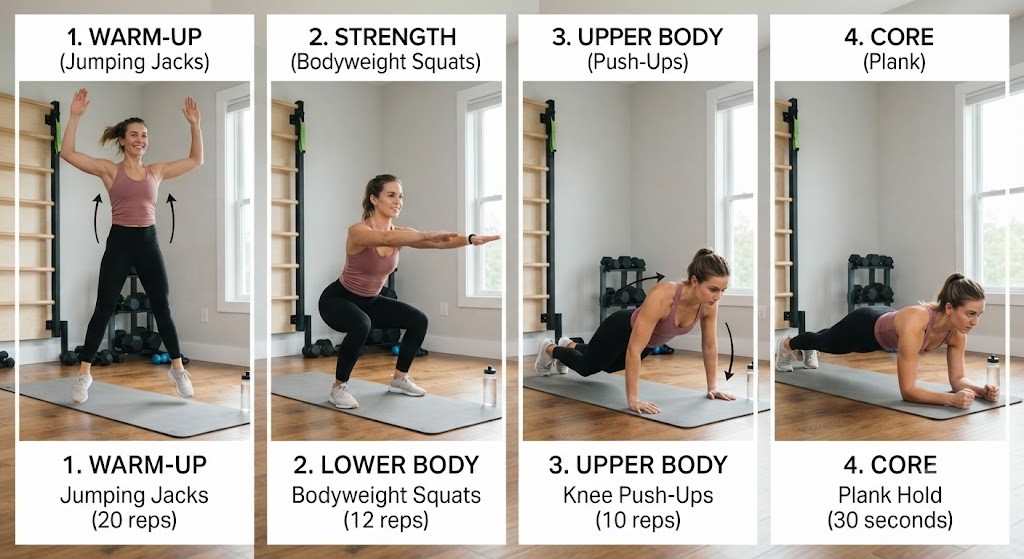
Starting a fitness journey can feel intimidating, especially when social media is filled with advanced workout routines and complicated training methods. The good news is that you don’t need expensive equipment or years of experience to get stronger and healthier. A well-planned full body workout for beginners focuses on simple, effective exercises that train your entire body while helping you develop proper technique and confidence.
Unlike advanced workout splits that target one or two muscle groups each day, a beginner full body workout trains every major muscle group in a single session. This approach helps you learn movement patterns faster, improves overall strength, and fits easily into a busy schedule. Whether your goal is to build muscle, lose weight, improve fitness, or simply feel healthier, this type of routine provides an excellent foundation.
In this guide, you’ll learn what a full body workout for beginners is, why it’s the best choice for new exercisers, its benefits, and how to prepare your body before each workout. You’ll also discover why consistency matters more than perfection during your first few months of training.
What Is a Full Body Workout for Beginners?
A full body workout for beginners is a training routine that works all the major muscle groups during a single workout session using simple, foundational exercises.
Instead of dedicating one day to chest, another to legs, and another to back, a full body workout includes movements that strengthen your legs, chest, shoulders, back, arms, and core in one session. This balanced approach allows beginners to practice important movement patterns several times each week without overwhelming the body.
For example, a beginner workout might include:
- Squats for the legs
- Push-ups for the chest and arms
- Rows for the upper back
- Glute bridges for the hips
- Planks for the core
By repeating these exercises two or three times per week, beginners improve technique, build strength, and create healthy exercise habits.
According to the World Health Organization (WHO, 2020), adults should perform muscle-strengthening activities involving all major muscle groups at least two days each week alongside regular physical activity.
Statistic: Adults should perform muscle-strengthening activities involving major muscle groups at least twice weekly. — Source: World Health Organization, 2020
Why Is a Full Body Workout Better Than a Split Routine for Beginners?
For beginners, a full body workout is generally more effective than a traditional split routine because it promotes faster learning, balanced muscle development, and easier recovery.
When you’re just starting, your nervous system is learning how to perform exercises correctly. Practicing movements multiple times each week helps improve coordination much faster than training each muscle group only once every seven days.
Split routines are designed primarily for experienced lifters who already have a solid strength base and need higher training volume for specific muscles. Beginners simply don’t require that level of specialization.
Benefits of Choosing Full Body Training
- Faster strength improvements
- Better movement coordination
- More calories burned per session
- Easier weekly scheduling
- Balanced muscle development
- Lower risk of overtraining
- More efficient workouts
Since each workout trains your whole body, missing one session won’t significantly affect your progress compared to missing a leg day or chest day in a split program.
For readers wanting to continue their fitness journey, see our beginner strength training.
Why Does a Full Body Workout Matter?
A beginner’s first workout program lays the foundation for long-term fitness success. Learning proper movement patterns early reduces injury risk and makes future training much easier.
Many people quit exercising because they choose complicated programs that demand six workouts each week. A full body routine removes that obstacle by providing maximum results with minimal complexity.
The American College of Sports Medicine (ACSM) consistently recommends resistance training as one of the most effective ways to improve overall health, maintain muscle mass, increase strength, and enhance functional fitness.
Builds Foundational Strength
Foundational strength refers to your ability to perform basic movement patterns safely and efficiently during everyday life.
Exercises such as squats, lunges, push-ups, rows, and glute bridges strengthen multiple muscles simultaneously. These compound movements improve overall body function instead of isolating a single muscle.
For example, bodyweight squats strengthen:
- Quadriceps
- Hamstrings
- Glutes
- Core muscles
This strength carries over into daily activities like climbing stairs, lifting groceries, carrying children, or standing for long periods.
Burns Calories Efficiently
Full body workouts engage several muscle groups at the same time, meaning your body uses more energy throughout the workout.
Because compound exercises recruit larger muscle groups, they naturally burn more calories than isolation exercises such as bicep curls or leg extensions.
When combined with a balanced diet, full body training can support fat loss while preserving lean muscle tissue.
Statistic: Adults who combine resistance training with regular physical activity improve body composition and overall health more effectively than exercise alone. — Source: American College of Sports Medicine, 2024
Saves Time
One of the biggest advantages of a full body workout for beginners is efficiency.
Instead of spending an hour in the gym six days every week, beginners can complete three quality workouts lasting around 30–45 minutes.
This schedule works well for:
- Students
- Office workers
- Busy parents
- Remote workers
- Anyone with limited free time
Short, consistent workouts are much easier to maintain than long, complicated exercise programs.
Encourages Long-Term Consistency
Consistency is far more important than intensity when you’re starting your fitness journey.
Many beginners make the mistake of training every day with high intensity before eventually burning out. A realistic schedule allows your body to recover while helping you stay motivated.
Completing three effective workouts every week for six months produces far better results than following an overly difficult routine for only two weeks.
Remember, fitness is a long-term lifestyle rather than a short-term challenge.
What Are the Benefits of Full Body Training?
A beginner full body workout provides numerous physical and mental benefits that extend beyond building muscle.
Because each session trains multiple muscles together, your body learns how to move more naturally and efficiently.
Major Benefits of Full Body Workouts
| Benefit | How It Helps Beginners |
|---|---|
| Muscle Development | Builds balanced strength across the entire body |
| Fat Loss Support | Burns more calories through compound movements |
| Better Posture | Strengthens back, shoulders, and core |
| Improved Endurance | Increases stamina gradually |
| Functional Strength | Makes daily tasks easier |
| Better Coordination | Improves movement efficiency and balance |
| Increased Confidence | Builds exercise skills and motivation |
| Time Efficiency | Delivers maximum results in fewer sessions |
Over time, these benefits improve overall health while reducing the risk of injuries caused by weak muscles or poor posture.
Can Beginners Build Muscle With Full Body Training?
Absolutely.
Beginners often experience rapid improvements in both strength and muscle size because their muscles respond quickly to resistance training. This period is commonly known as “newbie gains.”
During the first few months, even simple exercises can produce noticeable progress when performed consistently.
A beginner can build muscle by performing:
- Bodyweight squats
- Push-ups
- Glute bridges
- Resistance band rows
- Planks
Training two to three times each week while gradually increasing repetitions or resistance is usually enough to stimulate muscle growth.
Statistic: Most adults can significantly improve muscular strength within 8–12 weeks of consistent resistance training. — Source: National Strength and Conditioning Association (NSCA), 2023
Why Compound Exercises Are Best for Beginners
Compound exercises involve multiple joints and muscle groups working together.
Instead of isolating one muscle, these exercises teach your entire body to move efficiently.
Popular compound exercises include:
- Squats
- Push-ups
- Lunges
- Rows
- Planks
Advantages of Compound Movements
- Build strength faster
- Improve coordination
- Burn more calories
- Save workout time
- Increase balance and stability
- Prepare you for advanced exercises later
Learning these movements first creates a strong foundation before progressing to heavier weights or more advanced training methods.
How Should Beginners Warm Up Before a Full Body Workout?
A proper warm-up prepares your muscles, joints, and cardiovascular system for exercise. Skipping this step can increase stiffness, reduce performance, and raise the risk of injury.
Spend 5–10 minutes warming up before every workout to increase blood flow, activate muscles, and improve mobility.
Beginner Warm-Up Checklist
- Walk in place or perform light jogging for 2–3 minutes.
- Complete arm circles to loosen the shoulders.
- Perform hip circles to improve mobility.
- Do bodyweight squats to activate the lower body.
- Practice gentle lunges to prepare the legs.
- Finish with light dynamic stretches for the entire body.
A good warm-up helps you move more comfortably during your workout while improving exercise technique.
Step-by-Step Beginner Full Body Workout Routine
A full body workout for beginners should focus on simple compound exercises that strengthen every major muscle group while allowing enough recovery between sessions. Perform this workout 2–3 times per week on non-consecutive days, resting 45–90 seconds between sets.
| Exercise | Sets | Reps | Rest |
|---|---|---|---|
| Bodyweight Squats | 2–3 | 10–15 | 60 sec |
| Knee Push-Ups or Push-Ups | 2–3 | 8–12 | 60 sec |
| Glute Bridges | 2–3 | 12–15 | 45 sec |
| Bird Dog | 2 | 10 each side | 45 sec |
| Standing Lunges | 2 | 10 each leg | 60 sec |
| Dumbbell or Resistance Band Rows | 2–3 | 10–12 | 60 sec |
| Plank | 2 | 20–40 sec | 45 sec |
| Superman | 2 | 10–12 | 45 sec |
| Jumping Jacks | 2 | 30 sec | 30 sec |
Estimated workout time: 30–45 minutes
Statistic: Adults should perform at least 150 minutes of moderate physical activity and two muscle-strengthening sessions each week. — Source: World Health Organization, 2020
Bodyweight Squats
Bodyweight squats are one of the best lower-body exercises for beginners. They strengthen the quadriceps, hamstrings, glutes, and core while improving balance and mobility.
Stand with your feet shoulder-width apart, keep your chest up, and lower your hips until your thighs are nearly parallel to the floor. Push through your heels to return to the starting position.
Beginner Tip: Hold onto a chair or sturdy surface if you need extra balance.
Knee Push-Ups or Push-Ups
Push-ups strengthen your chest, shoulders, triceps, and core simultaneously.
Keep your body in a straight line from head to knees (or heels for regular push-ups). Lower yourself slowly until your chest nearly touches the floor, then push back up.
Modification: Begin with knee push-ups until regular push-ups become comfortable.
Glute Bridges
Glute bridges target the glutes, hamstrings, and lower back while improving hip stability.
Lie on your back with your knees bent and feet flat on the floor. Lift your hips until your body forms a straight line from shoulders to knees. Pause briefly before lowering.
Bird Dog
The Bird Dog is excellent for improving posture, balance, and core stability.
Begin on your hands and knees. Extend your right arm and left leg simultaneously while keeping your hips level. Return slowly and repeat with the opposite arm and leg.
Standing Lunges
Standing lunges build leg strength while improving coordination and balance.
Step forward with one foot and lower both knees until they form approximately 90-degree angles. Push back to the starting position and repeat with the opposite leg.
Tip: Use a wall or chair for additional support if necessary.
Dumbbell or Resistance Band Rows
Rows strengthen the upper back, shoulders, and biceps while helping improve posture.
Pull the dumbbell or resistance band toward your ribs while squeezing your shoulder blades together. Lower the weight under control before repeating.
Resistance bands are an excellent alternative if you don’t have dumbbells.
Plank
Planks are one of the best core exercises because they strengthen your abdominal muscles, lower back, and shoulders without placing excessive stress on the spine.
Maintain a straight body position from head to heels while keeping your core engaged. Avoid allowing your hips to sag.
Superman
The Superman exercise strengthens the lower back and improves spinal stability.
Lie face down with your arms extended overhead. Lift both your arms and legs off the floor simultaneously, pause briefly, then lower under control.
Jumping Jacks
Jumping jacks increase your heart rate while improving coordination and cardiovascular fitness.
Move at a comfortable pace and land softly to minimise stress on your joints.
How Many Days a Week Should Beginners Train?
Most beginners achieve the best results by performing full body workouts two or three times per week with at least one rest day between sessions.
Weekly Beginner Workout Schedule
| Day | Activity |
|---|---|
| Monday | Full Body Workout |
| Tuesday | Walking or Light Stretching |
| Wednesday | Full Body Workout |
| Thursday | Recovery or Mobility Work |
| Friday | Full Body Workout |
| Saturday | Walking, Cycling, or Yoga |
| Sunday | Complete Rest |
Following a structured schedule helps your muscles recover while keeping your progress consistent.
For better flexibility, check our best warm-up exercises before every workout.
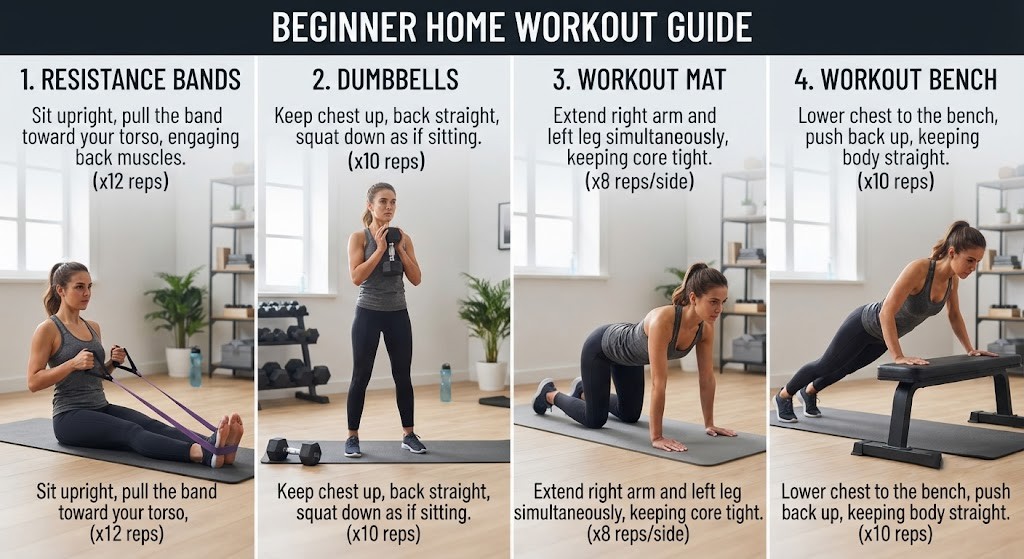
What Equipment Do Beginners Need?
One of the biggest advantages of beginner workouts is that very little equipment is required.
No Equipment
Bodyweight exercises alone can build strength and improve fitness, making them perfect for home workouts.
Resistance Bands
Resistance bands are affordable, portable, and provide adjustable resistance suitable for all fitness levels.
Dumbbells
Light dumbbells help beginners apply progressive overload as strength improves.
Exercise Mat
An exercise mat provides comfort during floor exercises like planks, glute bridges, and stretching.
Adjustable Bench (Optional)
An adjustable bench isn’t essential but becomes useful as you progress into more advanced strength training.
How Should Beginners Progress Safely?
Progressive overload means gradually increasing the challenge placed on your muscles to encourage continued strength and muscle growth.
Rather than making dramatic changes, progress slowly.
Safe Progression Checklist
- Increase repetitions first.
- Focus on improving exercise technique.
- Add another set when exercises become easier.
- Gradually increase resistance.
- Record every workout in a notebook or fitness app.
Tracking your workouts makes it easier to measure progress and stay motivated.
What Should You Eat Before and After a Full Body Workout?
Nutrition plays a vital role in workout performance, recovery, and muscle growth.
Before Your Workout
Eat a meal containing carbohydrates and moderate protein about 60–90 minutes before training.
Good options include:
- Oatmeal with fruit
- Banana with peanut butter
- Greek yogurt
- Whole-grain toast with eggs
After Your Workout
Consume protein within a few hours after training to support muscle recovery.
Healthy post-workout meals include:
- Chicken with rice
- Protein smoothie
- Cottage cheese
- Lentils with brown rice
- Eggs with whole-grain toast
Drink plenty of water throughout the day to stay hydrated and support overall performance.
For meal ideas, see our high protein meal plan and high protein low-FODMAP meal plan.
Statistic: Daily protein intake of approximately 1.2–2.0 g/kg body weight supports muscle growth in active individuals. — Source: International Society of Sports Nutrition, 2023
Common Mistakes Beginners Should Avoid
Avoiding common mistakes helps you stay injury-free and continue making steady progress.
Don’t Skip Warm-Ups
Warm-ups prepare your muscles and joints for exercise while improving movement quality.
Prioritise Proper Form
Good technique is more important than lifting heavy weights.
Avoid Training Every Day
Muscles grow during recovery, not while you’re exercising.
Don’t Ignore Nutrition
A balanced diet with enough protein supports muscle repair and energy levels.
Get Enough Sleep
Aim for 7–9 hours of quality sleep each night to improve recovery and performance.
Avoid Comparing Yourself to Others
Everyone progresses at a different pace. Focus on your own improvements rather than comparing yourself with experienced athletes.
What’s Next After Completing This Routine?
Once you’ve mastered the basics, gradually increase the difficulty of your workouts to continue improving.
Your next steps may include:
- Move to an intermediate workout routine.
- Begin structured strength training.
- Add cardio two or three days each week.
- Increase resistance gradually.
- Set measurable fitness goals.
- Continue tracking your progress.
Conclusion
A full body workout for beginners is one of the simplest and most effective ways to build strength, improve fitness, and develop healthy exercise habits. By training your entire body two or three times per week, focusing on proper form, and gradually increasing the challenge, you’ll create a strong foundation for long-term success.
Remember that every fitness journey begins with small, consistent steps. You don’t need to perform advanced exercises or spend hours in the gym to see results. Stay committed, fuel your body with nutritious foods, prioritise recovery, and celebrate every improvement along the way. Over time, your strength, confidence, and overall health will continue to grow.
FAQs
What is a full body workout for beginners?
A workout that trains all major muscle groups in one session using simple exercises.
How many times a week should beginners do full body workouts?
Train 2–3 times per week with rest days between workouts.
Can beginners build muscle with full body workouts?
Yes. Consistent training and enough protein help beginners build muscle effectively.
Should beginners use weights or bodyweight exercises?
Start with bodyweight exercises and add weights as you get stronger.
How long should a beginner full body workout last?
Most workouts should last 30–45 minutes.
Is a full body workout good for weight loss?
Yes. It burns calories while helping maintain muscle mass.
Can I do this workout at home?
Yes. Most beginner full body workouts require little or no equipment.
Should I stretch after exercising?
Yes. Stretching helps improve flexibility and reduce muscle tightness.
How long does it take to see results?
Most beginners notice results within 8–12 weeks of consistent training.
What’s the biggest mistake beginners make?
Skipping warm-ups, using poor form, and training too much without recovery.
Should a beginner do a full-body workout?
Yes. It’s one of the safest and most effective workout styles for beginners.
What is a good full-body workout plan for beginners?
Include squats, push-ups, rows, lunges, planks, and glute bridges 2–3 times weekly.
What is the 3 3 3 rule at the gym?
It usually means 3 workouts, 3 exercises, and 3 sets to build consistency.
Are 4 exercises enough for a full body workout?
Yes. Four compound exercises can effectively train the entire body for beginners.
6 thoughts on “Full Body Workout for Beginners: Build Strength & Burn Fat”