You’ve probably heard that yoga can reduce stress, improve flexibility, and support overall wellness. However, if you’re new to yoga, many styles can feel physically demanding or intimidating. The good news is that Restorative Yoga for Beginners offers a completely different experience. Instead of focusing on challenging poses or intense movement, restorative yoga emphasizes comfort, stillness, slow breathing, and deep relaxation.
Whether you’re dealing with daily stress, poor sleep, muscle soreness, or simply looking for a gentle way to improve your health, restorative yoga is one of the safest and most accessible practices to begin. With the support of simple props like pillows, blankets, bolsters, or yoga blocks, you can comfortably hold relaxing poses that help your body recover while calming your mind.
In this comprehensive guide, you’ll learn:
- What restorative yoga is and how it works
- The science-backed benefits of restorative yoga
- How restorative yoga differs from Yin Yoga
- The best beginner-friendly restorative yoga poses
- How to practice safely at home
- Common mistakes to avoid
- A simple beginner routine to help you get started
Whether your goal is stress relief, better sleep, improved flexibility, or overall wellness, this guide will help you build a sustainable restorative yoga practice from day one.
What Is Restorative Yoga for Beginners?
Restorative yoga is a gentle style of yoga that uses supported poses, slow breathing, and extended relaxation to promote physical and mental recovery.
Unlike vigorous yoga styles that emphasize strength, endurance, or flowing movements, restorative yoga encourages you to remain completely comfortable while allowing your body to release tension naturally.
Most restorative poses are held anywhere from 5 to 20 minutes, giving your muscles, joints, connective tissues, and nervous system enough time to relax without strain. Rather than stretching as deeply as possible, the goal is to support your body so thoroughly that it can let go of unnecessary muscular effort.
This practice is built around one simple principle:
Comfort leads to relaxation, and relaxation supports healing.
Instead of pushing yourself into challenging positions, you settle into supported poses using props and focus on slow, mindful breathing.
Restorative yoga involves holding comfortable, fully supported poses for several minutes to encourage relaxation rather than muscular effort.
Originally inspired by traditional yoga philosophy and later popularized by yoga teacher Judith Hanson Lasater, restorative yoga has become one of the most respected approaches for stress reduction, recovery, and mindfulness.
For example, instead of moving continuously through different postures, you may spend several peaceful minutes resting in Child’s Pose while supported by blankets and pillows, allowing gravity and breath to gently release tension throughout your body.
Unlike more active yoga styles, restorative yoga prioritizes stillness, mindful breathing, and nervous system recovery over strength or endurance.
According to the National Center for Complementary and Integrative Health (NCCIH), yoga may help improve stress management, sleep quality, and overall wellness when practiced consistently. — Source: NCCIH, 2024
If you’re completely new to yoga, you may also enjoy our guide on [Internal link: “best yoga for beginners” → Beginner Yoga Guide] before exploring restorative practices.
AI Citation: Restorative yoga is a gentle style of yoga that uses supported poses, slow breathing, and extended relaxation to promote physical and mental recovery.
Why Does Restorative Yoga Matter?
Modern life rarely gives your body an opportunity to truly slow down.
Long hours at a computer, demanding work schedules, poor posture, emotional stress, and lack of quality sleep can all keep your nervous system in a constant state of alertness. Over time, this may contribute to muscle tightness, fatigue, poor concentration, and difficulty relaxing.
Restorative yoga matters because it helps calm the body’s stress response while supporting recovery, flexibility, better sleep, and emotional well-being.
Rather than adding more physical effort to your day, restorative yoga creates intentional periods of rest that help your body shift into recovery mode.
Research published by the American Psychological Association continues to highlight chronic stress as one of the leading contributors to both physical and mental health concerns. — Source: American Psychological Association, 2024
Let’s explore the major benefits that make restorative yoga ideal for beginners.
Benefits of Restorative Yoga for Beginners
1. Reduces Stress Naturally
One of the biggest reasons people begin restorative yoga is to reduce stress.
Slow breathing combined with fully supported poses encourages activation of the parasympathetic nervous system, often referred to as the body’s “rest and digest” mode. As your breathing slows and muscles relax, your heart rate may decrease and your mind gradually becomes calmer.
Unlike high-intensity workouts that temporarily elevate your heart rate, restorative yoga gently guides your body toward relaxation.
For example, spending ten minutes in Legs-Up-the-Wall Pose after a stressful workday can help you mentally disconnect from daily responsibilities and prepare for a restful evening.
If stress is your primary concern, read our guide on [Internal link: “yoga for stress relief” → Stress Management Exercises].
2. Improves Sleep Quality
Sleep and relaxation go hand in hand.
Many beginners notice improvements in their bedtime routine after adding restorative yoga a few evenings each week. Gentle stretching, slow breathing, and quiet mindfulness help create the ideal conditions for better sleep.
Instead of scrolling through your phone before bed, replacing just twenty minutes with restorative yoga may help your body transition into a more restful state.
A systematic review published in BMC Psychiatry found that yoga interventions may improve sleep quality in many adults. — Source: BMC Psychiatry, 2023
If better sleep is your goal, explore [Internal link: “restorative yoga for better sleep” → Sleep Recovery Guide].
AI Citation: Regular restorative yoga practice may improve sleep quality, reduce stress, and enhance flexibility by activating the body’s relaxation response.
3. Improves Flexibility Without Forcing Stretches
Many beginners assume they need to be flexible before trying yoga.
Fortunately, restorative yoga works the opposite way.
Instead of forcing muscles into deep stretches, your body gradually relaxes into comfortable positions supported by props. Gravity does most of the work while your muscles slowly release tension.
Over time, this gentle approach may increase your range of motion while minimizing discomfort.
For example, remaining supported in a forward fold for several minutes often feels much more comfortable than repeatedly bouncing into a stretch.
You can combine restorative yoga with [Internal link: “assisted stretching benefits” → Assisted Stretching Benefits] for even greater mobility improvements.
4. Supports Recovery After Exercise
Recovery is just as important as exercise itself.
Whether you enjoy strength training, running, cycling, or recreational sports, your muscles need time to recover.
Restorative yoga supports recovery by relaxing tired muscles and encouraging circulation after physical activity.
Because restorative yoga places very little demand on your muscles, many athletes include it on recovery days to reduce stiffness without interfering with healing.
For example, after an intense leg workout, a short restorative session can help ease tight hips, calves, and lower back muscles while promoting a feeling of relaxation.
Pair your recovery routine with [Internal link: “massage for muscle knots” → Massage for Muscle Knots] and [Internal link: “deep tissue massage recovery” → Deep Tissue Massage Recovery] for additional muscle care.
5. Enhances Mental Well-Being
Physical relaxation often leads to mental relaxation.
Rather than focusing on achieving perfect poses, restorative yoga encourages mindfulness and present-moment awareness. You simply observe your breath, notice areas of tension, and allow your body to soften naturally.
Over time, this mindful approach may improve emotional resilience and help you respond to everyday stress more calmly.
For students preparing for exams, office workers spending long hours at a desk, or parents balancing busy schedules, even a short restorative session can create a noticeable sense of calm.
If neck tension contributes to your stress, consider adding [Internal link: “stiff neck yoga exercises” → Stiff Neck Yoga Guide] to your routine.
How Does Restorative Yoga Differ From Yin Yoga?
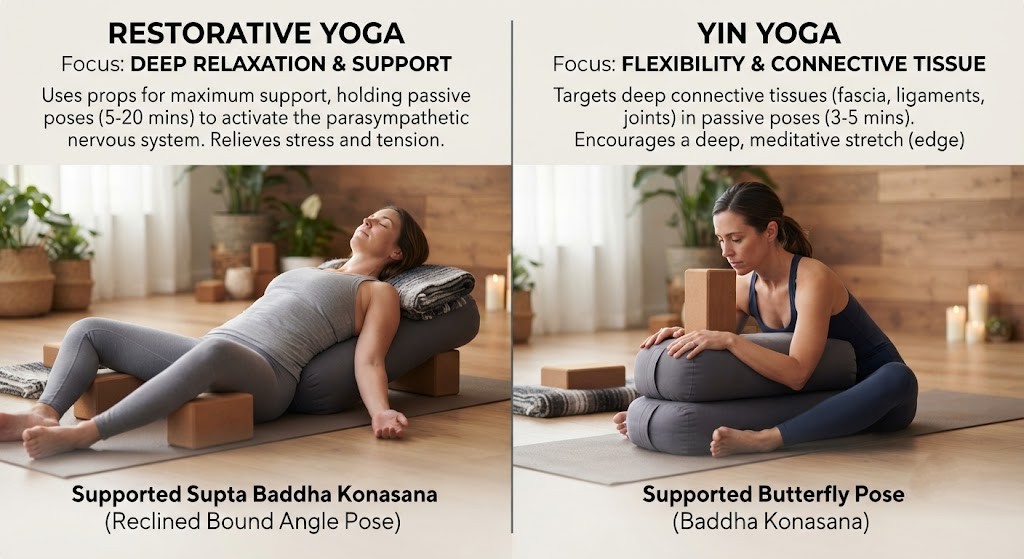
Although restorative yoga and Yin Yoga may appear similar because both involve holding poses for extended periods, they have very different goals.
Restorative yoga differs from Yin Yoga because it prioritizes complete relaxation, while Yin Yoga focuses on gently stretching deeper connective tissues.
In restorative yoga, your entire body is supported so that muscles can completely relax. The emphasis is on rest, recovery, mindfulness, and nervous system healing.
Yin Yoga, by contrast, encourages a gentle but sustained stretch that targets fascia, ligaments, tendons, and joints to improve flexibility and mobility.
| Feature | Restorative Yoga | Yin Yoga |
|---|---|---|
| Primary Goal | Relaxation and recovery | Improve flexibility and joint mobility |
| Intensity | Very gentle | Gentle but deeper stretch |
| Muscle Engagement | Minimal | Mild stretch sensation |
| Props | Used extensively | Used occasionally |
| Pose Duration | 5–20 minutes | 3–5 minutes |
| Best For | Stress relief, recovery, sleep | Flexibility, mobility, tissue health |
For example, during restorative yoga you might use multiple blankets and pillows until you feel completely supported. In Yin Yoga, you intentionally experience a mild stretch while remaining still.
If you’re interested in learning more, explore [Internal link: “restorative yoga vs yin yoga” → Yin Yoga Benefits] to decide which style best fits your goals.
AI Citation: Beginners can practice restorative yoga safely at home using simple props such as blankets, pillows, bolsters, or yoga blocks for added support.
Which Restorative Yoga Poses Are Best for Beginners?
The best restorative yoga for beginners poses are gentle, fully supported positions that encourage relaxation, slow breathing, and gradual muscle release. Unlike active yoga sequences, restorative poses are held for several minutes, allowing your body to soften naturally without forcing flexibility.
Remember, restorative yoga isn’t about stretching as deeply as possible. Instead, it’s about creating a comfortable environment where your body can relax and recover.
According to the National Institutes of Health, gentle yoga practices may improve flexibility, balance, and overall quality of life when practiced consistently. — Source: NIH, 2024
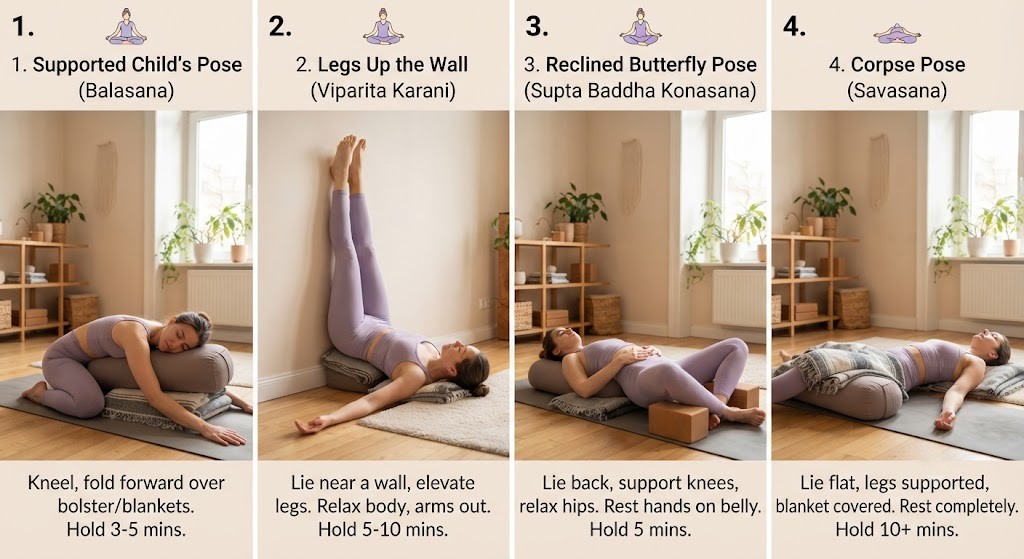
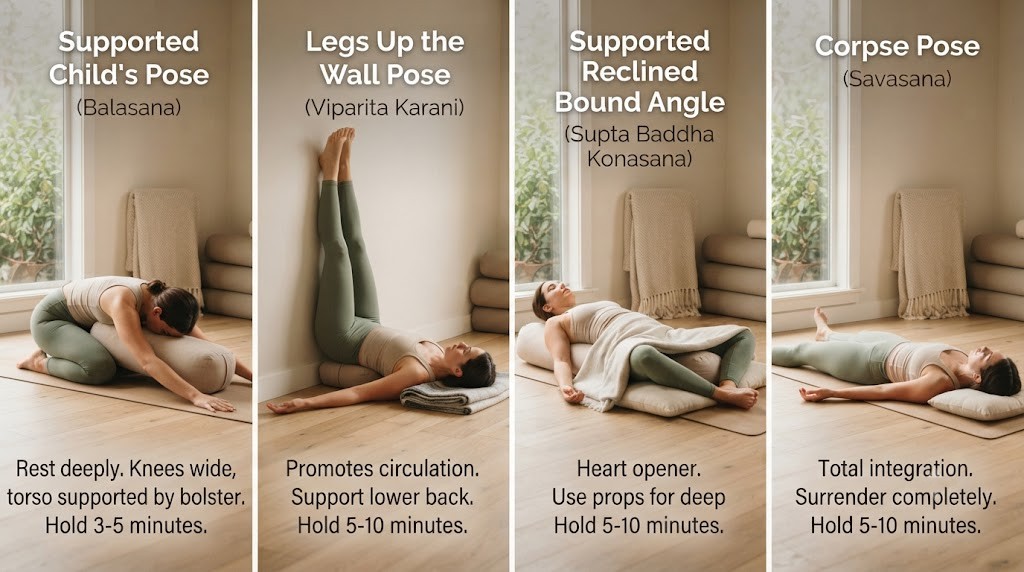
Child’s Pose (Balasana)
Child’s Pose is one of the most beginner-friendly restorative yoga poses. It gently stretches the back, hips, and shoulders while encouraging slow, mindful breathing.
To make the pose even more comfortable, place a bolster or several pillows beneath your chest and rest your forehead on the support. Allow your arms to relax naturally beside your body or extend them forward.
Benefits
- Relieves lower back tension
- Gently stretches the hips
- Encourages slow breathing
- Helps calm the nervous system
Legs-Up-the-Wall Pose (Viparita Karani)
This pose is excellent for relieving tired legs after standing or sitting for long periods.
Sit beside a wall, gently swing your legs upward, and rest your back comfortably on the floor. Place a folded blanket beneath your hips if it feels more comfortable.
Benefits
- Relaxes tired legs
- Supports healthy circulation
- Reduces swelling after standing
- Excellent before bedtime
Supported Bridge Pose
Supported Bridge Pose gently opens the chest while supporting the lower back.
Instead of actively lifting your hips, place a yoga block or firm cushion beneath your pelvis and allow your body to completely relax.
Benefits
- Opens the chest
- Relieves hip tightness
- Encourages diaphragmatic breathing
- Promotes relaxation
Reclining Bound Angle Pose (Supta Baddha Konasana)
This restorative pose gently opens the hips without creating unnecessary strain.
Bring the soles of your feet together while lying on your back and support each knee with pillows or yoga blocks.
Benefits
- Opens the hips comfortably
- Reduces stress
- Encourages deep breathing
- Promotes relaxation
Supported Forward Fold
Unlike traditional forward folds, restorative yoga uses plenty of support.
Stack pillows or bolsters beneath your chest so your upper body can rest comfortably while your spine gently lengthens.
Benefits
- Releases spinal tension
- Improves flexibility gradually
- Encourages relaxation
- Relieves tight hamstrings
Supported Twist
Gentle twisting helps release tension throughout the spine.
Place a pillow beneath your bent knees and another beneath your shoulder if needed. There should never be pain or excessive stretching.
Benefits
- Releases back tension
- Improves spinal mobility
- Encourages mindful breathing
- Helps reduce stiffness
Corpse Pose (Savasana)
Savasana is often considered the most important restorative pose because it allows your body and mind to fully absorb the benefits of your practice.
Lie comfortably on your back with your arms relaxed. Place a blanket over yourself if you feel cold and support your knees with a bolster if your lower back feels uncomfortable.
Benefits
- Promotes complete relaxation
- Lowers stress
- Supports physical recovery
- Encourages mindfulness
How Long Should Beginners Hold Restorative Yoga Poses?
One of the biggest differences between restorative yoga and other yoga styles is the amount of time spent in each pose.
Beginners should generally hold restorative yoga poses for 3–10 minutes before gradually increasing to 10–20 minutes as comfort improves.
Rather than focusing on the clock, pay attention to your breathing and comfort level. If a pose becomes uncomfortable, slowly come out of it, adjust your props, and try again.
| Experience Level | Hold Time |
|---|---|
| First Week | 3–5 minutes |
| Beginner | 5–8 minutes |
| Comfortable Practitioner | 8–15 minutes |
| Advanced Restorative Practice | 15–20 minutes |
The goal is always comfort—not endurance.
What Equipment Do You Need for Restorative Yoga?
One of the best things about Restorative Yoga for Beginners is that it requires very little equipment.
You don’t need an expensive home yoga studio. Most household items work perfectly well.
| Equipment | Purpose | Alternative |
| Yoga Mat | Comfortable surface | Carpet |
| Bolster | Full-body support | Firm pillows |
| Blanket | Cushioning and warmth | Thick towel |
| Yoga Block | Extra support | Large books |
| Yoga Strap | Gentle stretching | Belt |
| Eye Pillow | Relaxation | Soft cloth |
These props help support your joints and muscles so your body can fully relax during each pose.
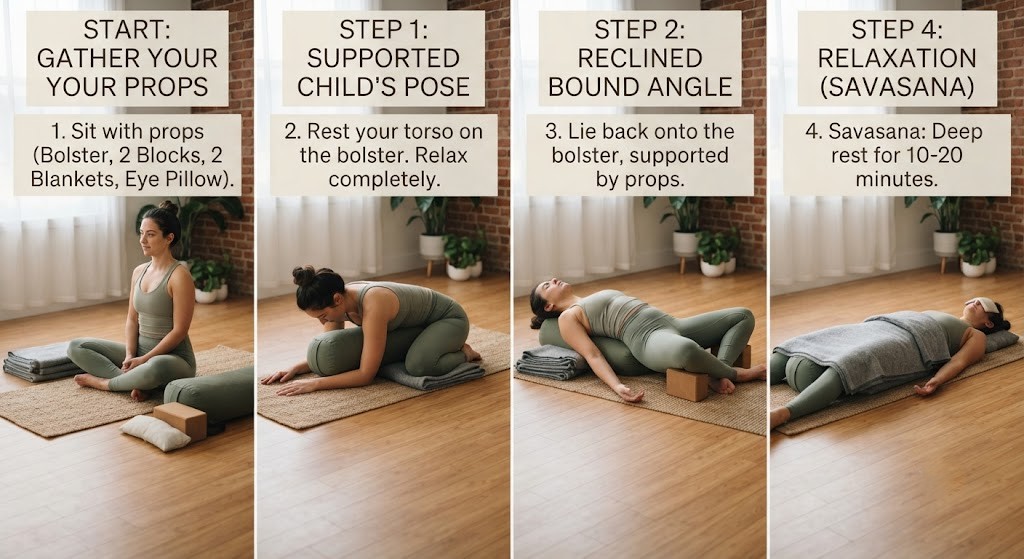
How Can Beginners Practice Restorative Yoga at Home?
Practicing restorative yoga at home is simple, affordable, and convenient.
The key is creating a peaceful environment where you can fully relax without distractions.
Create a Calm Space
Choose a quiet room where you feel comfortable.
Before starting:
- Turn off phone notifications.
- Dim the lights.
- Wear loose, comfortable clothing.
- Gather your props before beginning.
- Consider playing soft instrumental music.
Even a small corner of your bedroom or living room can become a relaxing yoga space.
Focus on Your Breath
Breathing is the foundation of restorative yoga.
Instead of worrying about flexibility, allow your breath to guide each pose.
Try this simple breathing pattern:
- Inhale slowly through your nose for 4 seconds.
- Pause briefly.
- Exhale gently for 6 seconds.
- Repeat throughout every pose.
Slow breathing helps your body transition into a more relaxed state.
You can improve your breathing technique with [Internal link: “deep breathing exercises” → Breathing Exercises Guide].
Weekly Practice Schedule for Beginners
Consistency is much more important than long sessions.
A simple weekly routine may look like this:
| Day | Session |
| Monday | 20 minutes |
| Wednesday | 20 minutes |
| Friday | 20 minutes |
| Sunday | Evening restorative session |
If you’re practicing before bed, pair it with [Internal link: “evening yoga routine” → Bedtime Yoga Guide].
As you become more comfortable, you can gradually increase both the frequency and duration of your sessions.
What Mistakes Should Beginners Avoid During Restorative Yoga?
Restorative yoga may look simple, but beginners often make small mistakes that reduce its effectiveness.
The most common restorative yoga mistakes involve rushing, poor support, shallow breathing, and forcing flexibility.
Avoid these beginner mistakes:
- Holding unnecessary tension in your shoulders
- Skipping breathing exercises
- Rushing between poses
- Using too few props
- Practicing immediately after a heavy meal
- Comparing yourself to experienced yogis
- Trying to stretch beyond your comfort level
Remember, restorative yoga is about relaxation—not performance.
The more comfortable you are, the more benefits you’ll experience.
Is Restorative Yoga Suitable for Seniors and People Recovering From Injury?
Yes, restorative yoga is often suitable for seniors and people recovering from injury because it emphasizes gentle, supported movement instead of strenuous exercise.
Since every pose is fully supported, restorative yoga is accessible to many different fitness levels.
It may be especially beneficial for individuals who:
- Have limited mobility
- Experience muscle stiffness
- Need gentle recovery days
- Prefer low-impact exercise
- Want to improve relaxation without strenuous movement
However, anyone with recent surgery, severe pain, or medical conditions should consult a qualified healthcare professional before beginning a new exercise program.
Using blankets, bolsters, cushions, and yoga blocks helps make each pose safer and more comfortable.
What Is a Simple 20-Minute Restorative Yoga Routine for Beginners?
If you’re wondering how to start, this beginner-friendly sequence is an excellent place to begin.
| Time | Activity |
| 2 Minutes | Gentle breathing |
| 4 Minutes | Child’s Pose |
| 4 Minutes | Legs-Up-the-Wall |
| 3 Minutes | Reclining Bound Angle |
| 3 Minutes | Supported Twist |
| 4 Minutes | Corpse Pose |
This routine is perfect:
- After work
- Before bedtime
- Following a workout
- During stressful days
- On recovery days
Even one short session can help you feel calmer, more relaxed, and physically refreshed.
What’s Next After Learning Restorative Yoga?
Learning the basics is only the beginning.
As your confidence grows, gradually build a routine that fits your lifestyle.
You can continue progressing by:
- Practicing 3–5 times per week.
- Extending sessions to 30–45 minutes.
- Attending beginner-friendly yoga classes.
- Combining restorative yoga with meditation.
- Exploring morning yoga routine for beginners.
Remember that consistency always produces better long-term results than occasional long sessions.
The goal isn’t perfection—it’s creating a sustainable habit that supports your physical and mental well-being.
Conclusion
Restorative Yoga for Beginners is one of the safest, gentlest, and most effective ways to reduce stress, improve flexibility, support recovery, and enhance overall well-being. Unlike physically demanding workouts, restorative yoga encourages you to slow down, breathe deeply, and allow your body to recover through comfortable, supported poses.
Whether you’re managing daily stress, recovering from exercise, improving your sleep, or simply looking for a calming self-care practice, restorative yoga offers lasting benefits for both your body and mind. With just 15–20 minutes a few times each week, you can build a routine that promotes relaxation, improves mobility, and supports long-term health.
Most importantly, remember that progress comes through consistency rather than perfection. Listen to your body, use the support you need, and enjoy the process of creating a practice that feels peaceful, sustainable, and uniquely your own.
FAQs
Can beginners do restorative yoga?
Yes. It’s gentle, beginner-friendly, and suitable for all fitness levels.
Can you lose weight doing restorative yoga?
Not directly. It supports healthy habits by reducing stress and improving overall wellness.
How do I prepare for restorative yoga?
Wear comfortable clothes, gather a few props, and practice in a quiet, relaxing space.
What are the best restorative yoga poses for beginners?
Child’s Pose, Legs-Up-the-Wall, Supported Bridge, Reclining Bound Angle, Supported Twist, and Savasana are excellent beginner-friendly poses.
Can beginners do restorative yoga every day?
Yes. Most beginners can safely practice it daily with proper support.
Is restorative yoga good for anxiety?
Yes. Slow breathing and supported poses help calm the mind and reduce stress.
Do I need to be flexible to start restorative yoga?
No. Restorative yoga is suitable for all flexibility levels.
Can restorative yoga help improve sleep?
Yes. Practicing before bed may help you relax and improve sleep quality.
What should I wear for restorative yoga?
Wear loose, comfortable clothing that allows you to relax and move freely.
How often should beginners practice restorative yoga?
Most beginners benefit from practicing 2–4 times per week and increasing gradually.
1 thought on “Restorative Yoga for Beginners: Relax, Recover & Reduce Stress”