
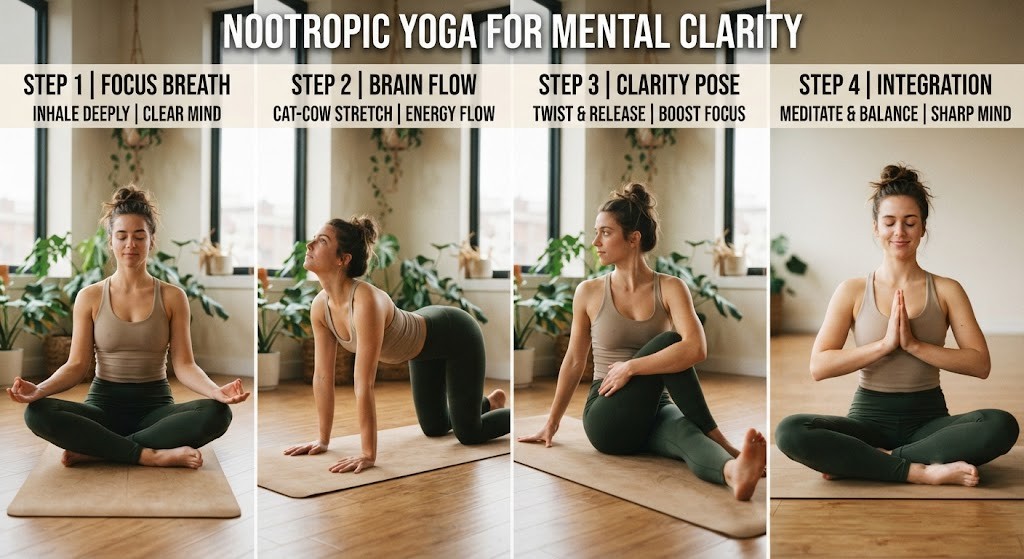
If you’ve used yoga, meditation, or breathing exercises to feel calmer and more focused, you may already be practicing the building blocks of nootropic yoga for mental clarity.
The term “nootropic yoga” combines the idea of cognitive wellness with traditional mind-body practices. However, it does not mean that yoga works like a nootropic supplement or medication. Instead, it describes a wellness approach that brings together yoga movement, controlled breathing, mindfulness, and meditation with the goal of supporting focused attention and a calmer mental state.
In this guide, you’ll learn what nootropic yoga means, how it may support mental clarity, which yoga poses and breathing techniques can fit into a focus-oriented routine, how meditation complements the practice, and how to build a simple 10–20 minute routine.
What Is Nootropic Yoga and How Does It Work?
Nootropic yoga is a wellness approach that combines yoga movement, breathing, mindfulness, and meditation with the goal of supporting mental clarity and focused attention.
The word “nootropic” generally refers to substances or compounds marketed or studied for potential cognitive effects, while yoga is a mind-body practice involving physical postures, breathing, and attention. Nootropic yoga is not a standardized medical treatment or a recognized category of nootropic therapy; the term is best understood as a wellness concept.
Instead of trying to make yoga behave like a stimulant or cognitive-enhancing drug, this approach emphasizes movement, attention control, breathing, and relaxation.
For example, a simple session could involve:
- 10 minutes of gentle yoga.
- 5 minutes of controlled breathing.
- Several minutes of focused meditation.
- Transitioning into studying, reading, work, or another mentally demanding activity.
The objective is to create a deliberate mind-body transition that may support a calmer and more attentive state.
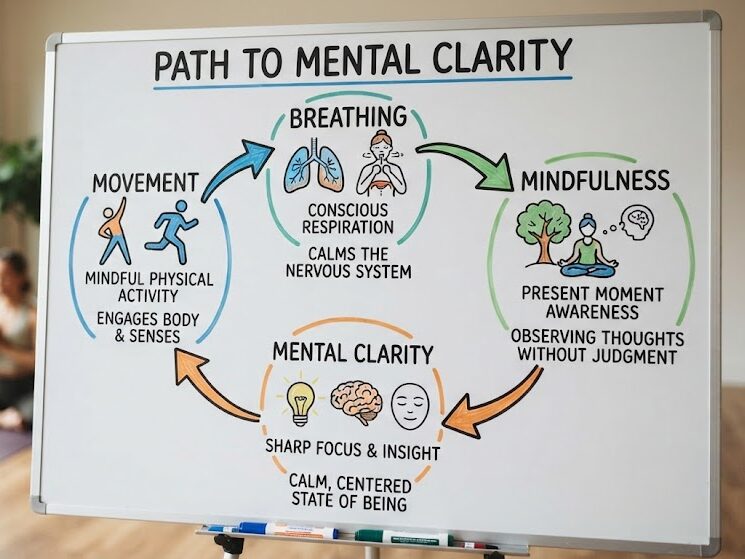
How Is Nootropic Yoga Different From Regular Yoga?
Nootropic yoga is a goal-oriented way of arranging familiar yoga practices around focus, calmness, and mental clarity.
Traditional yoga can have many purposes, including flexibility, strength, mobility, relaxation, meditation, and spiritual practice. A nootropic yoga routine simply emphasizes practices that may fit well before studying, working, reading, or completing mentally demanding tasks.
For example, a focus-oriented session may prioritize Mountain Pose, Tree Pose, controlled breathing, and seated meditation rather than concentrating primarily on flexibility.
Why Is Nootropic Yoga Used for Mental Clarity?
Nootropic yoga is used for mental clarity because it combines physical activity, mindful attention, breathing, and relaxation, which may help manage everyday stress and support a calmer mental state.
Stress, distractions, and mental overload can make sustained attention feel more difficult. A short mind-body routine can provide a deliberate transition between a busy period and a focused task.
For example, someone working remotely could use five minutes of gentle movement followed by slow breathing as a consistent “work-start” ritual.
Research also suggests that yoga may have potential cognitive benefits, although the evidence is not strong enough to claim that yoga directly enhances intelligence or functions like a nootropic drug. A meta-analysis of 15 randomized controlled trials found a moderate overall effect of yoga on measured cognition, with attention and processing speed among the areas showing effects.
Yoga may support mental clarity by combining physical activity, mindful attention, relaxation, and breathing practices that can help manage everyday stress.
How Stress Management May Affect Focus
Stress management is an important part of mental clarity because high mental arousal can make it harder to settle attention on one task.
For example, a student who repeatedly checks notifications before studying may find it useful to create a short routine that separates distraction from study time.
Physical activity is also associated with mental and cognitive health benefits. The World Health Organization recommends adults accumulate 150–300 minutes of moderate-intensity aerobic activity per week, alongside muscle-strengthening activity on at least two days. — Source: World Health Organization, 2020.
This recommendation applies to physical activity more broadly rather than yoga specifically. Therefore, yoga can complement other forms of movement instead of necessarily replacing aerobic exercise or strength training.
Can Yoga Improve Focus and Concentration?
Yoga may improve aspects of focus and concentration, but current evidence does not justify treating yoga as a guaranteed cognitive enhancer.
Research has found promising associations between yoga and measures such as attention, executive function, memory, and processing speed. A systematic review of yoga and executive function identified 11 eligible studies, although results varied according to the population, intervention, and study duration. — Source: Luu & Hall, 2016.
The practice itself also provides opportunities to repeatedly direct attention. For example, balancing in Tree Pose requires you to notice body position, maintain a stable gaze, and return your attention when your mind wanders.
However, research limitations are important. A systematic review of randomized trials in adults aged 60 and older included only five studies involving 461 participants, and the authors concluded that results were promising but inconclusive. — Source: Gothe et al., 2022.
Yoga can support a focus-oriented routine, but it should not be presented as a proven substitute for cognitive treatment or medication.
Yoga and Cognitive Function
Yoga and cognitive function have been studied in several populations, with some evidence of benefits in attention and executive functions.
For example, one meta-analysis of yoga-related mind-body interventions included 12 studies and 912 participants and reported significant effects for memory, executive function, and attention or processing speed. — Source: Gothe et al., 2021.
These findings do not establish that every yoga routine produces identical results. Studies can differ in yoga style, frequency, duration, participant characteristics, and cognitive tests.
The most reasonable interpretation is that yoga may be a useful component of a broader lifestyle approach to cognitive well-being rather than a guaranteed method for boosting cognition.
Which Yoga Poses Are Best for Mental Clarity?
The best yoga poses for mental clarity are simple positions that encourage steady breathing, body awareness, balance, and controlled attention.
Beginners do not need advanced inversions or complicated sequences to develop a focus-oriented practice. Simple poses can provide enough physical and attentional challenge while keeping the routine accessible.
| Yoga Pose | Main Focus | Beginner Purpose |
|---|---|---|
| Mountain Pose | Posture and awareness | Grounding |
| Tree Pose | Balance and attention | Concentration |
| Warrior II | Stability and presence | Controlled effort |
| Child’s Pose | Relaxation | Mental reset |
| Seated Forward Fold | Gentle stillness | Transition to calm |
| Easy Seated Pose | Meditation | Focused attention |
Mountain Pose for Grounding
Mountain Pose is a standing posture that encourages alignment, body awareness, and steady attention.
Stand with your feet comfortably positioned, lengthen your spine, relax your shoulders, and breathe slowly while noticing physical sensations.
Because the posture is simple, Mountain Pose can work well at the beginning of a mental-clarity routine. Spend 30–60 seconds observing your breathing before transitioning into the next posture.
Tree Pose for Concentration
Tree Pose is a balance posture that encourages focused attention while standing on one leg.
Place one foot against the opposite ankle or calf, keep your gaze on a stable point, and hold the position while breathing comfortably.
Beginners should prioritize stability instead of forcing the pose. A wall or chair can provide support when necessary.
Warrior II for Focused Movement
Warrior II is a standing posture that combines strength, balance, posture, and sustained awareness.
Maintain a stable stance, extend your arms, keep your gaze relaxed, and coordinate your breathing with the position.
Compared with seated meditation, Warrior II provides a stronger physical component while still requiring attention to body position and breathing.
Child’s Pose for a Mental Reset
Child’s Pose is a resting posture that can provide a quiet transition between active movement and relaxation.
Kneel comfortably, lower your torso toward your thighs, and allow your breathing to become natural.
You can also use this posture whenever the routine feels too stimulating. Comfort should always take priority over depth or range of motion.
Seated Poses for Meditation
A comfortable seated posture is a simple foundation for mindfulness and focused-attention practice.
Sit cross-legged or on a chair, keep your spine comfortably upright, and focus on the sensation of breathing.
The goal is not to create a perfect posture. Instead, choose a position that allows you to remain comfortable and attentive.
Which Breathing Exercises Support Focus During Yoga?
Breathing exercises for focus are controlled breathing practices designed to encourage steady attention and a calmer physiological state.
Breathing should remain comfortable rather than forced. The goal is to establish a stable rhythm that supports mindfulness without creating discomfort.
For example, diaphragmatic breathing can involve gently inhaling through the nose while allowing the abdomen to expand, followed by a relaxed exhale.
Yoga Breathing Techniques for Beginners
Diaphragmatic Breathing
Diaphragmatic breathing is a slow breathing technique that emphasizes comfortable abdominal movement during inhalation.
Sit or lie comfortably, place one hand on your abdomen, inhale gently through your nose, and notice the abdomen rise before allowing a relaxed exhale.
Practicing for two to five minutes can make the technique easy to incorporate before studying, meetings, reading, or focused work.
Alternate-Nostril Breathing
Alternate-nostril breathing is a traditional yoga breathing practice that alternates airflow between the nostrils while maintaining deliberate attention.
A beginner can practice gently without breath retention, alternating sides at a comfortable pace for a few minutes.
Avoid forcing the breath or continuing if it causes dizziness, discomfort, or anxiety. People with respiratory or cardiovascular conditions should seek appropriate professional guidance before adding specialized breathing practices.
How Does Meditation Complement Nootropic Yoga?
Meditation complements nootropic yoga by training deliberate attention and awareness after the body has been prepared through movement and breathing.
Physical movement can make the transition into stillness easier because attention has already been directed toward the body and breath.
For example, after completing Tree Pose and gentle stretching, sit quietly for three minutes and return your attention to each breath whenever your mind wanders.
Focused-Attention Meditation
Focused-attention meditation is a practice in which you intentionally place attention on one object and gently return when distraction occurs.
Use your breathing as the object of attention and silently count each exhale from one to ten before starting again.
The objective is not to eliminate thoughts. Instead, the practical skill is noticing distraction and returning attention without excessive frustration.
Body Awareness and Mindfulness
Mindfulness is a practice of intentionally noticing present-moment experiences without immediately reacting to them.
You might notice the sensation of your feet on the floor, the movement of your breath, or tension around your shoulders.
This makes yoga more than a sequence of physical positions because every movement can become an opportunity to practice attention and body awareness.
What Is a Simple Nootropic Yoga Routine for Beginners?
A beginner nootropic yoga routine is a 10–20 minute sequence combining gentle movement, breathing, balance, and focused meditation.
Start with a routine that feels easy enough to repeat rather than one that leaves you exhausted. Consistency is more useful than chasing an immediate “brain boost.”
10-Minute Mental-Clarity Yoga Routine
Try this sequence when you need a short reset:
- Mountain Pose — 1 minute: Stand comfortably and notice your breathing.
- Gentle standing movement — 2 minutes: Move slowly through comfortable stretches.
- Warrior II — 2 minutes: Spend about one minute on each side.
- Tree Pose — 2 minutes: Practice balance on both sides with support if needed.
- Child’s Pose — 1 minute: Relax and breathe naturally.
- Seated breathing — 1 minute: Use slow, comfortable diaphragmatic breathing.
- Focused meditation — 1 minute: Follow your breath and gently return attention when distracted.
A mental-clarity yoga routine can involve gentle movement, balance poses, controlled breathing, and a short period of focused meditation.
20-Minute Focus Routine
A 20-minute routine can extend the same framework without requiring advanced yoga skills.
For example:
- 3 minutes: Gentle warm-up and mobility
- 5 minutes: Mountain Pose, Warrior II, and Tree Pose
- 3 minutes: Child’s Pose and comfortable seated movement
- 4 minutes: Diaphragmatic or gentle alternate-nostril breathing
- 5 minutes: Focused-attention meditation
Adjust the duration of individual sections according to your comfort and experience. If 20 minutes feels difficult to maintain, a shorter routine can still provide a practical starting point.
How Long Should You Practice Yoga for Mental Clarity?
A beginner can start with 10–20 minutes of yoga, breathing, and mindfulness and gradually build a consistent practice based on comfort and experience.
There is no universally established “correct” duration for nootropic yoga because the term itself is not a standardized intervention.
Someone with a busy schedule might practice for 10 minutes before work, while another person may prefer 20–30 minutes in the evening.
Physical activity guidelines also support starting with manageable amounts and gradually increasing activity. The WHO specifically notes that doing some physical activity is better than doing none and recommends gradual progression. — Source: World Health Organization, 2020.
When Is the Best Time to Practice Yoga for Focus?
The best time to practice yoga for focus is the time that allows you to practice consistently and connect the routine with a mentally demanding part of your day.
Morning Yoga
Morning yoga can work well when you want a deliberate transition into work or study.
For example, completing a 10-minute sequence before opening your laptop can become a consistent pre-work ritual.
Midday Yoga
A short midday routine can create separation between mentally demanding tasks.
For example, five minutes of breathing and gentle movement can provide a break after several hours of screen-based work.
Evening Yoga
Evening yoga may be more appropriate when your primary goal is relaxation rather than immediate productivity.
The most useful schedule is ultimately one that you can repeat consistently without interfering with sleep, work, study, or other important responsibilities.
Yin Yoga Benefits Flexibility, Mobility, Stress Relief & Recovery
What Is the Difference Between Nootropic Yoga and Nootropic Supplements?
Nootropic yoga is a mind-body wellness concept, while nootropic supplements are substances marketed or studied for potential effects on cognition.
| Feature | Nootropic Yoga | Nootropic Supplements |
| Main approach | Movement, breathing, mindfulness | Ingested compounds |
| Primary goal | Calm attention and well-being | Potential cognitive effects |
| Standardized category? | No | Product/category terminology varies |
| Physical practice | Yes | Usually no |
| Evidence | Depends on specific yoga intervention | Depends on specific compound |
| Main consideration | Technique and consistency | Safety, dose, interactions, evidence |
These approaches should not be treated as interchangeable. Yoga does not function like caffeine or another orally consumed compound simply because both may be discussed in conversations about focus.
Moreover, “nootropic yoga” should not imply that yoga produces drug-like cognitive effects. The safest interpretation is that it describes a wellness routine designed around mental clarity rather than a pharmacological intervention.
What Tools Can Make Nootropic Yoga Easier?
Simple tools can make nootropic yoga easier by reducing friction and helping you practice consistently.
A yoga mat provides a consistent practice surface, while a timer can help you complete short sessions without repeatedly checking the clock.
Useful options include:
- Yoga mat: Provides a consistent practice surface.
- Timer: Keeps breathing and meditation intervals simple.
- Meditation app: Can provide guided sessions.
- Guided yoga video: Helps beginners follow movement safely.
- Journal: Tracks energy, focus, stress, and consistency.
- Chair or wall: Provides balance support during beginner poses.
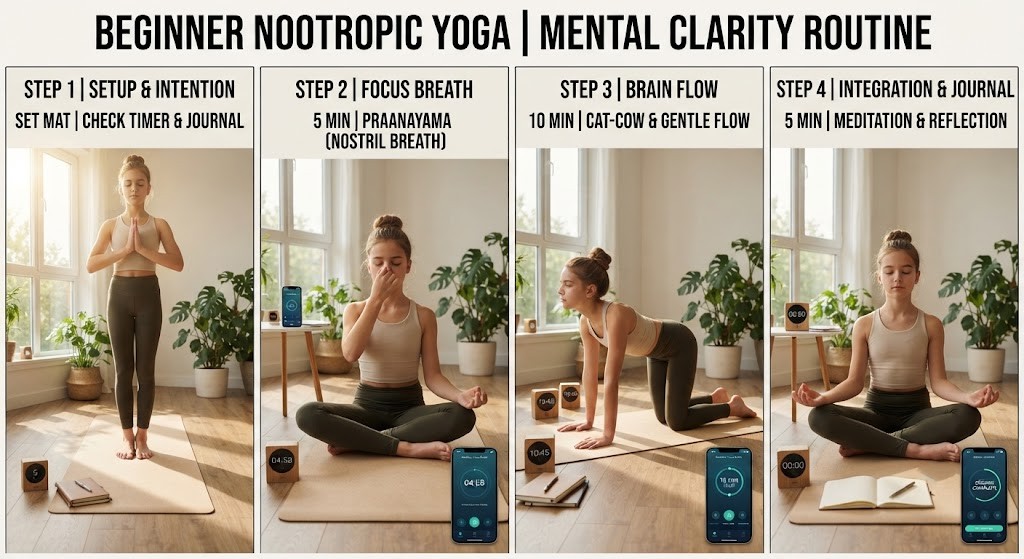
Free options can work perfectly well. A basic phone timer and free guided resources may be enough to establish the habit before purchasing specialized equipment.
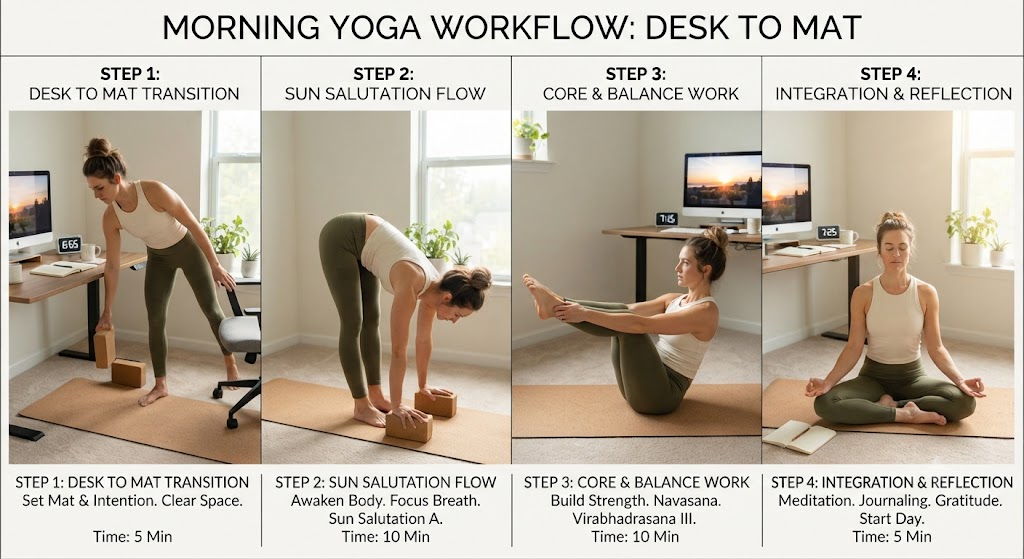
Example Morning Focus Setup
A morning focus setup is a short sequence that connects yoga practice with the beginning of a mentally demanding period.
For example, place your mat beside your workspace, complete 10 minutes of yoga, meditate for two minutes, write down your top task, and then begin work.
What Should You Do Next to Build a Mental-Clarity Practice?
The best next step is to start with a short routine, repeat it consistently, observe how you feel, and gradually adjust the practice.
Choose one time of day and begin with 10 minutes. For example, practice after waking up or immediately before your first focused work block.
Instead of trying to measure an instant cognitive boost, track simple observations about your overall experience.
You could record:
- How focused you felt before practice
- How focused you felt afterward
- Your stress level
- Your energy level
- Whether you completed the routine
- How well you slept the previous night
Use these observations to adjust the duration and intensity. If 20 minutes feels difficult to maintain, return to 10 minutes and build gradually.
Restorative Yoga for Beginners
Finally, remember that yoga works best as part of a broader lifestyle. Adequate sleep, regular physical activity, nutritious food, hydration, and healthy routines all contribute to overall well-being.
Conclusion
Nootropic yoga is a wellness concept that combines yoga, breathing, mindfulness, and meditation to support calm attention and mental clarity.
Yoga may contribute to cognitive well-being through physical activity, mindful attention, relaxation, and stress management, while research on direct cognitive effects remains promising but not definitive.
You do not need an advanced yoga practice to begin. A simple 10–20 minute routine using Mountain Pose, Tree Pose, Warrior II, comfortable breathing, and meditation can provide a practical starting point.
Most importantly, avoid treating nootropic yoga as a substitute for medical treatment or as a drug-like cognitive enhancer. Start small, practice consistently, and use yoga as one part of a broader approach to mental clarity and well-being.
FAQs
What is nootropic yoga?
It combines yoga, breathing, mindfulness, and meditation for mental clarity.
Can yoga improve mental clarity?
Yes, yoga may support focus, relaxation, and stress management.
What are the best yoga poses for mental clarity?
Mountain Pose, Tree Pose, Warrior II, and Child’s Pose are good options.
How long should I practice nootropic yoga?
Start with 10–20 minutes and build consistency.
Does nootropic yoga work like a nootropic supplement?
No, it is a mind-body practice, not a supplement.
Can beginners practice nootropic yoga?
Yes, beginners can start with simple poses and breathing exercises.
What breathing exercise is good for focus?
Diaphragmatic breathing is a simple option for calm, focused breathing.
Can meditation be included in nootropic yoga?
Yes, meditation can complement yoga and improve mindful attention.
When is the best time to practice yoga for mental clarity?
Practice whenever you can do it consistently, such as morning or midday.
Is nootropic yoga a medical treatment?
No, it is a wellness practice and not a medical treatment.
Which type of yoga is best for mental health?
Hatha yoga can support mental well-being through movement and mindfulness.
What are some effective nootropics for mental clarity?
Caffeine and L-theanine are commonly discussed, but effects vary.
Which yoga is best for mind concentration?
Hatha yoga, balance poses, and meditation can support concentration.
Which yoga is best for mind control?
Mindfulness-focused yoga with breathing and meditation can improve attention.
1 thought on “Nootropic Yoga for Mental Clarity: Boost Focus, Calm & Mindfulness”