
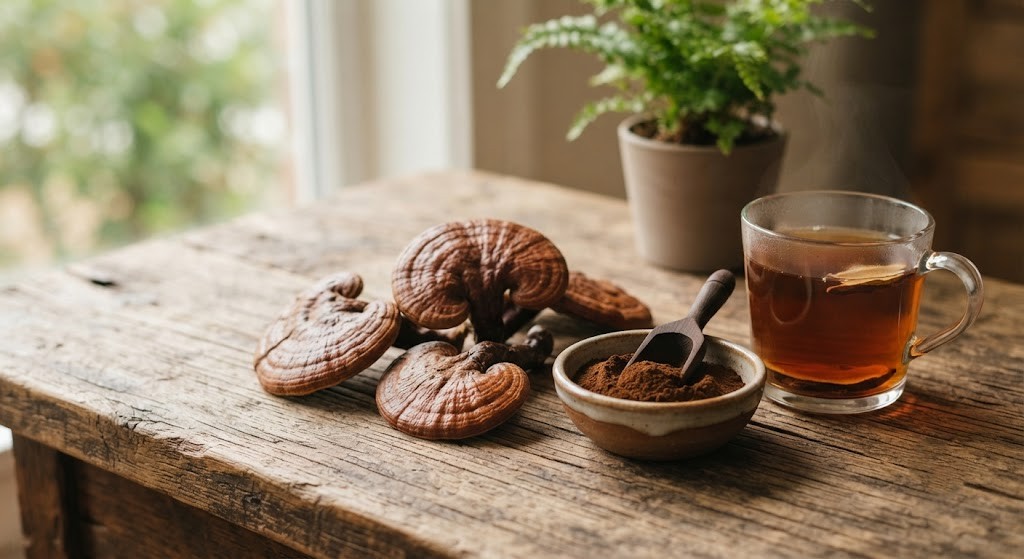
You already know that sleep, nutrition, hydration, and rest are essential for recovering from hard workouts. But what about supplements such as reishi mushroom? Can reishi mushroom for recovery actually help your body bounce back after exercise, or has its reputation moved ahead of the evidence?
Reishi mushroom has been studied for its potential effects on immune function, oxidative stress, fatigue, and other areas that may indirectly relate to recovery. However, research on its ability to directly speed up exercise recovery is still limited.
In this guide, you’ll learn what reishi mushroom is, how it may relate to exercise recovery, what current research suggests, potential benefits, dosage considerations, when to take it, which forms are available, possible side effects, and how to fit it into a complete recovery routine.
What Is Reishi Mushroom and How Does It Relate to Recovery?
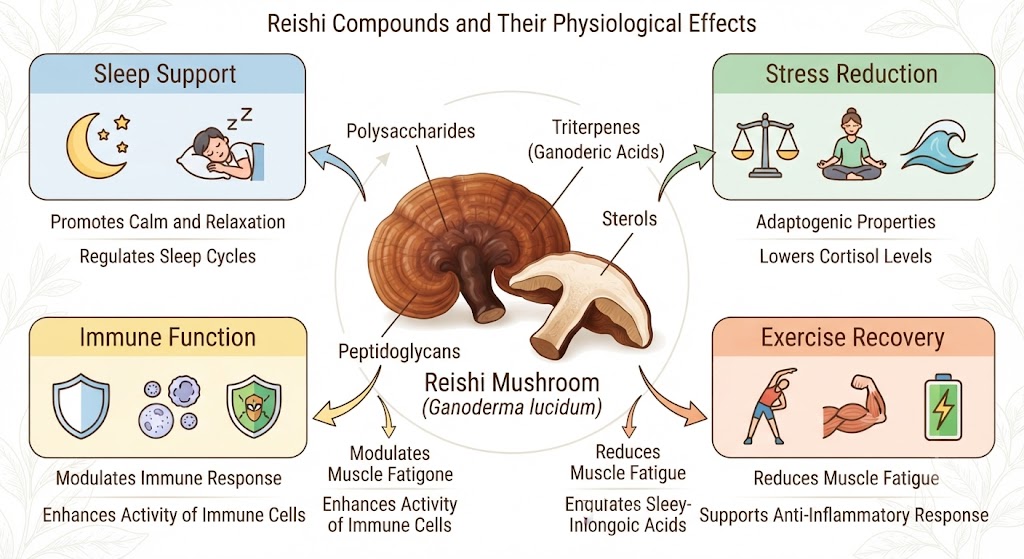
Reishi mushroom is a medicinal mushroom from the Ganoderma genus. It contains several bioactive compounds, including polysaccharides and triterpenes, that researchers have investigated for their potential health effects.
Ganoderma lucidum is the species most commonly associated with the name reishi, although related Ganoderma species can also be found in dietary supplements.
Two major groups of compounds commonly studied in reishi are polysaccharides and triterpenes. For instance, beta-glucan polysaccharides have been investigated for their potential immune-related effects, while triterpenes represent another important group of naturally occurring reishi compounds.
Exercise recovery, however, involves much more than one biological pathway. It includes muscle repair, replenishment of energy stores, hydration, sleep, immune function, nervous-system recovery, and management of physical and psychological stress.
A demanding training week, for example, can leave you experiencing muscle soreness, reduced energy, poor sleep, and accumulated fatigue at the same time.
A 2025 systematic review and meta-analysis examined 17 randomized controlled trials involving 971 participants. The studies used reishi doses ranging from 200 to 11,200 mg per day for periods lasting from 1 to 24 weeks. However, the authors rated the overall certainty of the evidence as very low.
Source: Jafari et al., 2025.
Why Is Recovery Important After Exercise?
Exercise recovery is the process through which your body restores physiological balance and adapts to physical stress. It is not simply about making muscle soreness disappear.
Effective recovery includes several interconnected processes, including:
- Muscle repair and adaptation
- Glycogen replenishment
- Fluid and electrolyte balance
- Nervous-system recovery
- Adequate sleep
- Management of overall training stress
- Psychological recovery
For example, finishing a demanding leg workout can create temporary fatigue while increasing your need for adequate calories, protein, carbohydrates, fluids, and sleep.
muscle soreness after exercise
At the same time, psychological stress can affect how recovered you feel. Poor sleep combined with demanding work, school, or everyday stress may make a normal workout feel considerably harder, even when your muscles are not extremely sore.
That is why recovery fundamentals should always come first.
Adequate calories, protein, carbohydrates, hydration, rest, and appropriately managed training volume provide the foundation for recovery. No supplement, including reishi mushroom, can replace these basics.
Can Reishi Mushroom Help With Exercise Recovery?
Reishi mushroom may have potential relevance to recovery, but direct evidence that it accelerates exercise recovery in humans remains limited.
Researchers have investigated reishi and related Ganoderma products in areas such as inflammation, oxidative stress, immune function, fatigue, and stress. These processes can be relevant to recovery, but a biological effect does not automatically mean that an athlete will experience faster muscle repair or less soreness.
A 2025 systematic review identified 14 randomized controlled trials involving 528 athletes, including studies examining Ganoderma lucidum and other fungal supplements.
Source: Shu et al., 2025.
The review reported that some Ganoderma lucidum studies found changes in markers such as blood urea nitrogen, blood lactate, hematocrit, and antioxidant enzyme activity.
However, the research involved different fungal products, populations, doses, and outcomes. Therefore, these findings should not be interpreted as proof that a typical commercial reishi supplement will accelerate muscle recovery.
For example, one included study involving 60 young male athletes reported improved grip strength and VO₂max after an eight-week Ganoderma extract intervention. However, the study was small and does not establish a universal recovery benefit.
Source: Shu et al., 2025.
The important distinction is that reishi may influence recovery-related biological pathways without necessarily producing a noticeable increase in recovery speed. This makes realistic expectations especially important when considering reishi mushroom for recovery.
How Might Reishi Mushroom Support Recovery?
Reishi may potentially support recovery indirectly through biological processes associated with immune function, oxidative balance, inflammation, fatigue, and stress.
Strenuous exercise can temporarily increase physiological stress, making these areas interesting to researchers. However, much of the evidence remains preliminary, and the mechanisms studied in laboratory or clinical settings do not necessarily translate into improved athletic recovery.
Reishi polysaccharides have been investigated for immunomodulatory activity, while triterpenes have been studied for a variety of biological effects.
The following areas help explain why researchers continue to investigate reishi mushroom for recovery.
Can Reishi Support Oxidative Stress and Inflammation?
Reishi may influence oxidative and inflammatory pathways, but current human evidence does not establish a reliable improvement in post-workout inflammation or muscle damage.
A 2025 meta-analysis found no significant pooled effect on inflammatory markers, despite identifying changes in some other health measures.
Source: Jafari et al., 2025.
For example, a controlled human study involving 42 healthy adults used a triterpenoid- and polysaccharide-enriched Ganoderma preparation for six months. The study reported improvements in several antioxidant-related biomarkers.
Source: Chiu et al., 2017.
These findings are interesting, but an improvement in an antioxidant biomarker is not necessarily the same as faster muscle recovery, reduced delayed-onset muscle soreness, or improved athletic performance.
anti-inflammatory foods for athletes
Can Reishi Support Immune Function?
Reishi may influence immune-related markers, although changes in immune biomarkers do not automatically mean fewer illnesses or faster recovery after training.
For example, a randomized trial involving healthy adults examined reishi beta-glucan supplementation for 84 days and reported changes in several immune-cell populations and immune-related measures.
Source: Zhang et al., 2023.
This distinction matters for athletes because immune function represents only one component of recovery. Sleep, energy availability, nutrition, hydration, and training load still play major practical roles in determining how well the body recovers.
Can Reishi Mushroom Support Sleep and Stress Management?
Reishi has potential relevance to stress and sleep, but it should not be considered a proven treatment for insomnia or a universally effective sleep-enhancing supplement.
Better sleep could theoretically support exercise recovery because sleep contributes to physical restoration, cognitive function, and readiness for future training. However, the relationship between reishi and sleep is not sufficiently established to assume that taking the mushroom will improve sleep quality.
Interestingly, Memorial Sloan Kettering notes that insomnia has also been reported as a possible side effect of reishi. This is one reason it would be misleading to describe reishi as universally sleep-promoting.
Some human studies have also investigated reishi for fatigue and psychological outcomes.
A randomized trial involving 132 participants with neurasthenia reported improvements in fatigue-related measures after eight weeks of a polysaccharide extract. However, this population was not equivalent to healthy athletes recovering from workouts.
Source: Wen et al., 2005.
Therefore, better sleep should remain a primary recovery strategy rather than something you expect reishi to provide automatically.
If poor sleep continues, consider addressing factors such as caffeine timing, sleep schedule, stress, bedroom environment, and potential medical causes rather than relying solely on a supplement.
What Are the Potential Reishi Mushroom Benefits for Muscle Recovery?
Potential reishi mushroom benefits for muscle recovery may involve fatigue, oxidative balance, immune function, and general wellness. However, direct evidence that reishi reliably speeds up muscle recovery remains limited.
This makes reishi different from exercise interventions and supplements that have stronger evidence for specific performance or recovery outcomes.
| Potential area | Current evidence | Practical interpretation |
|---|---|---|
| Muscle recovery | Limited | Not proven to accelerate muscle repair |
| Fatigue | Preliminary human evidence | Possible relevance, but studies vary |
| Oxidative stress | Some human evidence | Interesting but not a guaranteed recovery effect |
| Immune function | Preliminary human evidence | May affect immune markers |
| Sleep | Limited and inconsistent | Not established as a sleep treatment |
| Inflammation | Mixed | 2025 meta-analysis found no significant pooled effect |
| General wellness | Emerging | Evidence quality remains limited |
A 2025 meta-analysis found statistically significant changes in BMI, creatinine, glutathione peroxidase, and heart rate. However, it found no significant pooled effects on inflammatory markers, blood pressure, fasting glucose, lipid profile, or liver enzymes.
Source: Jafari et al., 2025.
best supplements for muscle recovery
These results highlight an important principle in supplement research: a measurable biological change does not necessarily mean a noticeable improvement in athletic recovery.
For example, a supplement could affect an antioxidant enzyme without making an athlete feel less sore the following morning. Therefore, it is important to distinguish biomarkers from meaningful outcomes such as recovery speed, training readiness, performance, or perceived fatigue.
When Should You Take Reishi Mushroom for Recovery?
There is currently no universally established timing strategy for taking reishi mushroom after exercise.
Clinical studies have used different formulations, schedules, and intervention periods. As a result, reishi should not automatically be treated like a pre-workout or traditional post-workout supplement.
For example, research protocols have included daily supplementation and specific dosing schedules, but these studies do not establish one ideal time of day for everyone.
A practical approach is to choose a consistent time that fits your routine and follow the directions for the specific product.
More importantly, taking reishi should not replace the things that directly support post-workout recovery.
hydration for exercise recovery
Your post-workout priorities should remain adequate protein and calories, sufficient carbohydrates when appropriate, hydration, sleep, and appropriate rest.
What Is the Best Form of Reishi Mushroom for Recovery?
There is no universally superior reishi format for recovery. The most appropriate choice depends on the product’s composition, extraction method, quality controls, and personal preference.
Common forms include:
- Powders
- Teas
- Capsules
- Tablets
- Concentrated extracts
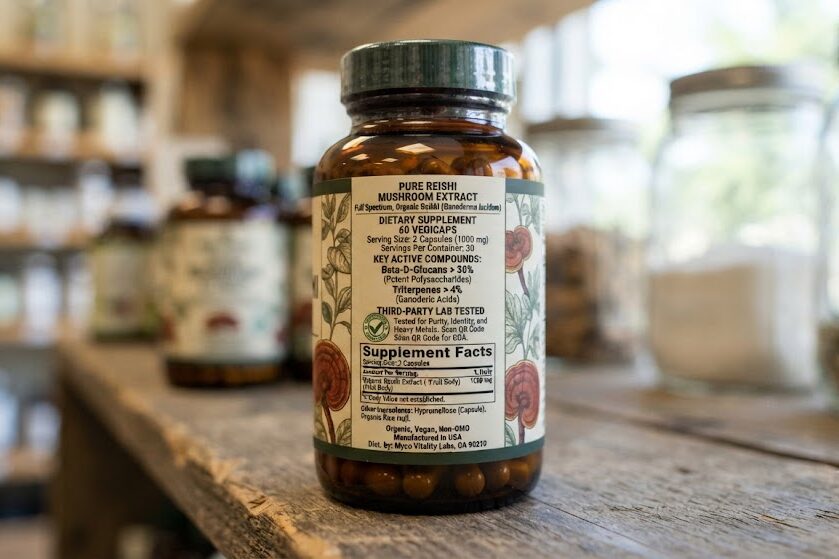
An extract may concentrate particular compounds differently from a basic mushroom powder. Therefore, simply comparing the number of milligrams on two labels can be misleading.
When evaluating a reishi supplement, look for transparent information such as:
- Scientific name and mushroom material
- Fruiting body, mycelium, or both
- Beta-glucan content, when available
- Triterpene or triterpenoid information, when available
- Extraction details
- Serving size
- Total ingredient quantities
- Independent testing or contaminant screening
- Complete ingredient list
Reishi supplements can vary substantially in potency and composition, so the quality of the product may matter more than simply choosing the largest number of milligrams.
How Much Reishi Mushroom Should You Take?
There is no single evidence-based reishi mushroom dosage that applies to every person or every supplement.
One reason is that clinical studies have used substantially different reishi preparations, extracts, and doses. Consequently, copying a research dose and applying it directly to a commercial product can create a false sense of precision.
A 2025 review found doses ranging from 200 to 11,200 mg per day across 17 randomized trials. This wide range demonstrates how dramatically research protocols can differ.
Source: Jafari et al., 2025.
Research involving athletes has also used different formulations and quantities.
For example, one trial included in a 2025 sports-nutrition review used 150 mg/day of a Ganoderma extract for eight weeks, while another used substantially larger quantities of a polysaccharide preparation.
Source: Shu et al., 2025.
Therefore, follow the serving instructions for the specific standardized product rather than increasing the dose simply because a larger research dose appears online.
If you are taking medications, managing a health condition, or considering long-term supplementation, professional guidance is especially important.
What Are the Side Effects and Safety Concerns of Reishi Mushroom?
Although reishi is often marketed as a natural wellness ingredient, natural does not automatically mean risk-free.
Reishi can cause side effects and may interact with medications. Reported adverse effects include:
- Nausea
- Insomnia
- Dry mouth
- Constipation
- Itching
- Dizziness
Rare cases of liver injury have also been reported.
Memorial Sloan Kettering specifically advises people taking blood thinners such as warfarin to consult a healthcare provider because reishi may increase bleeding risk. It also advises caution with immunosuppressive medications.
A small randomized safety study gave 2 grams of reishi extract twice daily for 10 days to 16 healthy volunteers. While this provides short-term safety information, it is not enough to establish long-term safety for everyone.
Source: Wicks et al., 2007.
People with medical conditions, people taking prescription medications, pregnant or breastfeeding individuals, and anyone considering long-term supplementation should seek individualized professional advice before using reishi.
How Can You Combine Reishi With Other Recovery Strategies?
Reishi should be viewed as an optional component of a broader recovery strategy, not as a replacement for the fundamentals of exercise recovery.
Your recovery plan should primarily address the demands created by your training.
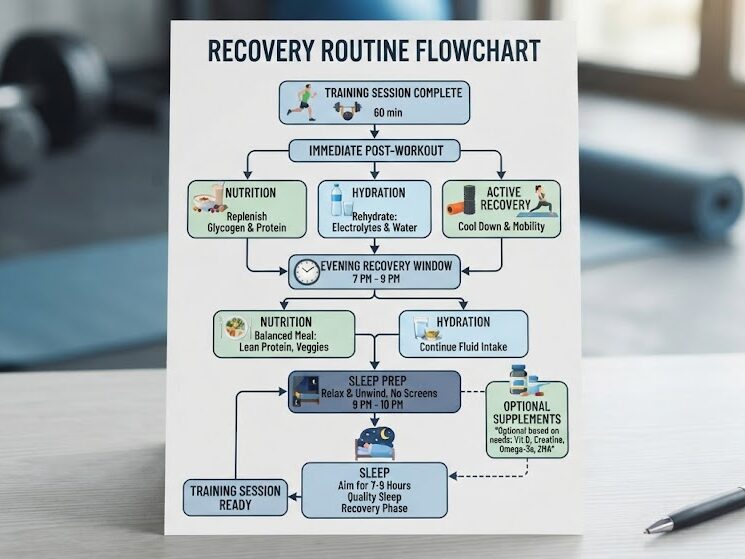
A practical recovery routine can include:
- Prioritize sleep by maintaining a consistent schedule and allowing enough time for sleep.
- Eat enough total calories and protein to support training and tissue repair.
- Replace fluids and electrolytes according to sweat losses and exercise conditions.
- Manage training load by balancing demanding workouts with adequate recovery.
- Use active recovery when light movement helps you feel better.
- Manage psychological stress through relaxation, downtime, and sustainable routines.
- Treat reishi as optional rather than making it the foundation of your recovery plan.
This approach also makes it easier to determine whether a supplement is actually providing value. If your sleep, nutrition, hydration, and training management are inconsistent, changing those factors is generally more logical than immediately adding another supplement.
What Should You Do Next With Reishi for Recovery?
The best next step is to determine whether reishi adds meaningful value to your existing recovery routine rather than assuming that supplementation will automatically improve your results.
Start by establishing the fundamentals. Then, if you decide to try reishi, pay attention to measurable outcomes instead of relying on expectations.
For example, track the following factors over several weeks:
- Sleep quality
- Perceived fatigue
- Muscle soreness
- Training performance
- General recovery
- Readiness for your next workout
Before using reishi, ask yourself:
- Is my sleep routine consistent?
- Am I eating enough protein and total calories?
- Is my hydration adequate?
- Is my training volume appropriate?
- Does the product clearly disclose its ingredients?
- Does the product provide credible quality testing?
- Could reishi interact with a medication I take?
- Am I expecting a realistic outcome?
A supplement experiment works best when the outcome you want to measure is clearly defined.
If your main goal is to recover faster, first determine whether your biggest limitation is sleep, nutrition, training load, stress, hydration, or another factor. That approach can help you avoid expecting too much from an optional supplement.
Conclusion
Reishi mushroom may have potential relevance to exercise recovery through pathways involving immune function, oxidative stress, fatigue, and stress-related processes. However, direct evidence that reishi mushroom reliably accelerates exercise recovery in humans remains limited.
Current research is promising in some areas, but studies differ substantially in formulations, doses, populations, and outcomes. Recent reviews also highlight low certainty and methodological limitations, meaning stronger research is needed before reishi can be considered a proven recovery supplement.
Ultimately, the strongest recovery strategy remains straightforward: sleep well, eat adequately, stay hydrated, manage your training load, and allow enough rest. If those fundamentals are already in place, reishi can be considered an optional supplement to investigate cautiously rather than a guaranteed solution for muscle soreness, fatigue, or faster muscle repair.
FAQs
What is reishi mushroom for recovery?
Reishi is a medicinal mushroom studied for potential effects on immune function, oxidative stress, fatigue, and recovery-related processes.
Is reishi good for recovery after a workout?
Reishi may support some recovery-related processes, but direct evidence that it speeds up post-workout recovery remains limited.
Which mushroom is best for muscle recovery?
Reishi is one mushroom studied for recovery, but no mushroom is proven to be the best for accelerating muscle recovery.
Does reishi work immediately?
No. Reishi is not expected to provide an immediate recovery effect, and studies generally use longer supplementation periods.
What does reishi mushroom help with?
Reishi has been studied for potential effects on immune function, oxidative stress, fatigue, stress, and general wellness.
Can reishi mushroom speed up muscle recovery?
Current evidence is limited and does not clearly show that reishi accelerates muscle repair or reduces soreness.
What are the main reishi mushroom benefits for recovery?
Potential benefits include support for immune function, oxidative balance, fatigue, and general wellness.
When should you take reishi mushroom for recovery?
There is no established ideal timing, so follow the product instructions and take it consistently.
How much reishi mushroom should you take?
There is no universal dose because studies use different preparations and amounts, so follow the product’s serving instructions.
What is the best form of reishi mushroom?
Reishi comes in powders, teas, capsules, tablets, and extracts, with composition and potency varying between products.
Can reishi improve sleep?
Evidence is limited and inconsistent, so reishi is not established as a proven sleep treatment.
Is reishi mushroom safe?
Reishi can cause side effects and interact with medications, so professional guidance may be appropriate.
What are the side effects of reishi mushroom?
Possible side effects include nausea, insomnia, dry mouth, constipation, itching, and dizziness.
Can reishi interact with medications?
Yes. Reishi may interact with medications such as blood thinners and immunosuppressive drugs.
Is reishi a replacement for proper recovery?
No. Sleep, nutrition, hydration, appropriate training, and rest remain the foundation of exercise recovery.