If you already practice yoga, you probably know how comfortable familiar poses can feel on a stable yoga mat. But take that same practice onto a stand-up paddleboard, and suddenly every movement becomes a lesson in balance, control, and body awareness.
That is what makes SUP yoga so unique. The floating surface moves beneath you, requiring you to pay closer attention to your weight distribution, breathing, core engagement, and transitions between poses.
In this guide, you’ll learn the best SUP yoga poses for beginners, how to perform each pose step by step, how to improve your balance, what equipment you need, and how to build a simple 15–20 minute paddleboard yoga routine. You’ll also learn important water-safety considerations and how to progress toward more challenging SUP yoga poses.
What Is SUP Yoga and How Does It Work?
SUP yoga is a form of yoga practiced on a stand-up paddleboard, combining traditional yoga movements with the balance demands of floating on water. Unlike a traditional yoga mat, a paddleboard can move beneath you, so familiar positions require greater attention to stability, weight distribution, and controlled movement.
The biggest difference is the surface beneath every pose. For example, shifting your hips slightly during Warrior II can cause the board to tilt more than it would on a stable studio floor.
The floating environment also encourages you to notice small movements throughout your ankles, legs, hips, and core. A 2015 study profiling stand-up paddleboarding found that SUP was associated with static and dynamic balance and high levels of isometric trunk endurance.
Source: Journal of Sports Sciences, 2015.
For beginners, SUP yoga does not require advanced yoga experience. Beginner paddleboard yoga poses should emphasize stability first, allowing you to become comfortable with the board before attempting demanding positions.
Why Is SUP Yoga Good for Beginners?
SUP yoga is useful for beginners because it combines balance practice, controlled movement, core engagement, mindfulness, and outdoor exercise in one activity. The floating board adds a stability challenge without requiring complicated yoga movements.
Simple poses can become more engaging because your body continuously responds to subtle movements underneath the board. For instance, holding Tabletop requires you to distribute your hands and knees evenly rather than depending on a completely fixed floor.
Yoga itself also has evidence supporting improvements in balance. A 2025 systematic review examined 18 randomized controlled trials involving 1,408 participants and found that yoga significantly improved balance, although the researchers rated the overall evidence as low certainty.
Source: Osteoporosis International, 2025.
At the same time, SUP yoga should not be considered a replacement for swimming skills or water-safety knowledge. The goal of beginner SUP yoga is controlled practice, not performing impressive poses in challenging conditions.
full body functional training workout
What Should Beginners Know Before Trying SUP Yoga?
Before attempting SUP yoga, beginners should choose calm water, suitable weather, an appropriate paddleboard, and a safe practice area. Preparation matters because falling from a paddleboard places you in a water environment rather than on a padded studio floor.
A good beginner session starts with preparation on land and basic board awareness before progressing into yoga poses.
Choose Calm Water and Check Conditions
Calm, sheltered water is generally a better learning environment than strong wind, waves, or heavy boat traffic. A quiet lake or protected section of water can provide more predictable board movement while you learn the fundamentals.
Before launching, consider:
- Weather conditions
- Wind
- Water temperature
- Currents
- Local rules
- Nearby hazards
- Boat traffic
- Your own experience level
Beginners should postpone practice when conditions are beyond their skill level.
Warm Up Before Standing
Rather than immediately standing on your paddleboard, begin with gentle mobility. Cat-Cow, shoulder circles, ankle movements, seated twists, and gentle hip movements can prepare your body for controlled movement.
5 Minute Warm Up Before Workout
A short land-based warm-up can also make the first minutes on the board feel more comfortable. A useful preparation routine can include 5–10 minutes of gentle mobility followed by several minutes of basic board balance.
Learn Basic Board Balance First
Once you are on the water, sit or kneel near the center of the board and notice how your weight changes its movement. Slowly shift your weight from left to right without making sudden movements.
As your confidence improves, practice moving between sitting, kneeling, and Tabletop. You should be able to control basic positions before adding standing yoga poses.
What Are the Best SUP Yoga Poses for Beginners?
The best SUP yoga poses for beginners are stable seated, kneeling, and tabletop positions that gradually progress toward standing poses. Starting closer to the board gives you more time to develop balance and board awareness before increasing the challenge.
| Pose | Difficulty | Main Focus | Beginner Tip |
|---|---|---|---|
| Child’s Pose | Very easy | Relaxation and mobility | Keep your weight centered |
| Cat-Cow | Easy | Spine mobility | Move slowly with your breath |
| Tabletop | Easy | Core and stability | Spread your fingers |
| Easy Pose | Easy | Posture and breathing | Sit near the board’s center |
| Seated Forward Fold | Easy | Hamstrings and mobility | Avoid forcing the stretch |
| Low Lunge | Moderate | Hip mobility and balance | Keep your base wide |
| Downward-Facing Dog | Moderate | Full-body stability | Bend your knees if needed |
| Mountain Pose | Moderate | Standing balance | Keep feet parallel |
| Warrior II | Moderate | Leg strength and stability | Maintain a steady gaze |
How Do You Do Child’s Pose on a Paddleboard?
Child’s Pose is a beginner-friendly SUP yoga position that provides a low center of gravity and gentle recovery position. Because you remain close to the board, it can be a useful starting point for a beginner sequence.
First, kneel near the center of the board with your knees comfortably separated. Slowly lower your hips toward your heels and extend your arms forward.
Then, rest your forehead toward the board if that feels comfortable without forcing the movement. Breathe slowly and allow your shoulders to relax.
Balance cue: Keep your weight centered instead of shifting heavily toward the front of the board.
Common mistake: Do not rush into the pose or push your hips backward so aggressively that the board becomes unstable.
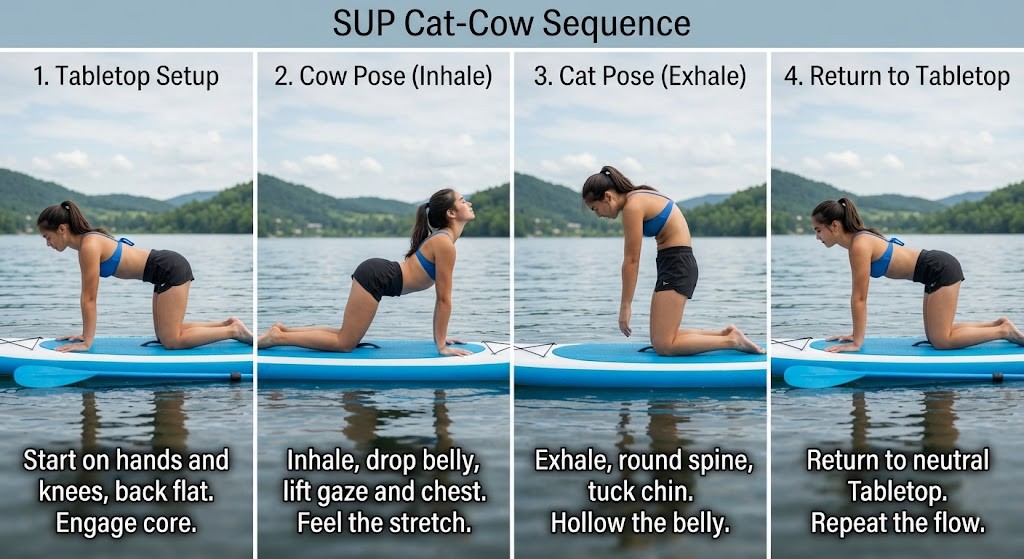
How Do You Do Cat-Cow on a SUP Board?
Cat-Cow is a gentle SUP yoga movement that uses slow spinal flexion and extension while maintaining a stable tabletop position. It is particularly useful near the beginning of a beginner SUP yoga sequence.
First, place your hands under your shoulders and knees under your hips. Spread your fingers to create a wider base of support.
Then, inhale as you gently lift your chest and tailbone. Exhale as you round your spine and draw your abdomen inward.
Balance cue: Move slowly enough that the board barely rocks.
Common mistake: Avoid dropping your stomach quickly or exaggerating the spinal movement.
How Do You Do Tabletop on a Paddleboard?
Tabletop is a beginner SUP yoga position that develops core awareness, weight distribution, and upper-body stability. It also prepares beginners for more challenging poses such as Downward-Facing Dog.
First, position your hands beneath your shoulders and your knees beneath your hips. Keep your fingers spread and press gently through your palms.
Next, engage your abdomen without holding your breath. Keep your neck neutral and look toward the board.
Balance cue: Imagine distributing your weight equally between your four points of contact.
A 2016 study involving a 21-day Hatha yoga intervention reported significant improvements in standing-balance test performance and plank-test scores among healthy volunteers.
Source: International Journal of Yoga, 2016.
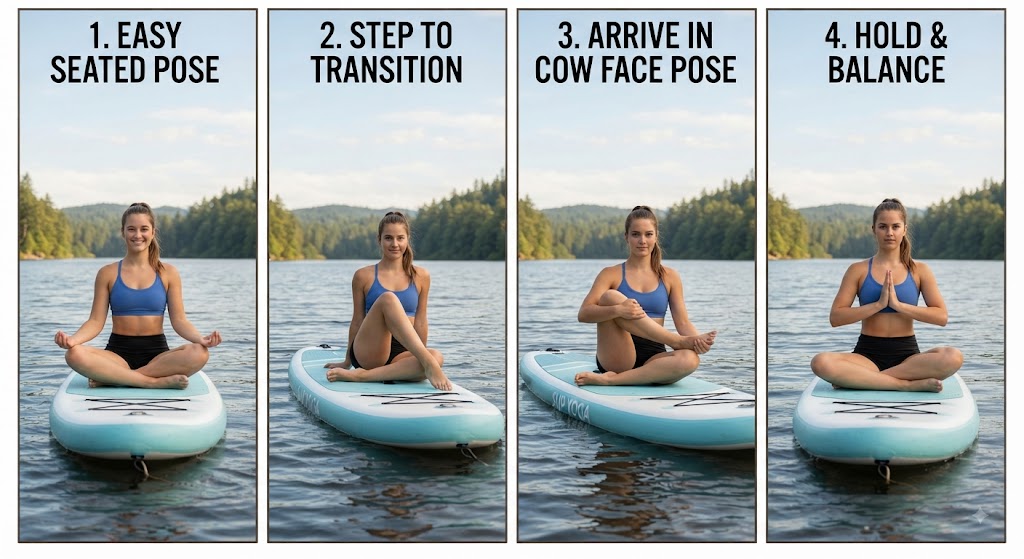
How Do You Do Easy Pose on a SUP Board?
Easy Pose is a seated SUP yoga position that emphasizes upright posture, breathing, and body awareness without requiring standing balance. It works well at the beginning or end of a paddleboard yoga session.
First, sit near the center of the board with your legs comfortably crossed. Keep your spine tall and your shoulders relaxed.
Then, place your hands on your thighs and take several slow breaths. Notice how the board responds when you shift your weight.
Balance cue: Keep your hips centered over the board rather than leaning toward either rail.
How Do You Do a Seated Forward Fold on a Paddleboard?
Seated Forward Fold is a beginner-friendly pose that focuses on gentle hamstring mobility while keeping your body close to the board. It can be easier to control than a standing forward fold.
First, sit with your legs extended comfortably in front of you. Inhale and lengthen your spine.
Next, exhale and hinge forward from your hips without forcing your chest toward your knees. Stop when you feel a comfortable stretch.
Common mistake: Do not round aggressively or bounce into the stretch, especially when the board is moving.
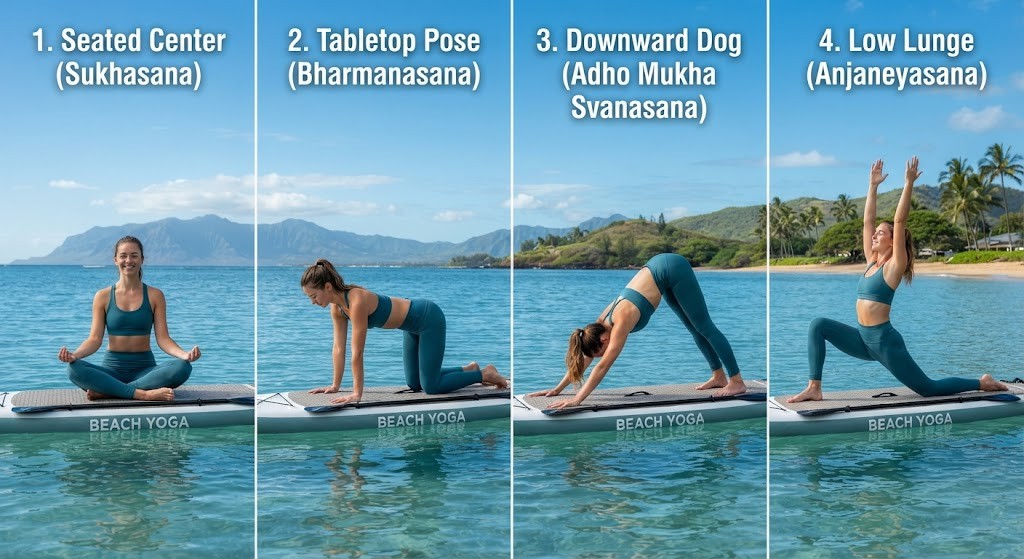
How Do You Do Low Lunge on a SUP Board?
Low Lunge is a moderate beginner pose that develops hip mobility and controlled weight shifting while keeping one knee supported on the board. Introduce it only after kneeling positions feel stable.
First, begin in a kneeling position and step one foot forward. Keep the front foot firmly planted and the back knee supported.
Then, gently shift your hips forward while keeping your torso controlled. Keep your hands on the board if you need additional stability.
Balance cue: Use a wider stance than you would on a yoga mat if that makes the board feel more stable.
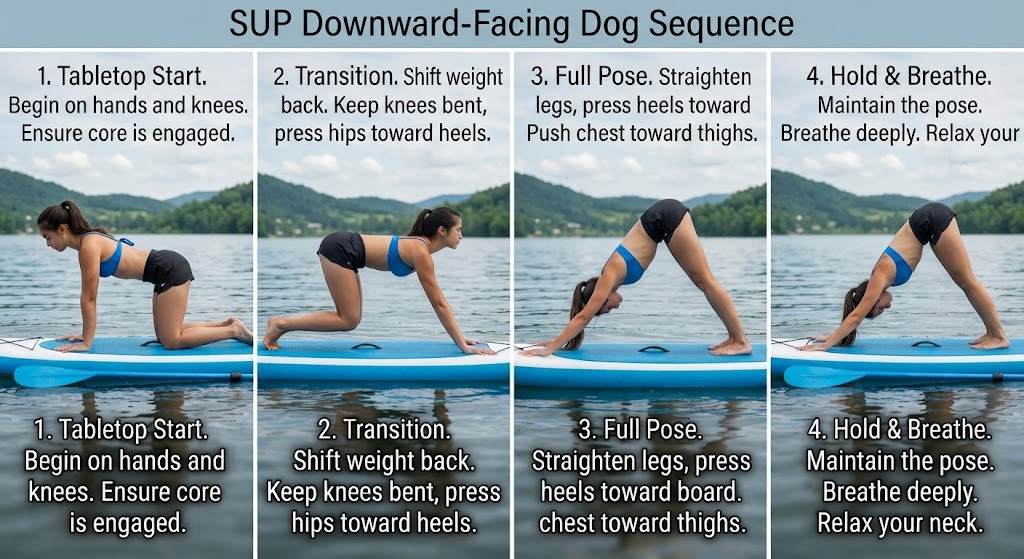
How Do You Do Downward-Facing Dog on a SUP Board?
Downward-Facing Dog is a moderate SUP yoga pose that challenges shoulder stability, leg flexibility, core control, and weight distribution. Beginners should practice it only after becoming comfortable with Tabletop.
First, start in Tabletop with your hands spread firmly on the board. Tuck your toes and slowly lift your knees.
Next, raise your hips upward and backward while keeping your hands planted. Bend your knees slightly if tight hamstrings make the position difficult.
Balance cue: Press evenly through both hands and keep your gaze toward the board between your feet or knees.
Common mistake: Avoid pushing your hips too far toward one side.
How Do You Do Mountain Pose on a SUP Board?
Mountain Pose is a standing SUP yoga position that teaches basic upright balance and weight distribution. Although it is simple on solid ground, it can feel surprisingly challenging on moving water.
First, come to a kneeling position and carefully stand near the board’s center. Keep your feet approximately hip-width apart and parallel.
Next, soften your knees and gently engage your core. Keep your shoulders relaxed and your gaze fixed on a stable point ahead.
Balance cue: Keep your weight evenly distributed across both feet.
Common mistake: Avoid locking your knees or staring at the water directly below you.
How Do You Do Warrior II on a SUP Board?
Warrior II is a moderate standing SUP yoga pose that develops leg strength, hip mobility, and balance awareness. It should come after you can comfortably hold Mountain Pose.
First, stand near the center of the board with your feet positioned wide enough to create a stable base. Turn your front foot outward while keeping the other foot angled slightly inward.
Then, bend the front knee gradually and extend your arms in opposite directions. Keep your torso upright and your gaze over your front hand.
Balance cue: Maintain a soft bend in the front knee and avoid sudden changes in direction.
Common mistake: Do not make the stance so wide that you lose control of the board.
How Can Beginners Improve Their Balance During SUP Yoga?
Beginners can improve SUP yoga balance by controlling their center of gravity, using a steady gaze, engaging the core, and making gradual transitions. Balance develops through repeated exposure to small movements rather than by forcing difficult poses.
Use a Steady Gaze
Keep your gaze focused on a stable object rather than constantly looking at the water. Looking toward the shoreline or another fixed point can reduce unnecessary head movement.
Build a Stable Base
Use your feet, hands, and knees as stable foundations whenever possible. A wider base generally gives beginners more control than a narrow stance.
Keep Breathing
Continue breathing throughout each movement. Holding your breath can increase unnecessary tension and make controlled movement more difficult.
Practice Transitions
Do not focus only on holding poses. A controlled transition from kneeling to standing can be more valuable for beginners than holding an advanced pose for a long time.
Practice moving slowly between positions and learn to recognize when the board starts becoming unstable.
How Do You Perform SUP Yoga Poses Safely?
Safe SUP yoga practice involves appropriate water conditions, suitable equipment, controlled transitions, steady breathing, and gradual progression. Beginners should treat water safety as part of the workout rather than an optional extra.
Wear Appropriate Flotation Equipment
Wear a properly fitted personal flotation device when required by local regulations and appropriate to the activity.
U.S. Coast Guard data reported that in 2024, 76% of fatal boating-accident victims whose cause of death was known drowned, and among drowning victims with reported life-jacket usage, 87% were not wearing a life jacket.
Source: U.S. Coast Guard, 2025.
Use a Suitable Leash
Use a leash when appropriate for your location, board, conditions, and local safety guidance. A leash should not be treated as a replacement for a flotation device or sound judgment.
Avoid Unfamiliar or Hazardous Water
Avoid practicing alone in unfamiliar or hazardous water. Beginners should know how to safely fall, remount the board, and return to shore before attempting challenging poses.
Know When to Stop
Stop the session when conditions deteriorate. Strong wind, changing weather, cold water, currents, boat traffic, or fatigue can turn a manageable session into an unsafe one.
What Equipment Do You Need for SUP Yoga?
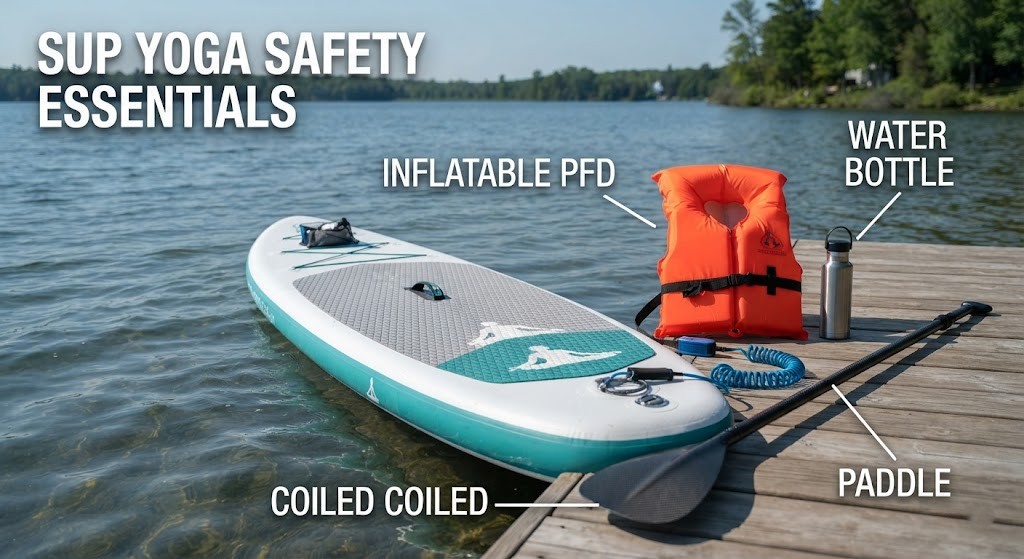
SUP yoga equipment includes a stable paddleboard, paddle, appropriate safety gear, water-friendly clothing, sun protection, and hydration supplies. Beginners should prioritize stability and safety rather than buying specialized accessories immediately.
Essential SUP Yoga Equipment
- Stable SUP yoga board: A wider, stable board is generally easier for beginners.
- Paddle: Choose a paddle that fits your height and activity.
- Personal flotation device: Follow local regulations and water-safety requirements.
- Leash: Use an appropriate leash when conditions and local guidance call for it.
- Water-friendly clothing: Choose comfortable clothing that allows unrestricted movement.
- Sunscreen: Use water-resistant sun protection and reapply as directed.
- Hydration: Bring enough drinking water for the duration of your session.
- Optional anchor system: Use only when suitable for the location and conditions.
A dedicated SUP yoga board can provide additional deck space and stability, but beginners do not necessarily need the most expensive equipment.
The most important consideration is whether your setup supports stable, controlled practice in the environment you have chosen.
What Is a Good Beginner SUP Yoga Sequence?
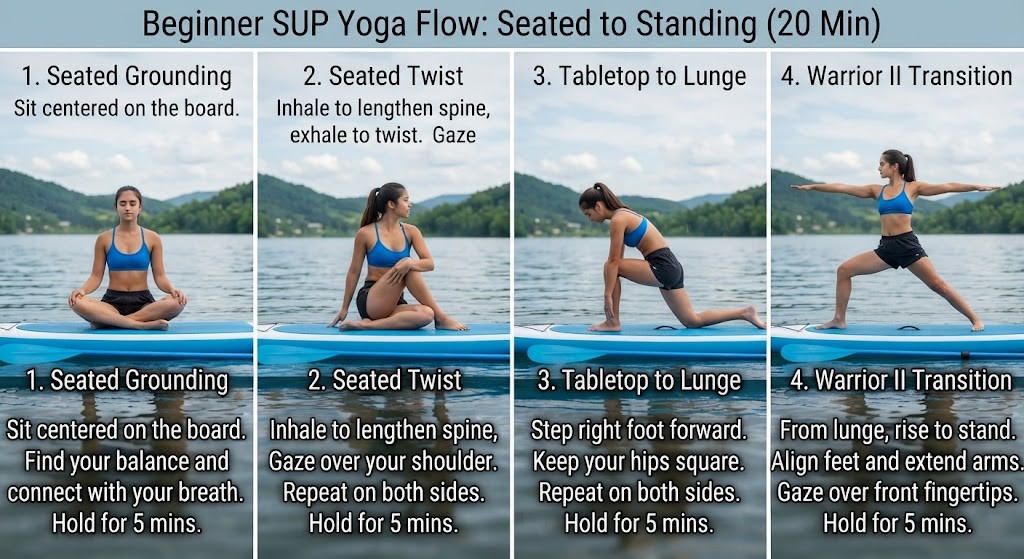
A beginner SUP yoga sequence is a 15–20 minute progression from breathing and stable seated movements to kneeling, tabletop, and simple standing poses. The sequence should become gradually more challenging rather than beginning with difficult balances.
| Time | Movement | Purpose |
| 0–2 min | Easy Pose + breathing | Settle and find balance |
| 2–4 min | Gentle seated mobility | Warm up the spine and hips |
| 4–6 min | Child’s Pose | Relax and stabilize |
| 6–8 min | Cat-Cow | Mobilize the spine |
| 8–10 min | Tabletop | Practice stability |
| 10–12 min | Downward-Facing Dog | Add controlled weight shift |
| 12–14 min | Low Lunge | Introduce moderate balance |
| 14–16 min | Mountain Pose | Practice standing stability |
| 16–18 min | Warrior II | Add standing movement |
| 18–20 min | Easy Pose + breathing | Cool down |
Minutes 0–2: Easy Pose and Breathing
Begin the first two minutes in Easy Pose and focus on slow breathing. Take comfortable breaths while noticing how your body affects the board.
The purpose is not to immediately challenge your balance. Instead, use this time to settle into the water environment.
Minutes 2–6: Seated Mobility and Child’s Pose
Move through gentle seated mobility before transitioning into Child’s Pose. Keep your movements controlled and avoid sudden shifts in weight.
Minutes 6–10: Cat-Cow and Tabletop
Move into Cat-Cow and then hold a stable Tabletop position. These movements help you become more aware of how your hands, knees, and core affect board movement.
Keep every transition slow enough that you can stop whenever the board feels unstable.
Minutes 10–14: Downward-Facing Dog and Low Lunge
Introduce Downward-Facing Dog and Low Lunge if those positions feel comfortable. If either pose feels unstable, return to Tabletop or another lower position.
Minutes 14–18: Mountain Pose and Warrior II
Once you are comfortable with the earlier movements, carefully transition into Mountain Pose. If your balance remains controlled, progress to Warrior II.
Avoid rushing this section. Standing poses create a greater balance challenge than seated and kneeling movements.
Minutes 18–20: Easy Pose and Breathing
Finish in Easy Pose with comfortable breathing. Allow your body and board to settle before ending the session.
What Are the Most Common SUP Yoga Mistakes to Avoid?
The most common SUP yoga mistakes include starting with advanced poses, moving too quickly, choosing difficult water conditions, ignoring safety equipment, and using poor weight distribution.
Avoiding these mistakes makes the learning process more predictable and helps you focus on developing fundamental skills.
Starting With Advanced Poses
Do not begin with one-leg balances simply because they look impressive. Foundational poses build the balance skills needed for more advanced movements.
Moving Too Quickly
Avoid sudden transitions. Jumping from kneeling directly into a standing pose can shift your center of gravity faster than you can respond.
Instead, break complex transitions into smaller movements.
Choosing Difficult Water Conditions
Do not practice in conditions that exceed your skill level. Calm, sheltered water is much more appropriate for learning than a small board in strong waves.
Ignoring Your Gaze
Avoid staring continuously at your feet or the water. A stable gaze can help maintain orientation and reduce unnecessary head movement.
Treating Falls as Failure
Do not treat falling as failure. Falling into the water is part of learning SUP, but you should practice falling and remounting safely before attempting difficult yoga poses.
The goal is to learn how to respond calmly and safely if you lose balance.
How Often Should Beginners Practice SUP Yoga?
Beginners can practice SUP yoga once or twice per week initially, allowing enough time to develop balance and confidence without turning every session into a demanding workout. The ideal frequency depends on experience, water conditions, recovery, and overall activity level.
Focus on Consistency
Focus on consistent practice rather than extremely long sessions. Two controlled 20-minute practices can be more useful for learning than one exhausting session every few weeks.
Repeat the Beginner Sequence
Repeat the same beginner sequence until the transitions feel predictable. Familiarity with the board is an important part of developing SUP yoga balance.
Progress Gradually
As your skills improve, gradually extend your practice or add one new pose at a time. Stop or modify movements when fatigue causes your technique or balance to deteriorate.
How Can You Progress to More Advanced SUP Yoga Poses?
Beginners can progress to advanced SUP yoga poses by mastering foundational movements, improving balance, and introducing only one new challenge at a time. Advanced poses should be earned through stable fundamentals rather than attempted immediately.
Master the Foundational Standing Poses
Make Mountain Pose and Warrior II comfortable before progressing to more demanding standing balances. Then practice controlled transitions between poses.
Build Supporting Strength and Stability
Develop additional core and lateral stability on land. For example, side plank workout can help you build experience with controlled weight-bearing away from the center of your body.
Increase One Variable at a Time
Progress difficulty gradually through:
- Longer balance holds.
- Narrower stances.
- Controlled arm movements.
- More complex transitions.
- Single-leg balance work.
- Advanced poses only after the basics feel reliable.
SUP yoga progression should increase one variable at a time.
If the water becomes rough, return to simpler seated or kneeling movements rather than forcing the planned progression.
What Are the Best Tools and Practical Tips for SUP Yoga?
The best practical tools for SUP yoga are a stable board, weather and water-condition information, safety equipment, hydration, and a simple sequence that matches your skill level. Beginners do not need a large collection of accessories to begin.
Check Weather and Water Conditions
Use local weather and water-condition resources before every session. Check wind, storms, temperature, currents, and any relevant local advisories.
Secure Essential Items
Keep essential items secured so they cannot become distractions during practice. Drinking water and sunscreen should be accessible without requiring unstable movements.
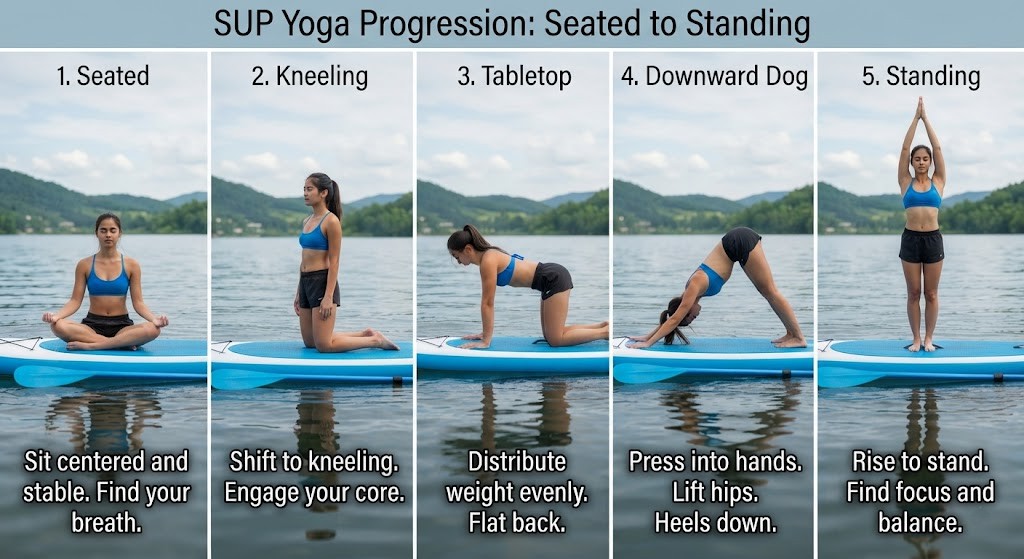
Use a Simple Progression
A simple visual progression can help you organize your workout:
Finally, remember that equipment cannot compensate for poor conditions. Good SUP yoga preparation begins with choosing the right environment, not buying more gear.
What’s Next for SUP Yoga Beginners?
The next step for SUP yoga beginners is to repeat foundational poses on calm water, improve board control, and gradually introduce more challenging movements. Progress should be based on stability and confidence rather than how advanced a pose looks.
Repeat the Beginner Flow
Repeat the 15–20 minute beginner flow for several sessions. Pay attention to which transitions feel unstable and practice those movements separately.
Build Supporting Strength and Mobility
Build supporting strength and mobility on land.
These exercises can complement your paddleboard practice by giving you additional opportunities to work on foundational movement skills away from the water.
Increase Difficulty Only When Ready
Increase difficulty only when you can maintain controlled breathing and steady movement. If you lose control during a pose, simplify the position instead of forcing it.
At the same time, consider practicing with an experienced SUP instructor when you are new to paddleboarding or unfamiliar with the local water environment.
Conclusion
SUP yoga combines traditional yoga movements with the balance demands of practicing on a stand-up paddleboard. Beginners do not need advanced yoga skills to start; they need a stable board, suitable conditions, basic water safety, and patience.
Start with Child’s Pose, Cat-Cow, Tabletop, Easy Pose, and other low-to-the-board movements. As your balance improves, gradually progress toward Downward-Facing Dog, Low Lunge, Mountain Pose, and Warrior II.
Core engagement, controlled breathing, a steady gaze, and gradual transitions can help beginners develop better board awareness. A beginner SUP yoga session should move from gentle warm-up movements and stable positions toward more challenging standing poses.
Most importantly, safe SUP yoga practice depends on choosing suitable water conditions, using appropriate equipment, controlling transitions, and progressing gradually. Your first goal is not a perfect pose—it is becoming comfortable, controlled, and confident on the board.
FAQs
What is SUP yoga?
SUP yoga is yoga practiced on a stand-up paddleboard.
Is SUP yoga good for beginners?
Yes, beginners can start with simple, stable poses.
What are the best SUP yoga poses for beginners?
Child’s Pose, Cat-Cow, Tabletop, Mountain Pose, and Warrior II are good options.
Do you need yoga experience for SUP yoga?
No, beginners can start with basic poses.
Is SUP yoga difficult?
It can be challenging because the board moves on water.
How long should a beginner SUP yoga session be?
A 15–20 minute session is a good starting point.
What equipment do you need for SUP yoga?
You need a stable paddleboard, paddle, safety gear, and water.
What water is best for SUP yoga?
Calm, sheltered water is best for beginners.
How can beginners improve SUP yoga balance?
Use a steady gaze, engage your core, and move slowly.
How often should beginners practice SUP yoga?
Beginners can start with once or twice per week.
Is SUP yoga safe?
It can be safer with proper equipment and suitable water conditions.
Can beginners do Downward-Facing Dog on a SUP?
Yes, after becoming comfortable with Tabletop.
Can beginners do Warrior II on a SUP?
Yes, once basic standing balance feels comfortable.
What should you do if you lose balance?
Stay calm, fall safely, and know how to remount the board.
How do you progress to advanced SUP yoga poses?
Master basic poses first, then gradually increase difficulty.