
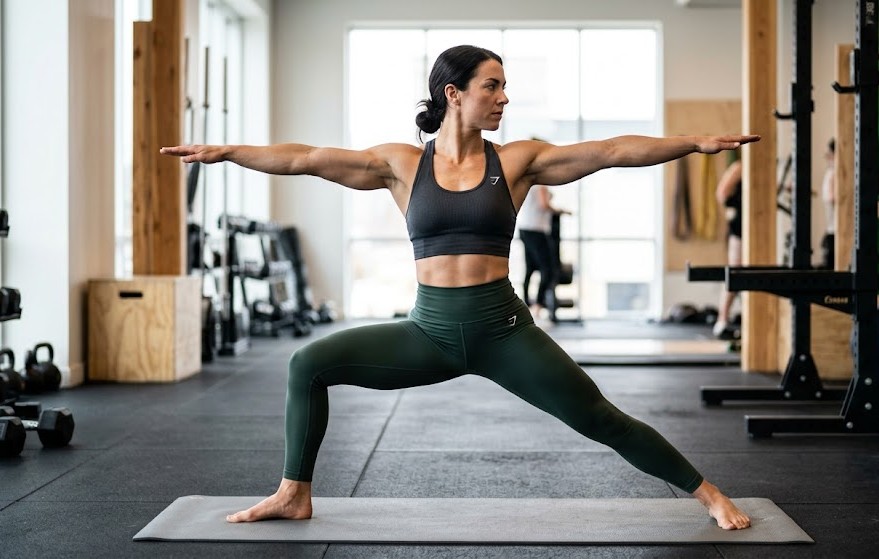
When most people picture yoga, they imagine deep breathing, gentle stretching, and the kind of calm that follows a stressful day — not muscle growth. Yet step into the right type of class and you’ll find practitioners holding extended planks, lowering into deep Chaturangas, and balancing in arm-supported poses that would humble plenty of regular gym-goers. The truth is that yoga for muscle growth is a real, trainable outcome, and it doesn’t require a single dumbbell to get there.
The missing piece for most people is understanding which yoga styles and poses generate enough resistance to actually challenge muscle fibers, and how to structure a practice so it produces measurable strength gains over time. In this guide, you’ll learn exactly how yoga builds muscle, which poses and styles deliver the biggest strength payoff, how progressive overload applies on the mat, and how to build a complete yoga-based muscle-building routine you can start this week.
What Is Yoga for Muscle Growth and How Does It Work?
Yoga for muscle growth is a strength-focused approach to practice that uses bodyweight resistance, isometric holds, and controlled movement patterns to stimulate muscle development — the same underlying process that drives results in a weight room, just powered by your own body instead of a barbell.
Traditional yoga classes often emphasize flexibility, relaxation, and general mobility, and there’s nothing wrong with that approach. Muscle-building yoga, however, shifts the focus toward poses that place sustained tension on major muscle groups and repeat movement patterns often enough to trigger adaptation. This makes it a genuinely useful option for anyone seeking a home workout without equipment that still delivers a serious strength challenge.
Muscle growth through yoga generally happens through a few overlapping mechanisms:
- Mechanical tension — holding or moving through a pose loads the targeted muscle fibers directly
- Time under tension — extended holds, like a 60-second Chair Pose, keep muscles working continuously without rest
- Metabolic stress — repeated transitions and flowing sequences create the muscular “burn” associated with hypertrophy-style training
For example, holding Chair Pose for 60 seconds creates significant tension in the quadriceps, glutes, and core, similar to what you’d feel from a weighted wall-sit.
According to the American College of Sports Medicine, muscular strength can improve through resistance-based bodyweight training when performed with sufficient intensity — Source: ACSM, 2024.
Can Yoga Really Build Muscle?
Yoga can build muscle when the training creates enough resistance, volume, and progressive overload to challenge the body consistently. A single gentle flow class won’t move the needle much, but a structured, strength-oriented practice can.
Advanced practitioners are proof of this. Many develop noticeably strong shoulders, arms, core, and legs through demanding poses such as:
- Crow Pose
- Side Plank and its extended-leg variations
- Chaturanga
- Warrior III holds
- Arm-balance and inversion work
None of these require an external weight. Bodyweight resistance alone can produce meaningful strength gains when intensity is high enough — your own body weight, held in the right position or moved through the right range often enough, is a legitimate training tool in its own right.
Why Is Yoga Beneficial for Strength and Muscle Development?
Yoga earns a place in a muscle-building plan because it develops strength, mobility, stability, and recovery all at once, rather than isolating just one of those qualities.
Many fitness programs focus almost exclusively on muscle size. Yoga, by contrast, improves both muscular development and movement quality together, which helps create a more sustainable, injury-resistant approach to long-term fitness.
Research shows that mobility limitations are associated with higher injury risk during training — Source: National Strength and Conditioning Association (NSCA), 2024.
Strength Development
Yoga challenges muscles through prolonged contractions and bodyweight loading. Poses such as Plank and Warrior III force muscles to work continuously without external support, building both strength and muscular endurance at the same time.
Functional Fitness Benefits
Yoga also improves the movement patterns used in daily activities and sports. Better balance, coordination, and core control translate directly into improved athletic performance, whether you’re an athlete or simply trying to move better in everyday life.
Improved Mobility and Flexibility
Flexibility improvements allow muscles to move through a greater range of motion, which can make strength training movements safer and more effective elsewhere in your routine. For example, deeper squatting mechanics often become noticeably easier after a few months of regular yoga practice.
For more guidance, explore our mobility workout plan.
Injury Prevention
Yoga strengthens the smaller stabilizing muscles that support your joints, which can reduce the overuse injuries commonly seen in repetitive training programs like running or weightlifting.
For more information, see our injury prevention exercises.
Sustainable Long-Term Training
Finally, yoga places less impact on the joints compared to heavy resistance training. That lower-impact nature makes it easier for many people to stick with their training consistently, which matters more for long-term muscle growth than any single workout ever will.
How Does Progressive Overload Apply to Yoga Training?
Progressive overload in yoga involves increasing pose difficulty, hold duration, training volume, or movement complexity over time. Muscle growth happens when muscles are repeatedly exposed to greater demands, and yoga follows the exact same physiological principle as traditional resistance training.
Increase Time Under Tension
Holding Plank Pose for 30 seconds today and 60 seconds next month creates additional muscular demand without changing the exercise itself.
Progress to Advanced Variations
Moving from a standard Side Plank to an extended-leg Side Plank increases the resistance and muscle recruitment required to hold the position.
Add More Volume
Performing multiple sets of challenging poses, rather than just one round, increases total workload and gives your muscles more reason to adapt.
Progressive overload remains the primary driver of long-term muscle growth, regardless of whether that overload comes from a barbell or your own body weight.
Which Types of Yoga Are Best for Muscle Growth?
Not all yoga styles are created equal when the goal is muscle growth. Power Yoga, Ashtanga Yoga, Vinyasa Yoga, Rocket Yoga, and Strength-Based Yoga are the most effective styles for building muscle.
Power Yoga
Power Yoga emphasizes strength, endurance, and athletic movement patterns. This style includes numerous push-up variations, planks, and challenging standing sequences that keep the body under tension for extended periods.
Readers interested in a structured plan can explore a dedicated best power yoga workou.
Ashtanga Yoga
Ashtanga Yoga uses structured, repeatable sequences that progressively challenge strength and muscular endurance session after session. For example, repeated Chaturanga transitions throughout a single class create substantial upper-body loading.
Vinyasa Yoga
Vinyasa Yoga combines flowing movement with strength-focused transitions. This style often includes dynamic sequences that keep muscles engaged continuously, rather than allowing extended rest between poses.
Rocket Yoga
Rocket Yoga incorporates advanced arm balances and strength-intensive postures. As a result, practitioners frequently develop significant upper-body and core strength over time.
Strength-Based Yoga
Strength-Based Yoga specifically targets muscular development through longer holds and progressive difficulty, making it the most direct yoga style for anyone training with hypertrophy as a primary goal.
What Are the Best Yoga Poses for Building Muscle?
The best yoga poses for muscle growth are compound movements that recruit multiple muscle groups simultaneously. Poses like Chaturanga, Plank, and the Warrior variations engage several muscle groups at once and contribute meaningfully to strength development.
| Yoga Pose | Primary Muscles Worked | Muscle-Building Benefit |
|---|---|---|
| Chaturanga | Chest, shoulders, triceps | Upper-body strength |
| Chair Pose | Quads, glutes, core | Lower-body endurance |
| Warrior I | Legs, shoulders | Full-body stability |
| Warrior II | Glutes, quads, core | Functional strength |
| Warrior III | Hamstrings, glutes | Balance and power |
| Plank Pose | Core, chest, shoulders | Total-body tension |
| Side Plank | Obliques, shoulders | Core strength |
| Crow Pose | Arms, shoulders, core | Advanced upper-body strength |
| Dolphin Pose | Shoulders, triceps | Pressing strength |
| Boat Pose | Core, hip flexors | Abdominal development |

Upper Body Muscle Builders
Chaturanga, Crow Pose, Dolphin Pose, and Side Plank effectively challenge the chest, shoulders, and triceps. These poses can complement an upper body strength workout.
Core Strength Builders
Boat Pose, Plank Pose, and Side Plank rank among the best core strengthening exercises.
What Is the Best Yoga Workout Routine for Muscle Growth?
The best yoga workout routine for muscle growth combines progressive, strength-focused poses with adequate recovery between sessions. Below are two starting points, depending on your current experience level.
Beginner Yoga Muscle-Building Routine
This routine works well for new practitioners who are still building foundational strength and control:
- Chair Pose – 3 x 30 seconds
- Plank Pose – 3 x 30 seconds
- Warrior I – 3 x 30 seconds each side
- Boat Pose – 3 x 20 seconds
- Dolphin Pose – 3 x 20 seconds
For additional guidance, follow a beginner yoga workout.
Intermediate Yoga Muscle-Building Routine
This routine increases both intensity and volume once the basics feel manageable:
- Chaturanga – 4 x 10 reps
- Warrior III – 4 x 30 seconds
- Side Plank – 4 x 30 seconds
- Crow Pose Practice – 10 minutes
- Boat Pose – 4 x 40 seconds
Sample Weekly Training Schedule
| Day | Workout |
|---|---|
| Monday | Strength Yoga |
| Tuesday | Recovery Yoga |
| Wednesday | Strength Yoga |
| Thursday | Mobility Session |
| Friday | Strength Yoga |
| Saturday | Optional Cardio |
| Sunday | Rest |
You can also integrate a full body yoga routine into your weekly plan for additional variety.
Can Yoga Build Muscle as Effectively as Weight Training?
Yoga can build muscle effectively, but traditional weight training generally produces greater hypertrophy potential. External weights allow for easier, more precise progression and higher mechanical loading, which often leads to faster increases in muscle size.

Similarities Between Yoga and Weight Training
Both training methods:
- Create muscular tension
- Improve strength
- Require progressive overload to keep producing results
- Support functional fitness
- Enhance overall body composition
Key Differences
| Factor | Yoga | Weight Training |
|---|---|---|
| Resistance Source | Bodyweight | External load |
| Flexibility Benefits | High | Moderate |
| Hypertrophy Potential | Moderate | High |
| Joint Impact | Lower | Higher |
| Equipment Needed | Minimal | Often required |
When Should You Combine Both?
Combining yoga with strength training can improve muscle development, mobility, recovery, and overall athletic performance more than either approach alone. Many athletes perform yoga on recovery days while following their regular strength training exercises on other days of the week.
What Mistakes Prevent Muscle Growth During Yoga Practice?
Even a well-designed yoga practice can stall out if a few key habits slip. The most common mistakes include insufficient intensity, lack of progression, poor nutrition, inconsistent training, and inadequate recovery.
Lack of Progression
Repeating the same easy poses for months without increasing difficulty limits adaptation, no matter how consistently you show up.
Insufficient Intensity
Muscles need a meaningful challenge to grow. If a pose feels easy from the first second to the last, it’s likely not doing much for muscle development.
Poor Nutrition
Inadequate calorie and protein intake reduces your muscle-building potential, regardless of how hard your sessions are.
Inconsistent Practice
Sporadic sessions fail to provide enough training stimulus for the body to adapt in a meaningful way.
Recovery Mistakes
Poor sleep and excessive training can slow recovery and blunt growth. For recovery strategies, explore the best recovery exercises.
What Should You Eat to Support Muscle Growth From Yoga?
Nutrition supports yoga-based muscle growth by providing the energy and building blocks required for muscle repair and adaptation. Training alone, without the right fuel, will only get you so far.
Protein Intake
Research suggests active individuals seeking muscle growth often benefit from approximately 1.6–2.2 grams of protein per kilogram of body weight daily — Source: International Society of Sports Nutrition, 2024.
A high protein diet plan can help you meet these targets without overcomplicating your meals.
Calorie Surplus
A modest calorie surplus supports muscle-building goals. Consuming roughly 200–300 calories above maintenance can help maximize gains without leading to excessive fat gain.
Hydration
Proper hydration supports performance, recovery, and overall muscle function, including during longer hold-based yoga sessions where sustained effort matters.
Recovery Nutrition
Consuming protein and carbohydrates after training supports adaptation and recovery. Learn more about muscle recovery nutrition.
Adequate protein intake and recovery are essential for maximizing muscle growth, regardless of whether your training comes from yoga or traditional resistance exercise.
How Often Should You Practice Yoga to Build Muscle?
Most people should practice strength-focused yoga three to five times per week to support muscle growth. Beginners often respond well to three weekly sessions, while intermediate practitioners can increase frequency based on their recovery capacity.
Research indicates that training muscle groups at least twice weekly generally supports greater hypertrophy than once-weekly training — Source: Journal of Strength and Conditioning Research, 2024.
How Long Does It Take to See Muscle-Building Results From Yoga?
Most people begin noticing strength improvements within 4–8 weeks and visible muscular changes within 8–16 weeks. Consistent practice combined with proper nutrition often leads to improved muscle definition, posture, and endurance during this period.
Consistency produces more muscle growth than occasional high-intensity workouts, so steady, repeatable effort matters more than going all-out once a month.
Tools, Examples, and Practical Applications
Practical tools can help track progress and improve your results from yoga-based muscle-building training.
Recommended Tools
- Yoga blocks
- Resistance bands
- Yoga straps
- Fitness tracking apps
- Workout journals


Free Alternatives
- Google Sheets workout tracker
- Smartphone notes app
- Free yoga timer apps
What’s Next: Creating Your Yoga Muscle-Building Plan
A successful yoga muscle-building plan combines clear goals, structured progression, and consistent tracking.
- Define your primary objective — for example, bigger shoulders, stronger legs, or improved overall athletic performance.
- Track measurable progress such as hold times, repetitions, body measurements, and strength improvements.
- Gradually increase training difficulty every few weeks rather than staying at the same level indefinitely.
- Consider combining yoga with resistance training for faster, more complete muscle-building results.
Small weekly improvements create significant long-term strength gains, even when each individual session feels incremental.
Conclusion
Yoga for muscle growth is a practical and effective training method that builds strength, muscular endurance, mobility, and body control all at once. While yoga may not match heavy resistance training for maximum hypertrophy, it can still stimulate meaningful muscle development through progressive overload, isometric holds, and challenging bodyweight movements like Chaturanga, Plank, and Warrior III.
By practicing consistently, eating enough protein, and gradually increasing training difficulty, you can build real muscle while also improving flexibility and overall athletic performance. Start with a few strength-focused sessions each week, stay patient with the process, and let progressive improvement — not occasional intensity — drive your long-term results.
FAQs
Can yoga alone build noticeable muscle?
Yes, strength-focused yoga styles can build noticeable muscle when practiced consistently and with enough intensity.
How is yoga different from regular stretching for muscle growth?
Yoga uses bodyweight resistance and sustained holds to build strength, while stretching mainly improves flexibility and mobility.
Which yoga pose builds the most muscle?
Poses like Chaturanga, Chair Pose, and Plank Pose are among the best for building muscle and strength.
Do I need props or equipment to build muscle with yoga?
No, your body weight is enough. Props can help improve form and progression but are not required.
Can beginners build muscle with yoga, or is it only for advanced practitioners?
Yes, beginners can build muscle by practicing foundational poses and gradually increasing difficulty over time.
Should I do yoga instead of weight training, or alongside it?
For best results, combine yoga with weight training. Yoga improves mobility and stability, while weights help build muscle faster.