
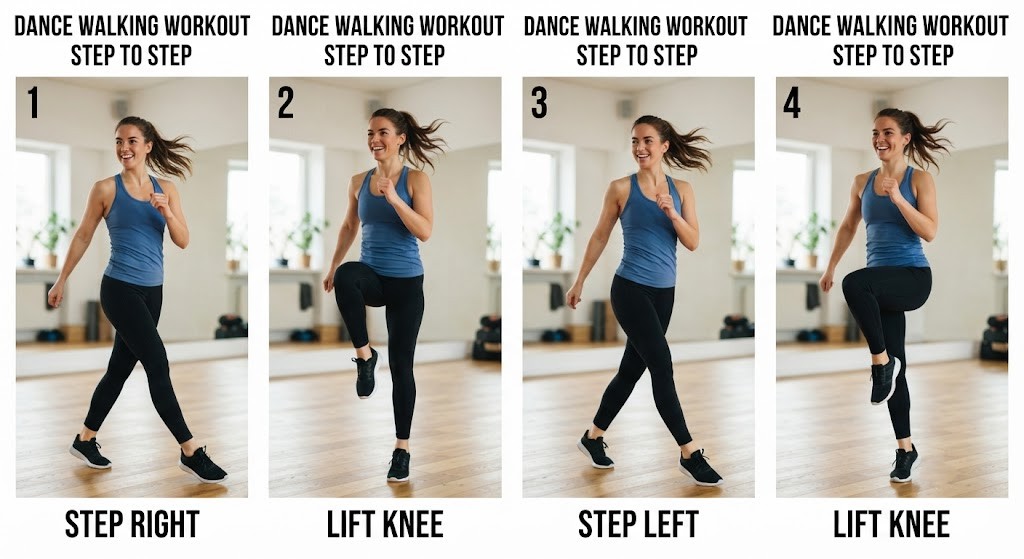
Walking is one of the simplest ways to become more active, but doing the same steps every day can eventually feel repetitive. A dance walking workout adds rhythm, simple dance-inspired movements, coordinated arm patterns, and changes in direction to make walking more engaging.
The good news is that you do not need advanced dance skills, special equipment, or a large workout space. In this guide, you’ll learn what dance walking is, how it works, the benefits it can provide, beginner-friendly dance walking moves, how to do it at home, how long to exercise, and how to build a sustainable routine.
What Is a Dance Walking Workout?
Dance walking is a cardio workout that combines walking patterns with rhythmic, dance-inspired movements such as step touches, side steps, knee lifts, and coordinated arm movements. Unlike ordinary walking, a dance walking workout intentionally introduces changes in rhythm, direction, footwork, and arm patterns.
For example, you might march forward for 30 seconds, perform step touches for 30 seconds, add alternating knee lifts, and then return to a steady walking pattern. The result is a continuous walking dance workout that adds variety without requiring complicated choreography.
Dance walking can be performed indoors, outdoors, or in a small open area at home. If you are new to walking-based exercise, see our guide to Retro Walking Workout.
Dance Walking vs. Regular Walking
Dance walking differs from regular walking because it combines basic walking with rhythmic and dance-inspired movements. Traditional walking generally involves repetitive forward movement, while dance walking can include side-to-side steps, knee lifts, heel digs, coordinated arm movements, and changes in rhythm.
| Feature | Regular Walking | Dance Walking |
|---|---|---|
| Primary movement | Forward walking | Walking plus dance patterns |
| Rhythm | Usually steady | Often changes with music |
| Direction | Mainly forward | Forward, backward, and sideways |
| Arm movements | Natural swing | Coordinated patterns |
| Coordination demand | Low | Low to moderate |
| Equipment | Usually none | Usually none |
| Indoor use | Possible | Especially practical |
Neither type of walking is automatically better. The most useful workout is one you can perform consistently at an appropriate intensity.
Why Does Dance Walking Matter?
Dance walking matters because it can turn simple walking into a more varied form of aerobic activity while making movement more enjoyable. Adding different steps and arm patterns can challenge coordination, balance, muscular endurance, and cardiovascular fitness while helping you spend less time being sedentary.
For example, combining marching with side steps requires you to control your feet, posture, and arm movements at the same time. This can make an otherwise basic walking session feel more engaging.
Regular physical activity also provides immediate and long-term health benefits, including better sleep, reduced anxiety, improved cardiovascular health, and a lower risk of several chronic conditions. — Source: [CDC, 2026]
In addition, nearly 31% of adults worldwide, or approximately 1.8 billion people, did not meet recommended physical activity levels in 2022. — Source: [WHO, 2024]
As a result, an enjoyable activity such as dance walking may be useful when it helps you replace sedentary time with regular movement. For more accessible exercise options, explore our low-impact workouts.
How Does a Dance Walking Workout Work?
A dance walking workout typically alternates basic walking or marching patterns with simple dance movements while maintaining a comfortable, continuous rhythm. As your coordination improves, you can progress from individual movements to longer combinations.
A simple sequence might include:
- 60 seconds of marching
- 30 seconds of step touches
- 30 seconds of alternating knee lifts
- 60 seconds of relaxed walking
You can repeat or modify the sequence according to your fitness level and available space.
A Simple Dance Walking Pattern
A beginner dance walking pattern uses repeated movements that are easy to learn, control, and modify. Start with each movement for approximately 30–60 seconds before transitioning to the next.
Try this sequence:
- March in place for 60 seconds.
- Step right and touch, then step left and touch for 60 seconds.
- Add alternating knee lifts for 30 seconds.
- Perform gentle heel digs for 30 seconds.
- Walk forward and backward for 60 seconds.
- Repeat the sequence at a comfortable pace.
You can coordinate your arms with each movement, but arm patterns should never compromise your balance or posture. If coordinating your arms and legs becomes difficult, keep your arms relaxed and focus on your footwork first.
What Are the Best Dance Walking Moves for Beginners?
The best dance walking moves for beginners are simple rhythmic movements that add variety without requiring advanced choreography. Focus on controlled movement and a comfortable pace before attempting faster combinations.
Start with one movement, become comfortable with the rhythm, and then gradually combine it with another.
1. March and Step Touch
Marching is an excellent foundation for dance walking because it allows you to control your pace while continuously moving. Lift one foot at a time while keeping your torso upright and your steps comfortable.
Next, try a step-touch pattern. Step sideways with one foot and bring the opposite foot toward it without putting excessive weight on the touching foot. Repeat from side to side.
If you have limited space, keep the steps small rather than trying to travel across the room.
2. Side Steps and Knee Lifts
Side steps add lateral movement, while knee lifts introduce additional coordination and rhythmic variety. Begin by stepping gently from side to side, then add alternating knee lifts once the pattern feels natural.
For a lower-impact variation, keep the knee lift small and avoid bouncing. This makes the movement more approachable if you are new to dance cardio.
3. Heel Digs and Grapevine-Style Steps
Heel digs involve placing one heel slightly forward while keeping the movement controlled and rhythmic. Alternate between your heels while using relaxed arm movements.
Grapevine-style steps can add another coordination challenge by combining side steps with a crossing pattern. If the cross-step feels difficult, simplify the movement by performing repeated side steps instead.
4. Arm Swings and Dance Combinations
Coordinated arm movements can make a dance walking workout feel more rhythmic without requiring complicated choreography. Try natural arm swings, gentle overhead reaches, or alternating forward punches without locking your elbows.
For example, perform four step touches with natural arm swings, followed by four knee lifts with opposite-hand reaches. This creates a simple walking workout with dance moves that can be repeated with different rhythms.
How Do You Do a Dance Walking Workout at Home?
You can do a dance walking workout at home by combining a warm-up, rhythmic walking movements, short recovery periods, and a cool-down. A structured routine makes it easier to control your intensity instead of immediately trying to follow complicated choreography.
A 25-minute beginner session, for example, can include 5 minutes of warm-up, 15 minutes of dance walking, and 5 minutes of cool-down.
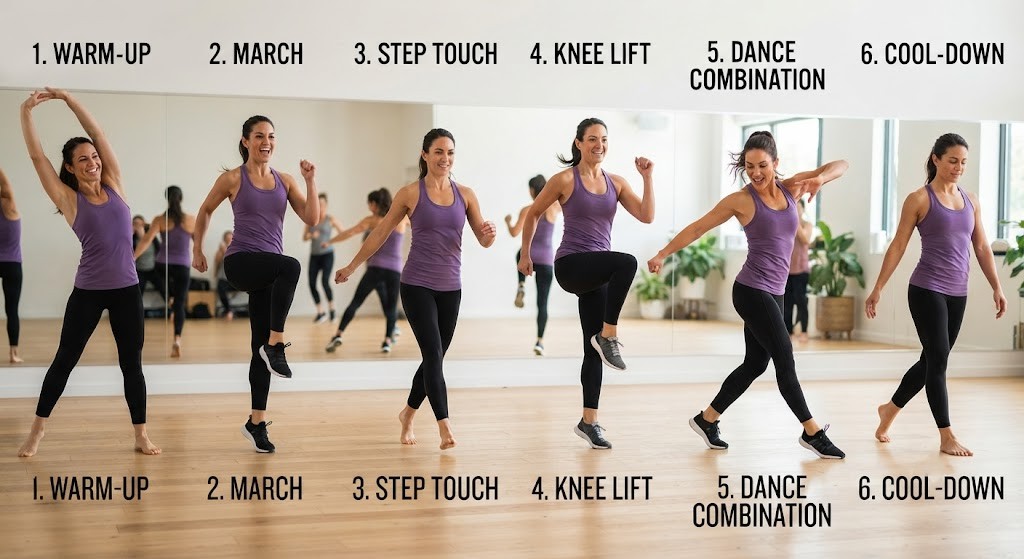
25-Minute Beginner Dance Walking Routine
A 25-minute dance walking routine gives beginners enough time to practice several movements while keeping the session manageable.
- Minutes 0–5 — Warm-up: Easy marching, shoulder rolls, gentle side steps, and relaxed arm swings.
- Minutes 5–8 — Basic walking: March forward, backward, or in place at an easy pace.
- Minutes 8–12 — Step touches: Alternate side steps with natural arm movements.
- Minutes 12–16 — Knee lifts: Use alternating knee lifts and reduce the height if necessary.
- Minutes 16–20 — Dance combination: Combine marching, side steps, heel digs, and arm movements.
- Minutes 20–25 — Cool-down: Gradually slow your pace and finish with comfortable mobility movements.
You do not have to complete 25 minutes immediately. Starting with 10–15 minutes of low-impact dance walking is reasonable, particularly if you are new to exercise. You can then increase the duration gradually as your fitness and comfort improve.
For another structured approach, see our beginner workout routine.
What Are the Benefits of Dance Walking?
Dance walking can support cardiovascular fitness, coordination, balance, muscular endurance, and daily physical activity when performed consistently. However, the exact benefits depend on factors such as workout intensity, duration, frequency, and your overall activity level.
For example, increasing your pace during a song can make a session more demanding, while using smaller movements can create a gentler workout.
Is Dance Walking a Good Cardio Workout?
Dance walking can be a good cardio workout when it raises your heart rate and is performed at a moderate or higher intensity appropriate for your fitness level. The fact that an activity is called dance walking does not automatically determine its intensity; how hard your body is working matters.
Adults are generally advised to complete 150–300 minutes of moderate-intensity aerobic activity per week, or an equivalent combination of moderate and vigorous activity. — Source: [WHO, 2026]
Adults are also advised to perform muscle-strengthening activities on at least two days per week. — Source: [CDC, 2023]
Therefore, dance walking can contribute to your weekly aerobic activity, but it should ideally complement rather than replace strength training.
Can Dance Walking Help With Weight Loss?
Dance walking can contribute to weight management by increasing physical activity and energy expenditure, but it does not guarantee weight loss. Changes in body weight depend on several factors, including total physical activity, food intake, sleep, genetics, and individual energy needs.
For example, consistently replacing sedentary time with 20-minute dance walking sessions may increase daily activity. However, the resulting change in body weight can vary from person to person.
The CDC also notes that the amount of physical activity needed to maintain a healthy weight varies by individual. — Source: [CDC, 2026]
How Long Should a Dance Walking Workout Last?
A dance walking workout can last anywhere from 10 minutes to 30 minutes or longer, depending on your fitness level, schedule, and workout intensity. Beginners can start with shorter sessions and gradually increase the duration.
For example, you might begin with 10–15 minutes three times per week and progress toward 20–30-minute sessions.
Adults can work toward the recommended weekly activity range by spreading moderate activity across multiple days. 150 minutes per week equals about 30 minutes on five days, although activity can be organized around an individual’s schedule. — Source: [CDC, 2023]
The important factor is building a routine you can maintain consistently rather than forcing yourself into sessions that are unnecessarily long.
Do You Need Equipment for a Dance Walking Workout?
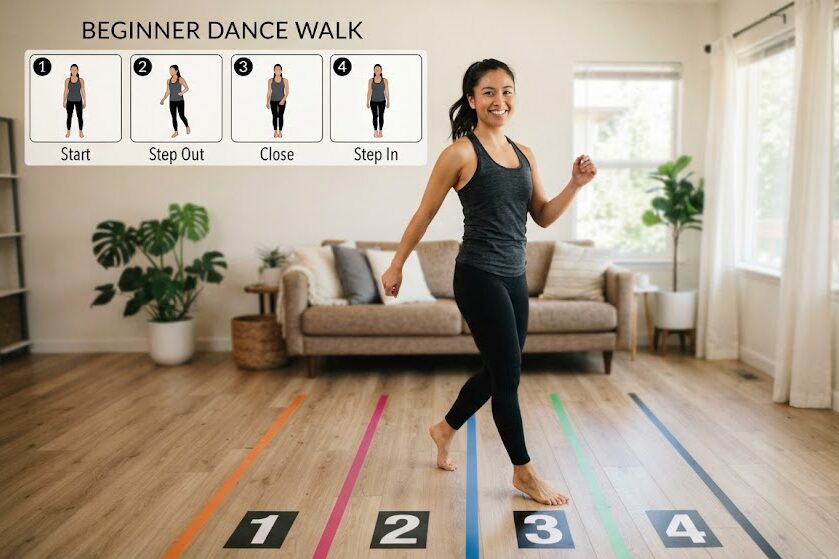
A dance walking workout generally requires little or no equipment. Supportive footwear, comfortable clothing, water, and enough clear floor space are usually sufficient.
You can perform an indoor dance walking workout in a living room, for example, by marching in place and using small side-to-side movements.
Useful additions include:
- Supportive athletic shoes
- Comfortable workout clothing
- Water bottle
- Music or headphones
- A timer
- Optional exercise mat for cool-down mobility
How Can Beginners Make Dance Walking Easier and Safer?
A safe dance walking workout includes a gradual warm-up, controlled movements, adequate space, supportive footwear, and modifications suited to your fitness level. Beginners should increase duration and intensity gradually rather than trying to immediately match advanced routines.
For example, if knee lifts feel uncomfortable, perform smaller knee lifts or simply return to marching in place.
Beginner Safety Modifications
Low-impact modifications can reduce unnecessary impact while allowing you to keep moving. You can modify dance walking by keeping one foot closer to the floor, shortening your range of motion, or slowing the rhythm.
Try these adjustments:
- Replace jumping with step touches.
- Keep knee lifts below hip height.
- Use smaller side steps in tight spaces.
- Reduce arm movements when balance is difficult.
- Take recovery periods whenever needed.
- Stop if you experience unusual pain, dizziness, or significant discomfort.
People with chronic health conditions, disabilities, or specific exercise limitations may benefit from discussing appropriate activity with a healthcare professional. — Source: [CDC, 2025]
For ideas that can complement your workouts, explore our Compression Boots Benefits for Recovery.
How Can You Progress Your Dance Walking Routine?
The simplest way to progress with dance walking is to increase duration, movement variety, or intensity gradually rather than changing everything at once. Consistent practice gives you time to become more comfortable with rhythm, balance, and coordination.
For example, you could begin with three 10–15-minute sessions during your first week and gradually progress toward 20–25-minute sessions.
Four-Week Dance Walking Progression
| Week | Sessions | Suggested Duration | Main Focus |
|---|---|---|---|
| Week 1 | 3 | 10–15 min | Basic movements |
| Week 2 | 3–4 | 15–20 min | Rhythm and coordination |
| Week 3 | 4 | 20–25 min | Longer combinations |
| Week 4 | 4–5 | 20–30 min | Endurance and variety |
You can also make each session more engaging by changing your music, movement combinations, or direction while keeping the overall intensity manageable.
As your fitness improves, add dance walking alongside cardio workouts , strength sessions, and mobility work. You can also turn your progress into one of your fitness challenges.
At the same time, dance walking does not need to become your only form of exercise. A balanced routine can include strength training, aerobic activity, mobility, and recovery.
Tips to Make Dance Walking More Enjoyable
One of the biggest advantages of a dance walking workout is its flexibility. You can adjust the movements to your preferred music, available space, and fitness level.
To keep your sessions interesting:
- Alternate between faster and slower songs.
- Change between forward, backward, and lateral movement.
- Combine two or three familiar moves rather than learning complicated choreography.
- Use smaller movements when exercising in a limited space.
- Focus on rhythm and consistency instead of perfection.
- Increase intensity gradually as the movements become easier.
The goal is not to perform a perfect dance routine. Instead, use simple movements to make walking more dynamic and enjoyable.
Conclusion: Make Walking More Fun With Dance
Dance walking is a practical way to combine walking, rhythmic movement, and simple dance patterns into an enjoyable cardio workout. Marches, step touches, side steps, knee lifts, heel digs, and coordinated arm movements provide enough variety to create an accessible routine for beginners.
When practiced consistently, dance walking can support cardiovascular fitness, coordination, balance, muscular endurance, and overall physical activity. It can also be adapted to small indoor spaces and modified for different fitness levels.
Start with 10–15 minutes, keep your movements controlled, and progress gradually. If you enjoy moving to a rhythm, a dance walking workout can transform an ordinary walking session into a more engaging habit that you may actually look forward to.
FAQs
What is dance walking?
Dance walking combines walking with simple dance moves like step touches, knee lifts, and arm movements.
What is a dance walking workout?
A dance walking workout combines rhythmic walking patterns with simple dance-inspired movements for cardio.
Is dance walking a good workout?
Yes, dance walking can improve cardio fitness, coordination, balance, and muscular endurance.
Can beginners do a dance walking workout?
Yes, beginners can start with simple, low-impact dance walking movements.
How long should I do a dance walking workout?
Beginners can start with 10–15 minutes and gradually increase the workout duration.
Can you do dance walking at home?
Yes, dance walking can be done at home with minimal space and little or no equipment.
Does dance walking help with weight loss?
Dance walking can support weight management by increasing physical activity and energy expenditure.
What are the best dance walking moves for beginners?
Marches, step touches, side steps, knee lifts, heel digs, and arm swings are beginner-friendly moves.
Is dance walking low impact?
Yes, dance walking can be low impact when you avoid jumping and use controlled movements.
What is the 3-3-3 rule for workout?
The 3-3-3 rule can have different meanings and is not a universally defined workout method.
Can I lose belly fat by dancing?
Dancing can support overall fat loss, but it cannot specifically target belly fat.
Is dancing a better workout than walking?
Neither is always better; the best choice depends on your intensity, goals, and consistency.
2 thoughts on “Dance Walking Workout: Fun Cardio to Boost Fitness & Burn Calories”