
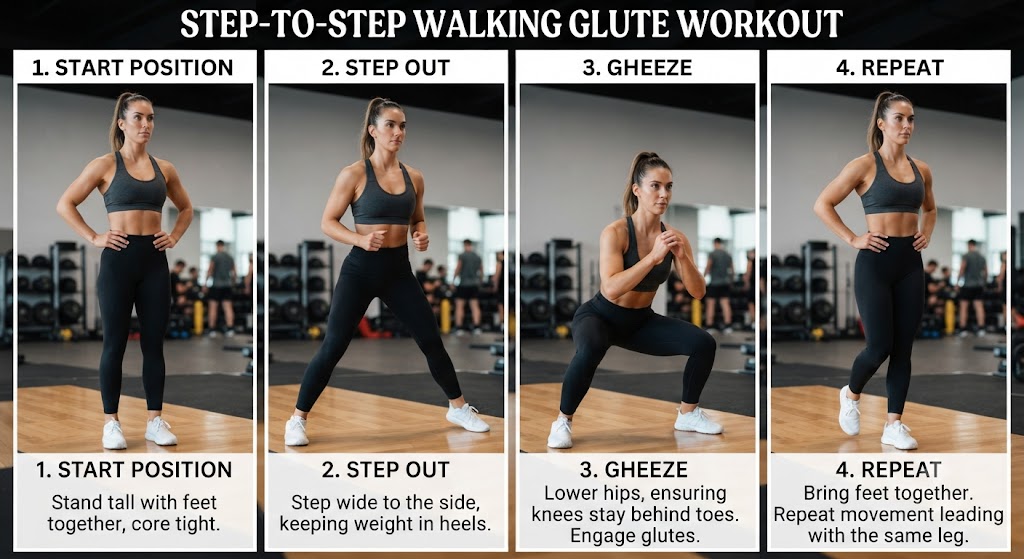
You may already walk regularly for fitness, weight management, or simply to stay active. But there is a big difference between a casual walk and a walking glute workout designed to place more emphasis on your lower body.
By adjusting your incline, pace, terrain, intervals, and strength exercises, you can turn an ordinary walk into a more purposeful workout. This approach can increase lower-body demand while keeping walking as a relatively accessible, low-impact form of exercise.
In this guide, you’ll learn how a walking glute workout works, which walking variations can increase lower-body demand, how long to walk, which glute exercises to add, how to progress your routine, and how often to train.
What Is a Walking Glute Workout?
A walking glute workout is a structured walking session that increases glute involvement through changes in incline, pace, terrain, intervals, or complementary strength exercises. Unlike an easy stroll, it deliberately changes walking intensity to create a greater challenge for the lower body.
Walking uphill, for example, requires you to move your body against gravity. This can increase both muscular and cardiovascular demand compared with relaxed walking on level ground.
Walking can also remain a relatively low-impact activity while becoming more challenging. If you already enjoy a Dance Walking Workout, adding hills, incline segments, or brisk intervals can make your regular routine more purposeful.
Why Does a Walking Glute Workout Matter?
A walking glute workout combines accessible cardiovascular activity with deliberate lower-body muscular demand. It can be particularly useful if you do not enjoy running or want to make walking more challenging without turning your workout into a running session.
The intensity of walking can vary considerably depending on speed and terrain. The 2024 Adult Compendium of Physical Activities assigns about 3.8 METs to moderate walking at 2.8–3.4 mph, compared with 5.3 METs for moderate-to-brisk hill walking at a 1–5% grade and 7.0 METs for 6–10% grades. — Source: [Compendium of Physical Activities, 2024]
Walking is valuable for general physical activity, but dedicated resistance training provides a stronger stimulus when maximizing muscle growth is the primary goal. The CDC recommends adults accumulate at least 150 minutes of moderate-intensity aerobic activity each week plus muscle-strengthening activity on at least 2 days per week. — Source: [CDC, 2025]
For variety, you can also combine walking with low-impact workouts to create a broader fitness routine.
How Does Walking Activate the Glute Muscles?
Walking activates the glute muscles primarily through hip extension and stabilization as your body moves forward and upward. The gluteus maximus contributes strongly to hip extension, while the gluteus medius and other hip muscles help stabilize the pelvis.
The demands can increase when the walking surface changes. When you walk uphill, for instance, you must push your body upward against gravity, increasing the overall workload on the lower body.
Incline and hill walking can increase lower-body demand compared with easy walking on a flat surface. The Compendium lists hill walking at a 6–10% grade at 7.0 METs versus 3.8 METs for moderate level walking at 2.8–3.4 mph. — Source: [Compendium of Physical Activities, 2024]
What Walking Techniques Increase Glute Activation?
Walking techniques that can increase glute involvement include incline walking, hill walking, brisk pacing, controlled uphill steps, and varied terrain. These strategies allow you to increase the challenge without necessarily increasing your workout to a running pace.
A treadmill incline is particularly convenient because you can adjust the elevation while maintaining a controlled walking speed.
However, technique still matters. Avoid taking excessively long steps or leaning heavily on treadmill handrails. Instead, maintain a controlled torso, take comfortable steps, and allow your legs to drive naturally through each stride.
What Are the Best Walking Variations for Glute Activation?
The best walking variations for glute activation include incline walking, hill walking, brisk walking, stair walking, and varied-terrain walking. Each variation changes the demands placed on your lower body.
| Walking Variation | Main Benefit | Difficulty |
|---|---|---|
| Flat brisk walking | Pace and endurance | Beginner |
| Incline walking | Increased uphill demand | Beginner–Intermediate |
| Hill walking | Natural resistance | Intermediate |
| Stair walking | High lower-body demand | Intermediate |
| Varied-terrain walking | Balance and muscular challenge | Intermediate |
| Backward walking | Different movement demand | Advanced |
Incline Walking
Incline walking is one of the simplest ways to increase workout difficulty on a treadmill. You can gradually increase the incline without needing to substantially increase your walking speed.
For example, walk comfortably for 3 minutes at 0–2% incline, then walk for 2 minutes at 5–8% before returning to a lower incline.
Hill Walking
Outdoor hills provide natural resistance and can make a regular walk considerably more challenging. You can use short uphill sections as intervals and recover during flatter or downhill portions.
Stair Walking
Stair walking creates a substantially higher lower-body demand and should be introduced gradually, particularly if you are new to structured exercise.
The Compendium lists general stair climbing at 6.8 METs, while fast stair climbing is listed at 9.3 METs. — Source: [Compendium of Physical Activities, 2024]
For a more detailed treadmill-based approach, see our incline walking workout guide.
Varied-Terrain Walking
Walking over different surfaces and elevations can introduce changes in balance and muscular demand. Trails, gentle hills, and other varied terrain can make a walking session more dynamic.
Backward Walking
Backward walking creates a different movement demand and is best reserved for more experienced exercisers who can perform it safely in an appropriate environment.
What Is the Best Walking Workout for Glutes?
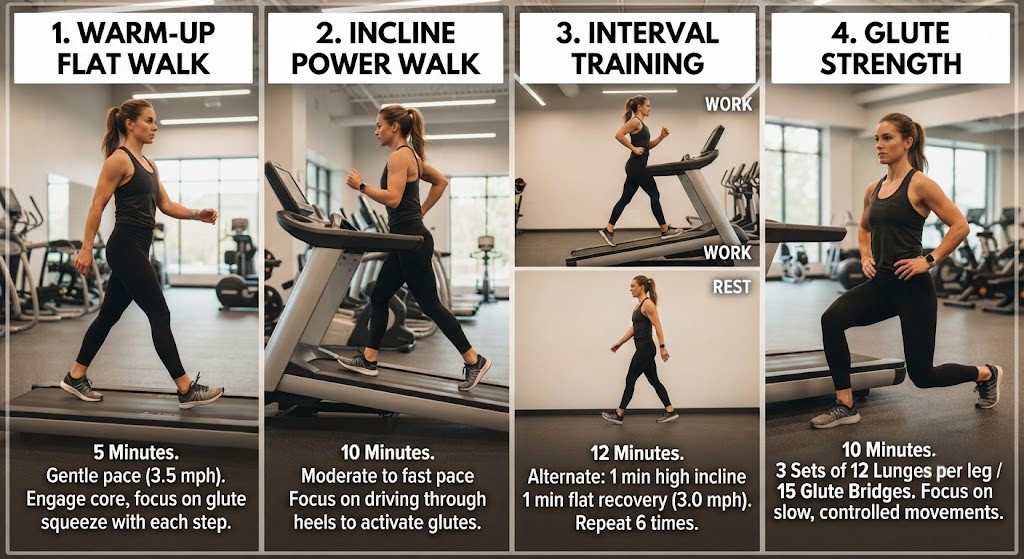
The best walking workout for glutes combines a warm-up, brisk walking, incline or hill intervals, recovery periods, and a cooldown. Rather than making every interval extremely intense, the goal is to create a structured and repeatable challenge.
A good walking glute workout should feel purposeful while still allowing you to maintain controlled movement and proper posture.
How Do You Do a Walking Glute Workout for Beginners?
A beginner walking glute workout can last about 25–30 minutes and alternate comfortable walking with short incline or brisk intervals.
Try this simple routine:
- Warm up — 5 minutes: Walk comfortably on a flat surface.
- Brisk walk — 5 minutes: Increase your pace while staying controlled.
- Glute interval — 2 minutes: Walk uphill or use a moderate treadmill incline.
- Recovery — 2 minutes: Return to an easy pace and lower the incline.
- Repeat — 3 rounds: Alternate the glute interval and recovery.
- Cooldown — 5 minutes: Gradually reduce your pace.
This creates a practical 29-minute walking glute workout without requiring weights or complicated equipment.
If you are completely new to structured walking, begin with a Brisk Walking Workout and gradually introduce glute-focused intervals.
How Long Should You Walk for a Glute Workout?
A walking glute workout can be effective in 25–45 minutes, depending on your fitness level, intensity, and weekly training schedule. Longer workouts are not automatically better because workout quality and recovery also matter.
A beginner might complete a 25-minute session with three incline intervals. An intermediate walker could progress toward 40 minutes with six controlled uphill intervals.
Consistency is more important than making every workout exhausting. The CDC recommends at least 150 minutes of moderate aerobic activity per week for adults, which can include brisk walking. — Source: [CDC, 2025]
What Glute Exercises Can You Add to a Walking Workout?
Glute exercises can complement walking by providing direct resistance that walking alone may not provide. Useful exercises include glute bridges, squats, reverse lunges, step-ups, and lateral movements.
For example, you could walk for 10 minutes, complete a short glute-strengthening circuit, and then return to walking.
Simple Walking-and-Glute Strength Circuit
- Glute bridges: 12–15 repetitions
- Bodyweight squats: 10–15 repetitions
- Reverse lunges: 8–10 per leg
- Step-ups: 8–12 per leg
- Lateral band walks: 10–15 steps per direction
You can perform the exercises as a single circuit or incorporate selected movements between walking intervals.
ACSM’s 2026 resistance-training guidance emphasizes that resistance training supports strength and hypertrophy, and that bodyweight exercises, elastic bands, and home-based routines can produce meaningful benefits. — Source: [ACSM, 2026]
For additional lower-body training, explore our leg workouts and inner thigh workout resources.
Can Walking Build Glute Muscles Without Weights?
Walking can support glute endurance and lower-body fitness without weights, but dedicated resistance exercises are generally more effective for maximizing glute muscle growth.
Changing the incline, pace, terrain, or interval structure can make walking more demanding. However, walking may not provide enough progressive resistance to create the same muscle-building stimulus as progressively loaded strength exercises.
For example, an uphill walking interval can challenge your legs more than a relaxed flat walk. In contrast, progressively loaded squats or lunges can provide a more direct resistance stimulus for muscle growth.
ACSM’s 2026 position stand reviewed evidence from more than 137 studies involving over 30,000 participants and provides updated guidance on resistance training for muscle function and hypertrophy. — Source: [ACSM, 2026]
Therefore, if your primary goal is cardiovascular fitness and muscular endurance, walking can play a major role. If maximizing glute hypertrophy is the priority, combine walking with progressive resistance training.
What Tools Do You Need for a Walking Glute Workout?
A walking glute workout requires very little equipment. A treadmill, hills, stairs, comfortable walking shoes, and a timer can provide everything needed for many routines.
Resistance bands can also make your complementary glute exercises more challenging.
Useful options include:
- Treadmill: Adjust speed and incline.
- Outdoor hills: Use natural elevation as resistance.
- Stairs: Add short climbing intervals.
- Timer: Structure work and recovery periods.
- Resistance band: Add glute-strengthening exercises.
- Walking shoes: Support comfortable, consistent walking.
- Light weights: Optional for appropriately prepared exercisers.
How Do You Progress a Walking Glute Workout?
Progressing a walking glute workout means gradually increasing walking intensity, incline, duration, terrain difficulty, interval volume, or complementary resistance exercises. You do not need to increase every variable simultaneously.
For example, if you currently perform four 2-minute incline intervals, you could progress to five intervals before substantially increasing the incline.
Walking Glute Workout Progression
| Level | Walking Structure | Progression |
|---|---|---|
| Beginner | 25–30 minutes | 3 incline intervals |
| Intermediate | 30–40 minutes | 4–6 incline intervals |
| Advanced | 40–45 minutes | More incline, hills, or resistance work |
ACSM recommends matching resistance-training variables to the goal and emphasizes consistency over unnecessarily complicated programming. — Source: [ACSM, 2026]
Progressive overload works best when you change one major variable at a time. For example, increase incline first. Later, you can increase interval volume or add resistance exercises.
What Can You Track?
To make your progress easier to measure, record:
- Walking time
- Walking pace
- Treadmill incline
- Number of uphill intervals
- Terrain difficulty
- Perceived effort
- Resistance exercises performed
This approach lets you see gradual improvement without relying on how exhausted you feel after each workout.
How Often Should You Do a Walking Glute Workout?
Most beginners can start with 2–3 walking glute workouts per week while leaving room for easier walking and recovery days. Your ideal frequency depends on workout intensity, fitness level, and the amount of other lower-body training you perform.
A sample week could look like this:
| Day | Workout |
|---|---|
| Monday | 30-minute walking glute workout |
| Tuesday | Easy walking or rest |
| Wednesday | Strength-focused lower-body workout |
| Thursday | Easy walking |
| Friday | 30–40-minute walking glute workout |
| Saturday | Optional relaxed walk |
| Sunday | Rest or recovery |
Adults should perform muscle-strengthening activity on at least 2 days per week, alongside their aerobic activity. — Source: [CDC, 2025]
If you combine walking with demanding leg workouts, recovery becomes particularly important. Use our fitness recovery resources to help structure easier days around harder training sessions.
How Can You Make a Walking Glute Workout More Effective?
The most effective way to make walking more challenging is to manipulate one or more training variables gradually rather than making every workout extremely intense.
You can increase the challenge by:
- Raising the treadmill incline.
- Adding more uphill intervals.
- Increasing walking duration.
- Increasing your pace while maintaining control.
- Choosing hillier terrain.
- Adding stairs.
- Incorporating glute-strengthening exercises.
- Progressively increasing resistance during strength exercises.
For example, start with three short incline intervals during a 30-minute session. Once that feels manageable, add another interval rather than immediately choosing a much steeper incline.
This gradual approach makes it easier to build consistency and monitor your progress.
What Is the Next Step for a Walking Glute Workout?
The next step is to choose one walking variation, follow a structured routine, and increase the challenge gradually as your fitness improves. You do not need to begin with steep hills, long workouts, or heavy resistance.
Start with a manageable 25–30-minute session. As your fitness improves, you can gradually increase the number of intervals, incline, walking duration, terrain difficulty, or resistance-training volume.
Tracking walking time, incline, pace, interval count, and perceived effort can also help you make progression more measurable.
If you enjoy structured goals, a fitness challenges plan can help turn occasional walking into a more consistent routine.
Conclusion
A walking glute workout turns ordinary walking into a more purposeful lower-body session by manipulating incline, pace, terrain, intervals, and resistance exercises. Incline and hill walking can increase lower-body demand, while dedicated strength exercises provide a more direct approach to improving glute strength and muscle growth.
The best routine is ultimately one you can perform consistently and recover from comfortably. Start with the beginner-friendly 29-minute routine, focus on controlled movement and good posture, and gradually increase the challenge as your fitness improves.
Whether you walk on a treadmill, climb outdoor hills, or combine brisk walking with bodyweight exercises, a structured approach can make your regular walks more purposeful.
FAQs
What is a walking glute workout?
A walking glute workout uses hills, inclines, brisk pacing, or intervals to increase glute and lower-body demand.
Is walking good for your glutes?
Walking can strengthen your glutes and improve endurance, especially when walking on hills or inclines.
Does incline walking work the glutes?
Yes, incline walking increases lower-body demand and can engage the glutes more than flat walking.
How long should a walking glute workout be?
A walking glute workout can last 25–45 minutes, depending on your fitness level and workout intensity.
Can walking build glutes without weights?
Walking can improve glute endurance, but resistance exercises are generally better for maximizing muscle growth.
What exercises can you add to a walking glute workout?
Glute bridges, squats, lunges, step-ups, and lateral band walks can complement a walking glute workout.
How often should you do a walking glute workout?
Beginners can start with 2–3 walking glute workouts per week and include recovery days.
Is walking or strength training better for growing glutes?
Strength training generally provides a stronger stimulus for glute muscle growth than walking alone.
Can beginners do a walking glute workout?
Yes, beginners can start with short walks and gradually add brisk or incline intervals.
What equipment do you need for a walking glute workout?
You only need comfortable walking shoes and a safe walking surface. A treadmill or resistance band is optional.
Can you build glutes by walking?
Walking can strengthen your glutes and improve endurance, especially on hills and inclines.
How to make glutes bigger by walking?
Use incline walking, hills, and brisk intervals, and add glute exercises for better muscle growth.
How to tone your bum when walking?
Walk uphill or on an incline and combine walking with regular glute exercises.
Can you grow glutes in 2 weeks?
Significant glute growth is unlikely in 2 weeks. Consistent training over a longer period is needed for noticeable muscle growth.
1 thought on “Walking Glute Workout: Strengthen & Sculpt Your Glutes While Walking”