
You’ve probably seen the triceps kickback workout as a simple dumbbell exercise for targeting the backs of your arms. But despite its straightforward appearance, small changes in your elbow position, torso angle, resistance, and range of motion can significantly affect how effectively you perform the movement.
In this guide, you’ll learn how to perform a triceps kickback workout with proper form, which muscles it works, how many sets and reps to do, how to choose the right weight, and which variations you can use at home or in the gym. You’ll also learn how to avoid common mistakes and incorporate kickbacks into a balanced arm or upper-body routine.
What Is a Triceps Kickback Workout?
A triceps kickback workout is an isolation exercise routine that trains the triceps by extending the elbow against resistance. The classic version uses a dumbbell while you hinge forward, keep your upper arm relatively stable, and straighten your elbow behind you.
The movement primarily targets the triceps brachii, the muscle on the back of your upper arm that acts as a major elbow extensor. When you straighten your bent arm against resistance, your triceps contract to produce that elbow extension.
A kickback differs from exercises such as pushdowns, dips, and close-grip presses because it emphasizes single-joint elbow extension while the upper arm is held behind the torso. This makes it useful as an accessory or isolation movement rather than a replacement for larger compound exercises.
How Does a Triceps Kickback Work?
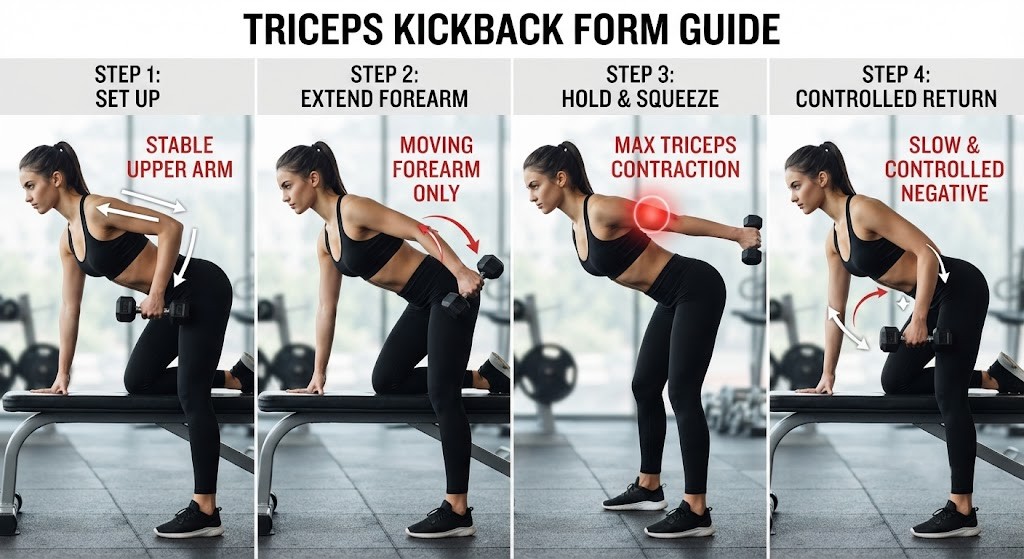
A triceps kickback works by keeping the upper arm relatively fixed while the forearm moves backward through elbow extension. The exercise starts with a bent elbow and finishes with the arm nearly straight.
For example, if your elbow begins at approximately 90 degrees, you extend the forearm until the elbow is straight while avoiding momentum from your shoulder or torso. ACE specifically recommends keeping the upper arm stationary and close to the torso during the movement.
Therefore, the exercise is best considered a triceps isolation movement, not a full-body strength exercise. A lighter dumbbell that allows precise control is generally more useful than a heavier dumbbell that causes you to swing.
Why Does the Triceps Kickback Matter?
The triceps kickback matters because it provides a simple way to strengthen the muscles responsible for elbow extension. Stronger triceps can contribute to pressing movements while giving you an accessible isolation exercise for an arm-focused workout.
Resistance training itself supports muscular strength, endurance, and physical function. The American College of Sports Medicine’s 2026 resistance-training position stand reviewed 137 systematic reviews involving more than 30,000 participants, emphasizing that consistency is more important than unnecessarily complicated programming.
Source: American College of Sports Medicine, 2026.
For example, you might perform kickbacks after a chest press or shoulder press when larger compound exercises have already received your highest priority.
Kickbacks are also convenient because they require relatively little equipment. Dumbbells, resistance bands, and cables can all be used, making the exercise adaptable to both home and gym workouts.
What Are the Benefits of Triceps Kickbacks?
Triceps kickbacks can strengthen the triceps, support arm training, and provide a practical isolation exercise. They are particularly useful when you want to add direct elbow-extension work after compound pushing movements.
For example, a beginner might perform two sets of controlled kickbacks after push-ups, while an intermediate lifter might use them near the end of a dedicated arm workout.
The main benefits include:
- Direct triceps training: The exercise emphasizes elbow extension.
- Simple setup: A pair of light dumbbells can be enough.
- Home-friendly training: You can perform the movement without a large machine.
- Arm-training variety: Kickbacks complement pushdowns and overhead extensions.
- Technique practice: The exercise teaches controlled elbow extension.
- Flexible programming: You can use bilateral or single-arm versions.
In addition, adults are generally advised to perform muscle-strengthening activities on at least 2 days each week as part of an overall physical-activity routine.
Source: U.S. Department of Health and Human Services, 2026.
How Do You Do Triceps Kickbacks With Proper Form?
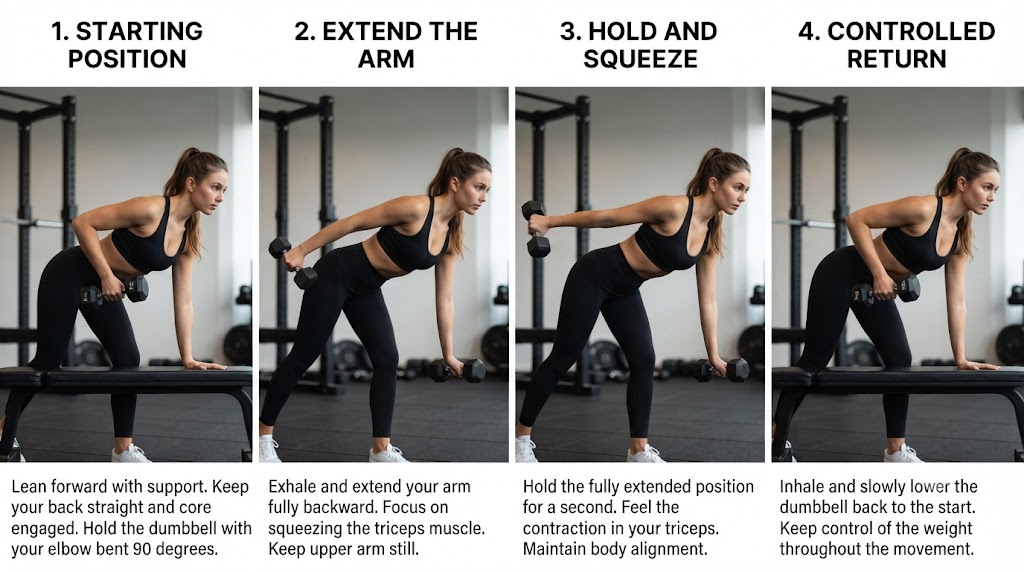
A proper triceps kickback involves keeping the upper arm relatively stable while extending the forearm backward and controlling the weight during the return. The following steps provide a beginner-friendly setup based on established exercise guidance from the American Council on Exercise.
Step 1: Choose a Manageable Weight
Choose a dumbbell that allows you to complete every repetition without swinging or changing your torso position. Kickbacks generally require less weight than many pressing exercises because the movement isolates the elbow joint.
If a heavier dumbbell forces you to lift your elbow, rotate your shoulder, or change your torso position, switch to lighter resistance.
Step 2: Set Your Stance
Use a stable split stance or staggered stance to create a strong base. Place one foot slightly forward, distribute your weight comfortably, and brace your abdominal muscles.
You can also place your free hand on your thigh or a stable support if needed. This reduces the balance demand and allows you to focus more closely on the working arm.
Step 3: Hinge Your Torso Forward
Hinge forward from your hips while maintaining a neutral and supported torso position. Avoid rounding your lower back or excessively arching it.
Your chest should face toward the floor while your spine remains controlled and your head stays aligned with your body.
Step 4: Position Your Elbow
Keep the working upper arm close to your torso and relatively parallel to the floor. Bend your elbow so the forearm points toward the floor or slightly forward.
ACE recommends maintaining the upper arm near the torso instead of repeatedly lifting and lowering it during each repetition.
Step 5: Extend the Arm
Straighten your elbow by driving the forearm backward until the arm is comfortably extended. Squeeze the triceps at the end of the movement without forcing the elbow beyond a comfortable position.
Keep the upper arm still throughout the extension. The elbow should act as the primary moving joint, rather than allowing the shoulder to create additional momentum.
Step 6: Control the Return
Slowly bend the elbow and return the dumbbell to the starting position. Do not simply allow gravity to drop the weight.
For example, taking roughly two seconds to lower the weight can help you maintain control. ACSM guidance also emphasizes controlled lifting and lowering during resistance training.
Step 7: Coordinate Your Breathing
Exhale during the extension and inhale during the controlled return. This creates a simple rhythm and helps prevent unnecessary breath-holding.
What Muscles Do Triceps Kickbacks Work?
Triceps kickbacks primarily work the triceps brachii, the three-headed muscle responsible for elbow extension. The three heads are the long head, lateral head, and medial head, and they work together during elbow extension.
The triceps attach through a common tendon near the elbow, while their different origins influence their functions and the ways arm position can affect their contribution. The long head also crosses the shoulder joint, giving it an additional role in shoulder movement.
| Muscle or area | Role during kickbacks |
|---|---|
| Triceps brachii | Primary muscle producing elbow extension |
| Long head | Contributes to elbow extension and crosses the shoulder |
| Lateral head | Contributes strongly to elbow extension |
| Medial head | Contributes to elbow extension |
| Core muscles | Help stabilize the torso |
| Shoulders and upper back | Help maintain arm and torso position |
Describing kickbacks as an exercise for only one triceps head would therefore be misleading. All three triceps heads participate in elbow extension, although arm position can influence their relative contribution.
How Many Sets and Reps Should You Do for Triceps Kickbacks?
Triceps kickbacks generally work well with moderate repetitions and controlled resistance because technique is especially important during this isolation exercise. A practical starting point is 2–3 sets of 10–15 repetitions per arm.
Your ideal prescription depends on your goal, training experience, and the rest of your workout. ACSM’s 2026 guidance suggests that strength, hypertrophy, and power can require different training approaches while emphasizing individualized programming.
| Goal | Practical starting point |
|---|---|
| Beginner | 2 sets × 10–15 reps |
| General strength | 2–3 sets × 8–12 reps |
| Muscle development | 2–4 sets × 10–15 reps |
| Technique practice | 2 sets × 12–15 reps |
| Single-arm work | 2–3 sets × 10–15 reps per side |
For example, if 12 repetitions feel easy while your form remains excellent, you can gradually increase resistance. If you need to swing the dumbbell to complete eight repetitions, the resistance is probably too high.
Controlled repetitions and appropriate resistance are more important than using the heaviest possible weight.
What Is the Best Weight for Triceps Kickbacks?
The best weight for triceps kickbacks is a resistance you can control through the complete movement without swinging, shrugging, or changing your torso position. There is no single dumbbell weight that is appropriate for everyone.
Kickbacks usually require relatively light resistance compared with compound movements because the triceps perform a more isolated movement. A weight that feels easy during a chest press may become challenging during strict kickbacks.
Use these signs to select the appropriate resistance:
- You can complete your planned repetitions with consistent form.
- Your upper arm stays relatively stable.
- You can pause briefly near full extension.
- You can control the lowering phase.
- Your torso does not rotate or rise during repetitions.
- The final repetitions feel challenging without becoming sloppy.
Reduce the weight when technique deteriorates rather than treating heavier resistance as automatic progress.
What Are the Best Triceps Kickback Variations?
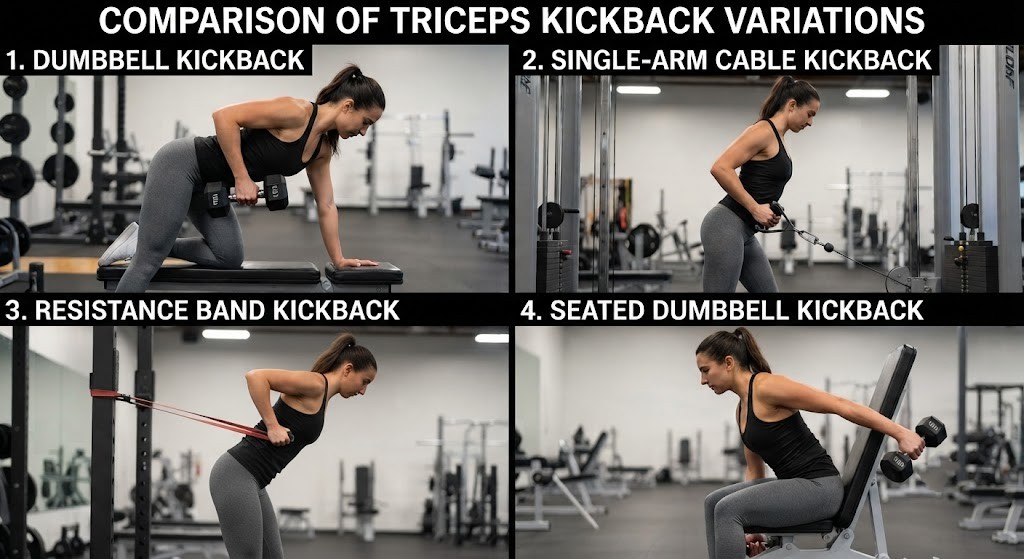
The best triceps kickback variation depends on your available equipment, stability, and training preference. Dumbbells are the simplest option, while bands and cables provide alternative ways to apply resistance.
Dumbbell Triceps Kickback
The dumbbell triceps kickback is the standard version and requires minimal equipment. It works well for both home workouts and gym sessions.
You can use two dumbbells for bilateral kickbacks or one dumbbell while supporting yourself with the opposite hand.
Single-Arm Triceps Kickback
The single-arm triceps kickback trains one side at a time and can simplify technique practice. Supporting your free hand on a bench or thigh can improve stability.
Unilateral training can also help you notice differences in control between sides. Complete the same number of controlled repetitions on each arm.
Resistance Band Triceps Kickback
The resistance band triceps kickback is a practical home-based variation that replaces dumbbell resistance with elastic resistance. Bands are portable and useful when you do not have weights available.
Cable Triceps Kickback
The cable triceps kickback uses a cable attachment to provide adjustable resistance during the movement. It can be useful in a gym when you want convenient load adjustments.
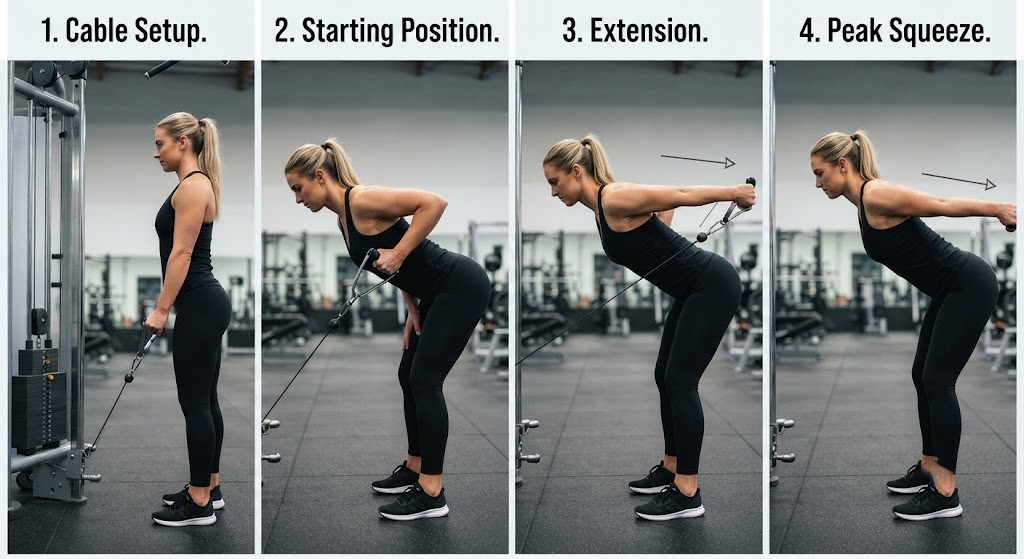
Set the pulley low, grip the handle, hinge forward, and maintain the same stable upper-arm position used in the dumbbell version.
Seated Triceps Kickback
The seated triceps kickback can reduce some balance demands by providing a more supported setup. It may be useful for exercisers who struggle to maintain a stable standing position.
The same technical principle still applies: keep the working upper arm controlled and move primarily through the elbow.
What Equipment Can You Use for Triceps Kickbacks?
Triceps kickbacks can be performed with dumbbells, resistance bands, or cable machines. Your best option depends on where you train and which form of resistance you can control comfortably.
Dumbbells
Dumbbells provide the simplest setup for progressive resistance and unilateral training. A pair of light dumbbells is enough for a basic home routine.
Resistance Bands
Resistance bands provide a portable alternative for home workouts and travel. ACSM notes that resistance bands and other nontraditional resistance methods can be effective training options.
Cable Machines
Cable machines provide adjustable resistance and convenient load changes for gym-based training. They are especially useful when you want to fine-tune resistance in smaller increments.
What Are the Most Common Triceps Kickback Mistakes?
The most common triceps kickback mistakes involve excessive weight, swinging, unstable torso positioning, and unnecessary shoulder movement. These errors can shift the exercise away from controlled elbow extension.
Swinging the Weight
Swinging the dumbbell reduces the control that makes kickbacks useful as an isolation exercise. If your torso or shoulder generates momentum, the triceps may no longer be doing most of the intended work.
Moving the Upper Arm
Repeatedly lifting and lowering the upper arm changes the exercise instead of keeping the movement focused on elbow extension. Keep the upper arm relatively stable throughout each repetition.
Using Too Much Weight
Excessive resistance commonly causes shortened repetitions and compensatory movement. Choose a lighter dumbbell if you cannot extend and return the arm under control.
Rushing the Repetitions
Fast repetitions can reduce control during both the extension and return phases. A slower, deliberate tempo makes it easier to maintain consistent technique.
Losing Torso Position
A changing torso position can create unnecessary movement and reduce stability. Brace your core and maintain a neutral spine while performing the set.
Ignoring the Return Phase
The lowering phase is part of every repetition and should remain controlled. Allowing the weight to fall removes an important part of the resistance-training stimulus.
ACE specifically advises avoiding torso rotation, low-back arching or sagging, and excessive upper-arm movement during kickbacks.
Can You Do Triceps Kickbacks at Home?
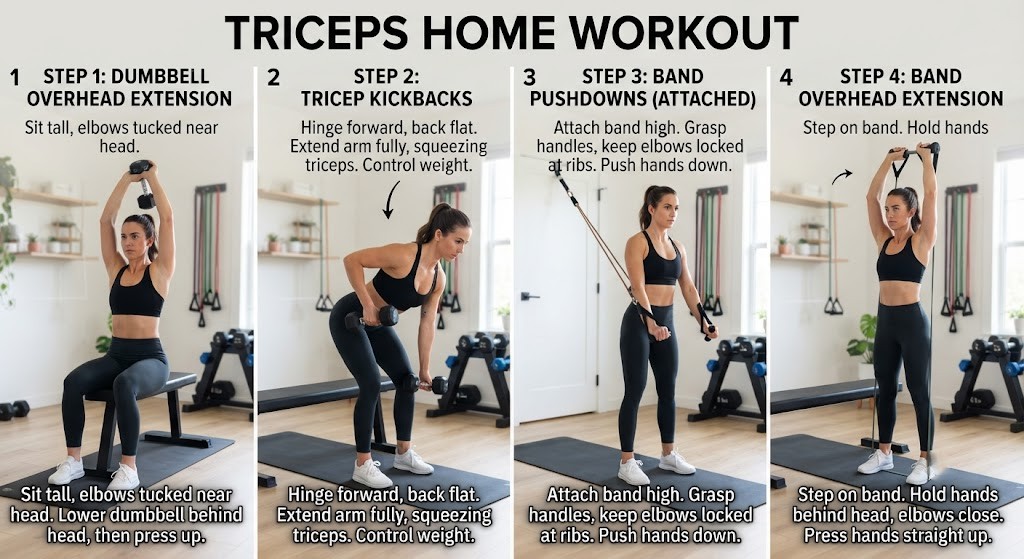
You can do triceps kickbacks at home with dumbbells, resistance bands, or other suitable resistance equipment. You do not need a cable machine or full gym setup to train your triceps effectively.
ACSM’s 2026 resistance-training guidance reports that home-based routines, elastic bands, and bodyweight training can produce meaningful improvements in strength and physical function.
For example, a simple home arm session could include:
- Dumbbell biceps curls — 3 × 10–12
- Dumbbell triceps kickbacks — 3 × 10–15
- Overhead triceps extensions — 2 × 10–12
- Lateral raises — 2 × 12–15
How Do You Add Triceps Kickbacks to an Arm Workout?
Triceps kickbacks fit best as an isolation exercise after larger pushing movements or earlier in a workout when technique practice is the priority. Their simple setup makes them easy to combine with other triceps exercises.
Beginner Arm Workout
A beginner arm workout can use kickbacks as the primary direct triceps isolation movement. Start with manageable resistance and focus on learning consistent technique.
- Dumbbell curls — 3 × 10–12
- Triceps kickbacks — 2 × 10–15
- Hammer curls — 2 × 10–12
- Overhead triceps extensions — 2 × 10–12
Intermediate Triceps Workout
An intermediate triceps workout can place kickbacks after heavier compound or cable movements. This arrangement lets you prioritize larger exercises before finishing with a controlled isolation movement.
- Close-grip press — 3 × 6–10
- Triceps pushdowns — 3 × 8–12
- Overhead triceps extension — 3 × 10–12
- Triceps kickbacks — 2–3 × 12–15
A chest-and-triceps session could place pressing exercises first because they train multiple upper-body muscles, followed by kickbacks for direct triceps work.
At the same time, avoid adding so many direct triceps exercises that your total training volume becomes difficult to recover from. The best triceps workout is one you can perform consistently while maintaining quality repetitions and adequate recovery.
How Can You Progress Your Triceps Kickback Workout?
The next step is to choose a manageable resistance, practice strict form, and gradually increase training difficulty over time. Your first goal should be repeatable technique rather than immediately lifting heavier weights.
Progressive overload does not require large jumps in weight. For example, you could first increase repetitions from 10 to 12 with excellent form before moving to a slightly heavier dumbbell.
Track a few simple variables:
- Weight used
- Repetitions completed
- Number of sets
- Technique quality
- How challenging the final repetitions feel
- Recovery between sessions
Consistency beats complexity in resistance training. ACSM’s 2026 position stand specifically highlights consistency as a major driver of results rather than requiring complicated programming methods.
In addition, remember that an arm-focused exercise should be part of a balanced training plan. Adults are generally encouraged to perform muscle-strengthening activities involving major muscle groups at least 2 days per week.
Source: U.S. Department of Health and Human Services, 2026.
Triceps Kickback Workout Checklist
Before starting your next set, use this quick form checklist:
- Choose a manageable resistance.
- Establish a stable stance.
- Hinge forward from the hips.
- Keep your torso controlled.
- Brace your core.
- Keep the upper arm relatively stable.
- Extend primarily through the elbow.
- Avoid swinging or shrugging.
- Fully control the return.
- Stop or reduce the weight when technique breaks down.
This simple checklist can help keep each repetition focused on the intended movement rather than momentum.
Conclusion: Build Stronger Triceps With Consistent Training
Triceps kickbacks are a simple isolation exercise for strengthening the muscles that extend the elbow. Their effectiveness depends less on using heavy weights and more on stable positioning, controlled movement, appropriate resistance, and consistent training.
You can perform the exercise with dumbbells, resistance bands, or cables and adapt it to beginner, home, or gym workouts. Maintaining a stable torso and relatively fixed upper arm helps keep the movement focused on the triceps.
Start with a resistance you can control, track your sets and repetitions, and gradually increase the training challenge as your technique improves. Pair triceps kickbacks with compound pushing exercises and other well-chosen triceps movements to create a balanced arm-training routine.
FAQs
What is a triceps kickback workout?
A triceps kickback workout isolates the triceps through controlled elbow extension.
What muscles do triceps kickbacks work?
Triceps kickbacks primarily target all three heads of the triceps.
What does a tricep kickback work?
A tricep kickback mainly works the triceps during elbow extension.
Which 3 tricep exercises?
Three effective triceps exercises are kickbacks, pushdowns, and overhead extensions.
Can you build triceps with just kickbacks?
Yes, but combining kickbacks with other exercises provides more variety.
Is tricep kickback a bad exercise?
No, tricep kickbacks can be effective when performed with proper form.
How many triceps kickbacks should I do?
Start with 2–3 sets of 10–15 repetitions per arm.
What is the best weight for triceps kickbacks?
Use a manageable weight that allows controlled repetitions without swinging.
Are triceps kickbacks good for building muscle?
Yes, they can help strengthen and develop the triceps.
Can beginners do triceps kickbacks?
Yes, beginners can use light resistance and focus on proper form.
Can I do triceps kickbacks at home?
Yes, you can perform triceps kickbacks with dumbbells or resistance bands.
Are dumbbell or cable triceps kickbacks better?
Both can be effective depending on your equipment and training preference.
How often should I train my triceps?
Train your triceps as part of a balanced strength routine at least twice weekly.
Why do my shoulders move during triceps kickbacks?
Excessive weight or momentum can cause unnecessary shoulder movement.
Should triceps kickbacks be heavy or light?
Use light to moderate resistance that allows controlled repetitions.
Should I do triceps kickbacks before or after pushdowns?
Kickbacks are generally best performed after heavier triceps exercises.