
If you live in an apartment, dorm, shared home, or simply prefer exercising without disturbing others, a silent workout at home can be an ideal solution. You do not need jumping, running, loud equipment, or high-impact movements to make your workout effective.
A quiet routine can still train your legs, glutes, core, upper body, and cardiovascular fitness through controlled, grounded movements. In this guide, you’ll learn what a silent workout is, which exercises work best, how to build a 10- or 20-minute routine, and how to make your home workouts even quieter.
What Is a Silent Workout at Home?
A silent workout at home is a low-noise exercise session designed to minimize jumping, foot impact, equipment sounds, and other disruptive movements. Unlike high-impact workouts, silent routines emphasize controlled movements and typically keep at least one foot, hand, or another body part grounded.
A silent workout is not necessarily completely soundless. Breathing, clothing movement, a shifting exercise mat, and normal body movement can still create minor sounds. The goal is noise reduction rather than absolute silence.
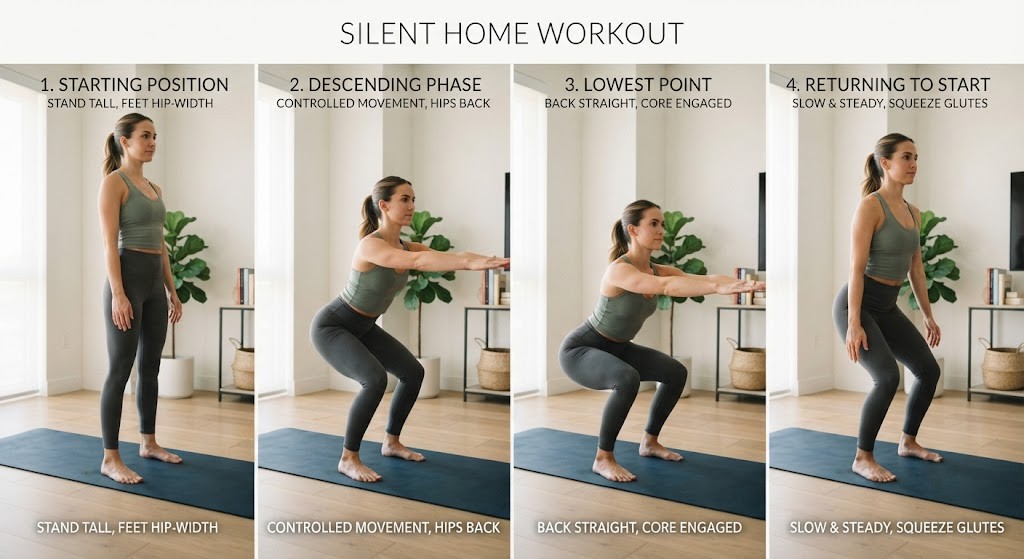
For example, replacing jump squats with slow bodyweight squats removes the landing impact while still working the legs.
Silent Workout vs. Low-Impact Workout
A low-impact workout focuses on reducing stress from high-impact movements, while a silent workout focuses specifically on minimizing noise. The two approaches often overlap, but they are not exactly the same.
For instance, cycling can be low impact but may produce equipment noise. A controlled wall sit, on the other hand, is both low impact and extremely quiet.
| Workout Type | Jumping | Foot Impact | Equipment Noise | Best For |
|---|---|---|---|---|
| Silent workout | Usually none | Very low | Minimal | Apartments and shared spaces |
| Low-impact workout | Usually limited | Low | Variable | Joint-friendly exercise |
| HIIT workout | Often possible | Moderate-high | Variable | Higher-intensity training |
| Traditional cardio | Depends | Variable | Variable | General fitness |
If you want more joint-friendly movement ideas, explore our low-impact workouts.
Why Are Silent Workouts Useful for Exercising at Home?
Silent workouts are particularly useful in apartments, shared homes, dorm rooms, bedrooms, and other noise-sensitive environments. They allow you to exercise without depending on jumping, running, or heavy equipment.
For example, someone living above another apartment can perform squats, glute bridges, and planks without repeatedly creating impact against the floor.
Quiet exercise can also make workouts easier to fit into a busy schedule. A short session can be performed during an early morning, lunch break, or late evening without unnecessarily disturbing other people.
The CDC recommends that adults get at least 150 minutes of moderate-intensity physical activity each week plus muscle-strengthening activity on at least two days — Source: CDC, 2025.
Importantly, that activity does not have to be noisy. Walking, controlled bodyweight exercises, and other moderate activities can contribute to your overall physical activity.
What Are the Best Silent Exercises to Do at Home?
The best silent exercises use controlled movements, keep your feet grounded, and require little or no equipment. Together, they can train the lower body, upper body, core, and mobility while minimizing impact.
A slow squat, for example, keeps both feet on the floor throughout the movement, making it considerably quieter than a jump squat.
Best Lower-Body Silent Exercises
Squats, reverse lunges, glute bridges, wall sits, and calf raises are excellent choices for quiet lower-body training.
Try the following:
- Bodyweight squats: 10–15 repetitions
- Reverse lunges: 8–12 per side
- Glute bridges: 12–15 repetitions
- Wall sit: 20–45 seconds
- Calf raises: 15–20 repetitions
Focus on smooth transitions rather than speed. Avoid dropping into the bottom of a squat or allowing your feet to strike the floor heavily.
Controlled inner-thigh movements can also complement your lower-body routine. For additional ideas, see our inner thigh workout.
Best Core and Upper-Body Silent Exercises
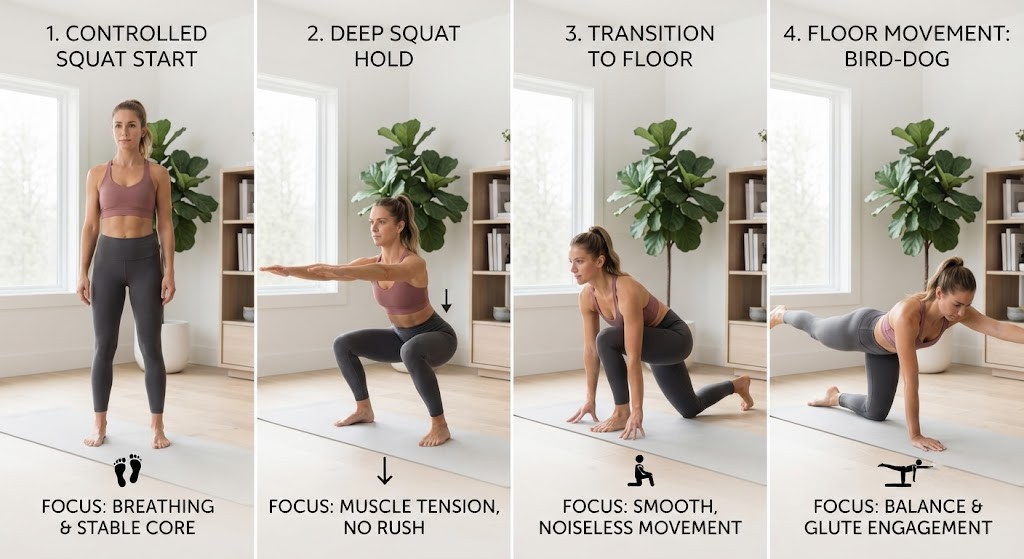
Planks, dead bugs, bird dogs, and controlled push-ups can strengthen your core and upper body without jumping or repeated foot impact.
The dead bug is particularly useful for quiet workouts because your back and limbs remain close to the floor. For a more focused routine, explore our dead bug workout.
Planks and bird dogs are also useful because they emphasize stability and controlled movement while producing very little noise.
Can You Get a Full-Body Workout Without Jumping?
Yes, a quiet full-body workout can combine lower-body strength, upper-body exercises, core training, and low-impact cardio without jumping. The key is to use different movement patterns rather than relying on impact to increase intensity.
For example, a single circuit can include squats for the legs, incline push-ups for the upper body, dead bugs for the core, and controlled marching for low-impact cardio.
20-Minute Silent Full-Body Workout
Begin with a 3-minute warm-up using:
- Shoulder circles
- Gentle marching
- Hip rotations
- Controlled arm movements
Then complete this circuit:
- Squats: 12 repetitions
- Reverse lunges: 8 per leg
- Incline push-ups: 8–12 repetitions
- Glute bridges: 15 repetitions
- Bird dogs: 8 per side
- Dead bugs: 8–10 per side
- Slow mountain climbers: 20 total
- Wall sit: 30 seconds
Rest for 30–60 seconds between rounds and complete two or three rounds.
This structure allows you to work multiple areas of the body while keeping the workout relatively quiet.
The CDC also notes that adults can spread physical activity throughout the week rather than completing it all at once — Source: CDC, 2025.
For additional core-focused exercises, explore our core workouts at home.
How Can You Do Silent Cardio at Home?
Silent cardio uses rhythmic, low-impact movements that raise activity levels without repeated jumping or hard foot strikes. You can increase your pace while keeping each step controlled.
Try:
- Marching in place
- Step-touch movements
- Standing knee drives
- Slow mountain climbers
- Alternating reverse lunges
- Controlled shadow boxing
- Low-impact walking patterns
The objective is to create continuous movement without turning each step into a hard landing.
Walking-based routines are another simple way to add movement without jumping. See our Dance Walking Workout for more ideas.
WHO recommends 150–300 minutes of moderate aerobic activity per week for adults, along with muscle-strengthening activities involving major muscle groups on at least two days — Source: WHO, 2021.
Your silent cardio sessions can therefore become one component of a broader weekly physical activity routine.
What Is a Good 10-Minute Silent Workout for Beginners?
A good 10-minute silent workout for beginners combines gentle warm-up movements, basic strength exercises, core work, and low-impact cardio. The goal should be a manageable session rather than an exhausting one.
Try this beginner-friendly structure:
| Time | Exercise |
|---|---|
| 1 minute | Gentle marching |
| 1 minute | Arm circles and mobility |
| 2 minutes | Bodyweight squats |
| 2 minutes | Reverse lunges |
| 2 minutes | Glute bridges |
| 1 minute | Dead bugs |
| 1 minute | Slow marching and breathing |
Beginners can reduce repetitions, move more slowly, or take additional rest whenever necessary.
Starting with a manageable workout can make consistency easier than immediately attempting an intense routine.
How Can You Exercise Quietly in an Apartment?
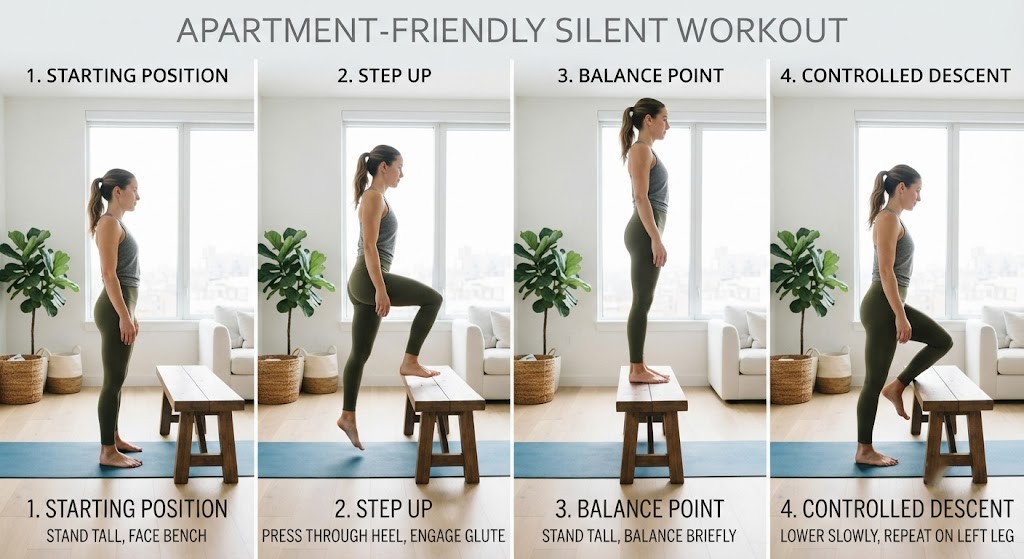
You can exercise quietly in an apartment by choosing grounded movements, controlling every repetition, and avoiding jumping or heavy equipment. The surface underneath you and the location of your workout can also affect how much noise you create.
For example, exercising on a supportive mat can be quieter and more comfortable than performing floor exercises directly on a hard surface.
Use these apartment-friendly habits:
- Keep both feet grounded whenever possible.
- Avoid jump squats, burpees, jumping jacks, and running in place.
- Lower your body slowly instead of dropping into positions.
- Put weights down carefully instead of releasing them.
- Keep furniture and loose objects away from your workout area.
- Choose floor-based exercises for especially quiet or late-night sessions.
The simplest way to reduce workout noise is to choose grounded movements, control every repetition, avoid jumping, and use a supportive exercise mat.
What Equipment Is Best for a Quiet Home Workout?
The best equipment for a quiet home workout is lightweight, stable, and easy to place down without impact. However, you can build an effective silent workout at home with no equipment at all.
An exercise mat can improve comfort during movements such as glute bridges, planks, dead bugs, and mobility exercises.
Useful equipment includes:
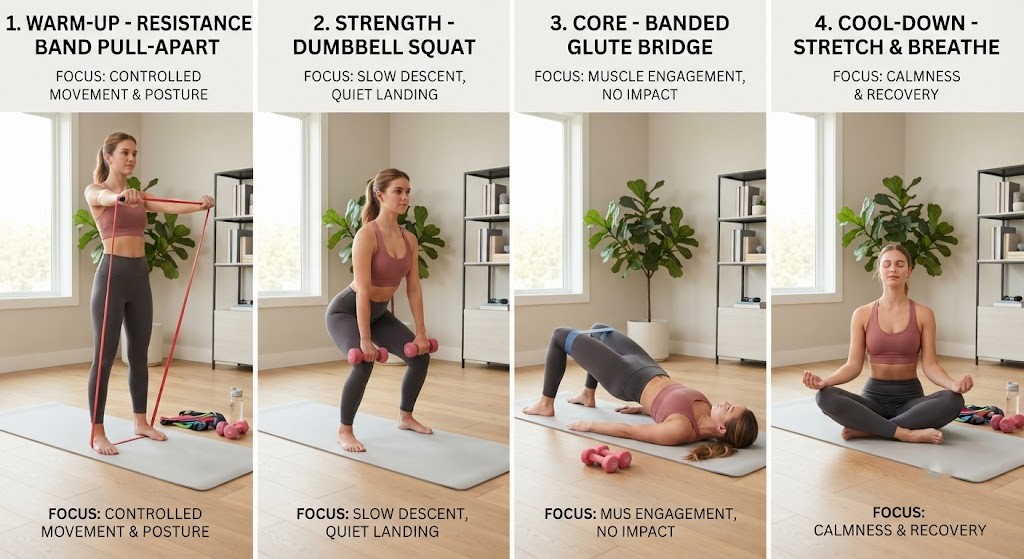
- Exercise mat: Adds cushioning and can reduce contact noise.
- Resistance bands: Provide adjustable resistance without requiring heavy equipment.
- Light dumbbells: Increase strength-training difficulty when handled carefully.
- Yoga blocks: Support mobility exercises and beginner modifications.
- Sliders: Add controlled core and lower-body movements.
Resistance bands can be particularly practical when storage space is limited.
You do not need an expensive home gym to perform a silent workout. Bodyweight exercises can provide the foundation, while simple accessories can add variety and resistance.
How Can You Make Your Home Workout Less Noisy?
You can make a home workout quieter by reducing impact, slowing your movements, and preventing equipment from hitting hard surfaces. Small adjustments can make a meaningful difference when you share walls or floors with other people.
For example, instead of dropping a dumbbell after completing a set, carefully lower it onto a mat or another stable surface.
Follow these noise-control steps:
- Replace jumping with grounded alternatives.
- Use slower repetitions instead of explosive movements.
- Keep your feet controlled when stepping or changing positions.
- Use a thick exercise mat for floor exercises.
- Secure loose equipment so bands, weights, and accessories do not rattle.
- Choose a stable workout area away from furniture that can vibrate.
- Keep music or workout audio low when others are sleeping.
Controlled movement can also make an exercise more challenging because you spend more time managing each repetition.
How Often Should You Do a Silent Workout at Home?
You can do a silent workout at home several times per week, depending on workout intensity, recovery, and your current fitness level. Beginners can start with two or three sessions per week and gradually increase their activity.
For example, a beginner might perform two 15-minute strength-focused sessions along with several walking or mobility sessions throughout the week.
A practical weekly structure could look like this:
| Day | Activity |
|---|---|
| Monday | 20-minute silent full-body workout |
| Tuesday | Light walking or mobility |
| Wednesday | 15-minute silent workout |
| Thursday | Rest or gentle movement |
| Friday | 20-minute silent full-body workout |
| Weekend | Walking, mobility, or recovery |
WHO recommends muscle-strengthening activity on two or more days per week for adults — Source: WHO, 2021.
If you are starting from a low level of activity, gradual progression is sensible. WHO specifically advises starting with manageable amounts and increasing activity over time — Source: WHO, 2020.
For recovery ideas, explore our fitness recovery.
How Can You Build a Consistent Silent Workout Routine?
A consistent silent workout routine starts with a realistic schedule, repeatable exercises, and gradual progression. You do not need a perfect plan; you need a routine that fits your space, schedule, and fitness level.
Start with 10–15 minutes three times a week. Once the routine becomes easier, you can increase repetitions, add another round, extend the session, or introduce light resistance.
Use this simple progression strategy:
- Choose your schedule: Start with two or three sessions each week.
- Choose six to eight exercises: Cover the legs, upper body, core, and cardio.
- Track your work: Record repetitions, duration, or resistance.
- Increase one variable: Add a few repetitions or extend the workout slightly.
- Review your form: Prioritize quality movement before speed.
- Adapt your space: Replace any exercise that creates excessive noise.
A simple activity log can help you monitor progress without becoming overly focused on calorie estimates.
You can also use structured workout challenges to make consistency more engaging.
Common Mistakes to Avoid During a Silent Workout
A silent workout should reduce unnecessary noise without sacrificing movement quality. Avoid these common mistakes:
Moving Too Quickly
Fast repetitions can make it harder to control your feet, joints, and equipment. Slow down and focus on deliberate movement.
Assuming Silent Means Easy
Removing jumping does not automatically make an exercise easy. You can increase difficulty through repetitions, duration, resistance, range of motion, or slower tempo.
Ignoring Form to Reduce Noise
Do not sacrifice proper technique simply to make an exercise quieter. Choose a different movement if the original exercise cannot be performed comfortably and with control.
Using Heavy Equipment in a Small Space
Heavy weights can create unnecessary noise and may be difficult to handle safely in confined areas. Bodyweight exercises and resistance bands can often provide sufficient variety.
Skipping the Warm-Up
A brief warm-up can prepare you for your workout and help you transition gradually into the exercises.
How Can You Progress a Silent Workout at Home?
A silent workout can become progressively more challenging without adding impact.
Once an exercise feels comfortable, consider changing one variable at a time:
- Increase repetitions.
- Hold a position longer.
- Add another circuit round.
- Slow down the lowering phase.
- Add resistance bands.
- Use light dumbbells.
- Reduce unnecessary rest between exercises.
For example, if 10 bodyweight squats become easy, you could gradually increase the repetitions rather than immediately switching to jump squats.
The same principle applies to core exercises, lunges, glute bridges, and controlled cardio movements. Progress does not require more noise; it requires an appropriate increase in challenge.
Conclusion: Make Quiet Exercise Part of Your Routine
A silent workout at home can provide an effective way to exercise without jumping, loud equipment, or a large workout space. Squats, lunges, glute bridges, planks, dead bugs, mobility exercises, and controlled cardio can work together to create a practical full-body routine.
The best silent workout is ultimately one that you can perform consistently while respecting the people around you. Start with 10 minutes, controlled movements, and a few exercises you enjoy, then gradually build your duration, repetitions, or resistance.
Physical activity also adds up over time. The CDC emphasizes that some physical activity is better than none, while regular activity provides broader health benefits — Source: CDC, 2025.
If you prefer a gentler mobility-focused finish, end your session with 15 Minute Daily Yoga Routine.
FAQs
What is a silent workout at home?
A silent workout is a low-noise routine that avoids jumping, heavy impacts, and loud equipment.
What are the best silent exercises at home?
Squats, lunges, glute bridges, planks, and dead bugs are effective quiet exercises.
Can you get a good workout without jumping?
Yes, low-impact exercises can provide an effective full-body workout without jumping.
How can I do a silent workout in an apartment?
Use grounded movements, exercise on a mat, and avoid jumping or dropping weights.
Can silent workouts help with cardio?
Yes, marching, step-touch movements, knee drives, and shadow boxing can provide quiet cardio.
Is a 10-minute silent workout enough for beginners?
Yes, a 10-minute workout is a simple way for beginners to build consistency.
How often should I do a silent workout at home?
Beginners can start with two or three silent workouts per week.
Can silent workouts build strength?
Yes, bodyweight exercises can help build strength when practiced consistently.
How to burn 700 calories in 1 hour?
Calorie burn depends on body size, exercise type, and workout intensity.
What is the 3-3-3 rule for working out?
The 3-3-3 rule is a workout method that can vary depending on the fitness program.
How to get 10,000 steps without leaving the house?
March in place, walk around your home, use stairs, and take frequent indoor walking breaks.
What burns 500 calories in 30 minutes?
Vigorous exercise can burn many calories, but the amount varies by person and exercise intensity.
1 thought on “Silent Workout at Home: Quiet Exercises for a Full-Body Workout”