
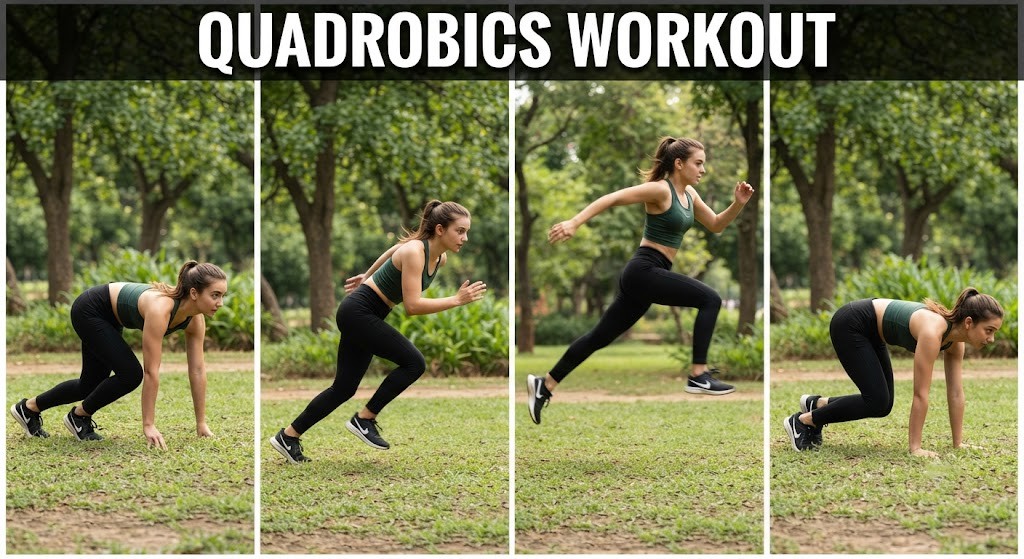
Full-body workouts usually rely on familiar exercises such as squats, push-ups, lunges, and planks. However, if you want to challenge your body in a completely different way, a full body Quadrobics workout introduces crawling, balance, coordination, mobility, and bodyweight strength into one movement-focused routine.
Quadrobics uses quadrupedal movement, meaning the hands and feet support the body during exercises such as crawling, static holds, transitions, and locomotion patterns. Because these movements require the upper and lower body to work together, Quadrobics can provide a unique training stimulus without requiring traditional gym equipment.
In this guide, you’ll learn what Quadrobics is, the best beginner exercises, how to warm up, how to create a 10-, 20-, or 30-minute routine, how to progress safely, and what muscles Quadrobics works.
What Is a Full Body Quadrobics Workout?
A full body Quadrobics workout is a bodyweight training session based on quadrupedal movement. Instead of performing exercises primarily while standing, you use your hands and feet to support and move your body through different positions.
Quadrobics is a form of quadrupedal movement training that uses the hands and feet to support the body during crawling, holds, transitions, and locomotion.
A full-body session can combine several physical qualities, including:
- Bodyweight strength
- Coordination
- Balance
- Mobility
- Core stability
- Conditioning
- Movement control
For example, a beginner workout could combine a bear hold, forward bear crawl, lateral crawl, beast shoulder taps, and controlled transitions.
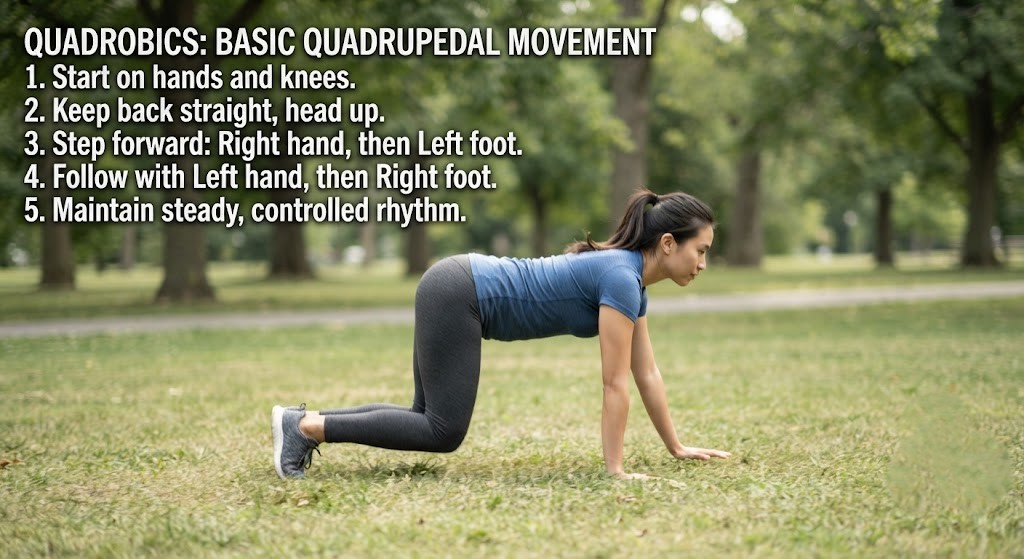
Research on quadrupedal movement training also provides some evidence for improvements in functional movement and joint range of motion, although the research base remains limited.
One randomized study included 42 active college-age participants who completed 8 weeks of quadrupedal movement training twice weekly. The training group showed greater improvements in several Functional Movement Screen measures and selected joint ranges of motion. — Source: Journal of Strength and Conditioning Research, 2022
What Are the Benefits of Quadrobics Workouts?
Quadrobics workouts combine weight-bearing, locomotion, stability, and coordination. This makes them different from exercises that train one movement pattern or muscle group at a time.
A full-body Quadrobics workout combines quadrupedal movements that challenge bodyweight strength, coordination, balance, mobility, and conditioning.
Improves Whole-Body Coordination
One of the biggest challenges of Quadrobics is coordinating your arms and legs while keeping your torso controlled.
For example, during a bear crawl, your opposite hand and foot move together while your core works to prevent excessive rotation. This creates a coordination challenge that is different from many conventional exercises.
Challenges Balance and Stability
Many Quadrobics movements require you to shift your bodyweight between three or four points of contact.
Beast shoulder taps are a good example. You temporarily remove one hand from the floor while maintaining control through the other hand, both feet, and your core.
Supports Functional Movement
Quadrobics can complement conventional functional fitness exercises because many movements require control across multiple directions and positions.
A lateral bear crawl, for instance, introduces side-to-side movement instead of focusing exclusively on forward-and-backward movement.
May Support Mobility and Functional Movement
Quadrupedal training may also contribute to functional movement and mobility.
The 2022 randomized study reported improvements in Functional Movement Screen scores and several active joint ranges of motion after an 8-week program. — Source: Journal of Strength and Conditioning Research, 2022
What Are the Best Quadrobics Exercises for Beginners?
The best beginner Quadrobics exercises are controlled movements that allow you to develop wrist tolerance, shoulder stability, core control, coordination, and basic locomotion skills.
A beginner Quadrobics workout should start with controlled foundational movements such as bear holds, bear crawls, and simple transitions before progressing to more complex locomotion patterns.
Bear Hold
The bear hold is a static quadrupedal position that teaches you how to support your body through your hands and feet.
Start on all fours. Lift your knees slightly from the floor, brace your core, and maintain a controlled position for 15–30 seconds.
Focus on keeping your spine controlled rather than simply trying to hold the position for as long as possible.
Bear Crawl
The bear crawl is one of the most recognizable Quadrobics movements.
Move forward slowly while keeping your knees close to the floor and your hips relatively stable. Concentrate on controlled opposite-limb movement rather than rushing.
Beast Shoulder Taps
Beast shoulder taps challenge core stability, shoulder control, and weight shifting.
From a bear position, lift one hand and gently tap the opposite shoulder. Place the hand back down and repeat on the other side.
Keep your hips as stable as possible while alternating sides.
Lateral Bear Crawl
A lateral bear crawl adds side-to-side locomotion to your workout.
Take small, controlled steps sideways while coordinating your hands and feet. Start with a short distance and gradually increase the duration as your movement becomes more comfortable.
Forward and Backward Crawling
Backward crawling changes the coordination challenge because you are moving in a direction that may feel less familiar.
Keep the movement slow and controlled. A short range is enough for beginners because the goal is to develop motor control rather than speed.
Frogger Movement
Frogger-style movements introduce a more dynamic transition between low and high positions.
Beginners can reduce the range of motion and perform slow repetitions before attempting faster transitions. Focus on maintaining control throughout the movement.
Beginner Quadrobics Exercise Guide
| Quadrobics exercise | Main focus | Beginner target |
|---|---|---|
| Bear hold | Core and shoulder stability | 15–30 sec |
| Bear crawl | Coordination and conditioning | 20–30 sec |
| Shoulder taps | Core control | 6–10/side |
| Lateral crawl | Coordination and mobility | 15–20 sec |
| Backward crawl | Motor control | 15–20 sec |
| Frogger | Dynamic movement | 5–8 reps |
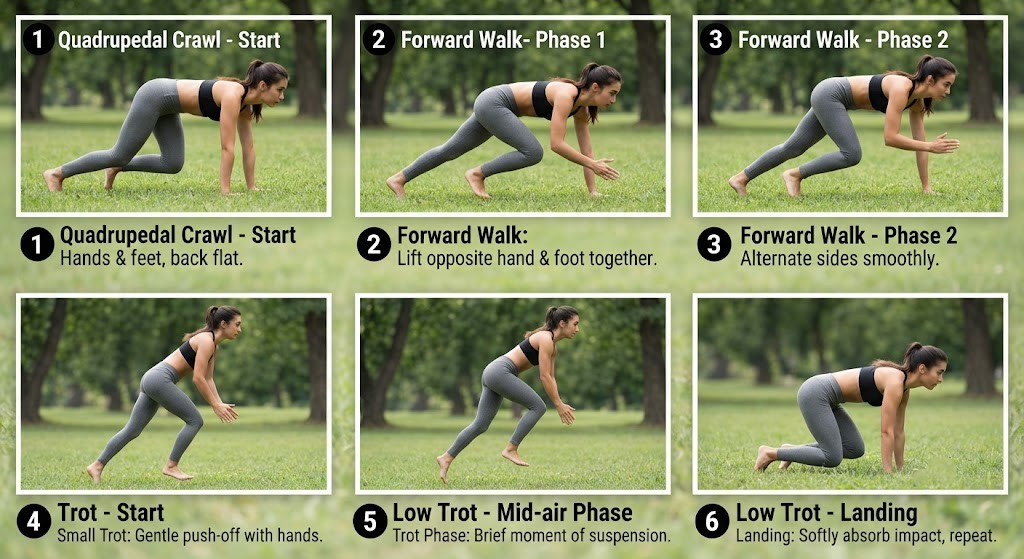
How Do You Warm Up Before a Quadrobics Workout?
A proper warm-up prepares the joints and muscles that will repeatedly support your body during quadrupedal movement.
A Quadrobics warm-up should prepare the wrists, shoulders, core, hips, knees, and ankles for repeated weight-bearing and quadrupedal movement.
Start With 5–7 Minutes of Preparation
Spend approximately 5–7 minutes preparing your joints and raising your body temperature.
You can include:
- Wrist circles
- Shoulder circles
- Cat-cow movements
- Hip circles
- Ankle movements
- Controlled bodyweight squats
Gradually Introduce Hand Weight-Bearing
Do not immediately begin with fast crawling.
Start in a comfortable tabletop position and gradually introduce more weight through your hands. From there, progress into a bear hold before beginning locomotion.
This approach gives you an opportunity to become familiar with the weight-bearing demands of Quadrobics.
5 Minute Warm Up Before Workout
How Do You Do a Full Body Quadrobics Workout at Home?
A full body Quadrobics workout at home can be completed in approximately 20 minutes using a clear floor area and bodyweight movements.
A bodyweight Quadrobics workout requires little or no equipment, although a comfortable exercise mat can make hand and knee contact more comfortable.
Before starting, make sure you have enough space to crawl forward, backward, and sideways without hitting furniture or other objects.
20-Minute Beginner Quadrobics Routine
Step 1: Warm Up for 5 Minutes
Begin with:
- Wrist circles
- Shoulder mobility
- Hip mobility
- Ankle movements
- Easy bodyweight squats
Step 2: Complete the Main Circuit
Perform the following movements:
- Bear hold: 20 seconds
- Forward bear crawl: 30 seconds
- Backward crawl: 20 seconds
- Beast shoulder taps: 8 repetitions per side
- Lateral bear crawl: 20 seconds per direction
- Frogger: 6 repetitions
- Rest: 45–60 seconds
Step 3: Repeat the Circuit
Repeat the circuit 2–3 rounds, depending on your experience and technique.
If you’re new to Quadrobics, one or two rounds are enough to begin. Increase the workload gradually rather than trying to complete three rounds immediately.
Full Body Workout for Beginners
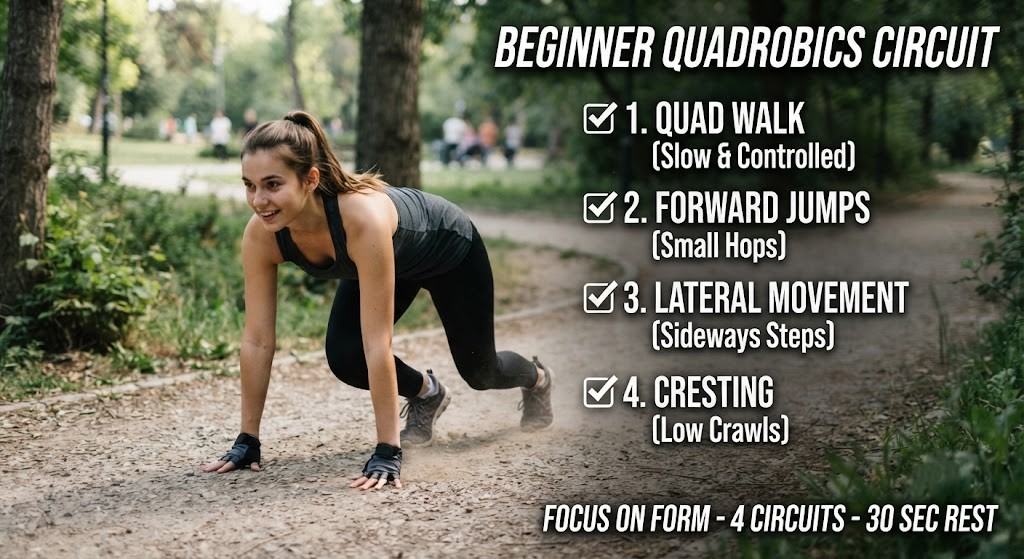
How Long Should a Quadrobics Workout Last?
A Quadrobics workout can last 10–30 minutes, depending on your fitness level, movement complexity, and rest requirements.
A 10-minute session can work well for beginners, while intermediate exercisers can gradually build toward 20–30-minute sessions.
For example, a 10-minute session might include five minutes of preparation followed by five minutes of low-intensity crawling and holds.
A 30-minute session can include a longer warm-up, several movement blocks, additional practice, and a cooldown.
However, workout duration should fit into your overall activity schedule rather than replacing every other form of exercise.
Current guidelines recommend that adults accumulate at least 150 minutes of moderate-intensity physical activity per week, or 75 minutes of vigorous activity, with muscle-strengthening activity on at least 2 days. — Source: CDC, 2025
How Many Days a Week Should You Do Quadrobics?
Beginners can start Quadrobics 2 days per week, leaving recovery time between demanding sessions.
Two weekly sessions can provide a practical starting point while you learn the movement patterns and monitor how your wrists, shoulders, knees, and hips respond.
For example, you could train on Monday and Thursday initially. This provides recovery time between sessions.
As your movement tolerance improves, intermediate exercisers can add a third session if they can maintain good technique and recover comfortably.
Can Quadrobics Build Strength and Improve Conditioning?
Quadrobics can challenge muscular strength and conditioning, particularly when movements are performed continuously and with controlled bodyweight resistance.
Quadrobics can build movement-specific strength and conditioning, but it should not be presented as a replacement for every form of resistance training.
For example, bear crawls repeatedly load the shoulders, arms, trunk, hips, and legs while you move across the floor.
However, conventional resistance exercises can provide a more straightforward way to progressively increase external load. This makes traditional resistance training a useful complement to Quadrobics rather than something that necessarily needs to be replaced.
The quadrupedal movement study found improvements in functional movement and selected range-of-motion measures, but it did not find significant between-group improvements in upper-body strength and endurance. — Source: Journal of Strength and Conditioning Research, 2022
What Muscles Does Quadrobics Work?
Quadrobics works multiple muscle groups because quadrupedal movements require the upper and lower body to coordinate while the trunk remains stable.
Quadrobics commonly challenges the shoulders, arms, chest, back, core, hips, glutes, thighs, and calves.
Upper Body
The hands repeatedly support bodyweight during crawling and static positions, creating a demand on the:
- Shoulders
- Arms
- Chest
- Upper back
Core
The abdominal and trunk muscles help stabilize the body while your arms and legs move.
This is particularly noticeable during bear crawls and shoulder taps, where maintaining a controlled torso is an important part of the movement.
Hips and Legs
The hips, glutes, thighs, and calves contribute to locomotion and stabilization.
Lateral crawling and directional changes can further challenge the lower body because the movement requires you to coordinate your legs with your upper body.
How Can Beginners Progress to Advanced Quadrobics Movements?
Quadrobics progression involves increasing movement duration, distance, coordination demands, or exercise complexity while maintaining controlled technique.
Progression should increase gradually rather than forcing advanced movements before foundational patterns feel stable.
Increase Work Intervals
Start with short intervals such as 15 seconds. Once your technique remains consistent, increase the interval to 20 or 30 seconds.
Increase Crawling Distance
Instead of immediately increasing speed, gradually increase the distance you can crawl while maintaining controlled movement.
Add Direction Changes
Once forward and backward crawling feel comfortable, introduce lateral movement and controlled directional transitions.
Increase Movement Complexity
More complex locomotion patterns can be introduced after foundational movements become familiar.
The key is to change one training variable at a time when possible. This makes it easier to understand how your body responds to increased workload.
Moreover, WHO recommends that adults accumulate 150–300 minutes of moderate-intensity aerobic activity per week for substantial health benefits, while muscle-strengthening activities should involve major muscle groups on at least 2 days weekly. — Source: WHO, 2026
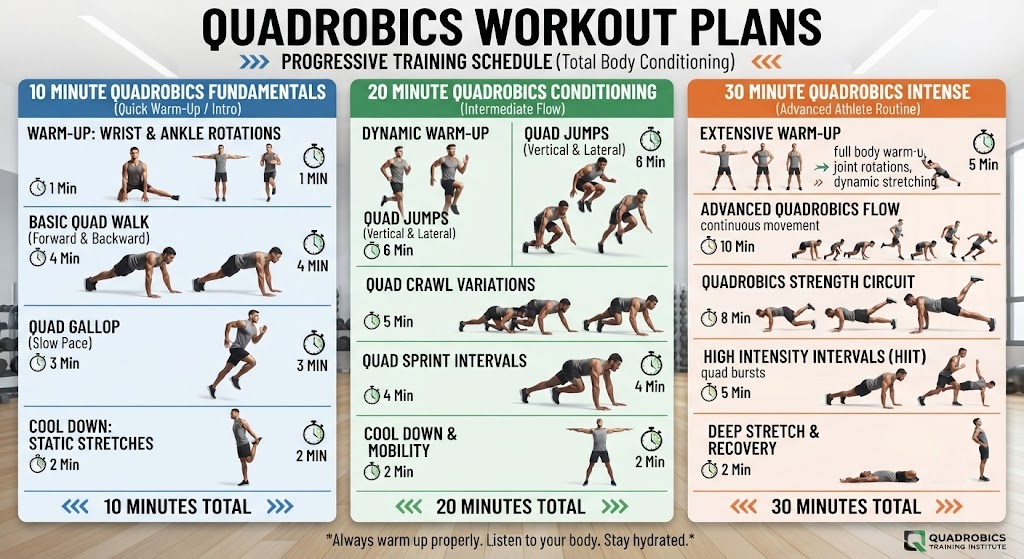
What Are 10-, 20-, and 30-Minute Quadrobics Workout Examples?
Quadrobics workouts can be scaled by changing the number of movements, rounds, work intervals, and rest periods.
Short sessions are useful for learning technique, while longer sessions can provide more practice and conditioning when recovery is adequate.
10-Minute Beginner Quadrobics Routine
Start with approximately three minutes of warm-up.
Then perform:
- Bear hold
- Forward crawl
- Backward crawl
- Shoulder taps
- Lateral crawl
Use approximately 20 seconds of work for each movement and allow 30 seconds of rest between movements.
The emphasis should be on learning the movement patterns rather than maximizing intensity.
20-Minute Quadrobics Routine
Start with a 5-minute warm-up.
Then complete 2–3 rounds of:
- Bear crawl
- Beast shoulder taps
- Lateral crawling
- Backward crawling
- Frogger movements
Adjust the number of rounds according to your experience and ability to maintain good technique.
30-Minute Intermediate Quadrobics Routine
A longer session can include:
- 7-minute warm-up
- Three 6-minute movement blocks
- 5-minute cooldown
Directional transitions and longer crawling intervals can be introduced when foundational movements remain controlled.
How Do You Build a Quadrobics Routine Safely?
A safe Quadrobics routine prioritizes technique, manageable training volume, an appropriate surface, and gradual progression.
Controlled movement matters more than speed when you are learning quadrupedal exercises.
Choose an Appropriate Surface
Use a surface that provides enough grip without being excessively hard.
A comfortable exercise mat can also make hand and knee contact more comfortable during longer sessions.
Pay Attention to Wrist and Joint Position
Because Quadrobics involves repeated weight-bearing through the hands, beginners should pay attention to how their wrists and shoulders feel during exercise.
Keep your hands and wrists positioned comfortably and reduce the workload if you experience persistent pain.
Don’t Rush Into Advanced Movements
Social-media videos can make advanced Quadrobics movements look easy, but beginners should build their foundation first.
Start with bear holds and slow crawls before attempting explosive transitions or complex locomotion patterns.
Progress Gradually
A simple progression might look like:
Bear hold → forward crawl → backward crawl → lateral crawl → controlled transitions → more complex movements
This gives your body time to become familiar with the movement demands.
People with an existing injury, significant joint pain, or a medical condition should seek individualized professional guidance before beginning a demanding exercise routine. The CDC advises people with chronic conditions to discuss appropriate activity with a healthcare professional when needed. — Source: CDC, 2025
What’s Next: How to Build a Quadrobics Routine?
The next step is to practice foundational Quadrobics movements consistently while tracking duration, distance, repetitions, and technique.
A simple training log can help you identify progress without relying only on workout intensity.
Track Your Bear Hold
Record your best controlled bear-hold time.
For example, you might begin with 15 seconds and gradually work toward longer controlled holds.
Track Your Crawling
Record how long you can crawl without losing your posture or coordination.
As your control improves, you can gradually increase your work interval or crawling distance.
Track Your Transitions
Pay attention to how smoothly you move between positions.
The goal is not simply to perform more repetitions. Controlled transitions can provide useful feedback about your coordination and movement control.
Combine Quadrobics With Other Training
Finally, combine Quadrobics with conventional strength, mobility, and cardiovascular training for a more complete fitness routine.
Quadrobics works especially well as a movement-focused home workout, conditioning session, or coordination practice rather than needing to become your only training method.
full body workout for beginners
Conclusion
A full body Quadrobics workout combines crawling, static holds, transitions, coordination, balance, mobility, and conditioning into an unconventional bodyweight training approach.
The most practical way to begin is to focus on control before complexity. Start with a proper warm-up, practice bear holds and crawls, add controlled transitions, and gradually increase your training volume as your technique improves.
Quadrobics does not need to be complicated to be useful. A short beginner session can provide meaningful movement practice, while longer sessions can gradually introduce more crawling, directional changes, and advanced patterns.
Most importantly, consistency matters more than rushing through difficult movements. By building your Quadrobics routine step by step and combining it with other forms of strength, mobility, and cardiovascular training, you can make this unique movement style an enjoyable part of a broader fitness program.
FAQs
What is a full body Quadrobics workout?
A full body Quadrobics workout uses crawling, holds, and transitions to train multiple muscle groups.
Is Quadrobics good for beginners?
Yes, beginners can start with simple movements like bear holds and slow crawls.
What muscles does Quadrobics work?
Quadrobics works the core, shoulders, arms, chest, back, hips, glutes, thighs, and calves.
Can you do Quadrobics at home?
Yes, you can do Quadrobics at home with little or no equipment.
How long should a Quadrobics workout last?
A Quadrobics workout can last about 10–30 minutes depending on your fitness level.
How many days a week should you do Quadrobics?
Beginners can start with Quadrobics 2 days per week.
Can Quadrobics build strength?
Yes, Quadrobics can help develop bodyweight strength and conditioning.
Does Quadrobics improve mobility?
Yes, Quadrobics may help improve movement control and mobility.
What should you do before a Quadrobics workout?
You should warm up your wrists, shoulders, hips, knees, and ankles before training.
Is Quadrobics safe?
Yes, Quadrobics can be practiced safely with proper technique and gradual progression.
What is the best Quadrobics exercise for beginners?
Bear holds and slow bear crawls are simple exercises for beginners to start with.
Can Quadrobics replace strength training?
Quadrobics can complement strength training but does not need to replace traditional resistance exercises.
How do I improve my Quadrobics?
You can improve by practicing regularly and gradually increasing strength, mobility, coordination, and control.
Are Quadrobics a good workout?
Yes, Quadrobics can train coordination, balance, mobility, conditioning, and bodyweight strength.
How to jump high in Quadrobics?
You can improve jumping by practicing leg strength, explosive movements, and controlled landings.
Why are Quadrobics so hard?
Quadrobics can feel difficult because your arms, legs, core, and balance work together during unfamiliar movements.
How do I progress a Quadrobics workout?
You can progress by gradually increasing workout time, distance, rounds, or movement difficulty.
Can I do a 10-minute Quadrobics workout?
Yes, a 10-minute Quadrobics workout can be a good starting point for beginners.