
You’ve probably already noticed that crawling looks simple, but a properly performed bear crawl workout can challenge your entire body at once. The difference between an easy crawl and an effective one usually comes down to technique, coordination, and smart programming rather than effort alone.
A bear crawl combines core stability, upper-body strength, lower-body movement, coordination, and conditioning in one equipment-free exercise. Whether you’re a beginner learning the movement or an experienced athlete looking for a demanding conditioning drill, the bear crawl can be adapted to your fitness level.
In this guide, you’ll learn what a bear crawl is, how to perform it correctly, which muscles it works, its benefits, common mistakes, effective variations, and how to build a bear crawl workout at home.
What Is a Bear Crawl Workout?
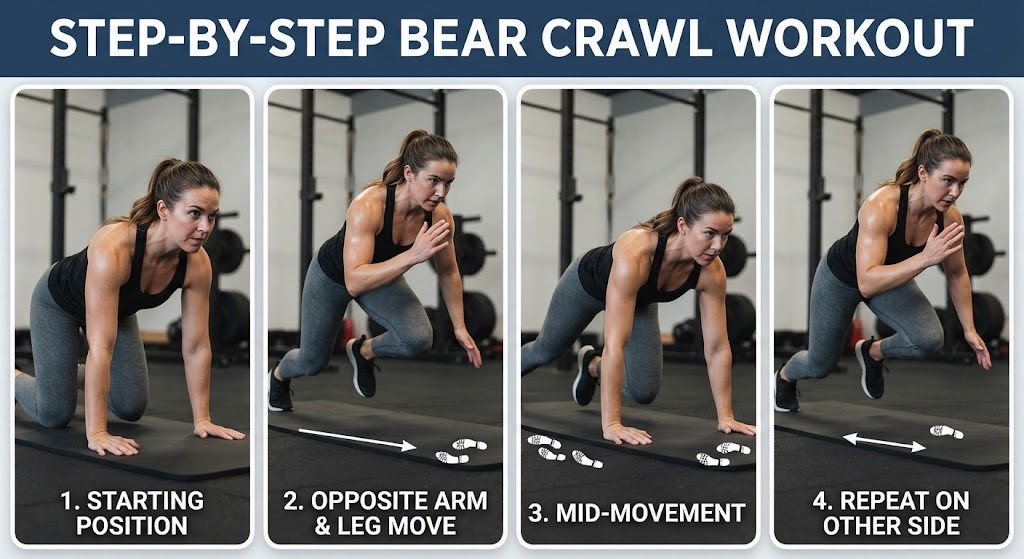
A bear crawl is a bodyweight exercise performed on the hands and feet with the knees hovering close to the floor while the opposite hand and foot move together. Unlike a traditional crawl, the knees remain off the ground, creating continuous tension through the core, shoulders, hips, and legs.
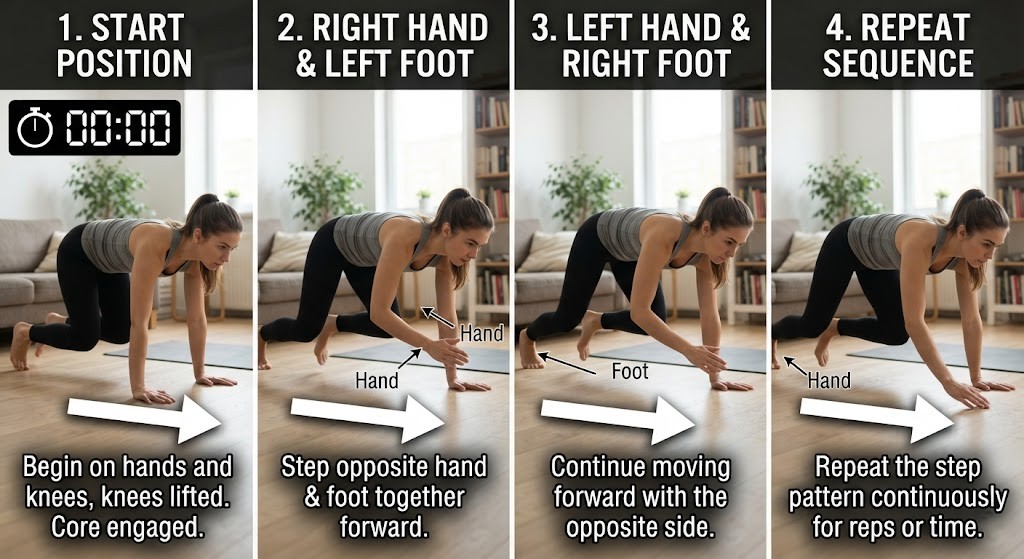
The bear crawl is also a contralateral movement, meaning your right hand generally moves with your left foot and vice versa. For example, crawling forward for 10 controlled steps requires your trunk to resist unwanted rotation while your limbs coordinate the movement.
Bear crawls also differ from movements such as the leopard crawl because the bear crawl usually keeps the hips slightly higher and the knees hovering beneath the torso. This makes the exercise useful for functional fitness, conditioning, and bodyweight strength training.
Why Is the Bear Crawl a Good Full-Body Exercise?
The bear crawl is a full-body movement that primarily challenges the core, shoulders, arms, hips, and legs while also developing coordination and muscular endurance. It combines stability and locomotion in one bodyweight exercise.
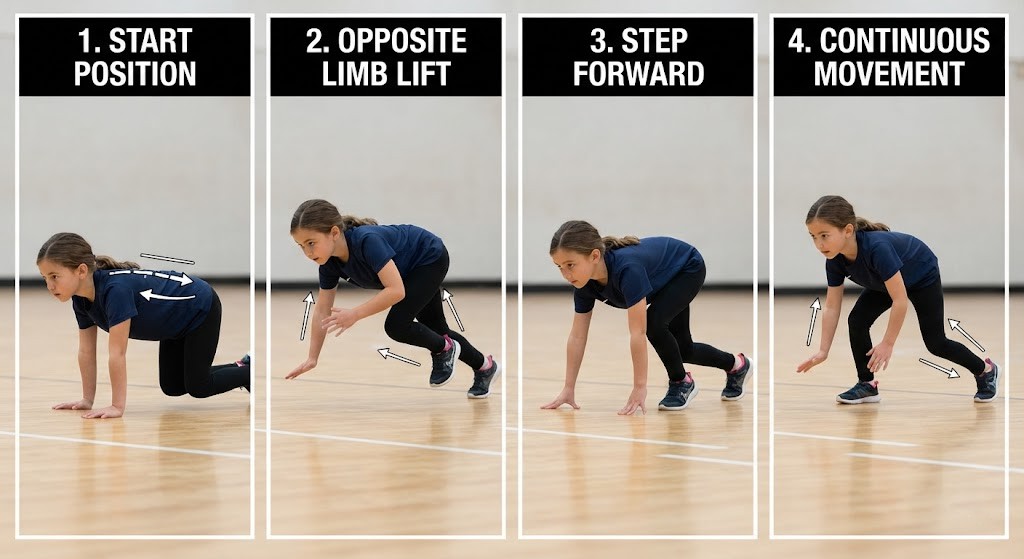
First, bear crawls can challenge core stability because your trunk must remain controlled while opposite limbs move. A slow crawl across a room forces your abdominal muscles to resist excessive twisting and arching.
Second, the exercise challenges the upper body through continuous weight bearing. Your shoulders, chest, arms, and upper back help support and control your body as you move.
At the same time, continuous bear crawls can raise breathing and heart rate, making them useful in conditioning circuits. Adults are generally advised to accumulate 150–300 minutes of moderate-intensity aerobic activity weekly, alongside muscle-strengthening activity on at least two days. — Source: U.S. Department of Health and Human Services, 2026
For more movement ideas, combine bear crawls with a full body bodyweight workout or a functional training workout.
What Muscles Does the Bear Crawl Work?
The bear crawl muscles worked include the core, shoulders, arms, chest, back, hips, glutes, and legs. The core and shoulders primarily stabilize the body while the hips and legs contribute to locomotion.
Because the movement requires multiple muscle groups to work simultaneously, it can be more demanding than its simple appearance suggests.
Core and Trunk
The rectus abdominis, transverse abdominis, and obliques help maintain a stable trunk during the crawl. Every time one hand and the opposite foot move, the abdominal muscles help control unwanted rotation.
A slower bear crawl can make this stability requirement particularly noticeable because you have more time to control each step.
For more targeted training, pair bear crawls with core strengthening exercises and best core workouts.
Shoulders, Arms, and Chest
The shoulders, triceps, chest, and upper back support your body through the hands. Your serratus anterior also contributes to controlled shoulder-blade movement as you shift your weight from one arm to the other.
For example, adding bear crawl shoulder taps increases the stability demand because one hand briefly leaves the floor. You can also complement this movement with shoulder strengthening exercises.
Hips and Legs
The glutes, hip flexors, quadriceps, and calves contribute to moving the lower body. However, the legs are not simply pushing you forward; they also help maintain the correct body position throughout every step.
Keeping the knees hovering close to the floor makes the hips and legs work continuously rather than allowing them to relax between steps.
How Do You Do a Bear Crawl Correctly?
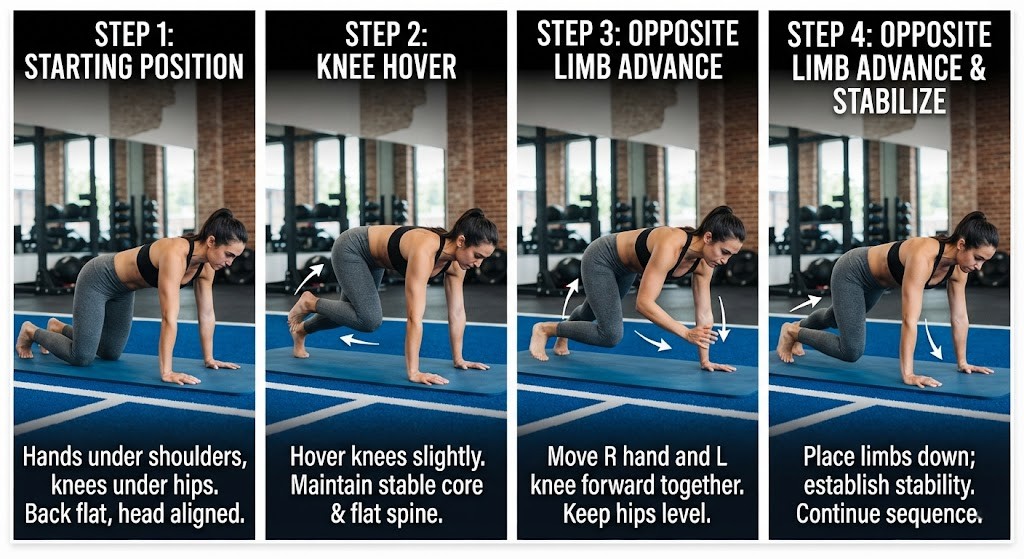
The proper bear crawl form involves keeping the core braced, spine controlled, hips relatively low, and movements short and deliberate. Good technique should feel coordinated rather than rushed.
Step-by-Step Bear Crawl Technique
Follow these steps to perform a bear crawl correctly:
- Start on all fours with your hands directly beneath your shoulders.
- Lift your knees about 1–2 inches from the floor.
- Brace your core as if preparing for a light punch.
- Keep your back neutral rather than excessively rounding or arching it.
- Move the opposite hand and foot together in a controlled pattern.
- Take short steps while keeping your knees close to the floor.
- Breathe steadily instead of holding your breath.
- Stop when your form breaks down, even if your planned interval has not ended.
Your goal is to keep the torso stable while the limbs move underneath it. Avoid allowing the hips to sway significantly from side to side.
Beginners should practice the movement slowly before increasing distance or speed. A useful starting point is 10–20 seconds of crawling followed by enough rest to restore good technique.
How Long Should You Bear Crawl for a Workout?
A bear crawl workout can last from short 10-second intervals to several minutes of accumulated work, depending on fitness level and workout structure. Quality should determine the duration rather than an arbitrary time target.
For beginners, try 3–5 rounds of 10–20 seconds, resting 30–60 seconds between rounds. Intermediate exercisers can use 20–30 second intervals, while advanced trainees can combine longer intervals with faster variations.
A simple progression might look like this:
| Fitness Level | Work Interval | Suggested Rounds | Rest |
|---|---|---|---|
| Beginner | 10–20 seconds | 3–5 | 30–60 seconds |
| Intermediate | 20–30 seconds | 3–5 | Based on form |
| Advanced | Longer intervals or faster variations | 4–5+ | Based on workout |
Importantly, bear crawls can contribute to general activity but should complement, rather than automatically replace, your broader training program. Current U.S. guidance recommends at least 2 days of weekly muscle-strengthening activity for adults. — Source: CDC, 2025
What Are the Benefits of a Bear Crawl Workout?
A well-designed bear crawl workout can provide several training benefits because the exercise combines movement, stability, and conditioning.
1. Builds Core Stability
Bear crawls require your trunk to remain controlled while your arms and legs alternate. This creates a dynamic core challenge rather than simply holding your body in one stationary position.
2. Challenges Upper-Body Endurance
Because the hands remain weight-bearing throughout the movement, the shoulders, arms, chest, and upper back have to continuously support and control your body.
3. Develops Coordination
The opposite-hand, opposite-foot pattern requires the upper and lower body to work together. Practicing this pattern can make the movement increasingly coordinated and controlled.
4. Provides Equipment-Free Conditioning
Bear crawls require no machines, weights, or specialized equipment. You can perform them at home, outdoors, or as part of a bodyweight circuit.
5. Adds Variety to Bodyweight Training
If your workouts mainly consist of squats, lunges, push-ups, and planks, bear crawls introduce locomotion and a different stability challenge.
6. Can Be Scaled to Different Fitness Levels
Beginners can crawl slowly for short distances, while experienced trainees can use lateral, backward, faster, shoulder-tap, or loaded variations.
Can Bear Crawls Improve Core Strength and Stability?
Bear crawls can improve core strength and stability by requiring the trunk to resist movement while the arms and legs alternate. This makes them particularly useful as a dynamic alternative to static core exercises.
For example, performing a 20-second slow bear crawl forces your abdomen and hips to stabilize repeatedly rather than holding one position. This makes the movement useful in HIIT workout exercises and functional circuits.
Moreover, bear crawls train coordination between the upper and lower body. That quality is valuable because many athletic and everyday movements require your limbs to work together while your trunk remains controlled.
What Are the Best Bear Crawl Variations for Beginners and Advanced Athletes?
Bear crawl variations change the direction, stability demand, speed, or resistance of the basic movement. Choosing the right variation lets you progress without sacrificing technique.
| Bear Crawl Variation | Best For | Difficulty |
| Beginner bear crawl | Learning technique | Beginner |
| Backward bear crawl | Coordination and control | Beginner–Intermediate |
| Lateral bear crawl | Side-to-side stability | Intermediate |
| Bear crawl shoulder taps | Core and shoulder stability | Intermediate |
| Loaded bear crawl | Strength and conditioning | Advanced |
| Fast bear crawl | Conditioning | Advanced |
Beginner Bear Crawl
Beginners can reduce the difficulty by shortening the crawling distance and slowing the movement. The primary goal is to learn the contralateral movement pattern while maintaining a stable torso.
Backward Bear Crawl
Backward bear crawls require greater coordination because you cannot rely as easily on visual feedback. Start with short distances and focus on controlling every step.
Lateral Bear Crawl
The lateral bear crawl moves from side to side rather than directly forward or backward. This variation challenges your ability to maintain trunk and hip control while changing direction.
Bear Crawl Shoulder Taps
In this variation, you briefly lift one hand to tap the opposite shoulder before placing it back down. Since your base of support becomes smaller, your core and shoulders must work harder to prevent excessive rotation.
Loaded Bear Crawl
Loaded bear crawls add external resistance to an already demanding movement. This is an advanced option and should only be introduced after you can perform standard bear crawls with consistent technique.
Fast Bear Crawl
A fast bear crawl increases the conditioning demand. However, speed should never come at the expense of body position, coordination, or controlled movement.
What Are the Most Common Bear Crawl Mistakes?
The most common bear crawl mistakes include lifting the hips too high, sagging the lower back, taking oversized steps, rushing, and failing to brace the core. Correcting these errors can make the movement more effective immediately.
1. Lifting the Hips Too High
Avoid pushing your hips toward the ceiling. Doing so changes the body position and can reduce the challenge to your trunk.
Instead, imagine maintaining a compact tabletop position while keeping your knees close to the floor.
2. Letting the Lower Back Sag
As fatigue increases, it can become tempting to let the lower back arch. This usually indicates that your core is no longer maintaining the desired position.
Shorten your steps or rest briefly when you can no longer maintain a controlled spine.
3. Taking Steps That Are Too Large
Giant steps can make it harder to maintain control. Short, deliberate steps usually produce better coordination than frantic crawling.
4. Moving Too Quickly
Fast movement is not automatically better. If you lose the opposite-hand, opposite-foot pattern or allow the hips to swing excessively, reduce your speed.
5. Forgetting to Breathe
Holding your breath can make the exercise feel unnecessarily difficult. Instead, maintain steady breathing throughout each interval.
6. Continuing After Technique Breaks Down
The goal of a bear crawl workout is not simply to survive the interval. When your technique deteriorates significantly, take a rest and resume when you can regain control.
How Do You Build a Bear Crawl Workout at Home?
A home bear crawl workout can combine crawling intervals with simple bodyweight exercises and requires little or no equipment. A clear structure makes the exercise easier to program.
Beginner Bear Crawl Workout
Complete 3 rounds:
- Bear crawl — 15 seconds
- Bodyweight squats — 10 reps
- Rest — 45 seconds
- Push-ups — 6–10 reps
- Rest — 45 seconds
The emphasis should be on learning the crawl rather than moving as quickly as possible. If 15 seconds causes your form to deteriorate, shorten the interval.
Intermediate Bear Crawl Workout
Complete 4 rounds:
- Forward bear crawl — 20 seconds
- Lateral bear crawl — 15 seconds per side
- Mountain climbers — 20 seconds
- Rest — 45 seconds
Current U.S. data show that only 26.4% of adults met both aerobic and muscle-strengthening guidelines in 2024, highlighting the value of accessible ways to add movement and strength work. — Source: Healthy People 2030, 2026
Advanced Bear Crawl Conditioning Workout
Complete 5 rounds:
- Fast bear crawl — 30 seconds
- Bear crawl shoulder taps — 10 per side
- Burpees — 8–10 reps
- Rest — 60 seconds
This version combines crawling with high-effort bodyweight movements. Advanced trainees should still prioritize consistent technique, particularly as fatigue builds across rounds.
How Can You Progress the Bear Crawl as You Get Stronger?
Bear crawl progression involves increasing distance, duration, repetitions, speed, or movement complexity while maintaining controlled technique. Progressive overload does not require adding weight immediately.
Increase Crawling Distance
First, gradually increase the distance you crawl. For example, progress from 5 meters to 8 meters and eventually 10 meters when you can maintain good form.
Increase Work Duration
You can also extend your intervals. For example, progress from 15 seconds to 20 seconds and eventually 30 seconds while keeping your movement controlled.
Increase Movement Complexity
Once the basic bear crawl feels comfortable, introduce more challenging variations such as:
- Backward bear crawls
- Lateral bear crawls
- Bear crawl shoulder taps
- Faster crawling intervals
- Controlled loaded bear crawls
This approach fits naturally into a progressive overload workout.
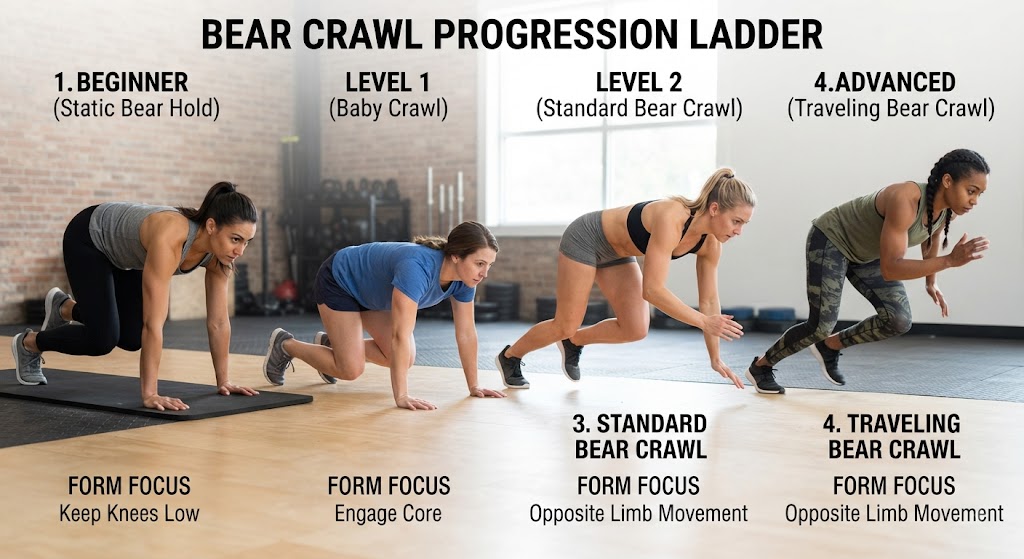
For advanced movement training, you can eventually explore an animal flow workout, which uses crawling and other ground-based movements in more complex combinations.
How Often Should You Include Bear Crawls in Training?
The ideal frequency depends on how bear crawls fit into the rest of your training. Since the movement can challenge the shoulders, arms, core, hips, and legs simultaneously, recovery should be considered when programming multiple sessions.
For beginners, short practice sessions can help develop coordination and technique. More experienced trainees can incorporate bear crawls into conditioning circuits or full-body workouts while adjusting volume according to their overall training load.
Instead of automatically adding more crawling every session, track factors such as:
- Crawling distance
- Work interval
- Number of rounds
- Variation difficulty
- Movement quality
- Recovery between sessions
This makes progression more measurable and helps prevent unnecessary increases in training volume.
What’s Next After Learning the Bear Crawl?
The next step after learning the bear crawl is to practice consistent technique before increasing workout difficulty. Your progression should follow performance quality rather than simply chasing longer intervals.
First, practice short sessions and record your distance or work time. For example, if 20 seconds feels controlled today, aim for 25 seconds only when your posture remains stable.
Second, combine bear crawls with strength, mobility, and conditioning exercises. A short warm-up using mobility exercises can prepare the shoulders, wrists, hips, and ankles for ground-based movement.
Finally, remember that better bear crawls come from better control, not simply faster crawling.
Conclusion
The bear crawl is an accessible full-body exercise that develops core stability, upper-body endurance, coordination, and conditioning without requiring gym equipment. Proper form starts with hands beneath the shoulders, knees hovering close to the floor, a braced core, controlled hips, and opposite-hand/opposite-foot movement.
A well-structured bear crawl workout can be adapted for beginners, intermediate exercisers, and advanced athletes. Beginners can start with short intervals and basic crawling, while experienced trainees can progress through longer distances, lateral or backward movements, shoulder taps, faster intervals, and controlled loading.
Most importantly, prioritize technique before intensity. By focusing on stable posture, short controlled steps, steady breathing, and progressive overload, you can make the bear crawl a practical part of strength workouts, home circuits, functional training, and conditioning sessions.
FAQs
What is a bear crawl workout?
A full-body workout using bear crawls to train strength, stability, coordination, and conditioning.
Is bear crawling a good workout?
Yes, it works the core, shoulders, arms, hips, and legs while improving coordination and endurance.
How long should you bear crawl for?
Beginners can start with 10–20 seconds per set and gradually increase the duration.
Why is bear crawl so hard?
It combines core stability, upper-body strength, coordination, and continuous movement.
Do bear crawls build abs?
Yes, bear crawls strengthen the abdominal muscles by keeping the core braced during movement.
What muscles does the bear crawl work?
It works the core, shoulders, arms, chest, back, glutes, hips, and legs.
How do you do a bear crawl correctly?
Keep your knees low, brace your core, maintain a controlled spine, and move the opposite hand and foot together.
Can beginners do bear crawls?
Yes, beginners can start slowly with short distances and brief intervals.
Can you do a bear crawl workout at home?
Yes, bear crawls require little or no equipment and work well in home workouts.
How do you make bear crawls harder?
Increase the distance, duration, speed, or difficulty of the variation while maintaining good form.
What is the most common bear crawl mistake?
Common mistakes include raising the hips too high, sagging the back, and taking steps that are too large.
1 thought on “Bear Crawl Workout: Build Full-Body Strength, Mobility & Endurance”