
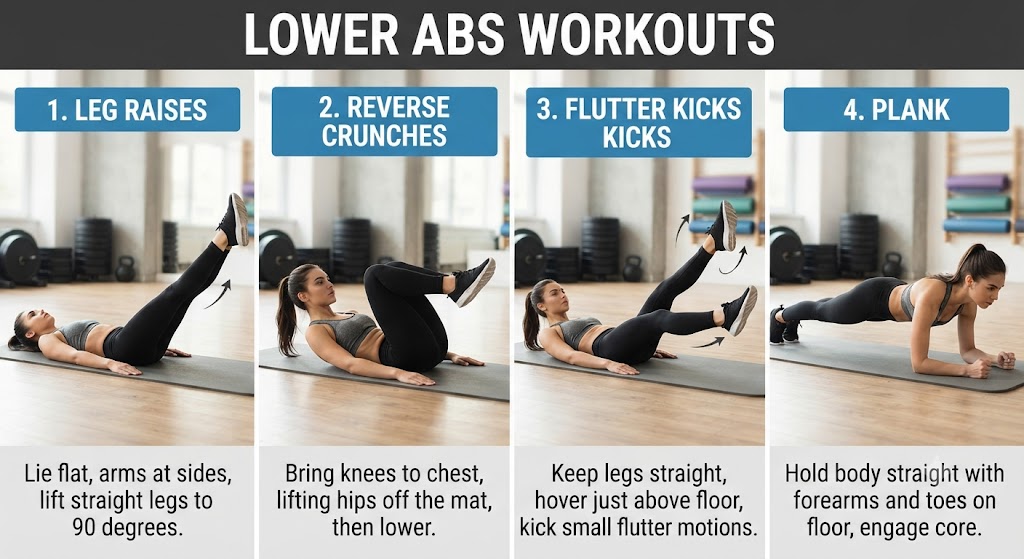
A strong core is about far more than doing endless crunches. While exercises such as crunches and leg raises can strengthen the abdominal muscles, different movements challenge the core in different ways—and the quality of your technique can make a major difference.
The most effective lower abs workouts combine controlled movement, proper pelvic positioning, steady breathing, and progressive difficulty. Whether you are training at home with no equipment or using a pull-up bar at the gym, you can build an effective routine around movements that challenge abdominal tension and trunk stability.
In this guide, you’ll learn what lower-ab exercises actually train, whether you can target the lower abs, which exercises work best for beginners and advanced trainees, how to perform them correctly, common mistakes to avoid, and how to build a sustainable lower abs workout routine.
What Are Lower Abs Workouts?
Lower abs workouts are exercises that strengthen the abdominal and core muscles through movements that challenge trunk control, pelvic positioning, and abdominal tension. For example, reverse crunches train you to control the pelvis while keeping the abdominal muscles actively engaged.
The phrase “lower abs” refers to the lower portion of the rectus abdominis, rather than a completely separate muscle. The rectus abdominis runs vertically along the front of the torso, and certain movements can place greater emphasis on actions involving the lower abdominal region.
This means an effective lower abs workout is not simply about choosing an exercise with the word “lower” in its name. How you perform the movement matters just as much as the exercise itself.
Maintaining abdominal tension, controlling the pelvis, and avoiding momentum can make even a simple bodyweight movement significantly more challenging.
Can You Actually Target the Lower Abs?
You can emphasize the lower portion of the abdominal region through certain movements, but you cannot completely isolate it from the rest of the rectus abdominis.
For example, a controlled reverse crunch involves curling the pelvis toward the torso, creating a strong challenge for the abdominal muscles. In contrast, simply swinging the knees upward can shift some of the work toward momentum and away from deliberate abdominal control.
The rectus abdominis is one continuous muscle. Therefore, lower-ab exercises do not isolate a completely separate “lower-ab muscle”; instead, certain movements can emphasize the lower portion of the abdominal region.
For more structured abdominal training, explore our core and abs workouts guide for additional movement options and programming ideas.
What Muscles Do Lower Abs Exercises Work?
Lower abs exercises primarily challenge the rectus abdominis while also involving muscles that contribute to trunk and pelvic control.
Depending on the exercise, you may also involve:
- Transverse abdominis: Supports abdominal bracing and trunk stability.
- Obliques: Help control rotation and side-to-side movement.
- Hip flexors: Assist with raising and positioning the legs.
- Lower-back muscles: Help stabilize the spine during controlled movements.
- Pelvic muscles: Contribute to overall trunk and pelvic control.
For example, during a leg raise, the hip flexors help move the legs while the abdominal muscles work to control the pelvis and torso.
As a result, lower abs training is best considered part of broader core strengthening exercises, rather than a completely separate abdominal training category.
Why Are Lower Abs Workouts Important for Core Strength?
Lower abs workouts can strengthen the muscles responsible for abdominal tension, pelvic control, and trunk stability. These abilities are useful not only during core exercises but also during many everyday movements and forms of exercise.
For example, maintaining a controlled pelvis during a leg raise requires the core to resist unwanted spinal movement. Similar control can be useful when performing resistance training, running, sports, and bodyweight exercises.
A stronger core can also help you maintain control when your arms and legs move independently from your torso.
However, effective core training is not about creating maximum fatigue. Quality of movement should come first. Ten slow repetitions performed with excellent control may be more useful than 30 rushed repetitions performed with poor positioning.
How Do Lower Abs Workouts Support Core Stability?
Lower abs workouts support core stability by teaching the trunk to remain controlled while the pelvis and limbs move.
Dead bugs are a good example. During this exercise, opposite arms and legs move while the torso remains stable. This challenges your ability to maintain abdominal tension and resist unwanted movement.
Controlled abdominal exercises can also improve awareness of pelvic positioning. That skill can become useful during movements such as:
- Squats
- Lunges
- Leg workouts
- Running
- Bodyweight exercises
- Resistance-training movements
A practical goal is therefore to focus on controlled, repeatable movement rather than maximum repetitions.
Can Lower Abs Workouts Reduce Lower-Belly Fat?
Lower abs workouts can strengthen the abdominal muscles, but they cannot specifically remove fat from the lower belly.
For example, performing hundreds of leg raises does not force the body to burn fat specifically from the lower abdomen. Fat loss occurs systemically rather than only in the area being exercised.
Changes in body composition generally require an appropriate combination of:
- Nutrition
- Physical activity
- Resistance training
- Sustainable energy balance
- Adequate recovery
Ab exercises can develop the muscles underneath body fat, while overall physical activity can contribute to energy expenditure.
For additional activity, a Walking Glute Workout can provide a simple cardiovascular option, while a brisk walking workout can increase walking intensity without requiring complex equipment.
What Are the Best Lower Abs Exercises?
The best lower abs exercises are movements that allow you to maintain abdominal tension while controlling your pelvis and spine.
Reverse crunches, dead bugs, toe taps, leg raises, hollow-body holds, mountain climbers, hanging knee raises, and controlled leg-lowering variations can all be incorporated into a lower abs workout.
The right exercise depends on your current strength and ability to maintain proper technique.
| Exercise | Level | Equipment | Main Challenge |
|---|---|---|---|
| Reverse crunch | Beginner | None | Pelvic control |
| Dead bug | Beginner | None | Core stability |
| Toe taps | Beginner | None | Abdominal bracing |
| Leg raise | Intermediate | None | Trunk and hip control |
| Hollow-body hold | Intermediate | None | Full-core tension |
| Mountain climbers | Intermediate | None | Dynamic core control |
| Hanging knee raise | Advanced | Pull-up bar | Core and grip control |
| Controlled leg lowering | Advanced | None | Eccentric abdominal control |
How Do You Do Reverse Crunches?
Reverse crunches are a lower-abdominal exercise that trains you to control the pelvis while curling it toward the torso. They can be performed on the floor with little or no equipment, making them a practical option for home workouts.
How to perform a reverse crunch:
- Lie on your back with your knees bent and hips positioned comfortably.
- Lift your feet from the floor.
- Brace your abdominal muscles.
- Gently curl your pelvis upward and bring your knees toward your chest.
- Avoid swinging your legs to create momentum.
- Slowly lower your pelvis back to the starting position.
The movement should come from controlled pelvic motion, rather than simply throwing the legs toward the chest.
Try 2–3 sets of 8–15 repetitions. If you cannot control the lowering phase, reduce the range of motion before increasing repetitions.
How Do You Perform Leg Raises for Abs?
Leg raises challenge your ability to control the pelvis while moving the legs. A lying leg raise can be performed on the floor with your legs extended, making it an accessible progression after easier movements.
How to perform a lying leg raise:
- Lie flat on your back.
- Place your hands beside your body or underneath your hips if that helps you maintain control.
- Brace your core.
- Slowly raise your legs while keeping the movement smooth.
- Lower your legs gradually.
- Stop before your lower back begins to lift excessively from the floor.
A smaller controlled range of motion is preferable to a larger range performed with poor spinal positioning.
Start with 2–3 sets of 6–12 repetitions. If straight-leg raises feel too difficult, bend your knees slightly to reduce the challenge.
How Do You Do Hanging Knee Raises?
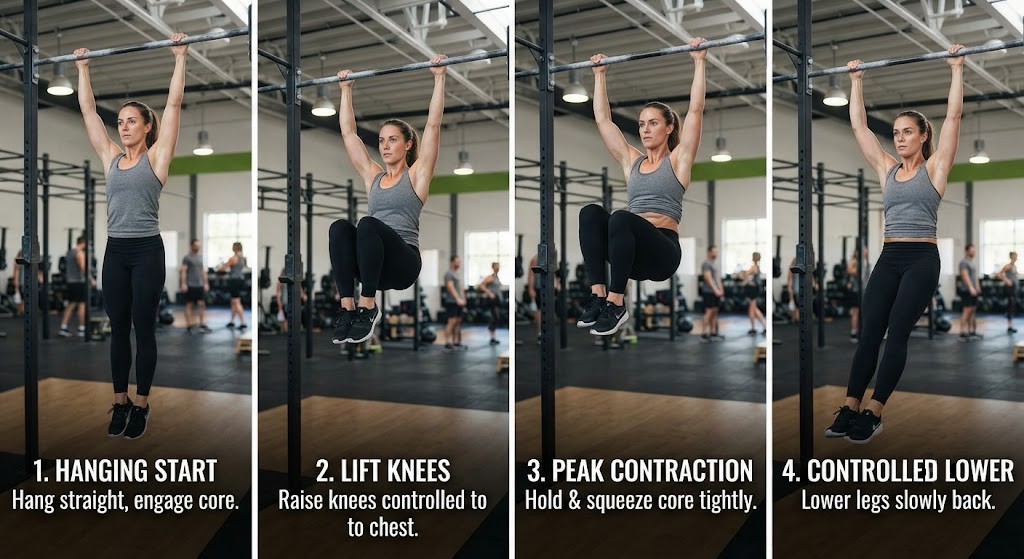
Hanging knee raises are a more demanding lower-core exercise that combines abdominal control with grip and shoulder stability.
How to perform hanging knee raises:
- Hang from a stable pull-up bar with your arms extended.
- Keep your shoulders controlled rather than completely passive.
- Brace your abdominal muscles.
- Raise your knees toward your chest without swinging.
- Lower your legs slowly.
- Reset before beginning the next repetition.
Avoid turning the exercise into a swinging movement. Excessive momentum can reduce the deliberate core challenge.
Try 2–3 sets of 6–12 repetitions once you can perform simpler floor-based movements comfortably.
How Do Dead Bugs and Hollow Holds Train the Core?
Dead bugs and hollow-body holds train the core by challenging your ability to maintain a stable trunk while your limbs move or remain extended.
For a dead bug, lie on your back, brace your abdomen, and slowly extend opposite limbs while keeping your torso controlled. If the standard version feels difficult, keep your knees closer to your torso.
For a hollow-body hold, extend your arms and legs only as far as you can while maintaining abdominal control.
These exercises demonstrate that core training does not always require repeated spinal movement. Stability-focused and isometric exercises can provide a different training stimulus.
For more exercise variety, compare these movements with other 360 Abs Workout designed to train the entire abdominal region.
How Do You Do Lower Abs Workouts at Home?
Lower abs workouts are easy to perform at home because many effective exercises require nothing more than floor space and a stable surface.
Reverse crunches, dead bugs, toe taps, hollow holds, and many leg-raise variations can all be performed without specialized equipment.
You also do not need to immediately add weights to make a home lower abs workout harder. You can increase difficulty by:
- Slowing the movement
- Increasing time under tension
- Increasing repetitions
- Increasing hold duration
- Extending the lever length
- Increasing range of motion
- Progressing to a harder exercise variation
What Is the Best No-Equipment Lower Abs Workout?
A no-equipment lower abs workout can combine several movements that challenge abdominal control in different ways.
The following routine can be completed in roughly 10–15 minutes:
- Dead bugs: 8–10 reps per side
- Reverse crunches: 10–15 reps
- Toe taps: 10–15 reps per side
- Controlled leg raises: 6–12 reps
- Hollow-body hold: 15–30 seconds
Rest 30–60 seconds between exercises and complete 2–3 rounds.
Beginners should prioritize technique rather than trying to complete every prescribed repetition. If your lower back begins arching excessively, shorten the range of motion or choose an easier variation.
How Can You Progress a Lower Abs Workout at Home?
You can progress a home lower-ab workout by increasing control, repetitions, duration, range of motion, or exercise difficulty.
For example, you might progress from bent-knee reverse crunches to straighter-leg variations after developing better pelvic control.
A simple progression system is:
- Level 1: Dead bugs and bent-knee reverse crunches.
- Level 2: Toe taps, standard reverse crunches, and short hollow holds.
- Level 3: Straight-leg raises and longer hollow holds.
- Level 4: Controlled leg lowering and more demanding lever positions.
Change only one difficulty variable at a time when possible. This makes it easier to determine whether your body is ready for the next progression while preserving exercise quality.
What Is the Best Lower Abs Workout for Beginners?
The best lower abs workout for beginners is short, controlled, and built around movements that can be performed without excessive spinal movement.
Dead bugs, toe taps, reverse crunches, bent-knee leg raises, and short hollow holds provide a practical starting point.
Beginner Lower Abs Workout
| Exercise | Sets | Reps/Time | Rest |
|---|---|---|---|
| Dead bug | 2 | 8/side | 30 sec |
| Toe taps | 2 | 10/side | 30 sec |
| Reverse crunch | 2 | 8–12 | 45 sec |
| Bent-knee leg raise | 2 | 6–10 | 45 sec |
| Hollow hold | 2 | 15–20 sec | 45 sec |
Complete the routine 2 times per week and focus on slow, controlled repetitions.
When the exercises become easier and your form remains strong, gradually increase repetitions or move to a more challenging variation.
What Is an Intermediate Lower Abs Workout?
An intermediate lower abs workout introduces more demanding movements and longer periods of abdominal tension.
An effective intermediate session could include:
- Reverse crunches: 3 × 12–15
- Straight-leg raises: 3 × 8–12
- Hollow-body hold: 3 × 20–40 seconds
- Mountain climbers: 3 × 20–30 seconds
Rest approximately 45–75 seconds between sets.
Intermediate trainees can also emphasize the eccentric portion of an exercise. For example, slowly lowering your legs during a leg raise can increase the challenge without requiring additional equipment.
What Is an Advanced Lower Abs Workout?
An advanced lower abs workout uses demanding movements that require substantial trunk control, strength, and coordination.
An advanced session could include:
- Hanging knee raises: 3 × 8–12
- Controlled leg lowering: 3 × 6–10
- Hollow-body hold: 3 × 30–45 seconds
- Reverse crunch with slow eccentric: 3 × 10–12
However, advanced exercises are not automatically better.
The best progression is the hardest variation you can perform consistently with proper technique. If an advanced exercise causes excessive swinging or loss of pelvic control, return to an easier variation.
How Should You Perform Lower Abs Exercises Correctly?
Proper lower-ab training involves controlled repetitions, steady breathing, and appropriate spinal and pelvic positioning.
For example, a slow leg raise performed with a stable pelvis can provide a stronger training challenge than a faster repetition performed with swinging legs.
How Do You Control Your Pelvis During Lower Abs Exercises?
Pelvic control means maintaining a deliberate relationship between your pelvis, abdomen, and spine throughout an exercise.
During a reverse crunch, for example, you should actively curl the pelvis rather than simply throwing your knees upward.
Use these steps:
- Brace your abdominal muscles before starting.
- Keep the movement slow enough to feel the pelvis moving.
- Avoid using your legs to create momentum.
- Maintain control during both the lifting and lowering phases.
- Reduce the range of motion if your positioning begins to deteriorate.
One useful cue is: Think about moving your pelvis, not simply moving your legs.
This cue can make reverse crunches and leg raises easier to understand and perform correctly.
How Should You Breathe During Lower Abs Exercises?
Breathing should remain controlled rather than being held throughout every repetition.
For example, you can exhale during the most demanding portion of a reverse crunch and inhale as you return to the starting position.
Steady breathing can help you maintain rhythm and avoid unnecessary tension. If you repeatedly hold your breath during relatively simple abdominal movements, reduce the intensity and focus on coordinating breathing with movement.
How Do You Avoid Using Momentum?
Avoid momentum by slowing both the lifting and lowering phases and stopping when you can no longer maintain proper positioning.
For hanging knee raises, the movement should not resemble a swinging pendulum. Instead, keep your torso controlled and move the knees deliberately.
Try using a two-second lowering phase for exercises such as reverse crunches and leg raises. This can make technique problems easier to identify while encouraging greater control.
How Often Should You Train Your Lower Abs?
Most people can train their lower abs approximately 2–3 times per week as part of a balanced core program, provided they recover adequately.
For example, you could perform focused core training on Monday and Thursday while using the remaining training days for other muscle groups.
However, more training is not automatically better. Your total workout volume, exercise intensity, sleep, nutrition, and recovery all influence how frequently you should train.
For broader guidance, see our workout recovery resource before increasing training frequency or volume.
How Many Reps Should You Do for Lower Abs Exercises?
The ideal repetition or time range depends on the exercise and its difficulty.
For example, you might perform 8–15 controlled reverse crunches while holding a hollow-body position for 15–45 seconds.
A practical starting point is:
- Dynamic exercises: 8–15 repetitions
- More difficult movements: 6–12 repetitions
- Static holds: 15–45 seconds
- Dynamic conditioning movements: 20–40 seconds
The goal is to choose a range that allows you to finish the set with good technique and meaningful effort, rather than chasing a specific number at the expense of control.
What Are the Most Common Lower Abs Workout Mistakes?
Common lower abs workout mistakes include using momentum, excessively arching the lower back, rushing repetitions, holding the breath, and progressing before mastering basic movement control.
For example, swinging during hanging knee raises may make an exercise appear easier while reducing deliberate abdominal control.
Mistake 1: Swinging the Legs
Swinging reduces the amount of controlled work required from your core.
A fast leg raise may use momentum to lift the legs instead of requiring gradual abdominal and pelvic control.
How to fix it: Slow the movement down and pause briefly when your legs reach the desired position.
Mistake 2: Excessive Lower-Back Arching
Excessive lower-back arching can indicate that an exercise is currently too difficult for your level of control.
For example, if your back lifts significantly during a leg raise, reduce the range of motion or bend your knees.
A smaller range with better control is usually the better progression.
Mistake 3: Rushing Repetitions
Rushing can turn a strength-focused movement into a momentum-based movement.
For example, 20 fast reverse crunches may provide less useful control practice than 10 deliberate repetitions.
How to fix it: Use a steady tempo and treat each repetition as a complete movement.
Mistake 4: Progressing Too Quickly
Moving to advanced exercises before mastering basic control can cause technique to deteriorate.
For example, jumping directly from lying leg raises to hanging leg raises may be unnecessary if your basic pelvic control still needs improvement.
How to fix it: Master the current exercise before increasing resistance, range of motion, or difficulty.
What Equipment Can Make Lower Abs Workouts More Effective?
Equipment is not required for effective lower abs workouts, but tools such as pull-up bars, benches, resistance bands, and cable machines can create additional progression opportunities.
For example, a pull-up bar allows hanging knee raises, which can provide a more demanding progression from floor-based abdominal exercises.
How Can You Use a Pull-Up Bar?
A pull-up bar increases the difficulty of lower-core training by placing your body in a hanging position.
Hanging knee raises challenge abdominal control while also requiring grip and shoulder stability.
Start with controlled knee raises before progressing to straight-leg raises. Your goal should be to prevent excessive swinging throughout the movement.
How Can You Use a Bench or Resistance Band?
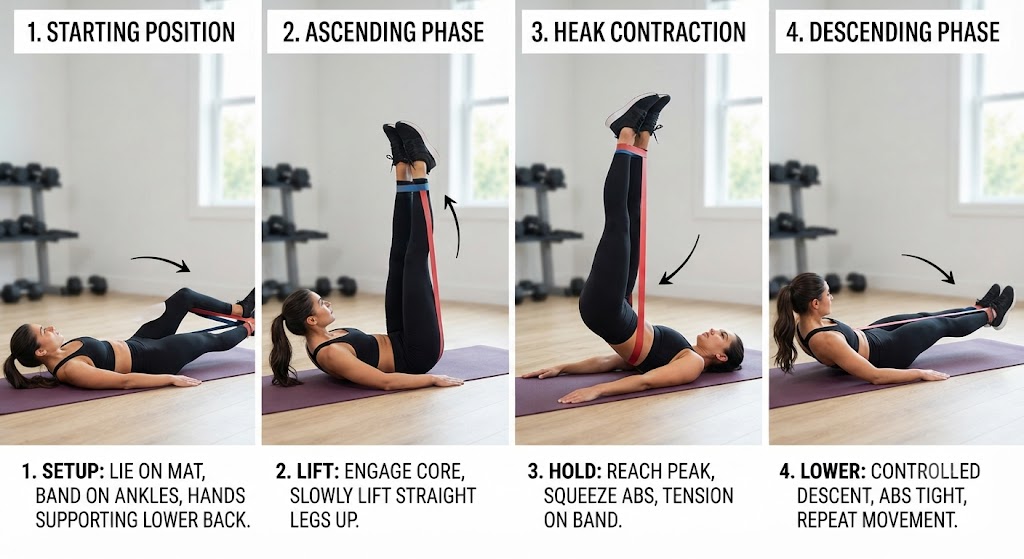
A bench or resistance band can create new exercise variations and progression opportunities.
A bench can provide additional positioning options, while a resistance band can add tension to selected movements.
Use resistance only when you can maintain the same controlled technique you use during bodyweight exercises.
What Tools Can Help With Workout Planning?
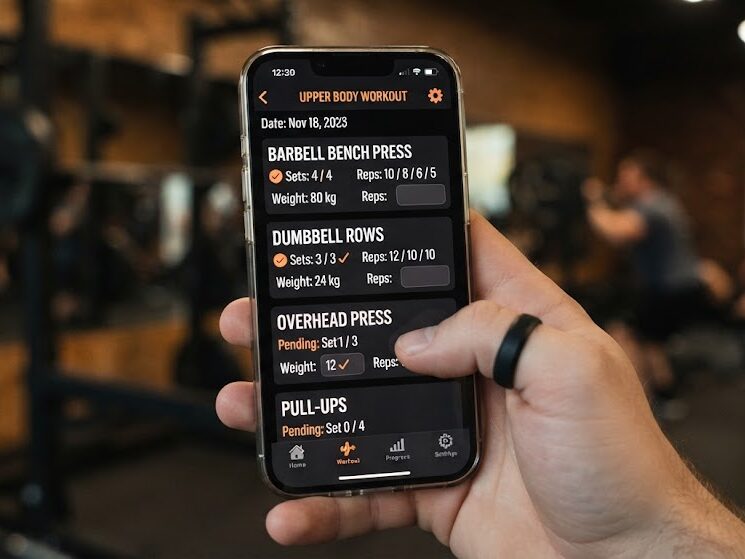
Workout-planning tools can help organize exercise volume, track progression, and estimate basic fitness metrics.
A simple notebook or phone-based tracker can also help you record:
- Sets
- Repetitions
- Hold times
- Exercise variations
- Progressions
How Do You Build a Sustainable Lower Abs Routine?
A sustainable lower abs routine combines consistent core training with progressive difficulty, full-body exercise, cardiovascular activity, appropriate nutrition, and adequate recovery.
You do not need to perform abdominal exercises every day to make progress. For many people, two focused core sessions per week can complement a broader strength-training schedule without allowing abdominal training to dominate the entire program.
Start by choosing 3–5 exercises that match your current ability. Perform them with controlled technique and record your repetitions or hold times.
Then, gradually increase the challenge when your current variation becomes comfortable.
You can progress through:
- More repetitions
- Longer holds
- Slower tempos
- Greater range of motion
- Longer lever positions
- More challenging exercises
How Can You Combine Lower Abs Workouts With Full-Body Training?
Lower abs workouts work best alongside full-body training because overall fitness involves more than abdominal strength.
For example, combining core exercises with full-body workouts allows you to train the legs, upper body, trunk, and cardiovascular system as part of a broader program.
You can also pair core sessions with leg workouts when appropriate, provided your overall training volume remains manageable.
How Does Cardio Fit Into Lower-Ab Training?
Cardiovascular exercise can complement a strength-focused core routine by increasing overall physical activity.
Walking, cycling, running, and an incline walking workout can all provide cardiovascular options without requiring additional abdominal exercises.
However, cardio should not be presented as a method for selectively removing lower-belly fat. Fat loss occurs systemically rather than from the exact area being exercised.
How Can Nutrition and Recovery Support Your Results?
Nutrition and recovery support your ability to train consistently and adapt to exercise.
Adequate food intake, hydration, sleep, and rest days can help you maintain performance across repeated training sessions.
If your goal includes greater abdominal definition, remember that muscle development and fat loss are related but separate goals. Developing the abdominal muscles can improve muscular development, while changes in body fat depend on overall energy balance and lifestyle.
How Can You Make Lower Abs Workouts More Effective?
Making a lower abs workout more effective does not necessarily mean adding more exercises. Instead, focus on improving the quality and progression of the movements you already perform.
Prioritize Technique
Good technique ensures that the intended muscles are challenged appropriately.
If you cannot maintain pelvic and spinal control, reduce the range of motion or switch to an easier variation.
Use Controlled Tempo
Slowing the movement can increase the demand without requiring additional equipment.
A controlled lowering phase is particularly useful for exercises such as leg raises and reverse crunches.
Progress Gradually
Once you can comfortably complete your current exercise with consistent form, increase one variable at a time.
You might add a few repetitions, increase hold duration, slow the tempo, or move to a harder variation.
Train the Entire Core
Although this guide focuses on lower abs workouts, a balanced program should also challenge other areas of the core.
Include movements that involve abdominal bracing, anti-rotation, trunk stability, and controlled movement in different directions.
Avoid Chasing Hundreds of Repetitions
More repetitions do not automatically produce better results.
If technique deteriorates after a certain point, additional repetitions may simply reinforce poor movement patterns. Instead, stop the set when you can no longer maintain the intended position and tempo.
What’s Next for Your Lower Abs Training?
The most effective approach is to build your lower abs workout around your current ability rather than copying the most difficult routine you can find.
Beginners can start with dead bugs, toe taps, and reverse crunches. Intermediate trainees can progress toward straight-leg raises and hollow-body holds, while advanced trainees can incorporate hanging knee raises and controlled leg-lowering variations.
The key is to make progress gradually while maintaining control.
A sustainable routine should fit into your broader training schedule rather than becoming a separate daily challenge. Combine core training with full-body exercise, cardiovascular activity, appropriate nutrition, and adequate recovery to support your overall fitness goals.
Conclusion
Lower abs workouts can strengthen the abdominal muscles while improving pelvic control, abdominal tension, and trunk stability. Exercises such as reverse crunches, leg raises, dead bugs, hollow-body holds, toe taps, and hanging knee raises provide useful options for different fitness levels.
The most important factor is not how many repetitions you can complete. Control, consistency, and progressive difficulty matter more than performing hundreds of rushed repetitions.
Choose exercises that match your current ability, maintain proper spinal and pelvic positioning, and gradually increase the challenge as your strength improves. Beginners can build a foundation with simple floor-based movements, while more experienced trainees can progress to demanding variations such as hanging knee raises and controlled leg lowering.
Finally, remember that lower-ab exercises can strengthen the abdominal muscles but cannot selectively eliminate lower-belly fat. Pair your core training with full-body exercise, cardiovascular activity, appropriate nutrition, and adequate recovery to support your broader fitness and body-composition goals.
FAQs
How do I get rid of my lower belly pooch?
Combine lower abs workouts with full-body exercise, balanced nutrition, and sustainable fat-loss habits.
Are lower abs harder to get?
Train your lower abs consistently with balanced nutrition and regular physical activity.
Can you actually target your lower abs?
Use exercises like reverse crunches and leg raises to emphasize the lower portion of the abs.
How to get V shape in lower abdomen?
Combine lower abs workouts with full-body training and healthy body-composition habits.
What are the best lower abs workouts?
Try reverse crunches, leg raises, dead bugs, hollow holds, and hanging knee raises.
How often should I do lower abs workouts?
Train your lower abs 2–3 times per week while allowing adequate recovery.
Can lower abs workouts burn belly fat?
Lower abs workouts strengthen the core but cannot specifically burn lower-belly fat.
Are leg raises good for lower abs?
Yes, leg raises challenge the abdominal muscles while improving pelvic and trunk control.
Are reverse crunches good for lower abs?
Yes, reverse crunches effectively train the abs through controlled pelvic movement.
Can I do lower abs workouts at home?
Yes, many lower abs exercises can be performed at home with little or no equipment.