

If you’re training consistently and already paying attention to your protein intake, you may have wondered whether EAA supplements for muscle growth can give you an additional advantage. Essential amino acids are closely involved in muscle protein synthesis, but knowing how they fit into a complete nutrition and training plan can be confusing.
Should you take EAAs before, during, or after a workout? Are they better than BCAAs? Can they replace protein powder? And if you already eat enough protein, do you need them at all?
This guide answers those questions in detail. You’ll learn what EAAs are, how they support muscle protein synthesis, the role of leucine, how the nine essential amino acids differ, when supplementation may be useful, and how to choose an EAA product without overlooking the fundamentals of muscle growth.
What Are EAA Supplements for Muscle Growth?
EAA supplements are products that provide the nine essential amino acids the body cannot produce in sufficient amounts and must obtain from food or supplementation. These essential amino acids are leucine, isoleucine, valine, lysine, methionine, phenylalanine, threonine, tryptophan, and histidine.
Your body uses amino acids to construct and repair proteins, including muscle proteins. Resistance training creates a stimulus for muscle adaptation, while dietary amino acids provide the raw materials required to support muscle protein synthesis.
This is where EAA supplements for muscle growth can fit into a nutrition plan. They provide all nine essential amino acids in a concentrated and convenient form, particularly when consuming a protein-rich meal is difficult.
EAAs vs. BCAAs
EAAs are broader than BCAAs. BCAAs contain only leucine, isoleucine, and valine, while a complete EAA formula contains all nine essential amino acids.
That distinction matters because muscle protein synthesis requires more than the three BCAAs. Although leucine is an important signaling amino acid, the other essential amino acids provide additional building blocks needed to construct new proteins.
For more details about related supplementation, see our guide to supplements for muscle growth.
Why Do EAAs Matter for Muscle Growth?
Essential amino acids support muscle growth by providing the amino-acid building blocks required for muscle protein synthesis after resistance exercise. Resistance training and protein intake work together to create the conditions needed for muscle adaptation.
Muscle protein synthesis is the process through which the body creates new muscle proteins. When you perform resistance exercise, you provide a stimulus that tells the body to adapt; adequate amino-acid availability helps provide the materials required for that adaptation.
Protein Intake Still Comes First
Although EAAs are important, supplementation should not distract from your overall protein intake.
The International Society of Sports Nutrition has stated that 1.4–2.0 g of protein per kilogram of body weight per day is generally appropriate for physically active individuals — Source: [Journal of the International Society of Sports Nutrition, 2017].
In addition, a 2025 scoping review examined 80 randomized controlled trials involving 5,290 participants and found that protein supplementation, particularly whey, creatine, and milk protein interventions, showed useful results alongside resistance training — Source: [PubMed, 2025].
Therefore, EAA supplements should generally be viewed as a tool that can complement adequate protein intake rather than replace it.
How Do Essential Amino Acids Support Muscle Protein Synthesis?
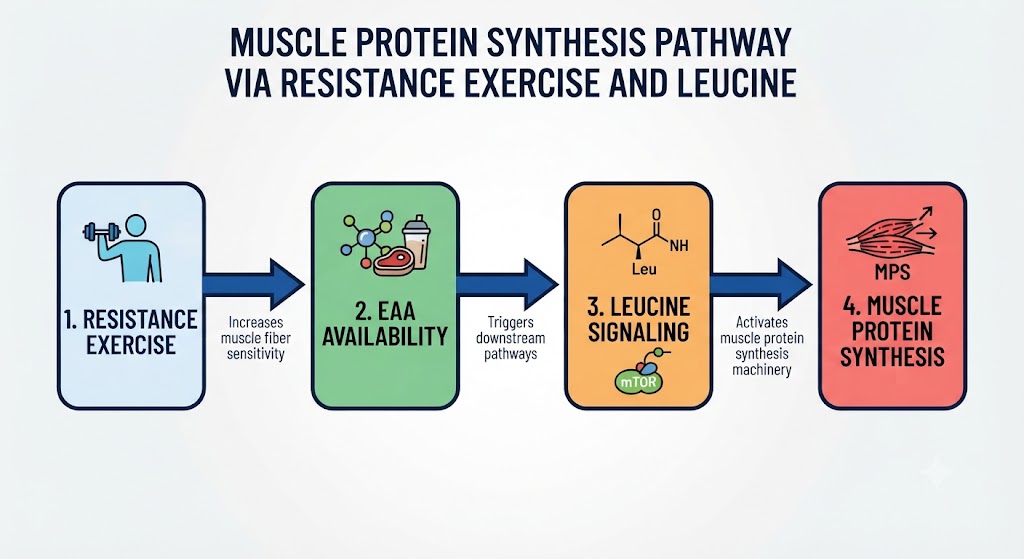
Essential amino acids support muscle protein synthesis by supplying both anabolic signals and the raw materials required to build new muscle proteins. Their role becomes particularly relevant when amino acids are consumed around resistance exercise.
The Role of Leucine
Leucine acts as an important signaling amino acid for muscle protein synthesis. Research has linked leucine and essential amino acids with activation of the mTORC1 pathway, a key regulator of muscle protein synthesis.
Resistance exercise can increase the muscle’s sensitivity to nutritional signals. Meanwhile, EAA availability provides substrates that can be used to form new proteins.
Studies have found that combining resistance exercise with essential amino acid ingestion can increase muscle protein synthesis more than either stimulus alone.
However, leucine does not work in isolation.
The remaining essential amino acids provide additional building blocks required to construct complete muscle proteins. This is one reason complete protein sources and EAA formulations are more comprehensive than isolated leucine or BCAA intake.
What Are the Nine Essential Amino Acids and What Do They Do?
The nine essential amino acids are leucine, isoleucine, valine, lysine, methionine, phenylalanine, threonine, tryptophan, and histidine. Because your body cannot make enough of these amino acids, they must come from food or supplementation.
| Essential amino acid | General role | Common food sources |
|---|---|---|
| Leucine | Supports muscle protein synthesis signaling | Eggs, dairy, meat, soy |
| Isoleucine | Supports protein metabolism and energy pathways | Meat, fish, dairy, legumes |
| Valine | Supports muscle metabolism and tissue repair | Dairy, meat, soy, legumes |
| Lysine | Supports protein formation and tissue maintenance | Meat, dairy, legumes |
| Methionine | Supports protein synthesis and methylation processes | Eggs, fish, meat, soy |
| Phenylalanine | Precursor for several important compounds | Meat, dairy, soy |
| Threonine | Supports protein structure and tissue maintenance | Eggs, dairy, legumes |
| Tryptophan | Precursor for serotonin and other compounds | Eggs, dairy, fish, soy |
| Histidine | Used in protein synthesis and histamine production | Meat, fish, dairy |
Which EAAs Are BCAAs?
Leucine, isoleucine, and valine are collectively called branched-chain amino acids, or BCAAs.
Therefore, a BCAA supplement provides three of the nine EAAs rather than the complete essential amino acid profile.
Animal proteins and several plant proteins can provide substantial amounts of all nine EAAs. A varied diet can therefore supply essential amino acids without requiring a dedicated EAA supplement.
Do EAA Supplements Actually Help Build Muscle?
EAA supplements can support the physiological process of muscle protein synthesis, but they do not independently replace the major drivers of muscle growth. Resistance training, sufficient protein, adequate energy intake, recovery, and consistent progression remain more important.
Research demonstrates that essential amino acid ingestion can stimulate muscle protein synthesis, particularly when combined with resistance exercise. However, an acute increase in muscle protein synthesis does not automatically guarantee a large increase in long-term muscle mass.
The practical value of supplementation therefore depends on what an EAA product adds to your existing diet.
When EAAs May Be More Useful
Someone who regularly consumes enough protein from eggs, dairy, fish, meat, soy, or protein powder may already receive substantial amounts of EAAs.
By contrast, someone who struggles to eat protein around training may find a convenient EAA drink more useful.
For example, if your schedule takes you directly from work to the gym and you cannot comfortably eat a protein-rich meal, an EAA drink may offer a practical alternative.
For broader recovery strategies, explore Reishi Mushroom for Recovery.
When Should You Take EAAs for Muscle Growth?
The best time to take EAAs depends on your diet, training schedule, and convenience rather than a universally required timing window. Total daily protein intake generally matters more than taking EAAs at one exact minute.
That said, different timing options can make sense depending on your circumstances.
Should You Take EAAs Before a Workout?
Taking EAAs before a workout can provide essential amino acids during a period when you are preparing to train. This can be practical when you have not eaten a protein-rich meal for several hours.
For example, an EAA drink may be convenient before an early-morning workout when eating a full meal feels uncomfortable.
However, if you have already consumed a complete protein-rich meal, adding EAAs may provide limited practical benefit.
You can also compare this strategy with Citrulline Pre Workout if your primary goal is workout energy rather than amino-acid intake.
Should You Take EAAs During a Workout?
Taking EAAs during a workout can provide a convenient source of essential amino acids, particularly when training sessions are long or meal timing is inconvenient.
The primary advantage is nutritional convenience rather than a requirement for every workout.
For example, someone completing a long training session between meals may prefer an EAA beverage rather than carrying or preparing a full protein-rich meal.
For more context, see intra-workout supplements and BCAA supplements during workouts.
Should You Take EAAs After a Workout?
Post-workout EAAs can supply essential amino acids when a protein-rich meal is not immediately available.
However, you do not need to treat the post-workout period as a narrow emergency window. Post-workout nutrition works best as part of your overall daily eating pattern.
A normal meal containing sufficient high-quality protein can provide the same essential amino acids without requiring a dedicated EAA product.
How Much EAA Supplement Should You Take for Muscle Growth?
There is no single universal EAA supplement dose that is appropriate for every person or every product. EAA formulas can differ substantially in total amino-acid content, serving size, ratios, flavoring, and added ingredients.
Start by following the product’s labeled serving instructions and considering how much protein you already consume.
For example, taking a large EAA serving on top of an already protein-rich diet may add cost without solving a meaningful nutritional gap.
Does a Larger EAA Serving Mean Better Results?
Not necessarily.
EAA dosage should be considered alongside total protein intake, meal composition, body size, training demands, and the product’s actual amino-acid profile.
Research also indicates that the anabolic response to amino acids is dose-dependent, reinforcing the importance of considering both the amount and composition rather than simply choosing a product labeled “EAA.”
Are EAAs Better Than BCAAs for Muscle Growth?
EAAs provide all nine essential amino acids, while BCAA supplements provide only leucine, isoleucine, and valine. This makes EAAs the more complete amino-acid formulation.
BCAAs can influence pathways involved in muscle protein synthesis, but research indicates that their response is generally less than that observed after consuming a complete protein source containing all indispensable amino acids.
| Feature | EAAs | BCAAs | Protein powder |
|---|---|---|---|
| Essential amino acids | 9 | 3 | Usually all 9 |
| Complete protein source | No | No | Often yes |
| Leucine included | Yes | Yes | Usually yes |
| Calories | Usually low | Usually low | Usually higher |
| Main advantage | Convenient EAA delivery | Simple BCAA delivery | Complete protein |
| Best use case | Protein gap or convenience | Specific preference | Increasing total protein |
BCAAs are therefore not automatically useless, but their narrower amino-acid profile makes them less complete than EAAs or high-quality protein.
Are EAA Supplements Better Than Protein Powder?
EAA supplements are not automatically better than protein powder because both options serve different nutritional purposes.
Protein powder generally provides a broader protein package and can contribute substantially toward daily protein intake.
EAA Supplements
An EAA product provides the nine essential amino acids in a concentrated format. This can make it appealing when you want amino acids without consuming a full protein shake.
EAAs may be particularly convenient when calories, digestion, portability, or meal timing are important considerations.
Protein Powder
Whey and other complete protein sources provide all essential amino acids while also supplying substantially more total protein per serving.
For example, whey protein isolate has been shown to produce substantial post-exercise essential aminoacidemia and whole-body anabolic responses.
Therefore, protein powder is often the more practical choice when your primary challenge is simply failing to reach your daily protein target.
What Foods Are High in Essential Amino Acids?
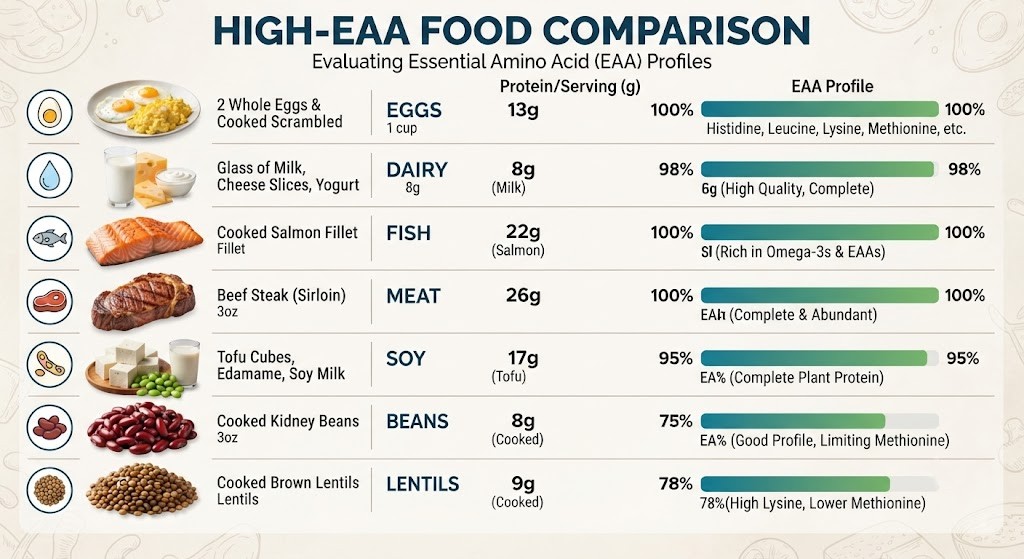
High-quality protein foods such as eggs, dairy, meat, fish, soy, and other protein-rich foods can provide all nine essential amino acids. Whole foods should generally form the foundation of a muscle-building nutrition plan.
Animal-based foods such as eggs, milk, yogurt, fish, chicken, and lean meat can provide complete protein profiles.
For example, a meal containing eggs and dairy can supply all nine EAAs while also providing substantial total protein.
Plant-Based Sources of EAAs
Plant-based diets can also provide essential amino acids through foods such as:
- Soy
- Tofu
- Tempeh
- Beans
- Lentils
- Peas
- Nuts
- Seeds
- Grains
Combining varied plant proteins across the day can help create a robust amino-acid intake.
Who Can Benefit Most From EAA Supplements?
EAA supplements may be most useful for people who have a genuine convenience, dietary, or meal-timing reason to use them. They are not automatically necessary for everyone who strength trains.
EAAs may be practical for people who:
- Have difficulty eating a full meal around training.
- Prefer a low-volume amino-acid drink.
- Follow a diet where protein intake is inconsistent.
- Train between meals and want a convenient option.
- Need portable nutrition during demanding schedules.
For example, someone who finishes work and goes directly to the gym may find an EAA drink easier to consume than a complete meal before training.
At the same time, people who already meet their protein needs through balanced meals may have less reason to add EAAs.
The practical value of EAA supplementation depends on whether the product fills a genuine nutritional or convenience gap.
Can You Take EAA Supplements on Rest Days?
You can take EAA supplements on rest days, but they are not inherently required when your daily protein intake is already adequate.
Muscle remodeling and recovery continue outside the gym, making consistent nutrition important throughout the week.
Rest days are still part of a muscle-building program because recovery supports adaptation from previous training. Maintaining adequate protein intake on a non-training day can help ensure your muscles have access to amino acids.
However, adding EAAs simply because it is a rest day does not automatically create additional muscle growth.
Prioritize total daily protein and balanced meals before treating EAA supplementation as a requirement.
Are EAA Supplements Necessary If You Already Eat Enough Protein?
EAA supplements are usually not necessary if you consistently consume enough high-quality protein from your diet.
Complete protein foods and protein supplements already deliver the essential amino acids required for muscle protein synthesis.
Adequate protein intake provides the amino acids needed for repeated muscle protein turnover. Someone meeting an appropriate daily protein target through dairy, eggs, meat, fish, soy, or protein powder may therefore have little nutritional need for an additional EAA product.
Think of EAAs as a Targeted Tool
EAA supplements should solve a specific problem rather than become an automatic addition to a supplement stack.
If your protein intake, resistance training, calorie intake, sleep, and recovery are already well managed, EAAs are an optional convenience rather than a foundation.
How to Choose an EAA Supplement for Muscle Growth
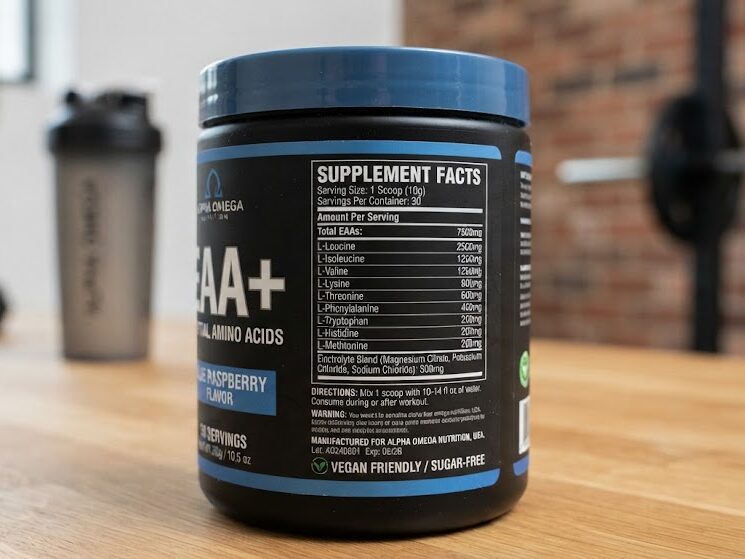
A good EAA supplement should provide a transparent amino-acid profile, clearly disclose serving amounts, and fit your dietary and training needs.
Product quality and label transparency matter because supplements are not routinely pre-approved by the FDA before reaching consumers.
When comparing EAA supplements for muscle growth, evaluate the following:
- Complete EAA profile: Check whether all nine EAAs are provided.
- Leucine content: Look for meaningful leucine inclusion without ignoring the other EAAs.
- Transparent serving size: Confirm exactly how many grams of each amino acid you receive.
- Avoid unnecessary proprietary blends: Clear quantities make products easier to evaluate.
- Added ingredients: Check sweeteners, stimulants, electrolytes, or other extras.
- Quality verification: Look for credible third-party testing where available.
- Dietary fit: Consider vegan, vegetarian, allergen, and flavor preferences.
Moreover, FDA dietary supplement rules require manufacturers to establish specifications for identity, purity, strength, composition, and contamination controls under current good manufacturing practices — Source: [U.S. Food and Drug Administration, 2007/current guidance].
What’s Next: How Should You Use EAAs in a Muscle-Growth Plan?
The best way to use EAAs in a muscle-growth plan is to treat them as a targeted supplement after establishing adequate protein, training, calories, and recovery.
This approach helps prevent a convenient supplement from replacing the fundamentals that actually underpin a successful muscle-building program.
A Practical EAA Strategy
- Establish your daily protein intake. Aim for an appropriate protein target based on body size, activity, and goals.
- Build meals around protein-rich foods. Prioritize complete protein sources throughout the day.
- Train progressively. Use a structured muscle-building workouts plan.
- Identify nutritional gaps. Ask whether your schedule makes complete protein intake difficult.
- Use EAAs strategically. Consider them before, during, or after training when convenience genuinely matters.
- Evaluate results over time. Track training performance, body weight, recovery, and consistency rather than expecting immediate changes.
Muscle growth is a long-term adaptation. An EAA supplement can support a good plan, but it cannot compensate for an inconsistent training program or inadequate nutrition.
How Should You Decide Whether EAA Supplements Are Worth It?
EAA supplements are worth considering when they solve a specific protein or convenience problem that your normal diet does not solve efficiently.
They are less compelling when you already meet your protein needs comfortably through food or complete protein supplements.
Before buying an EAA product, ask yourself:
- Am I consistently eating enough protein?
- Do I regularly need convenient nutrition around workouts?
- Would EAAs replace a less convenient option, or simply add another supplement?
For example, if you already drink a protein shake after training and meet your daily protein target, adding EAAs may provide limited additional value.
On the other hand, if you frequently train between meals and struggle with protein-rich food, an EAA drink may be more practical.
In addition, compare the cost and convenience with your existing options before purchasing.
The best supplement is the one that addresses a real need without distracting from the fundamentals.
Conclusion
EAA supplements can provide a convenient source of all nine essential amino acids, but they are not a substitute for adequate protein, resistance training, calories, sleep, or recovery. Their primary value comes from filling a genuine dietary or convenience gap.
Ultimately, leucine helps signal muscle protein synthesis while the remaining EAAs provide essential building blocks for new proteins. Whole-food protein and complete protein supplements can already supply these amino acids, so not everyone needs a dedicated EAA product.
The smartest approach is to start with the fundamentals. Assess your daily protein intake, maintain a consistent resistance-training program, support recovery, and then decide whether an EAA supplement makes your routine easier or more consistent.
If it solves a real problem, EAA supplements for muscle growth can be a useful addition to a well-designed nutrition and training plan. If your protein intake is already sufficient and convenient, they may simply be optional rather than essential.
For more supplementation guidance, explore our fitness supplement guide
FAQs
What are EAA supplements for muscle growth?
EAA supplements provide all nine essential amino acids needed to support muscle protein synthesis and recovery.
Does EAA help in muscle building?
EAA supplements provide essential amino acids that help support muscle protein synthesis and muscle building.
Is BCAA or EAA better for muscle growth?
EAA supplements are more complete than BCAAs because they provide all nine essential amino acids.
Is EAA better than creatine?
EAA supplements support muscle protein synthesis, while creatine supports strength, power, and exercise performance.
Is EAA a pre-workout?
EAA supplements are not traditional pre-workouts, but they can be taken before exercise to provide essential amino acids.
When should you take EAA supplements?
EAA supplements can be taken before, during, or after workouts depending on your nutrition and training routine.
Can EAA help with muscle recovery?
EAA supplements provide essential amino acids that support muscle protein synthesis and recovery after exercise.
Are EAA supplements necessary if you eat enough protein?
EAA supplements are generally not necessary when you already consume enough high-quality protein.
Can you take EAA supplements on rest days?
EAA supplements can be taken on rest days, but they may not be needed when daily protein intake is adequate.
Are EAAs better than BCAAs?
EAAs provide all nine essential amino acids, while BCAAs provide only leucine, isoleucine, and valine.
Are EAA supplements better than protein powder?
EAA supplements provide essential amino acids, while protein powder provides EAAs along with more total protein.
How much EAA should you take for muscle growth?
The recommended EAA serving depends on the product, so follow the supplement label and consider your daily protein intake.
1 thought on “EAA Supplements for Muscle Growth: Benefits, Timing & How They Work”