
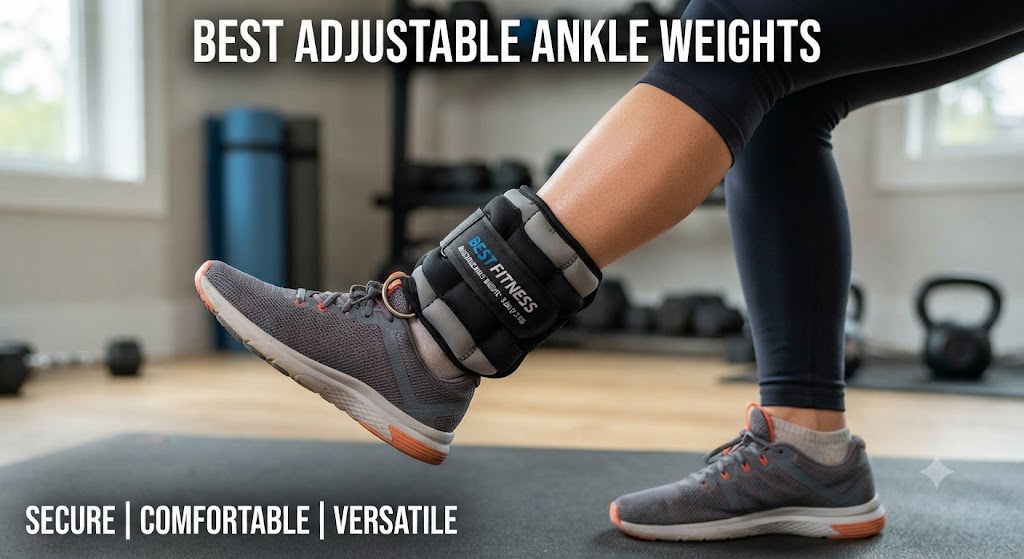
If you’ve used ankle weights for leg raises, glute exercises, Pilates, walking, or home workouts, you already know how much extra challenge a small amount of resistance can add. However, fixed-weight ankle weights can quickly become limiting when your strength, exercises, or training goals change.
That’s where adjustable ankle weights can be useful. Instead of committing to one fixed resistance, you can add or remove weight to match the exercise and your current fitness level.
In this guide, we’ll explain how adjustable ankle weights work, which features matter most, how different options compare, what exercises you can use them for, and how to choose the best adjustable ankle weights for your goals.
What Are Adjustable Ankle Weights?
Adjustable ankle weights are wearable resistance cuffs that allow you to increase or decrease the amount of weight attached to your ankles. Rather than purchasing a separate pair for every resistance level, you can modify the same pair for different exercises and training needs.
Common adjustable designs use removable sand-filled pockets, weight bags, plates, or rods. For example, Sportneer’s adjustable model uses removable weight bags and offers a 1–5-pound range per ankle.
Adjustability makes these weights particularly useful as home workout equipment because a single pair can provide several resistance levels. The best adjustable ankle weights combine a practical weight range with a secure fit, comfortable materials, easy adjustment, and durable construction.
Why Are Adjustable Ankle Weights Useful for Strength Training?
One of the biggest advantages of adjustable ankle weights is flexibility. You can use lighter resistance for movements that require greater control and increase the load when an exercise becomes easier.
For example, you might use a lighter setting for leg raises and then add resistance for controlled glute kickbacks. This allows the same equipment to support multiple exercises without requiring several pairs of weights.
Adjustable Resistance Supports Progressive Training
Adjustable ankle weights can also support progressive resistance training because you can gradually increase the load as your strength and exercise tolerance improve.
This makes them useful alongside progressive overload strategies. Instead of making a large jump in resistance, you can select a setting that provides a manageable increase.
They Save Space
Another practical benefit is storage. One pair can provide several resistance levels, which can be especially useful for people building a compact home gym.
Verywell Fit tested 23 ankle-weight options while evaluating factors such as comfort, exercise performance, and adjustability. — Source: Verywell Fit, 2026
What Features Should You Look for in Adjustable Ankle Weights?
When comparing the best adjustable ankle weights, look beyond the maximum weight. Important factors include the resistance range, adjustment increments, fit, closure, comfort, construction, durability, and the exercises you plan to perform.
A high maximum weight is not necessarily better if the minimum setting is already too heavy for your workouts.
Weight Range and Adjustment Increments
The weight range tells you how much resistance the ankle weights can provide, while adjustment increments tell you how precisely you can increase or decrease that resistance.
For example, a pair with smaller increments gives you more options for gradual progression than a design that requires large jumps between settings.
When choosing a pair, consider:
- Your comfortable starting resistance
- The maximum resistance you are likely to need
- How many adjustment levels are available
- Whether the increments are small enough for gradual progression
- Whether both cuffs can be adjusted evenly
A good starting point is a weight you can control without changing your movement pattern. Sportneer’s current adjustable model ranges from 1–5 pounds per ankle and uses removable weight bags. — Source: Sportneer, 2026
Fit, Closure, and Comfort
Ankle weights should remain secure without slipping, pinching, or digging into the skin. A well-designed cuff can make repeated exercises much more comfortable, particularly when you perform movements such as leg raises or glute kickbacks.
A wider padded cuff can distribute pressure more comfortably than a narrow strap. The closure should also remain secure throughout the exercise rather than requiring frequent adjustment.
Sportneer’s design combines neoprene construction with a reinforced metal loop, while testing from Verywell Fit found its adjustable model snug and comfortable during exercise. — Source: Verywell Fit, 2026
Durability and Construction
Durability depends on factors such as the cuff material, stitching, closure system, and construction of the removable weights.
Because adjustable ankle weights contain components that are repeatedly removed and reattached, pay attention to how the adjustment mechanism is designed. A product that is comfortable but difficult to adjust may be less convenient for regular training.
Exercise Compatibility
Your intended exercises should also influence your decision. A lightweight, comfortable pair may be more appropriate for Pilates or controlled leg exercises, while someone focused on progressive strength training may prioritize greater load capacity.
For more targeted training ideas, see our guides to Beginner Legs Workout and strength training.
What Are the Best Adjustable Ankle Weights for Home Workouts?
The best adjustable ankle weights depend on your resistance requirements, comfort preferences, fitness level, and intended exercises. Rather than treating one product as universally best, it makes more sense to compare the strengths of different designs.
1. Sportneer Adjustable Ankle Weights — Best Overall Adjustable Option
Sportneer Adjustable Ankle Weights are a strong option for beginners and intermediate users who want a flexible 1–5-pound range per ankle.
The removable weight bags make resistance adjustment straightforward, while the neoprene exterior provides a soft, breathable feel. The additional fastening hardware also helps keep the cuff secure during controlled lower-body exercises.
One limitation is that removable sand bags may be less convenient than rigid weight plates. The cuffs can also feel bulkier when used at their higher settings.
Overall, Sportneer is particularly appealing if you want an adjustable pair for general home workouts without immediately moving into very high resistance.
2. All Pro Adjustable Ankle Weights — Best for Progressive Loading
All Pro adjustable ankle weights are designed for users who want a broader resistance range and more deliberate progression.
Their removable-weight design can make them particularly useful for structured strength training or rehabilitation-style exercise where gradually changing resistance is important.
However, higher-load adjustable cuffs are generally less compact than lighter wearable designs. They are better suited to people who prioritize progression and load capacity over minimal bulk.
3. Synergee Adjustable Ankle Weights — Best for Higher Resistance
Synergee adjustable ankle weights are an option for exercisers who want more resistance than lightweight ankle cuffs typically provide.
Current comparisons list Synergee among adjustable options reaching substantially higher loads than basic 1–5-pound designs. — Source: SELF, 2025
Higher resistance can be useful for controlled strength movements. However, heavier ankle weights should not automatically be used for walking or fast, dynamic exercises simply because the product can accommodate the additional load.
How Do Different Adjustable Ankle Weights Compare?
Adjustable ankle weights differ primarily in their resistance range, adjustment mechanism, comfort, closure, and intended use.
| Option | Weight Range | Adjustment | Comfort | Closure | Best Use |
|---|---|---|---|---|---|
| Sportneer | 1–5 lb/ankle | Removable bags | Neoprene | Strap + loop | Home workouts |
| All Pro | Higher-load options | Removable weights | Padded cuff | Secure strap | Progressive strength |
| Synergee | Higher-load options | Adjustable packets | Padded design | Strap | Strength progression |
Sportneer is an accessible starting point for many users because its resistance range covers light-to-moderate training. Current expert roundups also identify Sportneer as a leading adjustable option. — Source: NBC Select, 2026
However, users who specifically need higher resistance may find the higher-load designs from All Pro or Synergee more appropriate.
What Exercises Can You Do With Adjustable Ankle Weights?
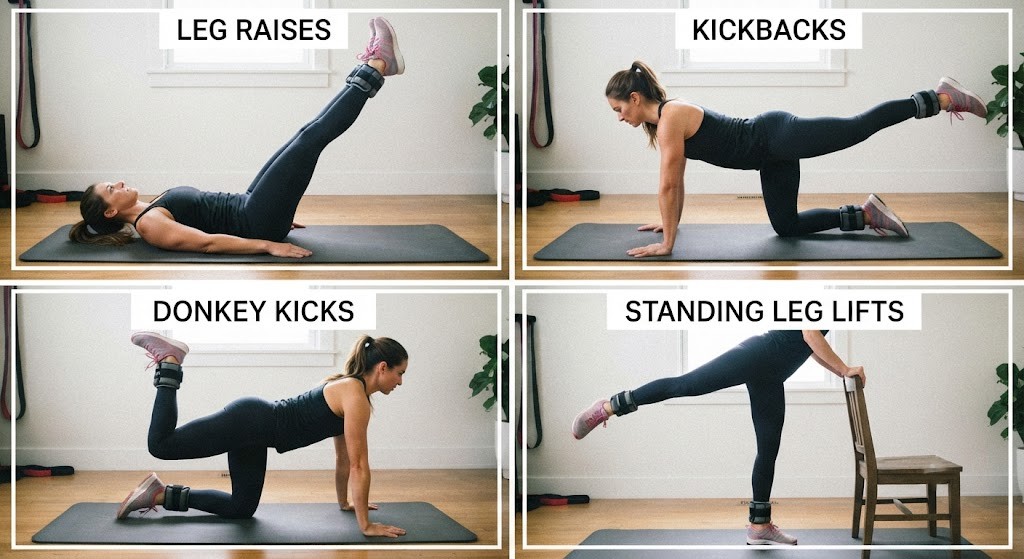
Adjustable ankle weights can add resistance to controlled lower-body movements such as leg raises, glute kickbacks, donkey kicks, and standing leg lifts.
For example, adding a light ankle weight to a bodyweight glute exercise can increase the challenge without requiring you to hold dumbbells.
They can also complement:
The key is to choose a resistance level that allows you to maintain control throughout the movement.
Leg Raises
Ankle weights can make straight-leg raises more challenging by increasing the resistance against gravity. Start with a manageable load and avoid swinging the legs to complete repetitions.
Glute Kickbacks
Glute kickbacks are another practical way to use ankle weights. A moderate resistance can make the movement more challenging while allowing you to focus on controlled hip extension.
Donkey Kicks
Donkey kicks can also be performed with ankle weights when the additional resistance does not cause you to lose control of the movement or compensate with other muscles.
Standing Leg Lifts
Standing leg lifts can benefit from added resistance, particularly when performed slowly. Maintaining posture and control is more important than selecting the heaviest setting.
Pilates
Adjustable ankle weights can also be incorporated into selected Pilates movements. However, resistance should remain light enough that it does not interfere with the controlled movement patterns that make Pilates effective.
Are Adjustable Ankle Weights Good for Walking and Low-Impact Workouts?
Adjustable ankle weights are not automatically appropriate for walking. Adding weight around the ankles can alter movement mechanics and place additional stress on the joints.
Harvard Health warns that ankle weights during walking or aerobics can increase stress on joints and contribute to muscle imbalance. — Source: Harvard Health, 2021
That does not mean ankle weights have no place in low-impact training. They can be useful for targeted exercises such as controlled leg lifts, where the added load directly increases resistance.
If you are considering them for Walking Glute Workout, pay attention to whether the added weight changes your natural stride or causes you to move differently.
How Much Weight Should Beginners Use With Ankle Weights?
Beginners should start with a light resistance that allows controlled movement and proper form rather than automatically choosing the heaviest available setting.
For example, if you are performing 12 controlled leg raises but need to swing your leg to complete the final repetitions, the resistance is likely too high for that exercise.
A sensible progression is:
- Start with a manageable resistance.
- Learn the movement pattern without compensating.
- Perform consistent, controlled repetitions.
- Increase the resistance gradually when the current setting becomes manageable.
- Reduce the load if technique deteriorates.
This approach supports strength training while reducing the temptation to sacrifice technique for heavier resistance.
How Do You Adjust the Weight on Adjustable Ankle Weights?
Most adjustable ankle weights allow you to change resistance by adding or removing internal weight bags, plates, rods, or similar inserts.
For example, Sportneer’s design uses individual removable bags, allowing users to customize the resistance for different workouts.
Before exercising, make sure every insert is properly secured and the cuff is fastened correctly.
Should Both Ankle Weights Have the Same Weight?
For bilateral exercises, adjust both ankle weights evenly. Using different loads on each ankle can change movement mechanics and make controlled exercises unnecessarily difficult.
If an exercise specifically calls for unilateral loading, follow the exercise requirements and use a resistance that you can control safely.
How Do You Make Sure Ankle Weights Fit Securely and Comfortably?
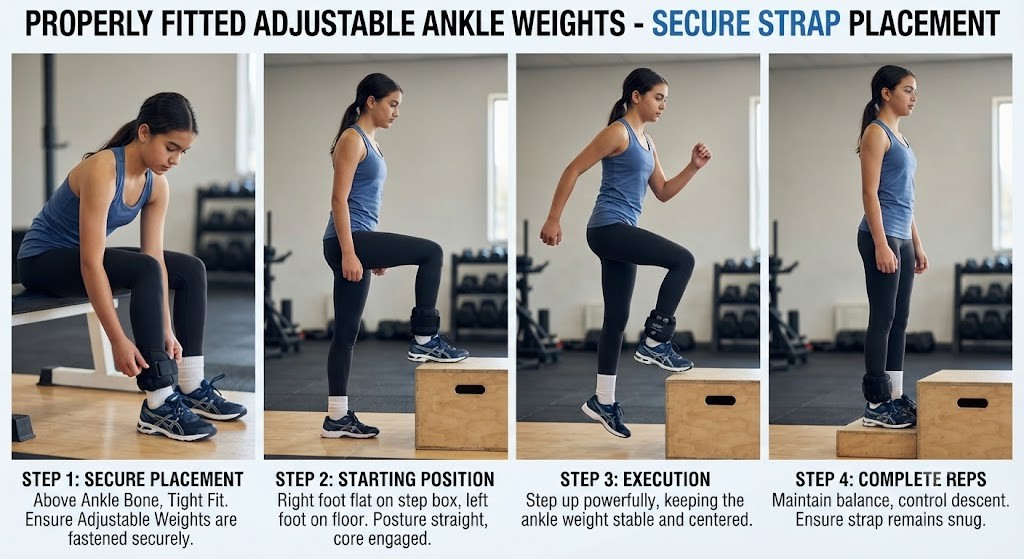
Proper fit means the ankle cuff stays firmly in position without slipping, pinching, or restricting normal movement.
A simple way to assess the fit is to perform several controlled repetitions. If you repeatedly need to stop and reposition the cuff, the fastening system or fit may not be suitable.
Before purchasing, check the manufacturer’s stated ankle circumference range. Sportneer’s current 5-pound model lists a fit range of approximately 7.5–12.5 inches around the ankle. — Source: Sportneer, 2026
Adjustable Ankle Weight Fit Checklist
Before using your new ankle weights, check that:
- The cuff sits securely around your ankle.
- The strap does not dig into your skin.
- The cuff does not slide during movement.
- The weight inserts are properly secured.
- Both cuffs are adjusted evenly when appropriate.
- Your normal range of motion is not restricted.
- You can perform the exercise without compensating.
How Do You Choose the Best Adjustable Ankle Weights for Your Goals?
The best adjustable ankle weights for you depend on your fitness level, target exercises, preferred resistance range, comfort requirements, and budget.
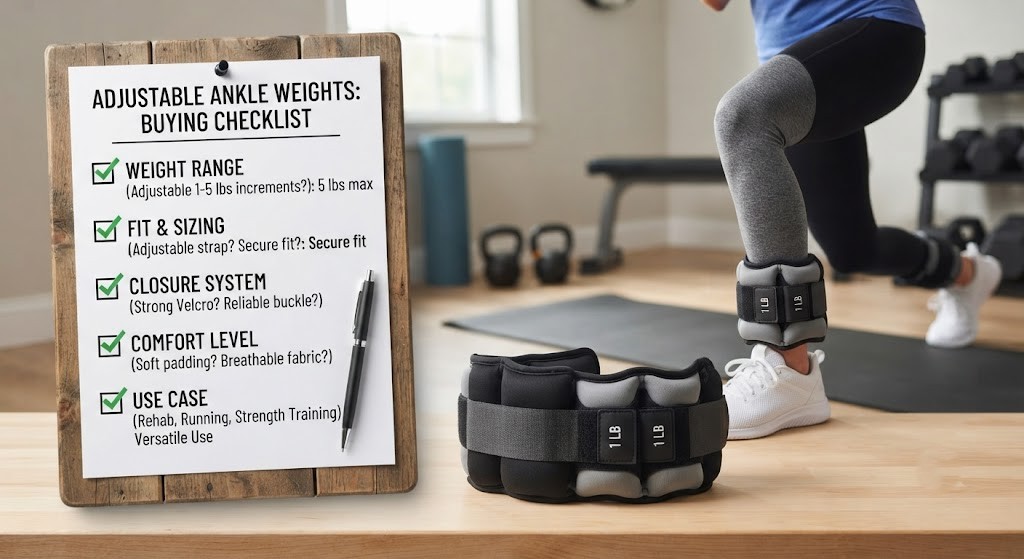
Use this checklist before buying:
- Choose your main exercises. Decide whether you primarily want leg raises, glute work, Pilates, or strength training.
- Select a suitable starting load. Choose resistance you can control comfortably.
- Check adjustment increments. Smaller increments offer more options for gradual progression.
- Inspect the closure. Look for a strap that remains secure throughout movement.
- Check the fit range. Confirm that the cuff accommodates your ankle circumference.
- Compare construction. Look for durable stitching, comfortable padding, and practical components.
- Consider portability. Compact cuffs are easier to store and transport.
- Think about future progression. Make sure the available resistance range gives you room to improve.
Adjustable Ankle Weights vs. Fixed-Weight Ankle Weights
The main difference between adjustable and fixed-weight ankle weights is flexibility.
Fixed-weight ankle weights provide one predetermined resistance. They can be simple and convenient, but you may eventually need another pair if your training requirements change.
Adjustable ankle weights, by comparison, allow you to modify resistance using removable weights or inserts.
| Feature | Adjustable Ankle Weights | Fixed-Weight Ankle Weights |
|---|---|---|
| Resistance options | Multiple | One |
| Progression | Easier to customize | Requires another pair for increases |
| Storage | One pair can replace several resistance levels | Multiple pairs may be needed |
| Adjustment | Requires adding/removing weights | No adjustment required |
| Convenience | More flexible | Simpler |
| Best for | Changing training needs | Consistent resistance |
For someone who expects their resistance requirements to change, adjustability can make the equipment more versatile.
What’s Next: How Should You Choose Your Adjustable Ankle Weights?
Your next step is to choose an adjustable ankle weight based on your actual training requirements, rather than simply selecting the product with the highest advertised resistance.
For example, someone beginning Pilates may benefit more from a comfortable light-to-moderate cuff than from a heavy strength-focused model.
Start conservatively and increase resistance when your technique remains controlled. Heavier resistance is not automatically better resistance.
If your goal is strength development, pair ankle-weight exercises with an appropriate workout recovery strategy and a broader lower-body training program.
Conclusion
The best adjustable ankle weights provide an appropriate resistance range, secure fit, comfortable construction, convenient adjustability, and sufficient durability for your specific training needs.
Sportneer stands out as a versatile adjustable option, while higher-capacity choices such as All Pro and Synergee may be better suited to users who prioritize progressive loading and greater resistance.
Ultimately, the right pair is not necessarily the heaviest one. Choose a resistance range you can control today while leaving enough room to progress tomorrow. By matching your ankle weights to your exercises, comfort preferences, fitness level, and training goals, you can turn a simple wearable weight into a practical addition to your home workout setup.
FAQs
Which adjustable ankle weights are the best?
Sportneer is a strong overall choice, while All Pro and Synergee are good options for higher resistance.
Which brand of ankle weights is the best?
Sportneer is a versatile choice, while All Pro and Synergee are suitable for users seeking higher resistance.
Are adjustable ankle weights good?
Yes, adjustable ankle weights provide customizable resistance for leg raises, glute exercises, Pilates, and other controlled movements.
What’s the best weight for ankle weights?
The best weight depends on your fitness level and exercise, but beginners should start light and increase resistance gradually.
Are adjustable ankle weights better than fixed ankle weights?
Adjustable ankle weights offer more flexibility because you can change the resistance as your strength and training needs progress.
How much weight should a beginner use with ankle weights?
Beginners should choose a light weight that allows them to maintain proper form and controlled movement.
Can you use adjustable ankle weights for leg raises?
Yes, adjustable ankle weights can increase resistance during leg raises and make the exercise more challenging.
Can you use adjustable ankle weights for glute exercises?
Yes, they can add resistance to exercises such as glute kickbacks, donkey kicks, and standing leg lifts.
Are ankle weights good for walking?
Ankle weights can increase joint stress and affect movement mechanics, so they are not always recommended for walking. — Source: Harvard Health, 2021
How do adjustable ankle weights work?
Adjustable ankle weights use removable bags, plates, rods, or inserts to change the resistance.
How should adjustable ankle weights fit?
They should fit securely around the ankle without slipping, pinching, or restricting normal movement.
Can you use the same adjustable ankle weights for different exercises?
Yes, you can adjust the resistance and use the same pair for different lower-body exercises.
Are heavier ankle weights always better?
No, the best resistance is a weight you can control while maintaining proper exercise form.