
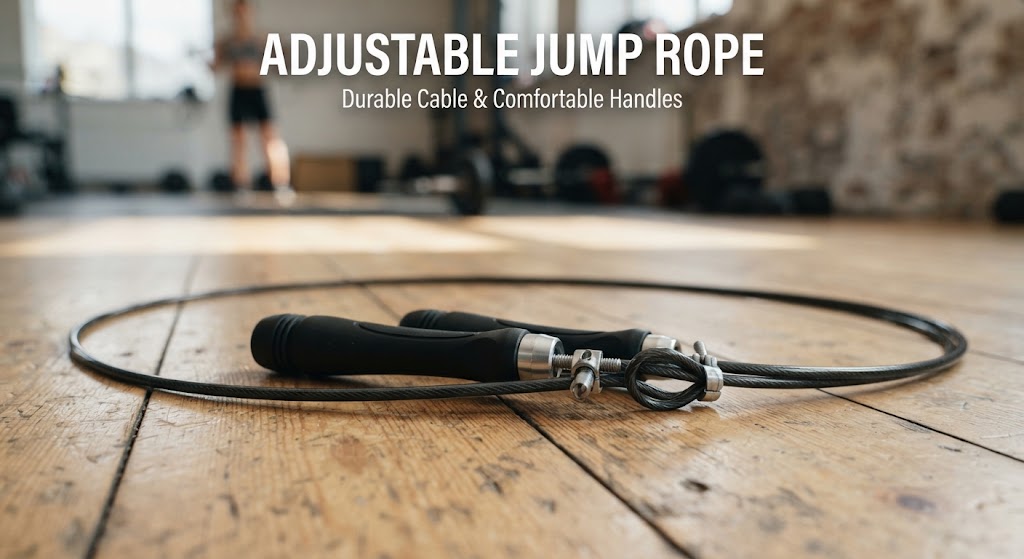
Jumping rope is one of the simplest ways to add cardio, coordination, and conditioning to your workout. But there is one detail that can make a surprisingly big difference: the rope itself.
If your jump rope is too long, too short, too heavy, or poorly suited to your training style, even basic jumps can feel awkward. An adjustable jump rope solves one of those problems by allowing you to customize the rope length to better match your height, experience, and workout goals.
In this guide, you’ll learn how an adjustable jump rope works, how to choose the right length, which rope types are best for different goals, what features to look for, and how to use one effectively for cardio, HIIT, conditioning, and beginner training.
What Is an Adjustable Jump Rope and How Does It Work?
An adjustable jump rope is a jump rope with a length-adjustment system that allows you to customize the cable to your height and training needs. Unlike a fixed-length rope, an adjustable model lets you shorten or, depending on the design, replace the cable without purchasing an entirely new rope.
Most adjustable ropes use a clamp, screw, sleeve, or handle-based adjustment system to secure the desired length. For example, you might begin with a slightly longer setting while learning basic jumps and gradually shorten the rope as your technique becomes more efficient.
Adjustability is also useful when multiple people share the same rope. A household jump rope can be sized for users with different heights rather than requiring a separate rope for each person.
An adjustable jump rope is designed to make rope length customizable rather than permanent.
How Is an Adjustable Rope Different From a Fixed-Length Rope?
An adjustable rope differs from a fixed-length rope because its working length can be changed after purchase. A fixed-length rope can be convenient when it is already sized correctly, but an incorrectly sized rope may force you to replace it or work around inefficient technique.
For example, a beginner may initially need a little more clearance while learning. As their jumping form improves, they can shorten an adjustable rope rather than purchasing another model.
This makes adjustability particularly useful for beginners, households with multiple users, and people whose training style changes over time.
Why Is Adjustable Length Important for Jump Rope Training?
Adjustable length matters because proper rope sizing helps you maintain clearance, rhythm, and efficient jumping technique. A rope that is too long can encourage excessive arm movement, while a rope that is too short may repeatedly catch your feet or head.
For example, if you are jumping with consistent timing but the rope repeatedly catches your toes, checking its length should be one of the first things you investigate.
Adjustability also allows beginners to make gradual changes. Instead of immediately trying to use a highly optimized short speed rope, you can start with a comfortable length and reduce it as your technique develops.
A 2015 study involving 24 preadolescent soccer players found that eight weeks of jump-rope training improved performance on a motor coordination test by 9% compared with the study’s baseline performance. — Source: [Journal of Sports Science & Medicine, 2015]
Proper jump rope length helps users maintain consistent clearance, rhythm, and jumping technique while reducing the need for unnecessary arm movement.
Jump rope can also contribute to your weekly aerobic activity. Current CDC guidance recommends that adults get at least 150 minutes of moderate-intensity physical activity per week, alongside muscle-strengthening activity on at least two days. — Source: [CDC, 2025]
How Do You Choose the Right Jump Rope Length for Your Height?
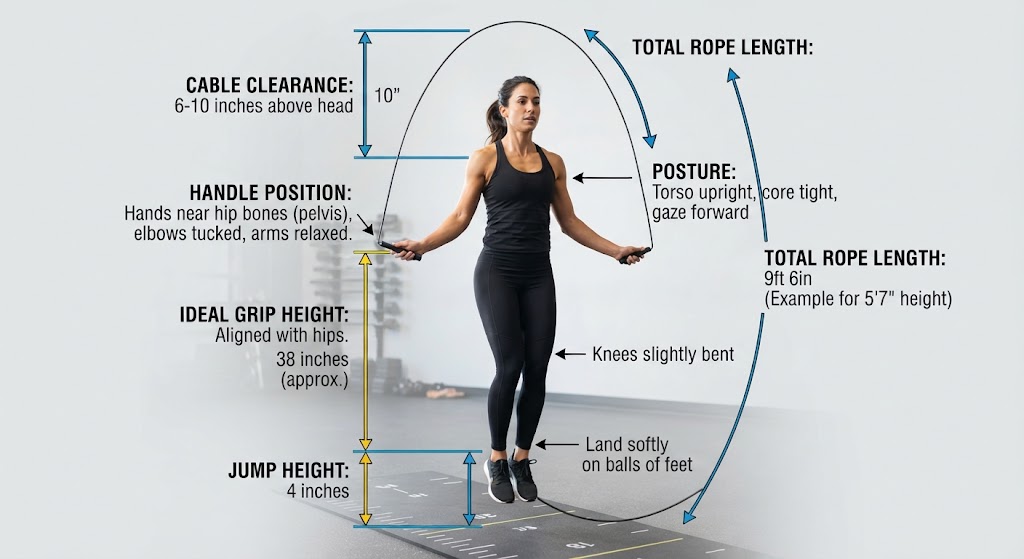
The right jump rope length depends on your height, experience, jumping technique, and intended workout style. A practical starting point is to choose a rope that clears your head and feet comfortably without creating excessive slack.
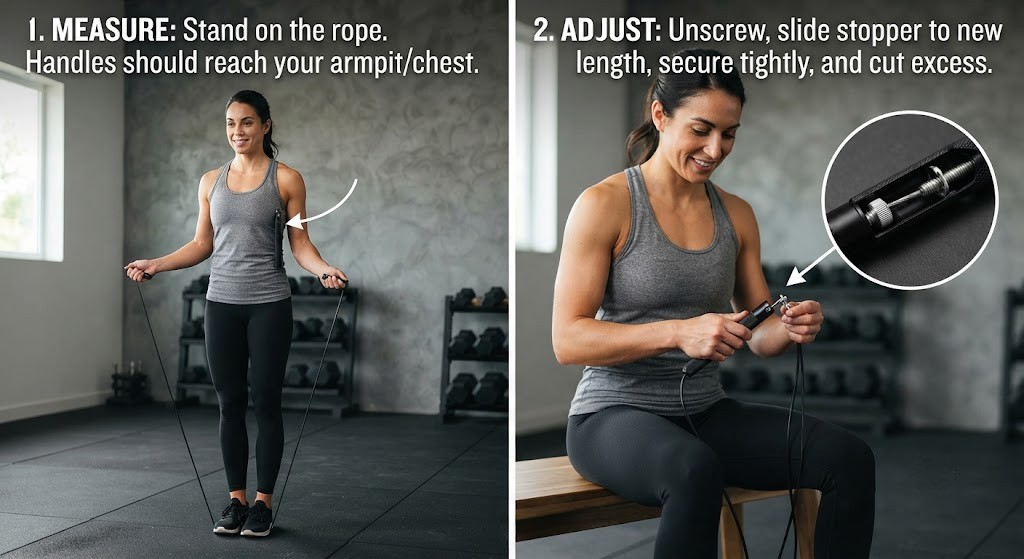
One common way to check the starting length is to stand in the middle of the rope with one foot and bring both handles upward along your body. A beginner-friendly starting position generally places the handles around the lower chest or armpit area, depending on the rope design and your technique.
A taller beginner may need a longer starting setting than an experienced jumper of the same height because beginners often use wider arm movements.
Jump Rope Length by Height
| User height | Practical starting length | Typical use |
|---|---|---|
| Under 5’2″ | About 8 ft | Beginners and general fitness |
| 5’2″–5’8″ | About 8–9 ft | General fitness and cardio |
| 5’8″–6’2″ | About 9–10 ft | Beginners and intermediate users |
| Over 6’2″ | About 10 ft or longer | Taller users and beginners |
These ranges are starting points rather than universal rules because rope length also depends on technique, handle position, and rope type.
Experienced jumpers often prefer a shorter rope because it can support faster rotations and tighter technique. For example, a speed-focused athlete practicing double unders may use a shorter cable than someone performing relaxed recreational jumps.
Your ideal jump rope length is the shortest comfortable length that gives you reliable clearance and controlled technique.
What Is the Best Adjustable Jump Rope for Beginners?
The best adjustable jump rope for beginners is one that can be sized correctly, feels comfortable in the hands, and provides enough feedback to make learning easier. Beginners do not necessarily need the lightest or fastest rope available.
For example, a slightly thicker PVC-coated cable can be easier to see and feel during basic jumps than an extremely thin speed cable.
When choosing your first rope, prioritize:
- Easy length adjustment
- Comfortable handles
- Durable construction
- A forgiving cable
- Good visibility and feedback
- Replacement-cable availability
Advanced bearings and specialized speed components can be useful later, but they are not essential for learning basic jumps.
What Types of Adjustable Jump Ropes Are Available?
Adjustable jump ropes are available in several designs, including PVC-coated cables, bare speed cables, beaded ropes, and weighted ropes. Each type changes the rope’s feel, speed, feedback, and suitability for different workouts.
PVC-Coated Adjustable Jump Ropes
PVC-coated ropes are versatile options for general fitness, cardio, and beginner training. The coating gives the rope more visibility and durability than an extremely thin bare cable.
For example, someone learning basic jumps at home may find a PVC rope easier to control than a very light speed cable.
They are particularly useful when you want one rope that can handle different types of everyday training.
Bare Speed Cables
Bare or lightly coated speed cables are designed for rapid rotation and advanced techniques. Their low weight allows them to move quickly, but that same feature can make them less forgiving for beginners.
For example, experienced athletes practicing double unders may prefer a thin speed cable because fast rotation is a priority.
If your main objective is learning basic technique, however, a highly lightweight speed rope may provide less feedback than a thicker alternative.
Beaded and Weighted Ropes
Beaded ropes provide additional visual and physical feedback, while weighted ropes increase resistance and can make each rotation feel more demanding. These options can be useful when your goal extends beyond basic speed work.
For example, a weighted rope can make short conditioning intervals more challenging without requiring a complicated workout.
Speed ropes are generally designed for fast rotations and advanced techniques, while thicker or weighted ropes can provide more resistance and feedback during training.
What Features Should You Look for in an Adjustable Jump Rope?
The most important adjustable jump rope features include the adjustment mechanism, handle comfort, bearings, cable material, cable thickness, weight, durability, and replacement-part availability.
These details determine how easy the rope is to size, control, maintain, and use over time.
Adjustment Mechanism
A good adjustment mechanism should hold the cable securely without requiring complicated tools every time you change the length.
For example, a simple screw or clamp system can be convenient when multiple people share one rope or when you want to experiment with different lengths.
Before using the rope, make sure the adjustment point is properly secured. A loose cable can affect consistency and may interfere with normal use.
Handles and Bearings
Handle comfort matters because repeated jumping requires frequent rope rotations. Textured handles can help provide a secure grip when your hands become sweaty.
Bearings are rotating components inside some handles that help the rope turn smoothly. However, more bearings do not automatically mean a better rope. Cable type, handle design, weight, and your technique also influence performance.
For general fitness, a comfortable and secure handle may be more important than having the most sophisticated bearing system.
Rope Material and Thickness
Rope material affects durability, visibility, speed, and feedback.
For example:
- A thicker PVC rope can be easier to see and control.
- A thin cable can rotate rapidly.
- Beaded ropes can provide more physical and visual feedback.
- Weighted ropes can make rotations feel more demanding.
The right option depends on what you want from your workouts rather than simply choosing the lightest cable.
Weight and Replacement Parts
Rope weight affects how quickly it rotates and how much feedback you feel during each revolution.
Replacement cables are also valuable for frequent users because the cable can wear out before the handles do. A rope with replaceable components can therefore be more practical for long-term training.
Choosing an adjustable jump rope involves considering rope length, material, handle design, adjustment mechanism, weight, and the user’s intended training style.
How Do You Adjust an Adjustable Jump Rope Correctly?
Adjusting an adjustable jump rope correctly means setting the cable to a comfortable starting length, securing the adjustment point, and testing the rope before making smaller changes.
The goal is not to find the perfect length in one adjustment. Instead, use a comfortable starting point and make gradual changes based on how the rope behaves during actual jumps.
Step-by-Step Rope Adjustment
- Stand on the center of the rope with one foot.
- Bring both handles upward while keeping the cable straight.
- Choose a beginner-friendly starting length based on your height and current technique.
- Secure the adjustment mechanism according to the rope’s design.
- Perform several relaxed jumps to check clearance.
- Shorten the rope gradually if excessive slack remains.
- Retest the rope after each adjustment.
For example, if the rope consistently passes far above your head, shorten it slightly instead of making a dramatic adjustment.
At the same time, do not judge your rope from one missed jump. Consistent patterns of catching, excessive clearance, or awkward arm movement provide more useful feedback.
What Is the Difference Between a Speed Rope and a Regular Adjustable Jump Rope?
A speed rope is a lightweight jump rope designed for rapid rotation, while a regular adjustable jump rope is generally optimized for versatility, control, and general fitness.
The better choice depends on whether you prioritize speed, learning, conditioning, or mixed workouts.
| Feature | Speed Rope | General Adjustable Rope |
|---|---|---|
| Cable | Very thin/light | Usually thicker |
| Rotation | Very fast | Moderate to fast |
| Feedback | Lower | Higher |
| Beginner friendly | Moderate to low | High |
| Double unders | Excellent | Possible |
| General cardio | Excellent | Excellent |
| Learning basic jumps | Less forgiving | More forgiving |
An advanced athlete practicing double unders may benefit from a speed rope, while someone learning basic bounce steps may prefer a more visible and forgiving cable.
Ultimately, the best adjustable jump rope is not necessarily the fastest or most technologically advanced model.
The best adjustable jump rope is the one that can be sized correctly for the user, feels comfortable in the hands, and matches the user’s training goals.
Can You Use an Adjustable Jump Rope for Cardio and HIIT Workouts?
Yes. An adjustable jump rope can be used for cardio, HIIT, warm-ups, conditioning, coordination practice, and interval training.
Its biggest practical advantage is versatility. The same compact piece of equipment can support different workout intensities simply by changing the duration, pace, rest periods, or rope style.
For example, you can perform 30 seconds of jumping followed by 30 seconds of rest for a beginner interval session.
Rope skipping can also be vigorous exercise. In one study, participants jumping at 125–145 skips per minute reached average oxygen-consumption values of 41.1–42.5 mL/kg/min, with reported average energy expenditure of 58.6–60.3 kJ/min. — Source: [Medicine & Science in Sports & Exercise, 1980]
Moreover, a 2021 randomized trial followed 46 young adults during an eight-week intervention and examined rope-skipping exercise alongside dietary approaches, demonstrating that structured rope-skipping can be incorporated into controlled exercise programs. — Source: [Nutrients, 2021]
Beginner Jump Rope Workout
A beginner jump rope workout should emphasize short intervals, controlled technique, and adequate recovery rather than maximum speed.
Try this simple structure:
- 30 seconds: Basic jumps
- 30 seconds: Rest
- 30 seconds: Alternating-foot jumps
- 30 seconds: Rest
- 30 seconds: Basic jumps
- 60 seconds: Recovery
- Repeat: 3–5 rounds
The goal is to maintain controlled, repeatable movement throughout the session. If your technique starts breaking down, take additional recovery rather than simply trying to jump faster.
What Are the Best Adjustable Jump Rope Tools and Practical Accessories?
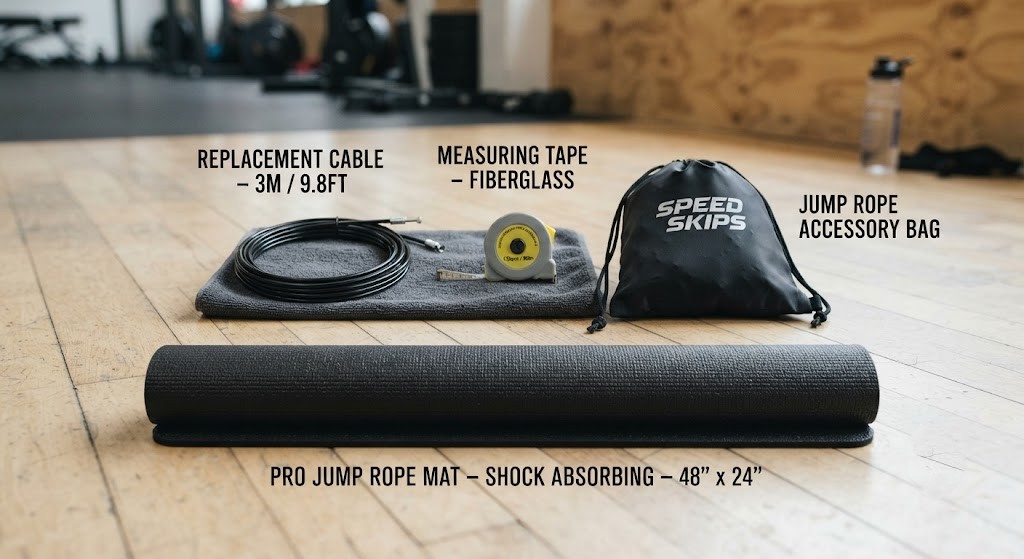
The most useful jump rope accessories are a suitable training surface, comfortable footwear, measuring tool, storage solution, and replacement cable when needed.
Accessories should solve a practical training or maintenance problem rather than simply add more equipment.
Jump-Rope Mat
A jump-rope mat can provide a consistent training surface and may make repetitive jumping more comfortable.
For example, a dedicated mat can be useful when training on hard indoor flooring.
Measuring Tape
A measuring tape is useful when setting the initial cable length. It can help you make deliberate adjustments instead of relying entirely on estimates.
Storage Bag
A storage bag can help prevent the rope from becoming tangled between workouts. This is especially useful for thin cables that can be difficult to organize.
Replacement Cable
Replacement cables are valuable for frequent users because the cable is a wear component. If the handles remain in good condition, replacing the cable can extend the useful life of the setup.
Comfortable footwear can also provide a more stable and comfortable training setup.
How Do You Start Jump Rope Training as a Beginner?
Beginner jump rope training should progress from correct sizing and basic bouncing to rhythm, intervals, speed, and eventually advanced techniques.
Starting gradually gives you time to develop timing and coordination before increasing workout intensity.
Follow This Beginner Progression
- Size the rope correctly for your height and current technique.
- Practice the basic bounce with small, controlled jumps.
- Build rhythm by maintaining consistent wrist rotation.
- Add alternating feet once basic jumps feel comfortable.
- Introduce short intervals to build conditioning.
- Increase speed gradually rather than forcing faster rotations.
- Practice advanced techniques such as double unders only after basic control improves.
For example, a beginner might train for 5–10 minutes at a time before progressing to longer sessions.
Keep your movements controlled rather than trying to jump excessively high. Efficient rope jumping generally relies on rhythm and timing, so unnecessary height or exaggerated arm movements can make the exercise more difficult.
When Should You Shorten the Rope?
You can consider shortening an adjustable jump rope when you consistently have excessive clearance above your head or find yourself using unnecessarily large arm movements.
However, make changes gradually.
A rope that is too short can create the opposite problem, causing frequent catches and making otherwise consistent jumps difficult. Adjust the cable in small increments, then test your technique again.
Why Recovery Matters
Recovery becomes increasingly important as you increase jumping volume.
If your legs feel unusually fatigued, reduce the duration or intensity rather than trying to push through every session.
Full Body Workout for Beginners
What’s Next: How Should You Start Training With an Adjustable Jump Rope?
The next step is straightforward: choose a suitable rope, adjust it carefully, and practice consistently before investing in advanced equipment.
Your first goal should be repeatable technique, not maximum speed.
For your first few sessions, spend time learning basic jumps with a comfortable rope length. Once your movement becomes consistent, you can experiment with slightly shorter settings, faster rotations, or different rope types.
At the same time, combine jump rope training with other forms of exercise. Adults are generally advised to accumulate at least 150 minutes of moderate aerobic activity or 75 minutes of vigorous aerobic activity per week, plus muscle-strengthening work on at least two days. — Source: [CDC, 2025]
You can also combine jump rope sessions with leg workouts and core and abs workouts to create a broader home-training routine.
This approach allows the adjustable jump rope to complement your overall fitness program rather than becoming your only form of exercise.
Conclusion: Why an Adjustable Jump Rope Is a Practical Choice
An adjustable jump rope is a practical fitness tool because it allows you to customize rope length as your height, technique, and training needs change. Getting the length right can improve clearance and rhythm, while choosing the appropriate rope material and design can make different workouts more comfortable and effective.
You also do not need the most expensive or advanced rope to get started. A properly sized rope, comfortable handles, a suitable training surface, and consistent practice matter more than unnecessary features.
Start with basic jumps, make small adjustments, and increase your training gradually. Whether your goal is cardio, conditioning, coordination, HIIT, or simply adding more movement to your home workouts, an adjustable jump rope can be a simple and versatile addition to your fitness routine.
FAQs
What is an adjustable jump rope?
An adjustable jump rope lets you change the rope length to suit your height and training needs.
How do I know what jump rope length I need?
Choose a length that clears your head and feet comfortably without excessive slack.
Is an adjustable jump rope good for beginners?
Yes, it can be adjusted as your technique and experience improve.
Should a jump rope reach your armpits?
The handles can reach around your lower chest or armpit area as a starting point.
Is a longer or shorter jump rope better?
Beginners may prefer slightly longer ropes, while experienced jumpers often use shorter ropes.
What type of adjustable jump rope is best for cardio?
A PVC-coated adjustable rope is a versatile choice for general cardio.
What is the difference between an adjustable jump rope and a speed rope?
An adjustable rope changes length, while a speed rope is designed for faster rotations.
Can I use an adjustable jump rope for HIIT?
Yes, it works well for short jumping and rest intervals.
Are weighted jump ropes better for fitness?
Not necessarily, but they can provide more resistance during training.
Do jump rope bearings matter?
Bearings can improve rotation, but rope weight, material, and technique also matter.
How often should I adjust my jump rope?
Adjust it whenever the current length no longer feels comfortable or efficient.
Can two people use the same adjustable jump rope?
Yes, its length can be changed for users of different heights.
How long should a beginner jump rope for?
Starting with 5–10 minutes is a practical option for beginners.
Can jump rope improve coordination?
Yes, jump-rope training can help develop timing, rhythm, and coordination.
What accessories do I need for an adjustable jump rope?
A mat, comfortable footwear, measuring tape, storage bag, and replacement cable can be useful.
What will 100 skips a day do?
100 skips can add a small amount of cardio and coordination practice to your daily routine.
What is 20 minutes of jump rope equivalent to?
Twenty minutes of jump rope can provide a vigorous aerobic workout, depending on your pace and intensity.
Is 1000 skips per day good?
Yes, if you are accustomed to the volume, but beginners should increase gradually.
Which type of jump rope is best?
PVC-coated ropes are versatile, speed ropes suit fast training, and weighted ropes add resistance.