
If you’ve spent your entire day climbing, weightlifting, playing an instrument, gaming, or doing whatever else that involves the use of your hands, you’re already aware of the importance of more developed and stronger fingers and grip. Nevertheless, efficient finger strength training cannot be done by using any kind of equipment; rather, it needs proper resistance, movement control, progressive overload, and sufficient recovery period.
A finger strengthener tool is a convenient device that will help you work out the fingers, hand, and muscles involved in gripping without having to build up your own gym. Depending on the model, you’ll be able to train your fingers separately, work on the strength of your grip, improve your finger extension, or increase the resistance gradually.
This article covers what a finger strengthener tool does, the difference between finger strength and grip strength, the basic types of finger strength trainers, their possible advantages, proper use, frequency of exercises, and choosing the right equipment.
What Is a Finger Strengthener Tool and How Does It Work?
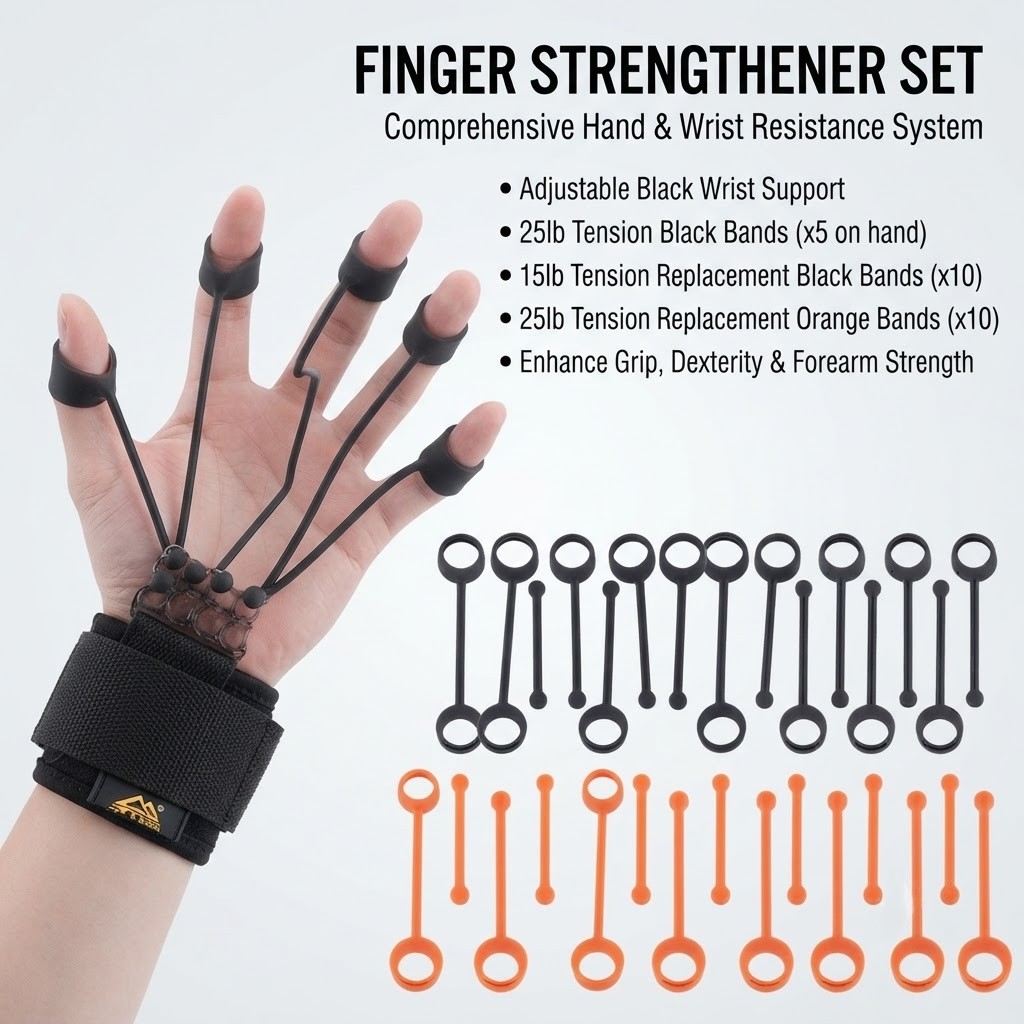
A finger strengthener tool is a compact resistance-training device designed to strengthen the fingers, hand, and supporting grip muscles through controlled finger or hand movements. These tools create resistance as you squeeze, extend, or individually move your fingers against a spring, elastic band, or adjustable mechanism.
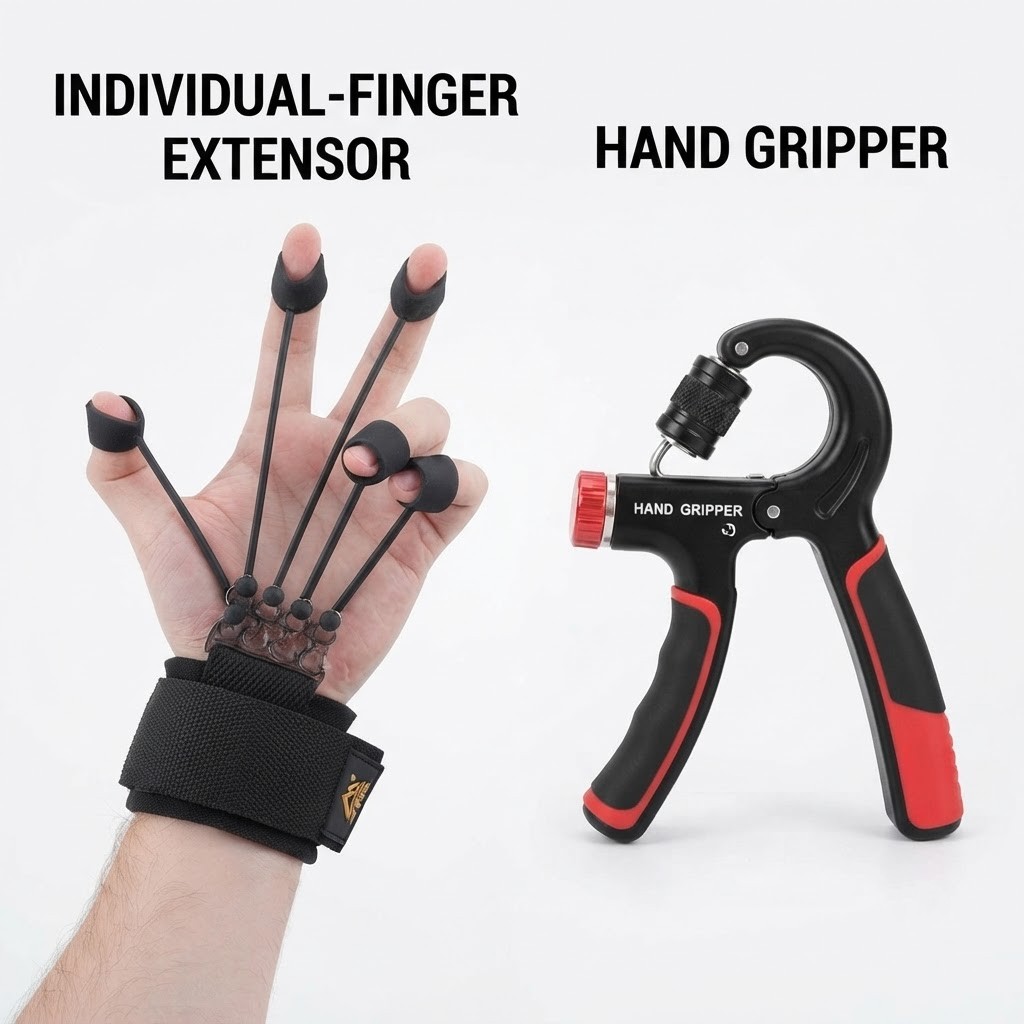
For example, an individual-finger exerciser may place separate loops around your fingertips so each finger works against its own resistance. This makes it different from a traditional hand gripper, where several fingers generally contribute to one squeezing movement.
More broadly, finger strength training involves applying manageable resistance to the fingers and gradually increasing training difficulty as strength and control improve. This approach can be useful when your goal is specific finger control rather than simply producing a stronger whole-hand squeeze.
Finger Strength vs. Grip Strength
Finger strength refers to your ability to produce force through individual fingers or finger groups, while grip strength describes the broader ability of the hand and forearm to hold or squeeze an object.
For example, a climber may need specific finger strength to hold a small edge, while someone carrying grocery bags relies more heavily on overall grip strength.
This distinction is important when choosing equipment. A finger exerciser can be useful for isolated finger work, whereas a hand grip strengthener may be better suited to general squeezing and forearm training.
Why Is Finger Strength Important for Grip and Hand Performance?
Finger strength is important because the fingers help generate force, stabilize objects, and control many gripping and manipulation tasks. Stronger finger control can be useful when holding climbing holds, gripping sports equipment, playing an instrument, or maintaining control of a heavy object.
Handgrip strength is also widely used as a practical measure of overall muscular strength. A 2024 systematic review analyzed data from 2,405,863 adults across 69 countries and regions, creating international handgrip-strength norms across adulthood.
Source: [International Journal of Epidemiology/PubMed, 2024].
At the same time, finger-specific strength has particular relevance to climbing. A systematic review found that resistance training targeting the finger flexors improved finger strength, rate of force development, and forearm endurance compared with climbing training alone, although the researchers noted that more evidence is needed.
Source: [Biology of Sport/PubMed, 2023].
Who Can Benefit From Finger Strength Training?
Finger strength training can be useful for climbers, musicians, athletes, gamers, gym-goers, and people who want more deliberate hand and forearm training.
For example:
- Climbers may prioritize finger force and endurance.
- Musicians may value individual-finger control.
- Athletes may use finger and grip work to complement their sport.
- Gamers may incorporate light, controlled hand conditioning.
- Gym-goers may add finger and grip work to broader strength training.
- General fitness users can use compact resistance tools for convenient hand training.
Finger exercises can complement broader strength training rather than replace it. The World Health Organization recommends that adults perform muscle-strengthening activities involving major muscle groups on 2 or more days per week.
Source: [World Health Organization, 2021].
What Are the Different Types of Finger Strengthener Tools?
The main types of finger strengthener tools include individual-finger trainers, finger extension bands, hand grippers, adjustable resistance devices, and finger resistance bands. Each category serves a somewhat different training purpose.
| Tool type | Primary target | Best suited for |
|---|---|---|
| Individual-finger exerciser | Finger isolation | Musicians, beginners, coordination work |
| Finger extension bands | Finger opening and extension | Balancing flexion-focused training |
| Hand gripper | Overall grip | General strength and athletes |
| Adjustable finger trainer | Variable finger resistance | Progressive training |
| Finger resistance bands | Finger movement and endurance | Portable home workouts |
| Grip trainer | Hand and forearm | General grip development |
Understanding these differences makes it easier to select a tool that matches your training objective.
Individual-Finger Exercisers
Individual-finger exercisers use separate resistance points to train fingers more independently. For example, each finger may sit inside a small loop that must be pressed downward against spring resistance.
This design makes individual-finger control the primary focus. It can be particularly appealing to musicians or anyone who wants to train fingers separately rather than relying on a single whole-hand squeeze.
Finger Extension Bands
Finger extension bands resist the outward movement of the fingers and can train muscles involved in opening the hand.
For example, placing a small elastic loop around your fingertips and slowly spreading your fingers creates resistance in the opposite direction from a squeezing exercise.
This difference matters because repeated squeezing emphasizes finger and hand flexion. Extension work can therefore provide a useful complement to a flexion-focused routine.
Hand Grippers and Adjustable Trainers
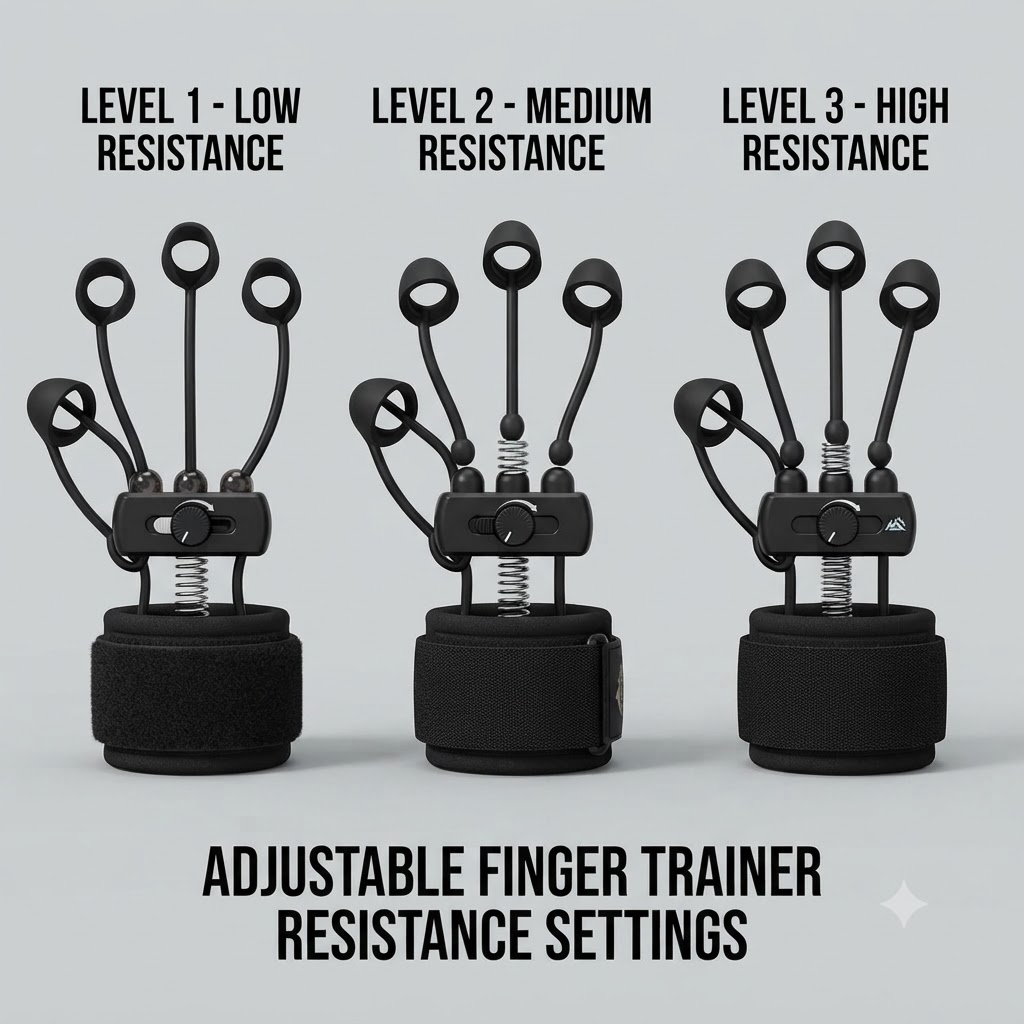
Hand grippers are designed primarily for whole-hand squeezing, while adjustable trainers let you modify resistance or training difficulty.
For example, someone beginning with light resistance can increase the setting after consistently completing the target repetitions. Adjustable resistance can also make a device useful for a longer period as your strength improves.
What Are the Benefits of Using a Finger Strengthener Tool?
Finger strengthener benefits can include improved finger force, grip endurance, hand control, and convenient resistance training when the tool is used consistently.
Because these devices are generally compact, they can also make hand training easier to incorporate into a regular routine.
Potential benefits include:
- Finger strength: Resistance provides a simple way to challenge the muscles involved in finger movement.
- Grip endurance: Repeated submaximal contractions can train the hand to tolerate sustained effort.
- Hand control: Individual-finger devices can emphasize controlled movement.
- Training convenience: Small devices are easy to store and transport.
- Progressive resistance: Adjustable models can make it easier to increase difficulty gradually.
- Forearm involvement: Many gripping movements also challenge muscles in the hand and forearm.
However, a finger strengthener should be viewed as one component of a broader strength program, not as a replacement for compound exercises or sport-specific practice.
How Do You Use a Finger Strengthener Tool Correctly?
You use a finger strengthener correctly by selecting manageable resistance, positioning the fingers comfortably, performing controlled repetitions, and allowing enough recovery between sessions.
The goal is to train the intended muscles without relying on momentum or compensatory movements.
Step 1: Choose Manageable Resistance
Manageable resistance allows you to complete the planned repetitions with steady control and consistent finger positioning.
Start below your maximum effort rather than testing your strongest possible squeeze on every set. If you cannot maintain proper positioning, the resistance is likely too high.
Step 2: Position Your Hand Correctly
Proper hand positioning keeps the wrist comfortable and allows the fingers to move through their intended range.
For example, keep your wrist relatively neutral instead of repeatedly bending it to force a difficult repetition.
Step 3: Perform Slow Repetitions
Controlled repetitions make it easier to keep tension on the intended fingers.
Perform a smooth squeeze or extension, pause briefly when appropriate, and return slowly rather than bouncing through the movement.
Step 4: Rest Between Sets
Rest periods help maintain repetition quality and reduce unnecessary fatigue.
For example, a beginner could start with 1–2 minutes between sets and adjust based on the exercise and resistance.
Step 5: Progress Gradually
Progressive overload means increasing training difficulty only after your current workload becomes manageable.
You can progress by:
- Adding a few repetitions.
- Adding another set.
- Increasing resistance slightly.
- Moving to a more challenging variation.
The important point is to make gradual changes instead of increasing every training variable at once.
How Often Should You Use a Finger Strengthener Tool?
Most beginners can start with two or three focused finger-training sessions per week rather than training hard every day.
For example, you might train on Monday, Wednesday, and Saturday while allowing your fingers to recover between harder sessions.
Training frequency should depend on intensity, other activities, and how your hands feel. Climbers who already perform substantial finger loading during climbing sessions may need less additional finger work than someone whose only hand training comes from a light resistance device.
The WHO recommends gradual progression in physical activity and advises adults to include muscle-strengthening activities on at least 2 days per week.
Source: [World Health Organization, 2021].
However, general fitness guidelines do not provide a universal finger-strengthener prescription. Your routine should therefore be adjusted to the specific exercise, resistance, training history, and recovery demands.
What Resistance Should Beginners Use With a Finger Strengthener?
Beginners should use a resistance level that allows controlled repetitions without excessive strain and increase resistance gradually as the exercise becomes easier.
For example, if you cannot complete your planned repetitions without changing finger position or using momentum, reduce the resistance.
A simple starting point is 2 sets of 8–15 controlled repetitions for a resistance exercise, provided that the movement feels comfortable. This is a practical starting framework rather than a universal prescription.
Furthermore, avoid treating the highest resistance setting as the goal. Quality of movement is more valuable than maximum resistance when you are learning finger-strength training.
Stop an exercise if you experience sharp, worsening, or persistent pain rather than treating pain as proof that the workout is effective. If you are recovering from a hand, finger, tendon, or joint injury, seek individualized advice from an appropriately qualified healthcare professional before adding resistance training.
How Do You Choose the Best Finger Strengthener Tool?
Choosing a finger strengthener depends on your goal, required resistance, adjustability, comfort, portability, and whether you want to train individual fingers or overall grip strength.
For example, a musician may prioritize individual-finger movement, while a general fitness user may prefer an adjustable hand gripper.
What Features Should You Look For?
Resistance adjustability is one of the most useful features for beginners because it supports gradual progression. A tool with multiple resistance levels can remain useful longer than a fixed-resistance device.
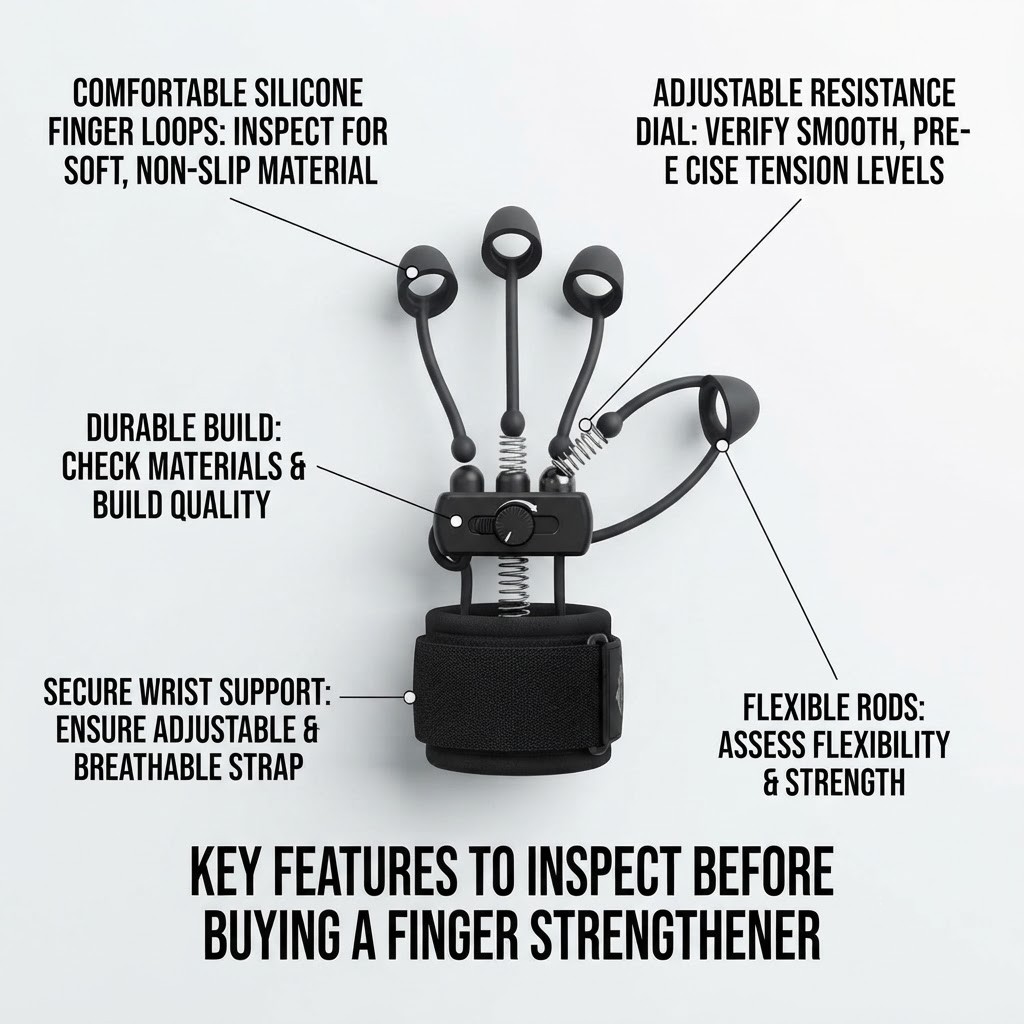
When comparing a finger strengthener tool, consider:
- Resistance range: Make sure the starting level is appropriate for your current ability.
- Adjustability: Multiple settings make progression easier.
- Finger independence: Separate resistance points are useful for isolated finger training.
- Ergonomics: Comfortable contact points encourage consistent use.
- Material: Durable springs, silicone, rubber, or plastic components should feel secure during repeated use.
- Portability: Compact designs work well for home, office, or travel training.
- Ease of cleaning: Smooth, simple surfaces can be easier to maintain.
- Intended use: Choose a finger exerciser, extension band, or gripper based on your specific goal.
Are Finger Strengtheners Good for Climbers, Musicians, and Athletes?
Finger strengtheners can be useful for climbers, musicians, and athletes when the resistance and movement match the demands of their activity.
However, the tool should complement rather than replace the actual activity or sport-specific practice.
Finger Strengtheners for Climbers
Climbers often need specific finger and grip strength because their sport places substantial demands on the hands and forearms.
Research comparing climbers with non-climbers has found substantially higher grip strength and forearm endurance among climbers, while higher-level climbers also demonstrated greater finger strength.
Source: [Sports Medicine/ PubMed, 2024].
However, more resistance is not automatically better. A systematic review of adult climbers identified factors such as higher climbing intensity, bouldering, reduced grip or finger strength, crimping, and previous injury in discussions of overuse-injury risk.
Source: [PubMed, 2024].
Therefore, climbers should consider overall training load rather than simply adding as much finger resistance as possible.
Finger Strengtheners for Musicians
Musicians can use individual-finger trainers to practice controlled finger movement and resistance separately.
For example, a pianist may prefer a device that allows each finger to work independently instead of a single squeezing gripper.
That being said, resistance training should complement actual instrument practice. A finger tool cannot reproduce every technical, rhythmic, or coordination demand of playing an instrument.
Finger Strengtheners for Athletes and Gamers
Athletes and gamers may use finger trainers to add convenient hand and grip work to their existing routines.
For example, a gamer might use light resistance during a separate training session rather than repeatedly squeezing a high-resistance device during gameplay.
For athletes, the ideal approach depends on the demands of the specific sport and how much additional hand or forearm loading is already included in training.
What Are the Most Common Finger Strengthener Mistakes to Avoid?
The most common finger strengthener mistakes are using excessive resistance, rushing repetitions, training too frequently, and ignoring painful symptoms.
For example, forcing a maximum-resistance squeeze every day can create unnecessary fatigue without guaranteeing better progress.
Mistake 1: Using Too Much Resistance
Excessive resistance can make it difficult to maintain proper finger positioning and controlled movement.
Choose a level that challenges you without forcing compensatory movements.
Mistake 2: Chasing High Repetition Counts
More repetitions are not automatically better for finger strength.
A controlled set of quality repetitions is generally more useful than hundreds of rushed movements.
Mistake 3: Training Hard Every Day
Finger tissues need recovery between demanding sessions.
Alternate harder training with rest or lighter activity instead of repeatedly pushing through fatigue.
Mistake 4: Ignoring Pain
Sharp or persistent pain should not be treated as normal training discomfort.
Stop the movement and consider professional assessment if symptoms persist or interfere with normal hand use.
Mistake 5: Training Only Finger Flexion
A balanced routine can include both gripping and finger-extension movements.
For example, combining a light extension band with a finger exerciser can provide different movement patterns.
What Are the Best Practical Uses for a Finger Strengthener Tool?
The best practical use of a finger strengthener depends on the activity you want to support and the specific hand quality you want to develop.
A single tool does not have to serve every purpose.
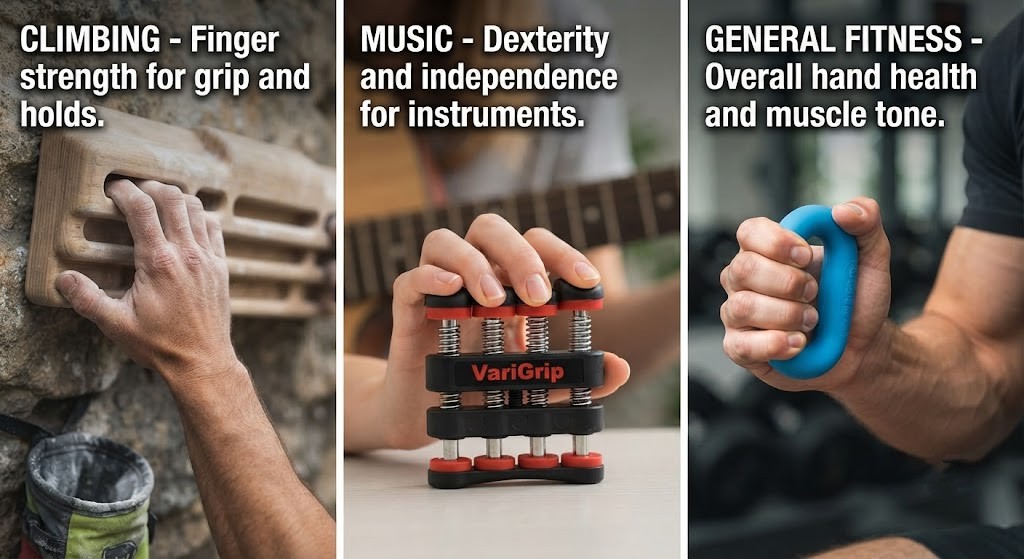
| User | Useful tool characteristic | Practical focus |
|---|---|---|
| Climbers | Finger-specific or adjustable resistance | Finger force and endurance |
| Musicians | Independent finger resistance | Finger control |
| Athletes | Grip-focused resistance | Grip strength and endurance |
| Gamers | Light, controlled resistance | Hand conditioning |
| Office workers | Portable, low-resistance design | Convenient hand exercise |
| General fitness users | Adjustable resistance | Progressive grip training |
For example, a climber may prioritize finger-specific resistance, while a general fitness user may get more value from an adjustable grip trainer.
How Can You Build a Simple Finger-Strength Routine?
A beginner finger-strength routine should combine controlled resistance, modest volume, recovery, and gradual progression.
For example, you can start with two sessions per week and increase difficulty only after the current workload feels comfortable.
Beginner Finger Strengthener Routine
- Warm up: Open and close your hands gently for 1–2 minutes.
- Finger exerciser: Perform 2 sets of 8–15 controlled repetitions.
- Finger extensions: Perform 2 sets of 10–15 easy repetitions.
- Light grip work: Perform 1–2 sets of controlled squeezes.
- Rest: Allow at least a day between harder finger-training sessions initially.
- Progress: Increase resistance or repetitions gradually when the current workload becomes easy.
The routine should feel challenging without turning every session into a maximum-effort test.
Moreover, broader strength training can complement dedicated finger work. You can combine finger exercises with Arm Wrestler Forearm Workout and grip strength exercises.
For people building a complete home routine, finger training can also fit alongside a equipment home workout.
How Should You Progress Your Finger Strength Training?
The next step is to track your resistance, repetitions, comfort, and recovery so you can make small, measurable changes over time.
For example, if you complete 2 sets of 12 repetitions comfortably for several sessions, you might add a small amount of resistance rather than immediately doubling the workload.
A simple progression cycle can look like this:
- Weeks 1–2: Learn the movements with light-to-moderate resistance.
- Weeks 3–4: Add a few repetitions while maintaining control.
- Weeks 5–6: Increase resistance slightly if your current workload feels easy.
- After Week 6: Continue progressing gradually or introduce a different movement.
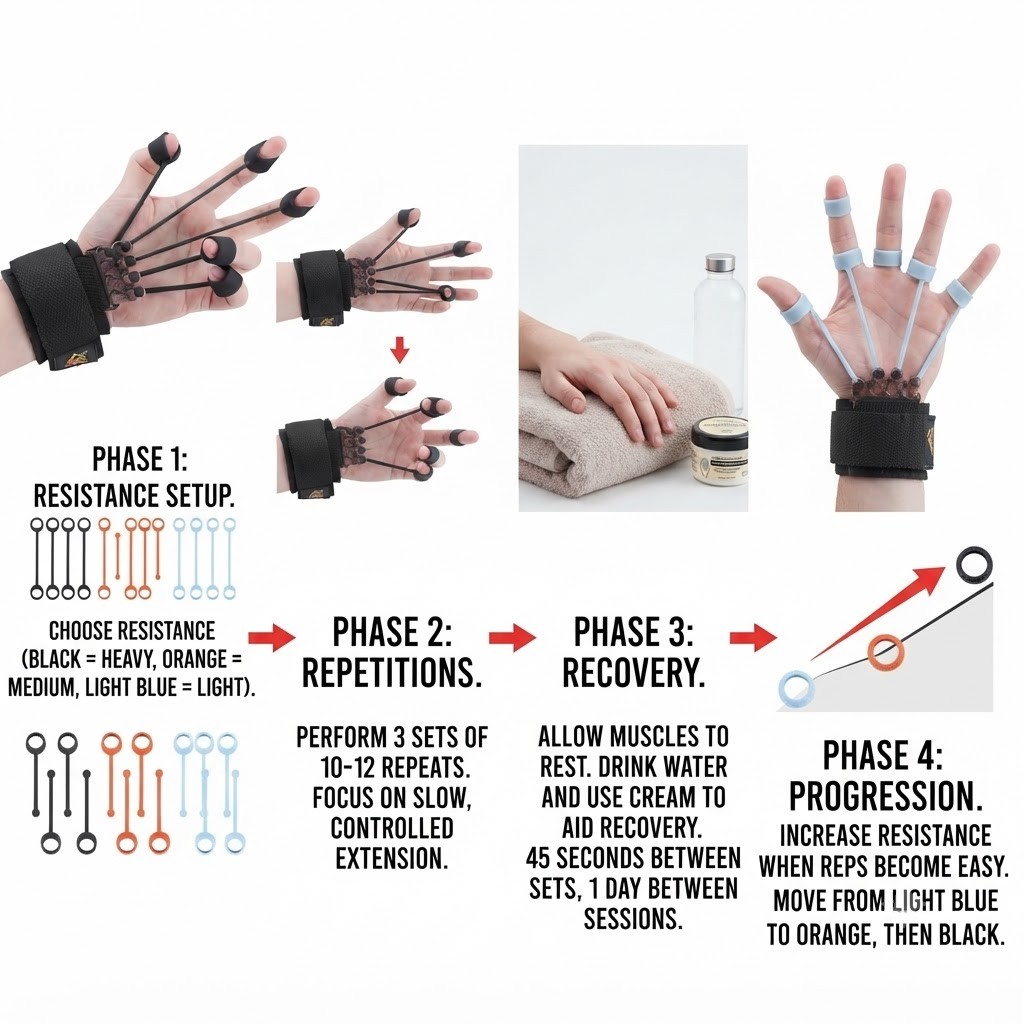
A custom visual can show finger isolation, grip squeezing, finger extension, recovery, and progressive overload as five connected stages. This diagram would help beginners understand that finger strength development is a process rather than a maximum-strength test.
For broader training, you can also explore biceps workouts and back workouts to build a more complete strength program.
Conclusion
A finger strengthener tool is a practical way to add targeted resistance training for the fingers, hand, and grip. Different tools serve different purposes, so the best option depends on whether you want individual-finger control, finger extension, general grip strength, or adjustable progression.
The most effective approach isn’t simply choosing the strongest device. Instead, consistent training with manageable resistance, controlled repetitions, gradual progression, and adequate recovery provides a more sensible foundation for developing finger strength.
Whether you’re a climber looking for stronger fingers, a musician working on finger control, an athlete improving grip endurance, or a beginner adding convenient resistance training to your routine, choose a tool that matches your goal. Start gradually, focus on movement quality, and increase difficulty only when your current workload becomes comfortable.
FAQs
What is a finger strengthener tool?
A finger strengthener tool uses resistance to train your fingers, hand, and grip muscles.
Do finger strengtheners actually work?
Yes, consistent use can improve finger strength, grip endurance, and hand control.
What is the best tool for strengthening my hands?
Hand grippers are useful for overall grip, while finger trainers target individual fingers.
Is 70 kg hand grip good?
Yes, 70 kg is a strong grip for many people, but strength varies by age, sex, and body size.
Can I use hand grippers daily?
Light training can be done daily, but intense sessions require enough recovery.
What does a finger strengthener do?
It helps improve finger strength, grip endurance, and hand control.
Is a finger strengthener the same as a hand gripper?
No, finger trainers can isolate fingers, while hand grippers mainly train whole-hand grip.
How often should I use a finger strengthener tool?
Beginners can start with two or three focused training sessions per week.
What resistance should a beginner use?
Choose a resistance that allows controlled repetitions without excessive strain.
How many repetitions should I do with a finger strengthener?
Start with around 2 sets of 8–15 controlled repetitions.
Can finger strengtheners improve grip strength?
Yes, they can help develop finger and overall grip strength.
Are finger strengtheners good for climbers?
Yes, they can complement climbing-specific finger and grip training.
Can musicians use a finger strengthener?
Yes, individual-finger trainers can help improve finger control and strength.
Are finger extension exercises important?
Yes, they complement squeezing exercises by training finger-opening movements.
What are the common finger strengthener mistakes?
Using too much resistance, rushing repetitions, training too often, and ignoring pain are common mistakes.
Can a finger strengthener build forearm strength?
Yes, many finger and gripping exercises also engage the forearm muscles.
How do I know when to increase resistance?
Increase resistance when your current workload feels easy and remains controlled.
Is a higher resistance finger strengthener always better?
No, the right resistance is more important than using the highest resistance.
Can finger strengtheners prevent hand injuries?
They are not guaranteed to prevent injuries, so gradual training and recovery are important.
What is the best finger strengthener tool?
The best tool depends on whether you want finger isolation, grip strength, extension, or adjustable resistance.