
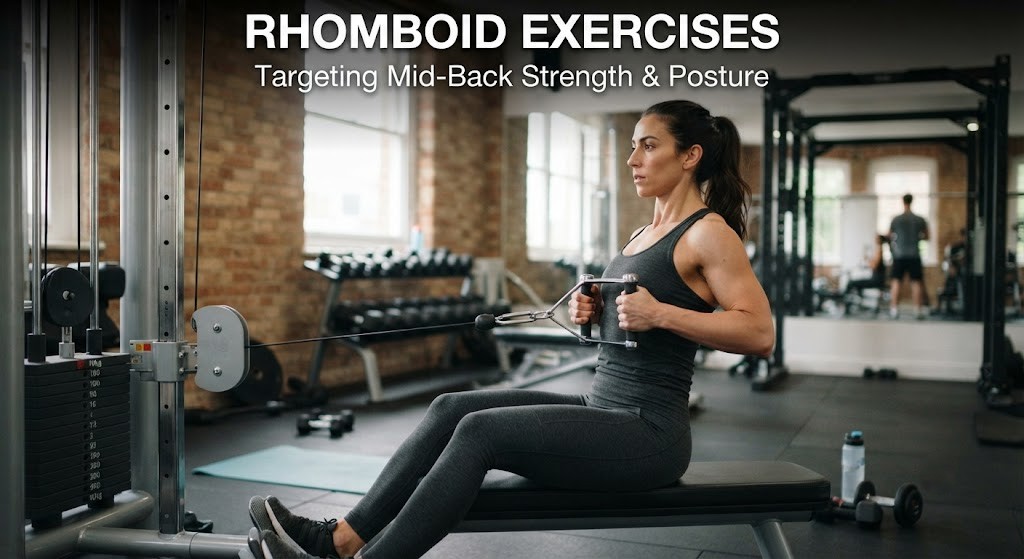
You’ve probably done rows, pulldowns, and other pulling exercises to strengthen your back, but one area often gets less attention: the rhomboids. Located between the spine and shoulder blades, these muscles play an important role in scapular retraction, stabilization, and controlled upper-body movement.
The right rhomboid exercises can help you build stronger upper-back muscles while improving your ability to control your shoulder blades during pulling movements. Whether you train at a gym or at home, you can target the rhomboids with cable machines, dumbbells, resistance bands, bodyweight exercises, or even simple prone movements.
In this guide, you’ll learn what the rhomboids do, the best rhomboid exercises for strength, how to train them at home, proper technique, common mistakes, recommended sets and reps, and how to build a practical rhomboid workout.
What Are Rhomboid Exercises and Which Muscles Do They Target?
Rhomboid exercises are movements that strengthen the rhomboid major and rhomboid minor by emphasizing shoulder-blade retraction, stabilization, and controlled upper-back movement.
The rhomboids sit between the spine and the inner edges of the shoulder blades. They help draw the shoulder blades backward and contribute to maintaining their position during upper-body movements.
Rhomboid major and rhomboid minor primarily contribute to scapular retraction and stabilization. During a controlled row, for example, gently bringing the shoulder blades toward each other increases the contribution of the muscles surrounding the scapulae.
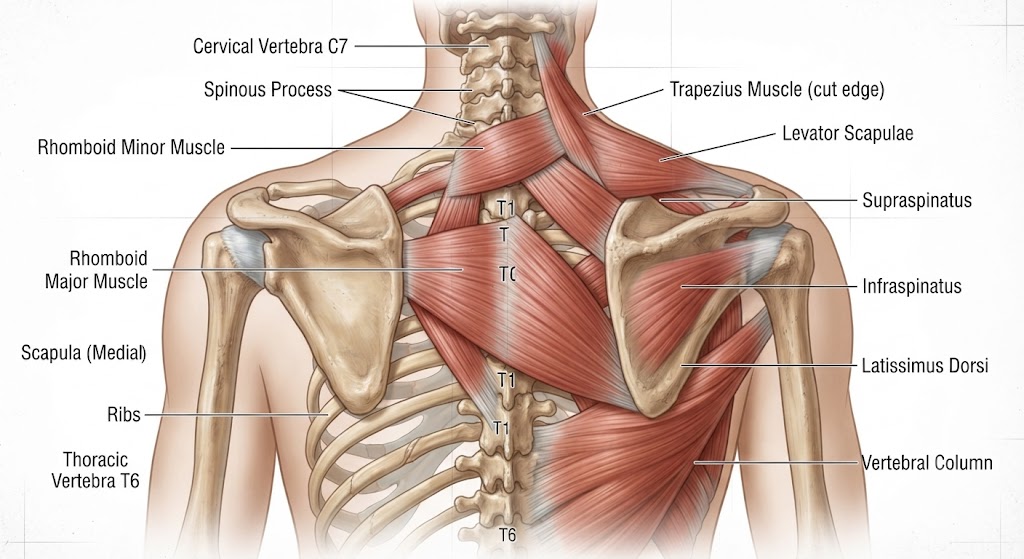
Because the rhomboids work alongside several other upper-back and shoulder muscles, they are best trained as part of a balanced program. For additional upper-back development, explore upper back workouts and 3D Shoulder Workout.
Why Are Rhomboid Exercises Important for Upper-Back Strength?
Rhomboid exercises help develop upper-back strength, scapular control, and pulling capacity while training muscles involved in stabilizing the shoulder blades.
The rhomboids work with other scapular muscles during pulling and upper-limb movements. When you perform exercises such as rows, controlled shoulder-blade movement can help you maintain a more consistent position throughout the repetition.
For example, during a cable row, the goal isn’t simply to move the handle toward your body. You also need to coordinate the movement of your arms and shoulder blades while avoiding unnecessary shrugging or torso movement.
Rhomboid training can also complement posture exercises. However, exercise should not be presented as a guaranteed treatment for pain or a medical posture problem.
What Are the Best Rhomboid Exercises for Building Upper-Back Strength?
The best rhomboid exercises are controlled pulling and scapular movements that allow you to retract and stabilize the shoulder blades without relying excessively on momentum.
Here are several effective options:
| Exercise | Equipment | Difficulty | Primary Focus |
|---|---|---|---|
| Seated Cable Row | Cable machine | Beginner–Intermediate | Retraction and rowing |
| Chest-Supported Dumbbell Row | Dumbbells + bench | Beginner–Intermediate | Upper-back pulling |
| Bent-Over Dumbbell Row | Dumbbells | Intermediate | Back strength |
| Resistance-Band Row | Resistance band | Beginner | Home pulling |
| Face Pull | Cable/band | Beginner–Intermediate | Scapular control |
| Reverse Fly | Dumbbells/band | Beginner | Upper-back isolation |
| Prone Y/T Raise | None/light weights | Beginner | Scapular control |
| Inverted Row | Bar/TRX | Intermediate | Bodyweight pulling |
Seated Cable Row
The seated cable row is one of the most practical rhomboid exercises because it provides adjustable resistance and allows you to practice controlled scapular movement.
Sit upright with your feet supported and grasp the handle. Pull the handle toward your torso while keeping your chest relatively stable and allowing your shoulder blades to move naturally.
Pause briefly when your shoulder blades reach a comfortable retracted position. Then extend your arms slowly and control the return instead of allowing the weight to pull you forward.
Avoid turning the exercise into a backward lean. Your goal is controlled upper-back movement rather than moving the heaviest possible load.
Chest-Supported Dumbbell Row
The chest-supported dumbbell row is particularly useful when you want to train the upper back while reducing the amount of torso stabilization required.
Set an adjustable bench at a comfortable incline and lie face down with a dumbbell in each hand. Keep your neck neutral and pull the dumbbells toward your lower ribs.
Gently bring the shoulder blades together without aggressively squeezing them. Lower the weights slowly and maintain control throughout the movement.
This setup can make it easier for beginners to focus on the pulling motion rather than using their lower back or momentum.
Resistance-Band Row
The resistance-band row is a simple and accessible rhomboid exercise for home workouts.
Anchor the band securely at approximately chest height. Pull the handles or band ends toward your torso while keeping your elbows controlled and your trunk stable.
Pause briefly at the end of the movement, then return to the starting position under tension. Beginners can use lighter resistance while learning how to coordinate the arms and shoulder blades.
Face Pull
Face pulls combine a pulling movement with shoulder and scapular control, making them a useful addition to an upper-back routine.
Set a cable or resistance band around upper-chest to face height. Pull the handles toward your face while allowing your elbows to move outward comfortably.
Control the return and avoid turning the exercise into a heavy shrug. Face pulls can complement rowing exercises rather than replacing them entirely.
Reverse Fly
The reverse fly uses horizontal arm movement to challenge the upper back and can be performed with dumbbells or resistance bands.
Hinge slightly forward or use a chest-supported position. Raise the weights outward until your arms approach shoulder level without forcing the range of motion.
Then lower the weights slowly. Light resistance is generally more useful than heavy dumbbells that cause swinging and reduce control.
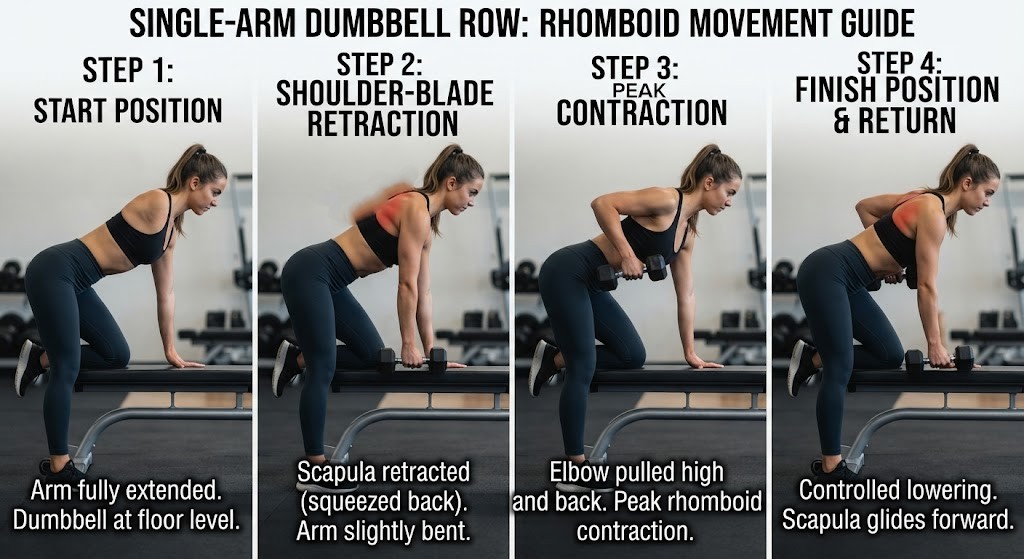
How Do You Perform a Dumbbell Row to Target the Rhomboids?
A dumbbell row can target the rhomboids effectively when you combine stable body positioning with controlled scapular movement.
Follow these steps:
- Set your position: Place one hand and knee on a stable bench when using a supported variation.
- Brace your torso: Keep your spine neutral and avoid excessive rotation.
- Pull the dumbbell: Drive your elbow backward toward your torso.
- Control the shoulder blade: Allow the scapula to retract without aggressively shrugging.
- Lower slowly: Return the dumbbell under control.
- Repeat: Complete the planned repetitions before switching sides.
Effective rhomboid training requires more than simply pulling a weight with your arm. The goal is to coordinate the arm, shoulder blade, and torso while maintaining control.
A lighter dumbbell that allows consistent technique can be more useful than a heavier weight that causes twisting, swinging, or excessive shoulder elevation.
What Are the Best Rhomboid Exercises to Do at Home?
You don’t need a fully equipped gym to train your rhomboids. Effective rhomboid exercises at home can include resistance-band rows, prone Y/T raises, reverse flyes, and bodyweight inverted rows when suitable equipment is available.
No-Equipment Rhomboid Exercises
Prone Y and T raises require little or no equipment and emphasize controlled shoulder-blade movement.
Lie face down and brace gently. Lift your arms into the selected Y or T position, pause briefly, and lower them slowly.
Reverse snow angels are another low-equipment option. Move your arms through a controlled arc while keeping the movement comfortable and avoiding aggressive spinal extension.
For more home training ideas, explore back workouts.
Resistance-Band Rhomboid Exercises
Resistance bands provide scalable resistance without requiring a cable machine. They can be used for rows and face pulls and are particularly convenient for home training.
ACSM’s 2026 position stand notes that elastic bands and home-based training can effectively support resistance-training goals. — Source: ACSM, 2026.
What Are the Best Rhomboid Exercises for Better Posture?
Rhomboid exercises for posture should focus on scapular control and upper-back strength rather than simply forcing the shoulders backward.
The rhomboids help retract and stabilize the scapulae, so controlled rows and related movements can be useful components of balanced upper-body training.
For example, a light resistance-band row performed with a neutral torso can help you practice coordinating arm movement with controlled scapular motion.
However, posture involves more than one muscle group. A balanced approach can include mobility work, general strength training, and when appropriate.
How Many Sets and Reps Should You Do for Rhomboid Exercises?
A practical starting point for many beginner-friendly resistance-training routines is 2–3 sets of 8–12 repetitions.
The CDC identifies 8–12 repetitions as a practical set range for muscle-strengthening activity and notes that two or three sets can provide additional benefits. — Source: CDC, 2023.
For example, a beginner could perform three sets of 10 controlled resistance-band rows instead of immediately choosing maximal resistance.
The appropriate number of sets and repetitions can vary according to training experience, exercise selection, resistance, and overall workout goals. Most importantly, your repetitions should remain controlled enough to maintain good technique.
The 2026 ACSM position stand emphasizes matching resistance-training variables to the goal and building consistency rather than relying on unnecessary programming complexity. Its evidence base included 137 systematic reviews and more than 30,000 participants. — Source: ACSM, 2026.
How Often Should You Train Your Rhomboids?
Rhomboid exercises can generally be included two or more days per week as part of a broader resistance-training program, depending on your total back volume and recovery.
The CDC recommends muscle-strengthening activities on at least two days each week for adults. — Source: CDC, 2025.
For example, you might perform rowing exercises on Monday and Thursday while using different variations during each session.
However, remember that your rhomboids already contribute to many compound back exercises. Therefore, consider your total weekly pulling volume instead of treating every rowing exercise as completely separate work.
What Are the Most Common Rhomboid Exercise Mistakes?
Even effective rhomboid exercises become less useful when technique breaks down. Common mistakes include:
- Using excessive weight
- Shrugging the shoulders
- Swinging the torso
- Shortening the range of motion
- Overextending the lower back
- Rushing the lowering phase
- Losing control of the shoulder blades
Using Too Much Weight
Heavy resistance can make it difficult to control the shoulder blades throughout the exercise.
Choose a load that allows you to maintain consistent technique from the first repetition to the last. If you need to swing your torso to finish the repetition, the resistance may be too challenging.
Shrugging the Shoulders
Excessive shrugging can change the intended movement pattern and shift the shoulders toward the ears.
Keep your neck relaxed and avoid deliberately driving your shoulders upward during rows, reverse flyes, or band exercises.
Using Momentum
Momentum reduces the need for controlled muscular work.
Instead of jerking the torso or rapidly pulling the weight, use a smooth movement and keep your body position stable.
Rushing the Eccentric Phase
The eccentric phase is the lowering portion of a repetition. Dropping the resistance quickly can make it harder to maintain control.
Lower the weight or resistance smoothly and maintain awareness of your shoulder position throughout the movement.
What Is a Good Beginner Rhomboid Workout?
A beginner rhomboid workout can combine one primary row, one lighter upper-back movement, and one home-friendly pulling exercise.
Beginner Rhomboid Workout
- Seated cable row: 3 × 8–12
- Reverse fly: 2 × 10–15
- Resistance-band row: 2 × 10–15
- Prone Y raise: 2 × 8–12
- Rest: Approximately 60–90 seconds between sets
Use manageable resistance and focus on maintaining good technique throughout each set.
If your form begins to deteriorate, consider reducing the resistance rather than forcing additional repetitions.
How Can You Progress a Rhomboid Workout Over Time?
Progressive rhomboid training doesn’t require constantly adding heavy weight. You can gradually increase resistance, repetitions, exercise difficulty, or training volume while maintaining proper technique.
A simple progression strategy is:
- Start with a resistance level you can control.
- Increase repetitions within your selected range.
- Once the movement becomes consistently manageable, increase resistance slightly.
- Maintain good technique with the new resistance.
- Progress to more challenging exercise variations when appropriate.
- Continue monitoring your total weekly pulling volume.
For example, you might begin with resistance-band rows and eventually progress to cable rows or more demanding free-weight variations.
A rhomboid workout should prioritize proper technique, manageable resistance, controlled repetitions, and gradual progression rather than using the heaviest possible weight.
What Equipment Is Useful for Rhomboid Training?
Rhomboid training can be performed with a variety of equipment, including resistance bands, dumbbells, cables, benches, pull-up bars, suspension trainers, and rowing machines.
The equipment changes the exercise setup and resistance profile, but good movement quality remains important regardless of what you use.
| Equipment | Useful Exercises | Best Use |
|---|---|---|
| Resistance band | Rows, face pulls | Home training |
| Dumbbells | Rows, reverse flyes | Free-weight training |
| Cable machine | Rows, face pulls | Adjustable resistance |
| Bench | Supported rows, Y/T raises | Stable positioning |
| Pull-up/row station | Inverted rows | Bodyweight training |
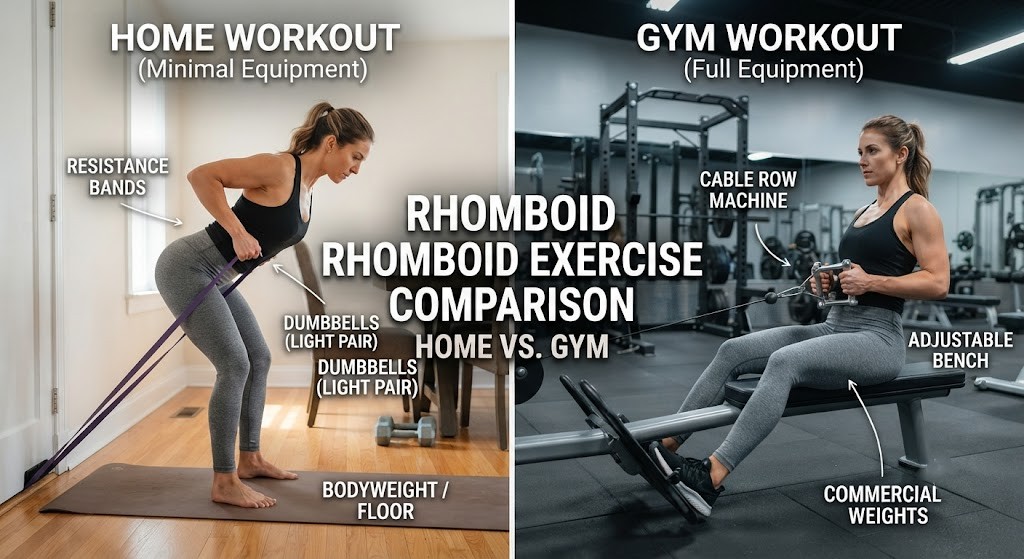
For beginners, an expensive setup isn’t necessary. The 2026 ACSM guidance specifically notes that effective resistance training does not require a gym or sophisticated equipment. — Source: ACSM, 2026.
How Do Rhomboid Exercises Fit Into a Complete Back Workout?
Rhomboid exercises are most effective when they complement rather than replace other back movements.
A balanced back workout can include exercises that train different areas and movement patterns, such as:
- Horizontal pulling movements
- Vertical pulling movements
- Scapular-control exercises
- Rear-delt movements
- Other upper-back exercises
- Lat-focused movements
Rows can provide the foundation for many back workouts, while face pulls, reverse flyes, and prone raises can add additional upper-back and scapular work.
This approach allows you to train the rhomboids while also developing the lats, trapezius, rear deltoids, and other muscles involved in upper-body pulling.
How Should Beginners Start Rhomboid Training?
Beginners should start with exercises that make it easy to learn the movement pattern and control the resistance.
Resistance-band rows, supported dumbbell rows, light reverse flyes, and prone Y/T raises can provide practical starting points.
Focus on these fundamentals:
- Maintain a stable torso.
- Keep your neck relaxed.
- Move through a comfortable range of motion.
- Avoid excessive shrugging.
- Control both the pulling and lowering phases.
- Use resistance that allows consistent technique.
- Increase difficulty gradually.
Once you can perform an exercise consistently, you can gradually increase resistance or move to a more challenging variation.
What’s Next: How to Build Stronger Rhomboids
The next step is to choose two or three rhomboid-focused exercises that fit your equipment, experience, and overall back program.
Start by mastering the movement with light or manageable resistance. Then track your repetitions and gradually increase resistance when you can maintain consistent technique.
After that, review your total weekly pulling volume and recovery. Adults are advised to perform muscle-strengthening activity at least two days per week, but your individual schedule should account for the rest of your training. — Source: CDC, 2025.
Finally, combine rhomboid exercises with movements for the lats, trapezius, rear deltoids, and other upper-back muscles for balanced development. You can also explore shoulder workouts as part of a broader upper-body routine.
Conclusion
Rhomboid exercises strengthen the rhomboid major and minor while emphasizing scapular retraction, stabilization, and controlled upper-back movement. Rows, reverse flyes, face pulls, prone raises, and resistance-band exercises provide practical options for both home and gym workouts.
Effective rhomboid training doesn’t require maximum weights or complicated programming. Instead, focus on manageable resistance, controlled repetitions, consistent technique, and gradual progression.
Whether you’re a beginner training at home or an experienced lifter working in a gym, choosing the right rhomboid exercises can help you build a stronger and more controlled upper back as part of a balanced resistance-training routine.
FAQs
What are the best rhomboid exercises?
Rows, face pulls, reverse flyes, prone Y/T raises, and resistance-band rows are effective options.
What exercises hit your rhomboids?
Dumbbell rows, cable rows, band rows, face pulls, reverse flyes, and inverted rows target the rhomboids.
Can you train your rhomboids at home?
Yes, resistance bands, dumbbells, and bodyweight exercises can effectively train your rhomboids at home.
Are rhomboids hard to grow?
No, consistent resistance training, proper form, and gradual progression can help develop the rhomboids.
What are the signs of a weak rhomboid muscle?
Poor shoulder-blade control, reduced pulling strength, and difficulty stabilizing the upper back can be possible signs.
Are rows good for rhomboids?
Yes, rows effectively target the rhomboids through controlled shoulder-blade retraction.
How many sets and reps should I do for rhomboid exercises?
Try 2–3 sets of 8–12 repetitions as a practical starting point. — Source: CDC, 2023.
How often should you train your rhomboids?
Train them two or more days per week as part of a balanced resistance-training routine. — Source: CDC, 2025.
Do rhomboid exercises improve posture?
They can strengthen the upper back and improve scapular control, which supports good posture.
Can poor posture cause rhomboid pain?
Poor posture may contribute to upper-back discomfort, although pain can have several possible causes.
What is the best rhomboid exercise for beginners?
Resistance-band rows, supported dumbbell rows, and light reverse flyes are beginner-friendly options.
Can I train rhomboids without weights?
Yes, prone Y/T raises, reverse snow angels, and inverted rows can train the rhomboids without traditional weights.
Are face pulls good for rhomboids?
Yes, face pulls train the upper back while promoting controlled shoulder-blade movement.
What equipment is needed for rhomboid exercises?
Resistance bands, dumbbells, cables, benches, or no equipment can be used depending on the exercise.
How can I make rhomboid exercises harder?
Increase resistance, repetitions, or exercise difficulty gradually while maintaining proper form.
Should I train rhomboids with my back or shoulders?
Rhomboids can be trained with your back or included in a broader upper-body workout.
Why do I feel my arms more than my rhomboids during rows?
Using too much weight or poor technique can shift the work toward your arms, so reduce the resistance and control each repetition.
Should rhomboid exercises be heavy?
No, use a manageable resistance that allows controlled movement and consistent technique.