
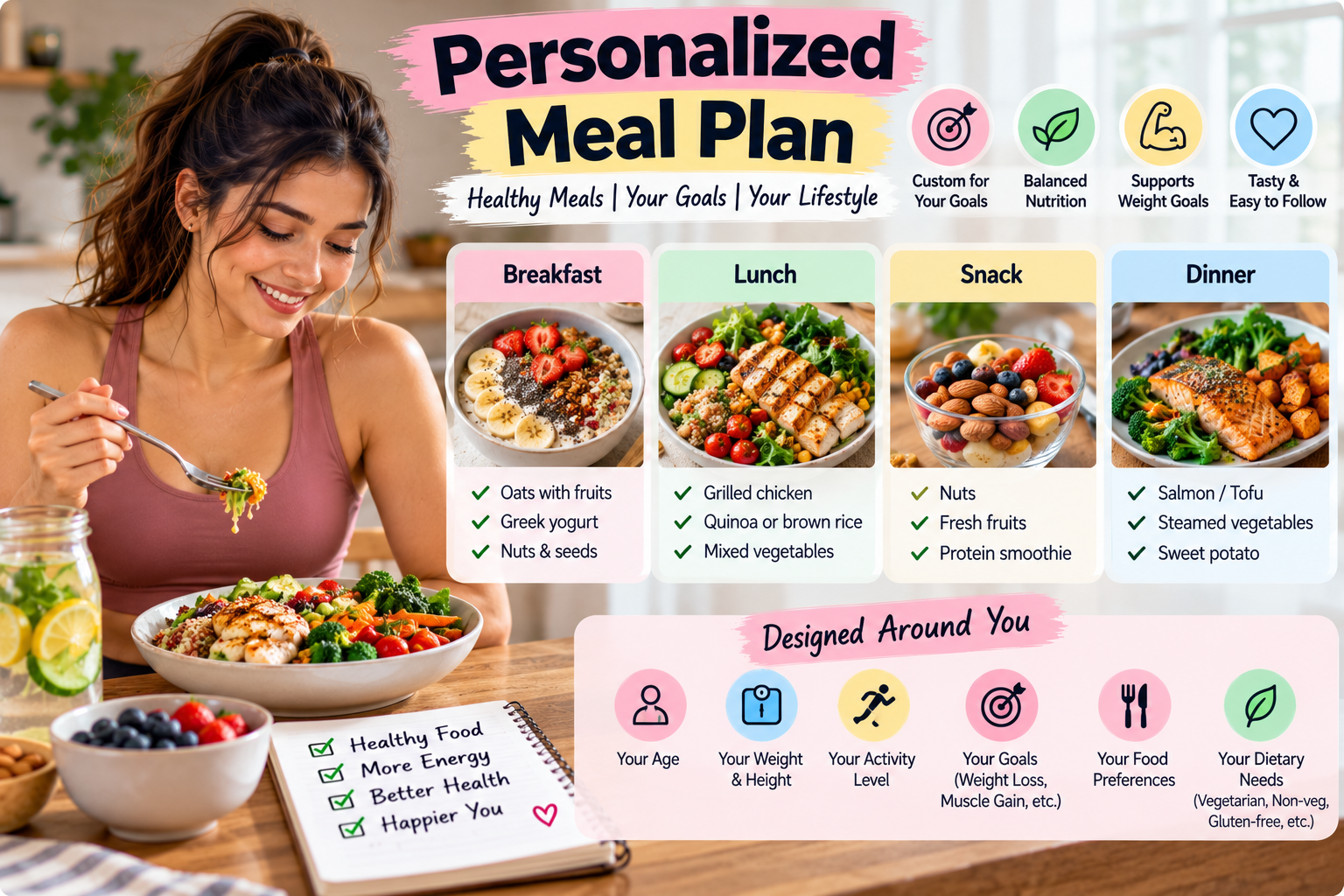
Eating healthier becomes easier when your diet matches your fitness goals, food preferences, budget, and daily routine. A generic diet chart may not work for everyone, but a personalized meal plan helps you choose suitable foods and portions for your individual needs.
Whether you want to lose weight, build muscle, or improve your overall nutrition, this guide explains how to create a flexible meal plan using everyday foods and free nutrition calculators.
What Is a Personalized Meal Plan?
A personalized meal plan is an eating plan tailored to your nutritional needs, activity level, fitness goals, food preferences, and lifestyle. It considers your calorie requirements, preferred foods, budget, and available cooking time.
For example, a vegetarian student building muscle might eat dal, soy chunks, milk, curd, rice, and roti. Someone trying to lose weight might focus on balanced meals, protein-rich foods, vegetables, and appropriate portions.
Personalized Meal Plan vs. Generic Diet Chart
| Feature | Generic diet chart | Personalized meal plan |
|---|---|---|
| Calories | Usually fixed | Estimated for individual needs |
| Food choices | Standard menu | Matches preferences |
| Portions | Generalized | Adjusted to goals |
| Budget | May be overlooked | Can prioritize affordability |
| Flexibility | Often limited | Fits your lifestyle |
A personalized diet plan makes healthy eating more practical by adapting nutritional guidance to your circumstances.
Why Is a Personalized Meal Plan Important?
A personalized meal plan can help you organize meals, manage portions, meet nutritional needs, and develop consistent eating habits.
Its main benefits include:
- Supports fitness goals: Adjust meals to support weight loss, muscle gain, or maintenance.
- Improves nutritional balance: Include protein, carbohydrates, fats, vitamins, and minerals.
- Saves time: Plan meals and prepare ingredients in advance.
- Encourages consistency: Build flexible habits without following a rigid menu.
For example, preparing dal, rice, and vegetables in advance can simplify weekday meals. If you eat out with friends, you can return to your regular routine at the next meal without unnecessary restriction.
How Do You Create a Personalized Meal Plan?
You can create a personalized meal plan by choosing a goal, estimating calorie needs, selecting suitable foods, and reviewing your progress.
Step 1: Choose Your Goal
Your primary goal influences your calorie intake and food portions.
| Goal | General approach |
|---|---|
| Weight loss | Maintain a suitable calorie deficit |
| Muscle gain | Consume sufficient calories and protein |
| Maintenance | Balance energy intake with expenditure |
| General health | Choose varied, nutrient-dense foods |
An ideal body weight calculator may provide a rough reference, but it cannot determine your nutritional needs by itself.
Step 2: Calculate Your Daily Calorie Needs
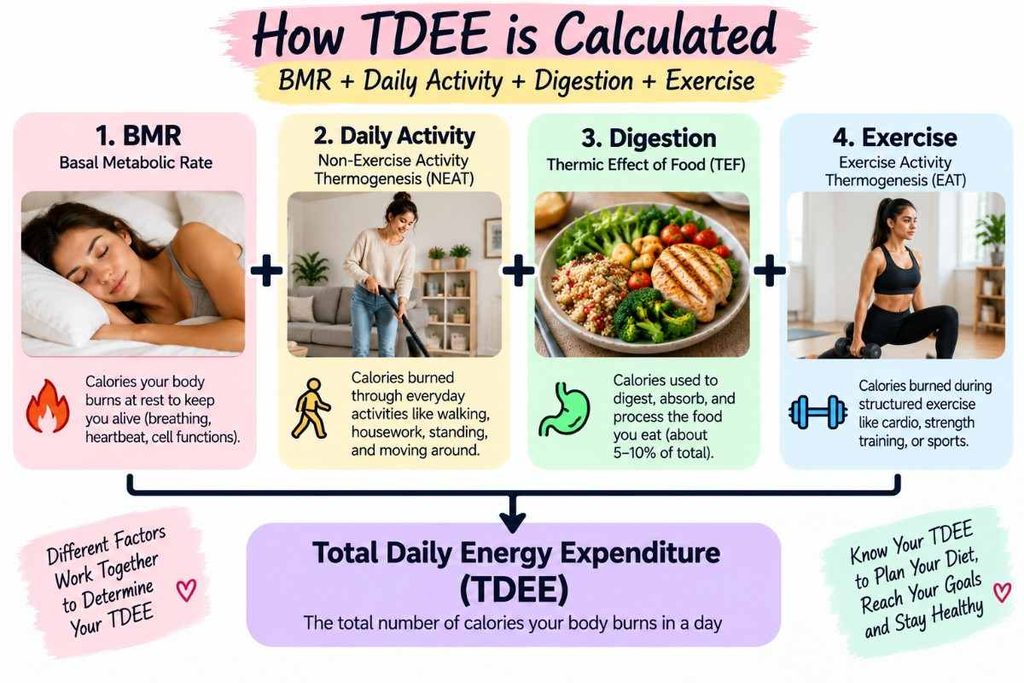
Use a TDEE calculator to estimate your maintenance calories. Total daily energy expenditure (TDEE) estimates the energy your body uses through resting metabolism, digestion, and physical activity.
For example, if your estimated maintenance requirement is 2,400 calories per day, use that figure as a starting point. Your actual needs may differ, so monitor longer-term progress before adjusting your intake.
Step 3: Set Your Macronutrient Targets
Macronutrients include protein, carbohydrates, and fats. Each supports different functions in the body.
| Macronutrient | Main role | Food sources |
|---|---|---|
| Protein | Tissue maintenance and muscle repair | Dal, eggs, tofu, yogurt |
| Carbohydrates | Energy for daily activity | Rice, roti, potatoes, fruit |
| Dietary fats | Cell function and vitamin absorption | Nuts, seeds, oils |
According to the National Academies’ Dietary Reference Intakes, the adult Acceptable Macronutrient Distribution Ranges are 45–65% of calories from carbohydrates, 20–35% from fat, and 10–35% from protein. These ranges are general guidelines, not individual prescriptions.
Source: National Academies of Sciences, Engineering, and Medicine, 2005.
A daily protein intake calculator and macro calculator can help estimate suitable starting targets.
Step 4: Choose Foods You Enjoy
Build your meal plan around affordable, familiar foods that provide a variety of nutrients.
Consider including:
- Protein: Dal, beans, eggs, curd, tofu, chicken, or fish.
- Carbohydrates: Rice, roti, potatoes, oats, or whole-grain bread.
- Healthy fats: Nuts, seeds, and suitable vegetable oils.
- Fruits and vegetables: Seasonal produce in different colors.
- Fluids: Water and other suitable beverages.
For more meal ideas, see Reverse Dieting Plan.
Step 5: Plan Portions and Review Progress
Divide your food choices into meals that suit your appetite and schedule. Three main meals with one or two snacks can work well, but other meal patterns may also be suitable.
Monitor your energy levels, hunger, workout performance, and longer-term progress. Adjust portions gradually instead of making drastic changes.
How Do Calorie Deficits and Surpluses Work?
A calorie deficit occurs when you consume less energy than your body uses over time. A calorie surplus occurs when you consume more energy than your body uses.
For example, someone with maintenance needs of approximately 2,300 calories might start with a modest reduction for weight loss or a modest increase for muscle gain, depending on their circumstances.
A calorie deficit calculator can help estimate a starting intake. Avoid extreme calorie restriction, and seek professional advice if you are unsure about your nutritional needs.
What Does a Daily Personalized Meal Plan Look Like?
A balanced personalized meal plan includes suitable portions, protein-rich foods, vegetables, fruit, and enough fluids to meet individual needs.
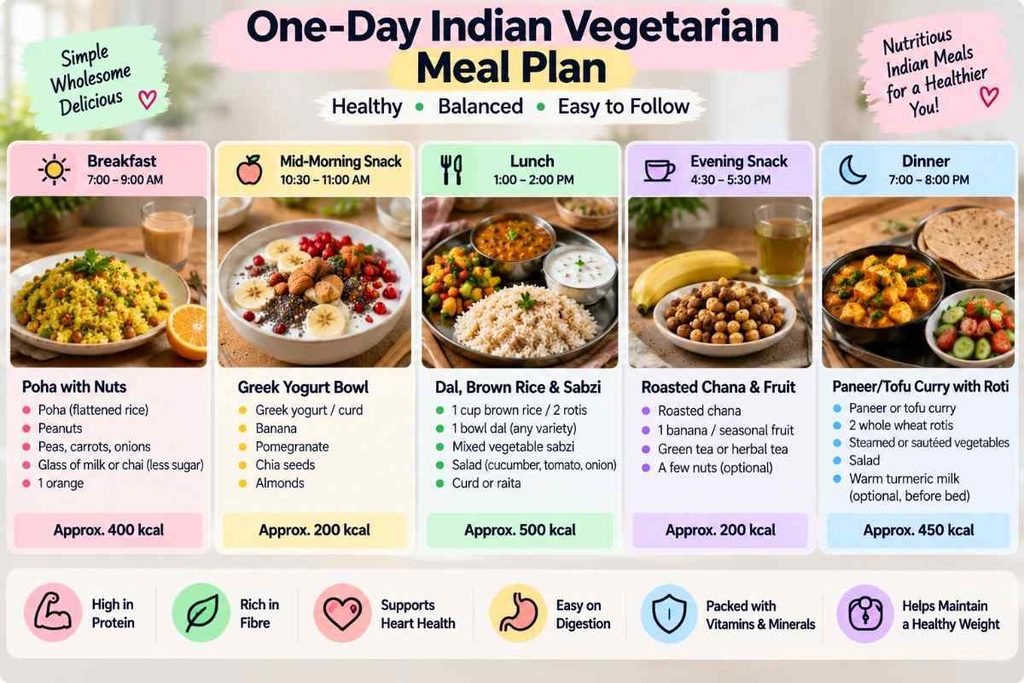
One-Day Indian Vegetarian Meal Plan
The following example provides approximately 2,000 calories. Actual values depend on portion sizes, recipes, and cooking oils.
| Meal | Example foods | Estimated calories |
|---|---|---|
| Breakfast | Vegetable poha, curd, and fruit | 400 |
| Morning snack | Banana and nuts | 200 |
| Lunch | Two rotis, dal, vegetables, and curd | 600 |
| Evening snack | Roasted chana and milk | 250 |
| Dinner | Rice, rajma, vegetables, and curd | 550 |
| Total | 2,000 |
This is an illustrative menu, not an individualized prescription. Adjust portions according to your energy requirements.
How Can You Adapt Meals to Different Diets?
You can modify your meal plan according to your dietary preferences.
- Vegetarian: Include dal, beans, dairy products, and soy foods.
- Vegan: Choose lentils, tofu, soy chunks, and suitable fortified alternatives.
- Non-vegetarian: Include eggs, chicken, or fish.
- Budget-conscious: Prioritize seasonal vegetables, rice, beans, and lentils.
Vegetarians may need to pay attention to vitamin B12 and iron. Vegan diets require reliable vitamin B12 sources, often through fortified foods or supplements when appropriate.
For additional ideas, explore high-protein vegetarian foods.
Which Free Tools Can Help You Build a Personalized Meal Plan?
Free nutrition calculators can help estimate calorie, protein, and macronutrient targets.
| Tool | Purpose |
|---|---|
| BMR calculator | Estimates resting energy requirements |
| TDEE calculator | Estimates daily energy expenditure |
| Calorie deficit calculator | Estimates a starting weight-loss intake |
| Daily protein intake calculator | Estimates protein requirements |
| Macro calculator | Estimates calories, protein, carbohydrates, and fats |
The NIDDK Body Weight Planner also allows adults to explore personalized calorie and activity plans.
Source: National Institute of Diabetes and Digestive and Kidney Diseases, publication year not specified.
Use these tools as starting references rather than exact prescriptions. Your actual requirements depend on individual characteristics and progress.
How Can You Make a Personalized Meal Plan Affordable?
A budget-friendly personalized meal plan uses simple recipes, affordable ingredients, and planned grocery shopping.
Try these practical strategies:
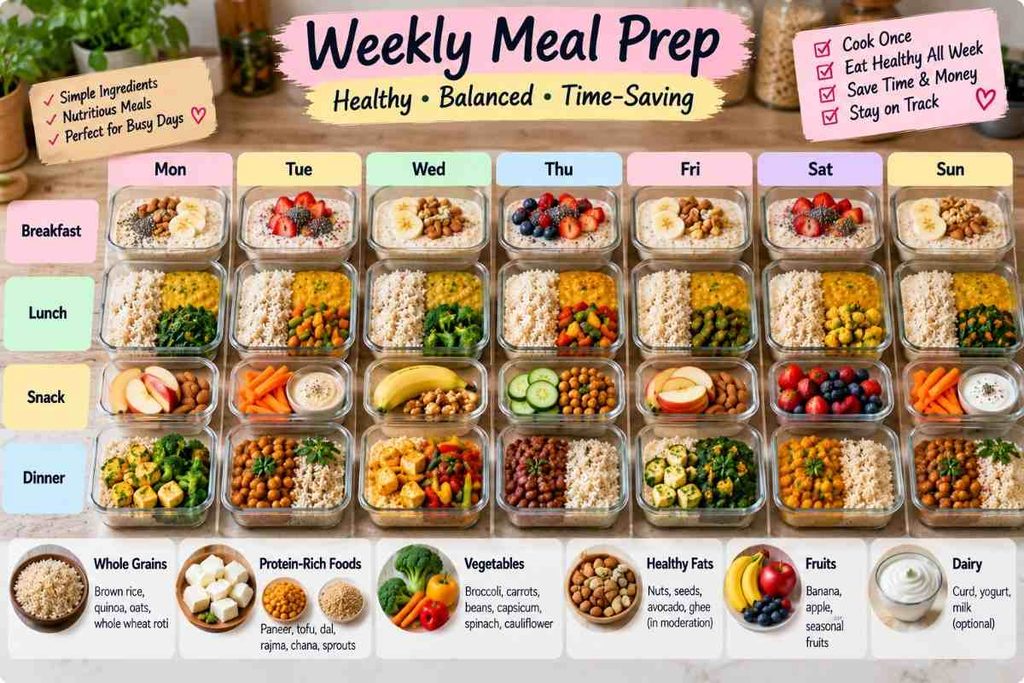
- Plan a few breakfasts, lunches, and dinners for the week.
- Batch-cook dal, beans, rice, and vegetables.
- Reuse ingredients across different recipes.
- Buy seasonal produce and locally available foods.
- Keep convenient snacks such as fruit, roasted chana, or yogurt available.
For example, cooked chickpeas can become a lunch salad and a dinner curry, saving time and reducing food waste.
How Often Should You Update Your Personalized Meal Plan?
Review your personalized meal plan regularly and adjust it when your goals, activity level, appetite, schedule, or progress changes.
Monitor your energy, hunger, workout recovery, food satisfaction, and longer-term weight trends if weight change is your goal. Daily weight fluctuations alone are not a reliable reason to change your calorie target.
If you experience persistent fatigue, excessive hunger, or declining workout performance, your plan may need review.
Can a Personalized Meal Plan Accommodate Allergies?
Yes, a personalized meal plan can accommodate vegetarian, vegan, lactose-free, gluten-free, and other dietary preferences when foods are selected carefully.
People with food allergies should check ingredient labels and avoid relevant allergens. Those managing diabetes, kidney disease, digestive disorders, or other medical conditions may need guidance from a registered dietitian or qualified healthcare professional.
A general-purpose meal plan cannot replace individualized medical care.
Conclusion
A personalized meal plan helps you organize nutrition around your fitness goals, calorie requirements, food preferences, budget, and daily routine. By combining balanced meals, suitable portions, and flexible food choices, you can develop eating habits that support your long-term goals.
Start with manageable changes, use free nutrition calculators as starting references, and adjust your plan as your needs change. Consistency and flexibility can make healthy eating easier to maintain.
FAQs
What is a personalized meal plan?
A diet tailored to your goals, calorie needs, food preferences, and lifestyle.
How do I create a personalized meal plan?
Set your goal, estimate calories, choose nutritious foods, and plan portions.
Can I create a personalized meal plan for free?
Yes, use free nutrition calculators and simple meal templates.
What should I eat for weight loss?
Eat vegetables, protein-rich foods, whole grains, and appropriate portions.
What should I eat for muscle gain?
Choose protein-rich foods, sufficient calories, carbohydrates, and healthy fats.
Is a vegetarian personalized meal plan effective?
Yes, dal, beans, soy, dairy, grains, vegetables, and fruits provide essential nutrients.
How often should I update my meal plan?
Review it regularly and adjust as your goals and activity levels change.
Do I need a nutritionist for a personalized meal plan?
Not always, but professional guidance helps with medical conditions and specialized nutritional needs.