
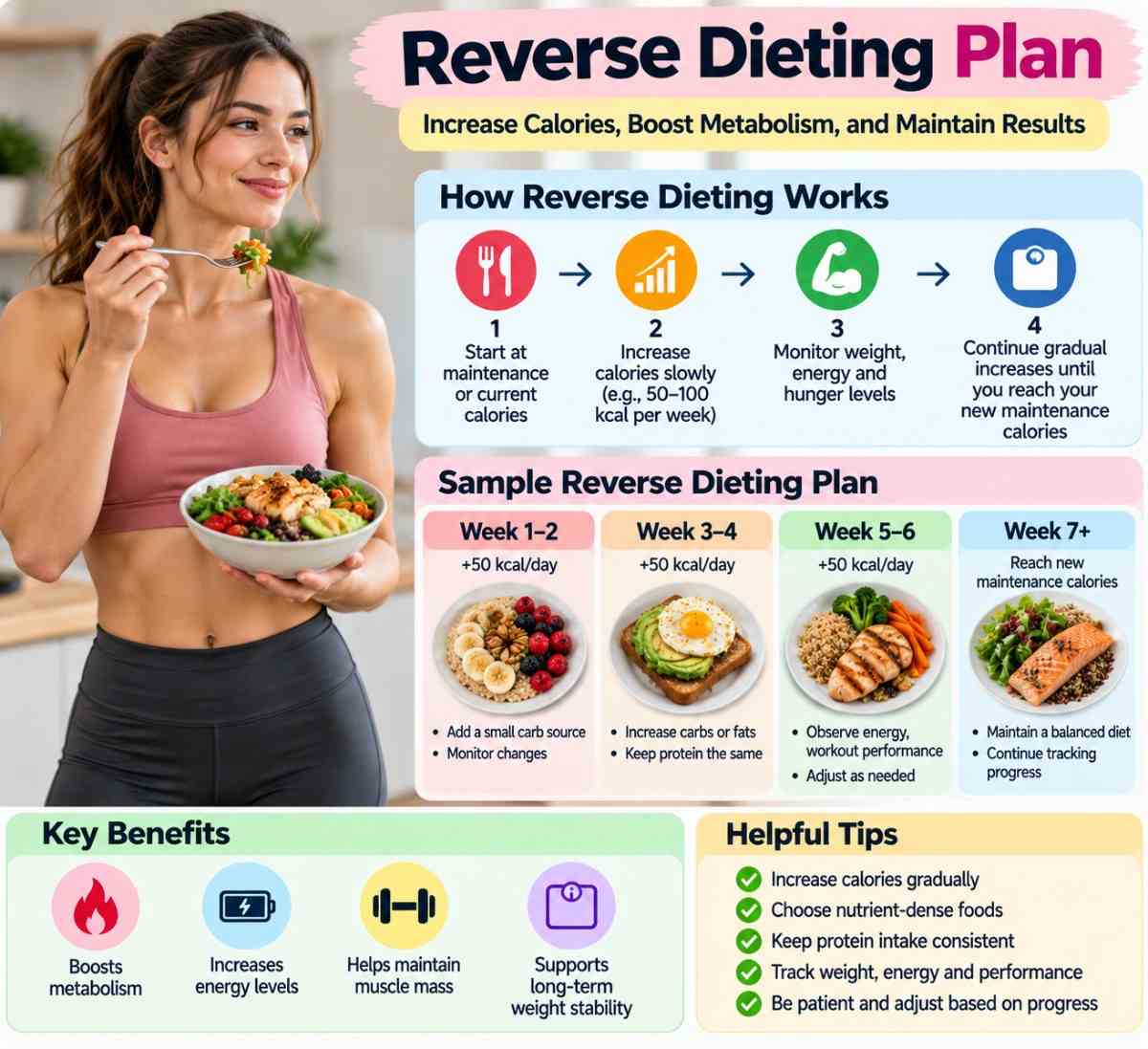
After weeks or months of dieting, increasing calories can feel risky, especially if you’re worried about regaining weight. However, staying in a calorie deficit forever isn’t necessary. A reverse dieting plan helps you gradually increase food intake while monitoring your weight, energy, hunger, and workout performance.
In this guide, you’ll learn how reverse dieting works, how many calories to add, and how to transition toward a sustainable maintenance routine.
What Is a Reverse Dieting Plan?
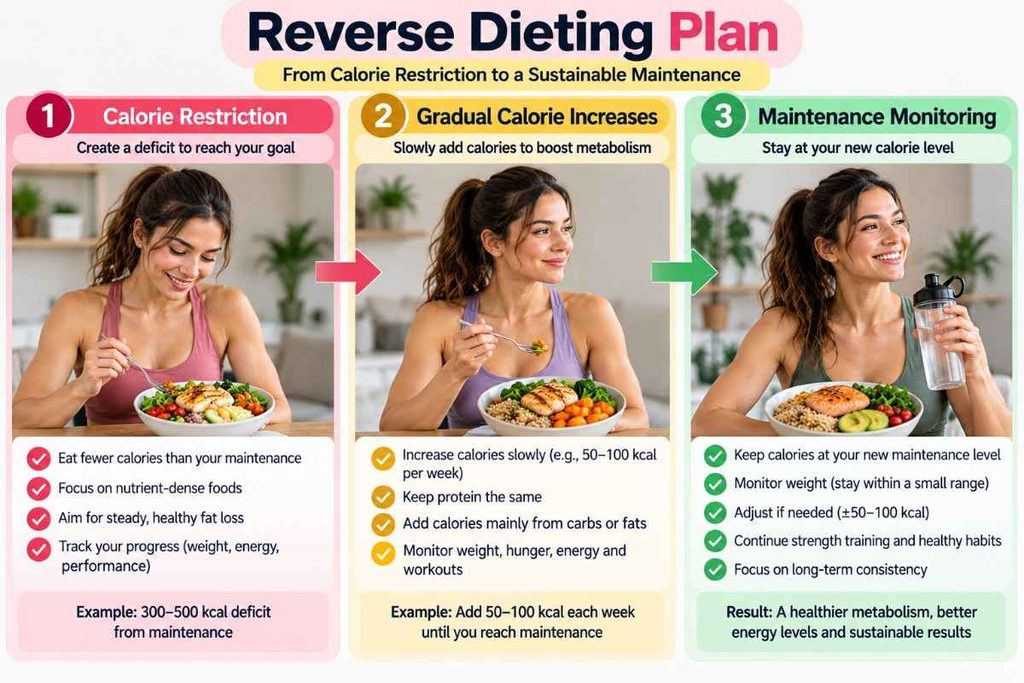
A reverse dieting plan is a nutrition strategy that gradually increases daily calorie intake after a period of calorie restriction, usually to find a sustainable maintenance level.
For example, someone eating 1,800 calories daily might increase to 1,900 calories and monitor their progress before making further adjustments.
However, gradual increases aren’t necessary for everyone. Returning directly to estimated maintenance calories is also a reasonable approach.
Who Should Consider Reverse Dieting?
Reverse dieting may suit people who have completed a fat-loss phase and prefer a structured transition back to maintenance.
It may be worth considering if you:
- Experience persistent hunger after dieting.
- Want to increase food intake gradually.
- Need a structured post-diet routine.
- Want to monitor changes in energy and training performance.
If you experience severe fatigue, significant dietary restriction, or other concerning symptoms, consult a qualified healthcare professional.
Why Consider Reverse Dieting After Weight Loss?
A reverse dieting plan can help organize your transition out of a calorie deficit. However, evidence has not established that reverse dieting prevents weight regain better than returning directly to maintenance calories.
How Does Dieting Affect Metabolism?
After weight loss, your body generally requires fewer calories because it is smaller. Changes in daily movement and metabolic adaptation can also influence energy expenditure.
Increasing food intake may improve energy availability and recovery when your previous intake was insufficient. However, reverse dieting does not automatically repair metabolism or guarantee fat-loss protection.
Focus on adequate nutrition, consistent activity, and realistic expectations rather than trying to manipulate your metabolism through tiny calorie increases.
How to Start a Reverse Dieting Plan
Follow these four steps to establish a practical starting point.
Step 1: Review Your Current Calories
Track your usual food intake for approximately seven days, if appropriate, including meals, snacks, drinks, oils, and sauces.
If you’re following a calorie deficit diet plan, review whether your current intake supports your energy and recovery.
Step 2: Estimate Maintenance Calories
Maintenance calories are the approximate daily energy intake needed to maintain body weight over time.
A BMR calculator for estimating resting energy needs can help estimate resting energy expenditure.
Remember that calculators provide estimates, not exact measurements.
Step 3: Choose Your Calorie-Increase Strategy
You can increase calories gradually or return directly to a reasonable maintenance estimate.
For example, someone eating 1,800 calories with estimated maintenance of 2,200 calories could add 100 calories at a time or move directly to 2,200 calories.
Consider your hunger, energy, training performance, and preference when choosing your approach.
Step 4: Monitor Your Progress
Track calorie intake, average body weight, hunger, energy, and workout performance. Avoid changing your plan because of a single weigh-in.
An initial weight increase may reflect replenished glycogen, water retention, or additional food in your digestive system rather than an equivalent increase in body fat.
How Many Calories Should You Add Each Week?
A common reverse dieting approach adds approximately 50–150 calories per day at a time. This is a practical guideline, not an evidence-established optimal range.
| Situation | Possible approach |
|---|---|
| You prefer gradual changes | Add around 50–150 calories daily and reassess |
| Maintenance is much higher than current intake | Consider a larger increase or direct return to maintenance |
| Hunger and recovery are poor | Prioritize adequate nutrition |
| Weight fluctuates temporarily | Maintain consistency and gather more data |
| Weight rises consistently for several weeks | Reassess intake and activity |
You don’t need to increase calories every seven days. Allow enough time to evaluate trends, and avoid prolonging insufficient intake simply to follow a schedule.
Sample Six-Week Reverse Dieting Plan
Suppose you currently eat 1,800 calories daily and estimate your maintenance needs at 2,200 calories.
| Week | Daily calorie target | Main focus |
|---|---|---|
| Week 1 | 1,900 | Establish consistent tracking |
| Week 2 | 2,000 | Assess hunger and energy |
| Week 3 | 2,100 | Review weight and workouts |
| Week 4 | 2,200 | Evaluate maintenance |
| Week 5 | 2,200 | Monitor weight and recovery |
| Week 6 | Adjust if needed | Refine maintenance intake |
This is an example, not a mandatory schedule. Your calorie needs may differ.
If your average weight remains broadly stable at 2,200 calories and your energy improves, that intake may be close to maintenance. If weight continues falling or rising consistently, reassess your needs.
Reverse Dieting vs. Returning Directly to Maintenance
Both strategies can help you transition out of a calorie deficit.
| Factor | Gradual reverse dieting | Direct maintenance |
|---|---|---|
| Calorie changes | Small increases | One larger adjustment |
| Main advantage | Structured transition | Reaches estimated maintenance sooner |
| Potential limitation | May prolong low intake | Initial scale changes may feel surprising |
| Best suited to | People who prefer gradual changes | People comfortable estimating maintenance |
Neither approach guarantees completely stable body weight. Choose the method that suits your circumstances.
How to Adjust Protein, Carbohydrates, and Fats
Your reverse dieting macros should provide enough protein, carbohydrates, fats, and total energy to support health and recovery.
Protein Intake
For healthy adults who exercise regularly, approximately 1.4–2.0 grams of protein per kilogram of body weight daily is a commonly recommended range.
A 70 kg adult might use 98–140 grams daily as an initial planning range.
Use a protein intake calculator to estimate your target.
Vegetarian protein sources include dal, chickpeas, milk, yogurt, paneer, tofu, soy chunks, nuts, and seeds.
Carbohydrates and Fats
Carbohydrates support training by replenishing muscle glycogen, while dietary fats provide essential fatty acids and support normal physiological functions.
You can increase calories by adding rice, potatoes, fruit, whole-grain bread, nuts, or seeds. A macro calculator can help estimate your macronutrient needs.
There is no mandatory reverse dieting macro ratio. Prioritize adequate protein, sufficient dietary fat, and enough overall energy.
What to Eat on a Reverse Dieting Meal Plan
You don’t need special foods to follow a reverse dieting plan. Balanced meals using familiar ingredients can help you increase calories without making your diet complicated.
Sample Vegetarian Meal Plan
| Meal | Example foods |
|---|---|
| Breakfast | Milk, whole-grain toast, banana, and nuts |
| Lunch | Rice or roti, dal, vegetables, and yogurt |
| Snack | Sattu drink or fruit with yogurt |
| Dinner | Roti, tofu or paneer, vegetables, and rice as needed |
| Optional snack | Milk, fruit, or nuts |
Portion sizes depend on your individual energy requirements.
You can add a banana to breakfast, slightly more rice at lunch, or yogurt and nuts as a snack. People following a High Protein Breakfast Ideas for Weight Loss can continue prioritizing protein while adjusting carbohydrates and fats.
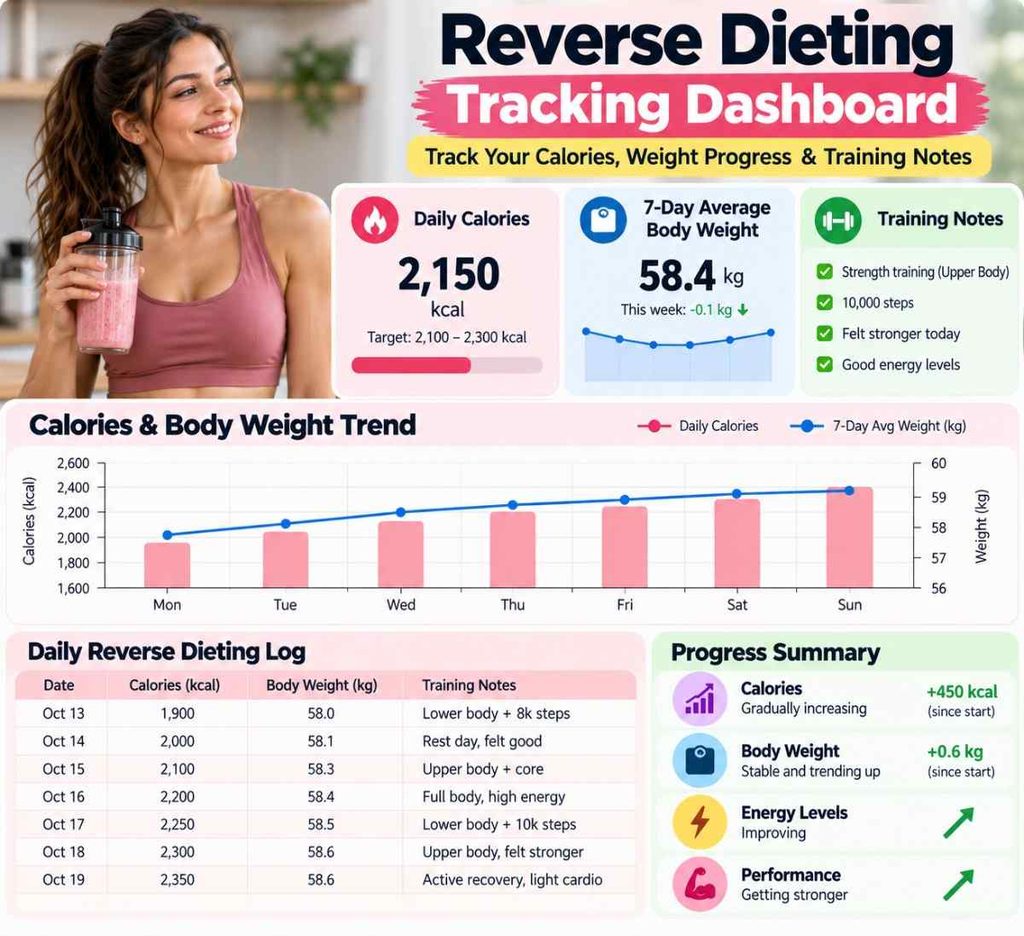
How to Track Reverse Dieting Progress
Consistent tracking helps you understand whether your calorie intake is appropriate.
Useful tools include:
- Food diary: Records calories and macronutrients.
- Weight-trend spreadsheet: Calculates average weekly weight.
- Training journal: Tracks strength, repetitions, and recovery.
- TDEE calculator: Provides an initial maintenance estimate.
You can also use your calorie deficit calculator to understand your previous deficit.
Common Reverse Dieting Mistakes
Avoid these common errors:
- Increasing calories too slowly: Small increases may prolong insufficient intake.
- Reacting to every scale change: Water, glycogen, and digestion affect weight.
- Ignoring fatigue: Persistent tiredness or declining performance may indicate a need for reassessment.
- Changing everything at once: Keep diet and activity reasonably consistent when evaluating progress.
If tracking becomes stressful or encourages unhealthy eating behaviors, consider alternative progress measures and professional support.
Is Reverse Dieting Different for Men and Women?
The basic principles are similar for men and women, but calorie needs vary with body size, body composition, activity, and individual physiology.
Women should pay attention to menstrual health and energy availability. Men should monitor hunger, fatigue, recovery, and training performance. Persistent symptoms in either case deserve professional assessment.
There is no universal gender-specific reverse dieting formula.
How Long Should You Follow a Reverse Dieting Plan?
A reverse dieting plan may last several weeks, but there is no scientifically established ideal duration.
The timeline depends on your current intake, estimated maintenance needs, and response to calorie increases. Once you reach a sustainable intake that supports your energy and goals, you can stop increasing calories and focus on maintenance.
What Should You Do After Reverse Dieting?
After establishing a workable intake:
- Maintain a balanced diet with sufficient energy.
- Continue strength training and prioritize recovery.
- Adjust food intake when your activity or goals change.
- Monitor weight trends without reacting to every fluctuation.
- Consider a lean bulk diet plan if muscle gain becomes your next goal.
You can also explore an FFMI calculator for tracking muscular development, keeping in mind that body-fat estimates and calculator outputs have limitations.
Conclusion
A reverse dieting plan offers one practical way to increase calories after weight loss, monitor your response, and establish a sustainable maintenance intake. Gradual calorie increases can provide structure, but returning directly to estimated maintenance calories is also reasonable for many people.
Reverse dieting does not guarantee that fat gain will be prevented or that metabolism will improve faster. Prioritize adequate nutrition, consistent training, and recovery rather than following a rigid schedule.
Start by reviewing your current intake, estimating your maintenance needs, and choosing an approach that suits your circumstances. The goal is to support your long-term health and performance—not to stay in a calorie deficit forever.
FAQs
What is the best reverse dieting plan for beginners?
Start by estimating maintenance calories and gradually increasing intake.
How many calories should I add when reverse dieting?
Try 50–150 extra calories daily and monitor progress.
How long does reverse dieting take?
It usually takes several weeks, depending on your needs.
Can reverse dieting cause fat gain?
Yes, a sustained calorie surplus can increase body fat.
Is reverse dieting necessary after weight loss?
No, you can return directly to estimated maintenance calories.
Does reverse dieting repair metabolism?
No, faster metabolic recovery through reverse dieting isn’t proven.
What should I eat during reverse dieting?
Eat balanced meals with protein, carbohydrates, healthy fats, fruits, and vegetables.
How much protein should I eat during reverse dieting?
A common range is 1.4–2.0 grams per kilogram of body weight daily for active adults.
When should I stop reverse dieting?
Stop increasing calories when your intake supports your energy needs and goals.
1 thought on “Reverse Dieting Plan: Increase Calories & Maintain Your Weight Loss”