
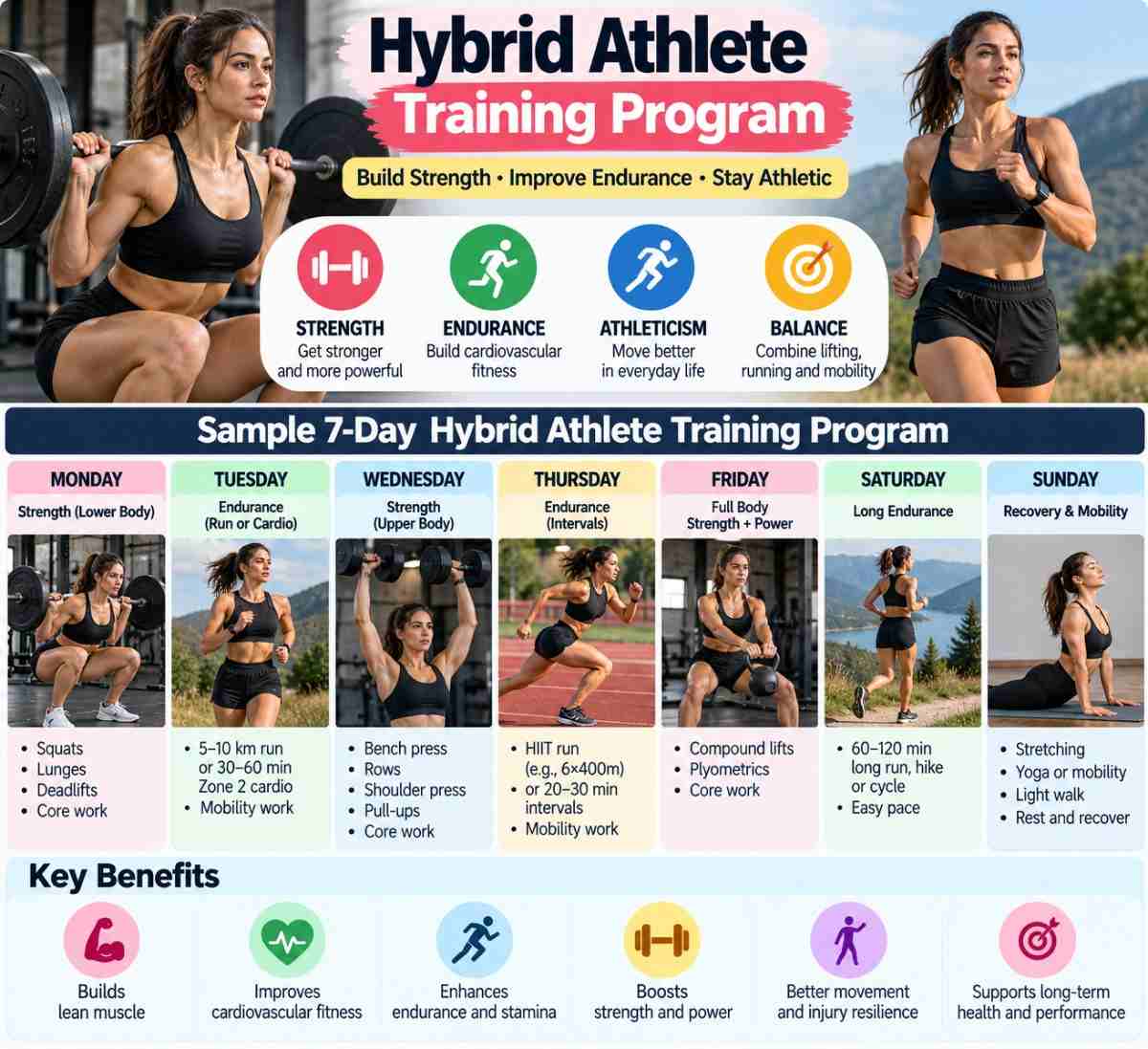
Weightlifting builds strength, while running improves endurance. But combining both requires a smart training plan to prevent excessive fatigue and support consistent progress.
A hybrid athlete training program combines strength training and endurance exercise to help you build muscle, improve cardiovascular fitness, and become a more versatile athlete. In this guide, you’ll learn how to structure weekly workouts, choose effective exercises, manage recovery, and fuel your body for better performance.
What Is a Hybrid Athlete Training Program?
A hybrid athlete training program is a structured workout plan that combines resistance training and endurance exercise to improve muscular strength, cardiovascular fitness, and overall athletic performance.
For example, a hybrid athlete might lift weights three days per week, run twice, and cycle once. Unlike bodybuilding or endurance-only training, hybrid training develops multiple physical abilities simultaneously.
What Does a Hybrid Athlete Train For?
Hybrid athletes train for strength, endurance, aerobic capacity, and functional performance. Common activities include:
- Strength training: Squats, deadlifts, presses, rows, and pull-ups.
- Running: Easy runs, long-distance sessions, and intervals.
- Cycling and rowing: Low-impact cardiovascular training.
- Conditioning: Sled pushes, loaded carries, and circuits.
- Core training: Planks and hanging knee raises.
Your training priorities depend on your goals. For example, someone preparing for HYROX may emphasize running and functional conditioning, while someone focused on muscle growth may prioritize resistance training.
Why Does Hybrid Athlete Training Matter?
Hybrid training develops strength and cardiovascular fitness together, helping you perform a wider range of physical activities. It can improve your lifting ability, running stamina, and overall work capacity.
What Are the Benefits of Hybrid Training?
The main benefits include:
- Improved muscular strength and muscle development.
- Better cardiovascular fitness.
- Greater endurance and work capacity.
- More versatile athletic performance.
- Measurable progress through lifting numbers, running pace, and workout duration.
Can You Build Muscle and Improve Endurance at the Same Time?
Yes. You can build muscle and improve endurance simultaneously, especially if you’re a beginner, returning to exercise, or following a well-managed program.
However, concurrent training interference can occur when the combined demands of strength and endurance training negatively affect adaptations to either activity.
To manage this:
- Prioritize progressive resistance training if muscle growth is your main goal.
- Increase running volume gradually.
- Separate hard runs and demanding leg workouts when practical.
- Eat enough to support training and recovery.
- Monitor fatigue and adjust your schedule when performance declines.
How Many Days a Week Should a Hybrid Athlete Train?
Beginners can start with three to five training days per week, depending on their fitness, schedule, and recovery. Three strength sessions and two easy cardio sessions provide a practical starting point.
What Is the Best Weekly Hybrid Athlete Workout Schedule?
The following seven-day schedule is a useful template for intermediate trainees.
| Day | Training | Main goal |
|---|---|---|
| Monday | Upper-body strength | Build strength and muscle |
| Tuesday | Easy run or Zone 2 cardio | Improve aerobic fitness |
| Wednesday | Lower-body strength | Strengthen legs and hips |
| Thursday | Recovery and mobility | Manage fatigue |
| Friday | Full-body strength | Develop overall strength |
| Saturday | Long easy run or cycling | Improve endurance |
| Sunday | Rest | Recover |
Beginners can use a simpler schedule:
- Monday: Full-body strength.
- Tuesday: 20–30 minutes of easy cardio.
- Wednesday: Full-body strength.
- Thursday: Rest or gentle mobility.
- Friday: Full-body strength.
- Saturday: 20–40 minutes of easy cardio.
- Sunday: Rest.
Intermediate and advanced athletes can add longer endurance sessions or controlled intervals if recovery remains adequate.
Which Strength and Endurance Workouts Should Hybrid Athletes Perform?
Hybrid athletes should combine compound strength exercises with mostly easy aerobic training and occasional higher-intensity cardio sessions.
What Are the Best Hybrid Athlete Strength Workouts?
Compound exercises train multiple muscle groups efficiently. A practical full-body workout includes:
| Exercise | Sets | Repetitions |
|---|---|---|
| Squat or goblet squat | 3 | 6–10 |
| Romanian deadlift | 3 | 8–10 |
| Bench press or push-ups | 3 | 8–12 |
| Dumbbell row | 3 | 8–12 per side |
| Reverse lunges | 2 | 8–10 per leg |
| Plank | 3 | 30–45 seconds |
Choose weights that allow you to maintain proper technique. When you can complete all repetitions comfortably, increase the load slightly during a future session.
Avoid taking every set to muscular failure. Leaving approximately two or three repetitions in reserve can help manage fatigue.
For structured load progression, use a one rep max calculator to estimate your strength level and select suitable training weights. one rep max calculator
How Should Hybrid Athletes Structure Running and Cardio?
A practical endurance plan includes three types of sessions:
- Easy aerobic training: Conversational-paced running, cycling, or rowing.
- Long endurance sessions: Gradually longer, comfortable workouts.
- Quality sessions: Controlled tempo runs or intervals.
Zone 2 training involves low-intensity aerobic exercise at a conversational effort. You should generally be able to speak in complete sentences during an easy Zone 2 run.
Use a running pace calculator to plan your target pace and a heart rate training zones guide to understand intensity ranges. running pace calculator.
How Much Zone 2 Cardio Should a Hybrid Athlete Do?
Start with two or three easy aerobic sessions per week, adjusting duration to your fitness and recovery.
For example, beginners might complete two 25-minute sessions. Experienced athletes may tolerate longer sessions. Increase duration gradually and reduce cardio volume if persistent soreness or declining lifting performance becomes a problem.
Should You Run Before or After Lifting Weights?
Perform the workout that matches your highest priority first.
- Muscle and strength: Lift first, then complete easy cardio if needed.
- Running performance: Run first when the session requires fresh legs.
- General fitness: Choose the order that supports consistency and good technique.
- Two demanding sessions: Separate them by several hours or different days when practical.
Hard intervals before heavy lower-body training may reduce your ability to produce force. Keep easy workouts comfortable and separate challenging sessions whenever possible.
How Do You Combine Running and Weightlifting Without Overtraining?
You can combine both activities by controlling training volume, scheduling demanding workouts carefully, and allowing enough recovery.
How Can Hybrid Athletes Manage Training Interference?
Training interference occurs when the combined demands of strength and endurance exercise may limit improvements in one or both qualities.
Follow these strategies:
- Identify your primary performance goal.
- Keep most cardio sessions easy when strength is the priority.
- Avoid increasing running distance and lifting volume simultaneously.
- Separate demanding workouts when possible.
- Monitor sleep, soreness, motivation, and performance.
Persistent fatigue, worsening performance, disrupted sleep, and recurring pain may indicate that your training load needs adjustment. Reduce workload and seek qualified medical advice if symptoms persist or cause concern.
How Should Hybrid Athletes Progress Over Four Weeks?
A four-week hybrid athlete training program should increase workload gradually while allowing you to assess performance and recovery.
| Week | Focus | Recommended adjustment |
|---|---|---|
| Week 1 | Establish a baseline | Learn exercises and use manageable loads |
| Week 2 | Build consistency | Add repetitions or a little cardio time |
| Week 3 | Progress selectively | Increase weight or duration in selected sessions |
| Week 4 | Assess recovery | Maintain, progress modestly, or reduce workload |
How Does Progressive Overload Work?
Progressive overload means gradually increasing training demands to encourage adaptation.
You can progress by:
- Adding a small amount of weight.
- Performing an additional repetition.
- Extending an easy run by five minutes.
- Maintaining a steadier pace at the same effort.
- Improving exercise technique.
Change only one or two variables at a time. Week four does not automatically need to be a deload; decide based on your performance and recovery.
What Should Hybrid Athletes Eat to Build Muscle and Improve Endurance?
Hybrid athletes need enough calories, protein, carbohydrates, and healthy fats to fuel workouts and support recovery.
How Much Protein Do Hybrid Athletes Need?
A practical protein target for many exercising adults is 1.4–2.0 grams per kilogram of body weight per day, depending on training demands and goals.
For example, a 70 kg athlete would aim for approximately 98–140 grams of protein daily.
Source: International Society of Sports Nutrition, 2017.
Suitable vegetarian protein sources include:
- Milk, curd, and Greek yogurt.
- Soybeans, tofu, and tempeh.
- Dal, chickpeas, and kidney beans.
- Sattu and other pulse-based foods.
- Whey or plant-based protein powder, if useful.
For a personalized estimate, use a daily protein intake calculator. daily protein intake calculator.
How Many Calories and Carbohydrates Do Hybrid Athletes Need?
Your calorie needs depend on body weight, training volume, and goals. Increasing running mileage may require additional meals or snacks to avoid an unintended calorie deficit.
Estimate your energy requirements using a TDEE calculator and BMR calculator.
Then, use a macro calculator to estimate your daily carbohydrate, protein, and fat targets. macro calculator.
Prioritize carbohydrate-rich foods such as rice, potatoes, oats, fruit, and whole grains. Muscle growth may benefit from a modest calorie surplus, while fat loss generally calls for avoiding an unnecessarily aggressive deficit.
For more meal ideas, explore high-protein foods for muscle growth. High Protein Lemonade.
How Can Hybrid Athletes Improve Recovery?
Recovery depends on sufficient sleep, appropriate nutrition, hydration, and a balanced training schedule.
Useful recovery strategies include:
- Aim for 7–9 hours of sleep per night as an adult.
- Eat enough calories and protein.
- Drink fluids regularly and replace electrolytes when appropriate.
- Schedule at least one rest or recovery-focused day.
- Reduce training demands when performance repeatedly declines.
Source: Watson et al., Sleep, 2015.
Recovery needs vary with training history, stress, age, and workload. Track your energy levels and performance instead of relying on soreness alone.
What Tools Can Help You Follow a Hybrid Athlete Training Program?
Training tools help you monitor strength, endurance, and nutrition. A simple training log can reveal whether your running volume is increasing too quickly or your lifting progress has stalled.
Useful tools include:
- Training log: Records weights, repetitions, distance, and perceived effort.
- Fitness watch: Tracks workout duration and heart rate trends.
- Running pace calculator: Helps estimate target running pace.
- One rep max calculator: Supports strength-load planning.
- Macro calculator: Estimates daily nutrition targets.
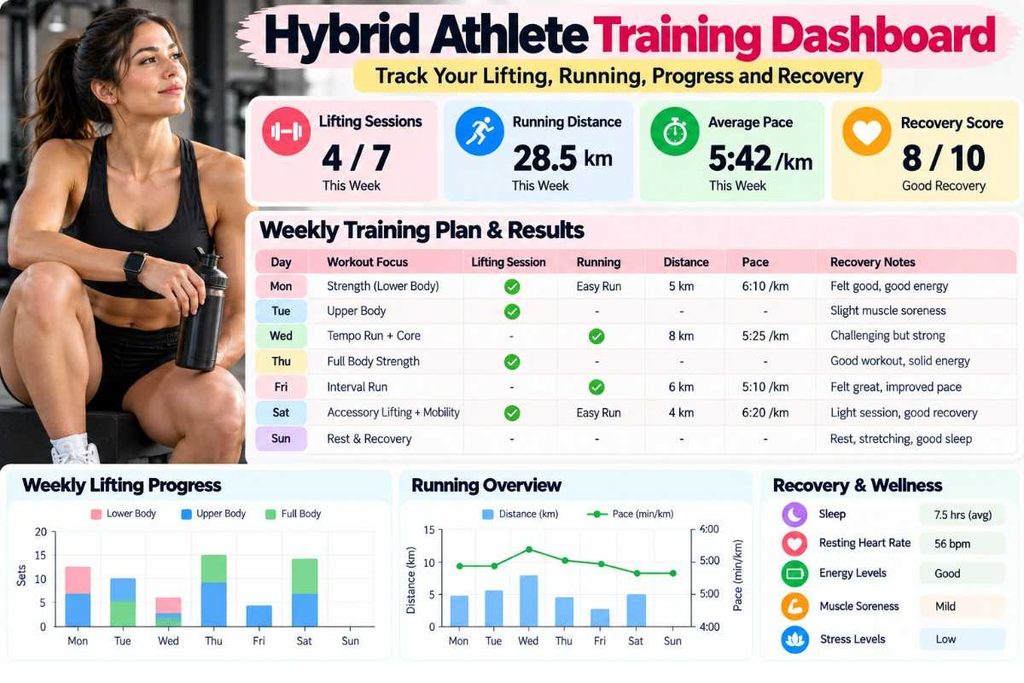
You can use a spreadsheet or notebook instead of purchasing specialized equipment. The best tracking system is one you update consistently.
Can You Follow a Hybrid Athlete Training Program at Home?
Yes. You can train at home using bodyweight exercises, resistance bands, dumbbells, and outdoor running or walking.
Three weekly home strength workouts combined with two cardio sessions can provide a strong foundation.
What Equipment Do You Need?
| Equipment | Main use | Alternative |
|---|---|---|
| Dumbbells | Squats, rows, presses | Loaded backpack |
| Resistance bands | Pulling and accessory work | Bodyweight variations |
| Exercise mat | Core and mobility | Carpeted floor |
| Running shoes | Outdoor running | Walking or cycling |
| Fitness watch | Heart-rate tracking | Talk test and stopwatch |
Push-ups, split squats, glute bridges, and planks can also develop strength when you choose suitable variations and gradually increase difficulty.

What Should You Do Next to Start Hybrid Training?
Start by choosing clear strength and endurance goals, building a manageable weekly schedule, and recording your baseline performance.
Follow this checklist:
- Choose two goals: Select one strength goal and one endurance goal.
- Assess your fitness: Consider your experience, schedule, and recovery needs.
- Build your schedule: Start with three strength sessions and two easy cardio sessions if appropriate.
- Record your baseline: Track weights, repetitions, running duration, and perceived effort.
- Support your training: Eat adequately, hydrate, and prioritize sleep.
- Review progress: Adjust your program every two to four weeks.
As your abilities improve, adapt the plan to your priorities. Emphasize endurance when running performance matters most, or prioritize progressive resistance training when muscle growth is your primary goal.
Conclusion
A hybrid athlete training program combines strength training, endurance exercise, nutrition, and recovery to develop well-rounded fitness. The best plan balances your goals with a workload you can sustain.
Start with a realistic weekly schedule, progress gradually, and track your performance. You don’t need to train like an elite athlete to become stronger and fitter. Consistency, patience, adequate nutrition, and recovery are the foundations of long-term progress.
FAQs
What is the best hybrid athlete training program?
A balanced plan combines strength training, cardio, nutrition, and recovery.
Can I build muscle and run at the same time?
Yes, consistent strength training and manageable running can improve both.
How many days a week should a hybrid athlete train?
Beginners can start with three to five days per week.
Is hybrid training good for beginners?
Yes, start with simple workouts and gradually increase intensity.
Should I lift weights or run first?
Lift first for strength goals and run first for running performance.
How much protein does a hybrid athlete need?
Many exercising adults need 1.4–2.0 grams per kilogram of body weight daily.
Is Zone 2 cardio enough for hybrid training?
It builds aerobic fitness, while some athletes may also benefit from intervals.
Can I follow a hybrid athlete training program at home?
Yes, use dumbbells, resistance bands, bodyweight exercises, and outdoor cardio.
How long does it take to see results from hybrid training?
Progress varies, but tracking performance over several weeks helps assess improvement.
How do I avoid overtraining while combining running and weightlifting?
Manage training volume, eat enough, sleep well, and schedule recovery days.