
You’ve probably tried shoulder stretches or mobility exercises to improve your upper-body movement. However, raising your arms overhead comfortably also requires coordination between your arms and shoulder blades.
Scapular wall slides are a simple exercise that helps you practice controlled arm elevation, shoulder-blade movement, and upper-body coordination using a wall for support. They require minimal equipment and can be included in warm-ups, mobility routines, and suitable strength-training programs.
In this guide, you’ll learn how to perform scapular wall slides correctly, which muscles they work, how many repetitions to do, common mistakes to avoid, and how to progress safely.
What Are Scapular Wall Slides?
Scapular wall slides are a shoulder-mobility exercise in which you slide your arms upward along or near a wall while practicing controlled shoulder-blade movement. The exercise develops awareness of how your shoulder blades move as your arms rise.
Your shoulder blades, also called scapulae, play an important role in overhead movements. For example, reaching into a high cupboard requires your shoulder blades to rotate and move naturally as your arms elevate.
Scapular wall slides help you practice this coordination in a controlled environment. The wall also provides a reference point that can help you notice compensations, such as arching your lower back to raise your arms higher.
Why Are Scapular Wall Slides Important?
Scapular wall slides help you practice shoulder mobility, shoulder-blade control, and upper-body coordination. These movement skills can support everyday reaching and exercise performance when combined with appropriate strength and mobility training.
The exercise is particularly useful for learning how to raise your arms without relying excessively on lower-back arching or unnecessary shoulder tension.
Potential benefits include:
- Shoulder mobility: Practice raising your arms through a comfortable range of motion.
- Scapular control: Develop awareness of how your shoulder blades move around your rib cage.
- Movement coordination: Practice coordinating arm elevation with shoulder-blade rotation.
- Warm-up preparation: Prepare your upper body for suitable pushing, pulling, and overhead exercises.
- Postural awareness: Recognize compensations such as excessive shoulder shrugging or rib flare.
For additional exercises, explore our shoulder mobility exercises.
However, scapular wall slides do not automatically correct rounded shoulders, prevent every shoulder injury, or treat all causes of shoulder pain. Their effectiveness depends on your technique, consistency, individual movement limitations, and overall exercise program.
Which Muscles Do Scapular Wall Slides Work?
Scapular wall slides primarily train movement control involving the serratus anterior and trapezius, while other shoulder and upper-back muscles help stabilize and guide the movement.
The amount of activity in each muscle varies according to your technique, the specific variation, and your individual movement patterns.
| Muscle | Main role during wall slides |
|---|---|
| Serratus anterior | Helps move and stabilize the shoulder blade against the rib cage. |
| Upper trapezius | Contributes to shoulder-blade elevation and upward rotation. |
| Middle trapezius | Helps control shoulder-blade positioning. |
| Lower trapezius | Contributes to upward rotation and scapular control. |
| Deltoids | Assist with raising the arms. |
| Rotator cuff muscles | Help stabilize the shoulder joint during arm movement. |
Why Are the Serratus Anterior and Trapezius Important?
The serratus anterior and trapezius work together to coordinate upward rotation of the shoulder blade as your arms rise. This movement helps the shoulder blade accommodate overhead arm elevation.
Practicing controlled wall slides can help you become more aware of this coordination without trying to hold your shoulder blades rigidly down and back.
For more targeted training, explore our serratus anterior exercises for shoulder stability.
How Do You Do Scapular Wall Slides Correctly?
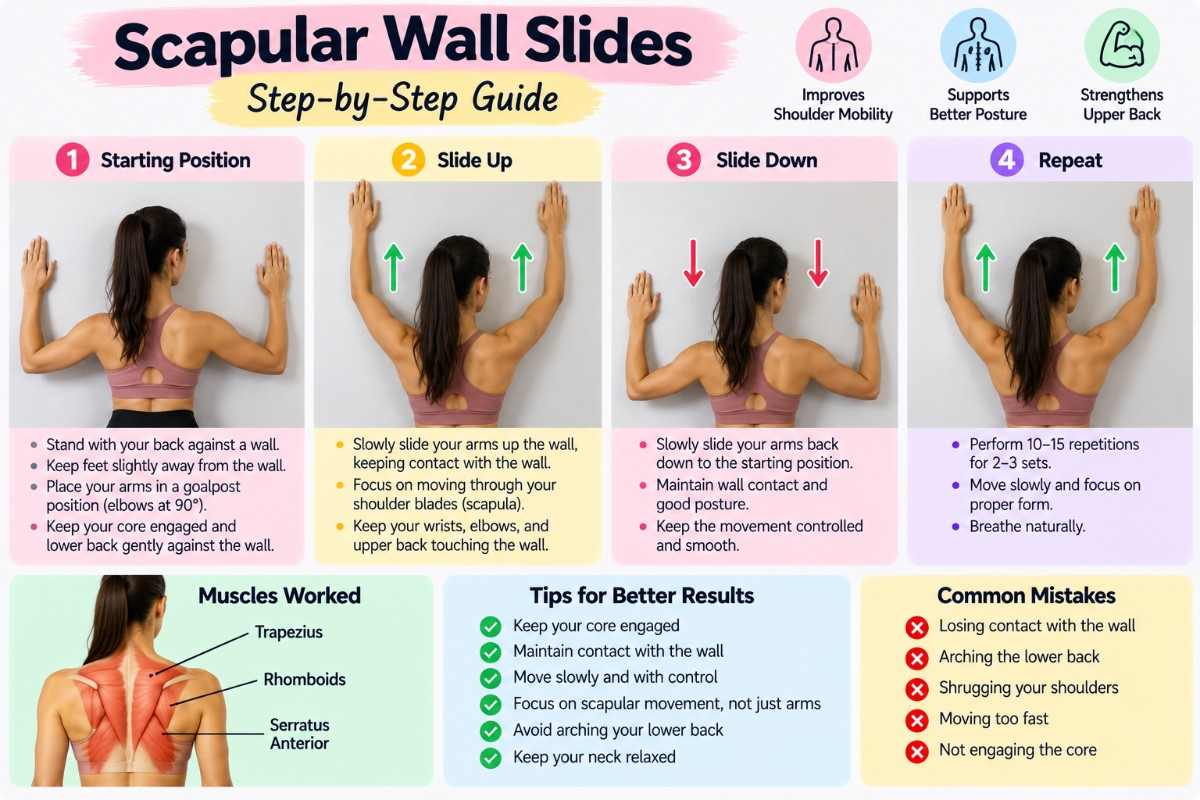
To perform scapular wall slides correctly, slide your arms upward slowly while maintaining a comfortable rib-cage position and allowing your shoulder blades to move naturally. Avoid excessive lower-back arching, forced overhead movement, and positions that cause pain.
Step 1: Set Up Against the Wall
Stand facing away from a wall, with your feet positioned comfortably and approximately a short step away if needed. Keep your knees relaxed and your head in a neutral position.
For the forearm wall-slide variation, place your forearms against the wall with your elbows bent. Position your arms within a comfortable range instead of forcing your wrists or elbows into a particular alignment.
Step 2: Position Your Rib Cage and Pelvis
Maintain a comfortable, stacked position between your rib cage and pelvis. Avoid pushing your chest forward or aggressively flattening your lower back against the wall.
If your lower back arches noticeably as you raise your arms, reduce the range of motion. Focus on controlled movement rather than trying to reach the highest possible position.
Step 3: Slide Your Arms Upward
Slowly slide your forearms upward while allowing your shoulder blades to move naturally around your rib cage. Keep the movement smooth and maintain a comfortable position for your elbows and wrists.
Allow your shoulder blades to rotate upward as your arms rise. Do not force them to remain down and back throughout the exercise, because they need to move to accommodate arm elevation.
Step 4: Pause at a Comfortable Height
Stop at the highest position you can reach without pain or excessive compensation. You do not need to raise your arms fully overhead for every repetition to be useful.
For example, a beginner with limited shoulder mobility may initially raise the arms only halfway. Gradually increase the range as your control and comfort improve.
Step 5: Return Slowly
Slide your arms back to the starting position under control. Breathe normally, avoid dropping your arms suddenly, and repeat while maintaining consistent technique.
Form tip: Stop if the movement causes sharp or increasing pain. Muscle effort is different from joint pain, and you should not force a painful range of motion.
How Many Scapular Wall Slides Should You Do Per Day?
A practical starting point is 1–3 sets of 8–12 controlled repetitions, provided the movement remains comfortable and your technique stays consistent.
Your ideal training volume depends on your experience, mobility, and reason for performing the exercise. Beginners may benefit from fewer repetitions while learning the movement.
| Experience level | Suggested starting volume | Main focus |
|---|---|---|
| Beginner | 1–2 sets of 6–8 repetitions | Learn comfortable positioning. |
| Intermediate | 2–3 sets of 8–12 repetitions | Improve control and consistency. |
| Experienced | 2–3 sets of 10–12 repetitions | Maintain control or try an appropriate progression. |
These numbers are general exercise suggestions rather than a medical rehabilitation prescription. If a physiotherapist has provided a specific program, follow their recommendations.
Are Scapular Wall Slides Good for Shoulder Mobility?
Yes, scapular wall slides can support shoulder mobility by helping you practice controlled arm elevation and coordinated shoulder-blade movement. They are most useful as part of a broader upper-body mobility routine rather than as a standalone solution for every mobility limitation.
For example, someone who struggles to raise their arms without arching their back can begin with a shorter, comfortable range and gradually develop better movement control.
Scapular wall slides may complement:
- Gentle shoulder circles.
- Upper-back mobility exercises.
- Appropriate rotator cuff strengthening.
- Controlled overhead movement practice.
However, restricted shoulder movement can have several causes, including joint limitations, previous injuries, pain, and individual anatomy. Wall slides may not address all these factors, so adjust the exercise to your needs.
Can Scapular Wall Slides Help Improve Posture?
Scapular wall slides can improve awareness of shoulder positioning and movement, but they do not guarantee permanent posture correction. Posture is influenced by strength, mobility, habitual positions, comfort, and individual movement preferences.
For example, an office worker who spends several hours sitting may use wall slides as a movement break. Combining them with regular walking, changes in working position, and suitable strengthening exercises can support a broader approach to physical activity.
What Are the Most Common Wall Slide Exercise Mistakes?
The most common wall slide mistakes include excessive lower-back arching, rib flare, excessive shrugging, forcing the arms overhead, losing forearm contact, and moving too quickly.
Correcting these habits can make the exercise more comfortable and easier to control.
| Common mistake | Why it matters | How to correct it |
|---|---|---|
| Excessive lower-back arching | Uses the lower back to compensate for restricted shoulder movement. | Reduce the range and keep your ribs comfortably positioned. |
| Rib flare | Causes the chest to lift excessively. | Maintain a comfortable rib-cage position. |
| Excessive shrugging | May indicate difficulty controlling the movement. | Move more slowly and use a comfortable range. |
| Forcing the arms overhead | Can create discomfort or compensation. | Stop before the position becomes painful or uncontrolled. |
| Losing forearm contact | May make the chosen variation harder to control. | Adjust your arm position or use a smaller range. |
| Moving too quickly | Reduces movement awareness and control. | Slide up and down slowly. |
Your forearms do not need to remain perfectly pressed against the wall if your anatomy or mobility prevents it. Adjust the exercise instead of forcing an uncomfortable position.
What Is the Difference Between Scapular Wall Slides and Regular Wall Slides?
Scapular wall slides emphasize coordinated shoulder-blade movement during arm elevation, whereas regular wall slides can refer to several different wall-based exercises with different goals.
Exercise names are not standardized across all fitness programs, so the distinction depends on the specific variation being taught.
| Feature | Scapular-focused wall slides | General wall slides |
|---|---|---|
| Main emphasis | Shoulder-blade coordination | Depends on the variation |
| Arm movement | Controlled elevation | May involve different arm paths |
| Equipment | Wall | Usually a wall |
| Typical use | Mobility and movement-control practice | Mobility, warm-ups, or other exercise goals |
| Difficulty | Adjustable to ability | Varies by exercise |
For example, a forearm wall slide may emphasize shoulder-blade movement, while another exercise called a wall slide might involve sliding your back down a wall to train your legs.
Therefore, check the exercise instructions instead of relying on the name alone.
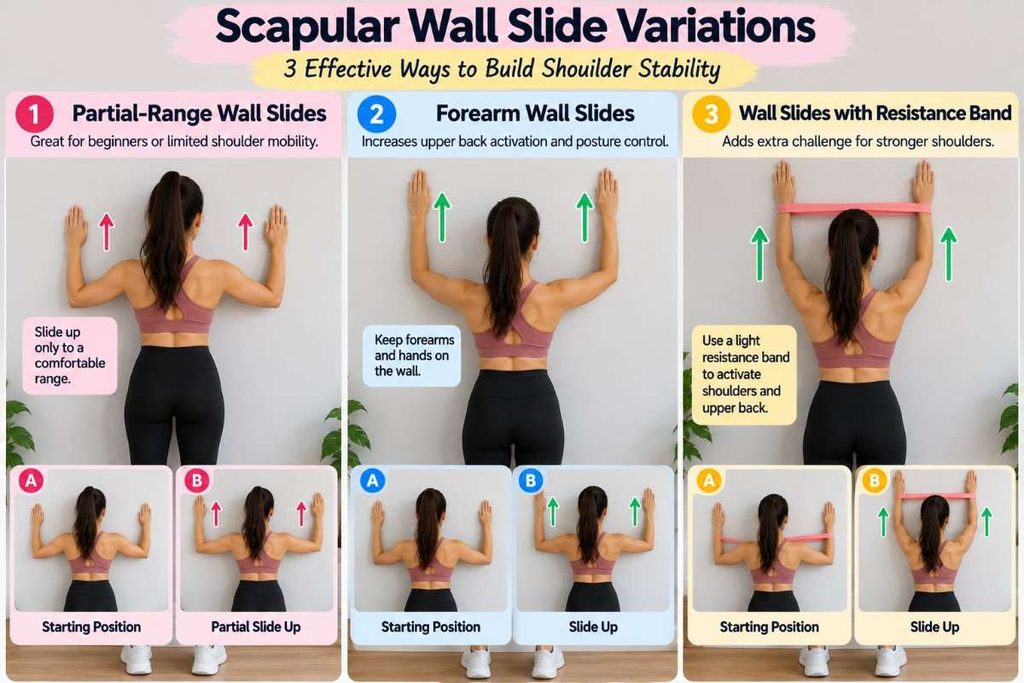
What Are the Best Scapular Wall Slide Variations for Beginners?
The best beginner variations allow you to practice smooth, comfortable movement without compensating through your lower back or forcing your shoulders. Start with the simplest version and progress when your technique becomes consistent.
1. Partial-Range Wall Slides
Partial-range wall slides involve raising your arms only as high as you can comfortably manage. This variation helps beginners learn the movement without forcing an overhead position.
Start with a smaller range and gradually increase it when you can maintain control without pain or excessive back arching.
2. Forearm Wall Slides
Forearm wall slides involve placing your forearms against the wall and sliding them upward slowly. Maintain comfortable contact with the wall without forcing your wrists or elbows into position.
This variation provides a clear reference point for practicing controlled arm elevation.
3. Wall Slides With a Resistance Band
Resistance-band wall slides add a control challenge by placing a light resistance band around the forearms or wrists, depending on the variation. Keep the resistance light enough to maintain smooth movement.
Beginners should first learn the basic movement without added resistance. A band is optional, not necessary for effective practice.
4. Progressed Wall Slides
Once you can perform the basic movement comfortably, consider increasing the range of motion or introducing a suitable resistance band.
Progress only when you can maintain good technique. Greater resistance or a higher arm position is not automatically better, particularly if it causes pain or changes your movement pattern.
For more options, see our Best Resistance Band Workout.
Should Your Back and Arms Stay Against the Wall During Wall Slides?
No, your back and arms do not necessarily need to remain completely flat against the wall throughout every wall-slide variation. The appropriate contact points depend on your anatomy, mobility, and the exercise instructions.
You may maintain light back contact while your forearms slide upward, but you should not force your lower back flat if that creates discomfort.
Similarly, some people cannot maintain continuous forearm or wrist contact without compensating. Prioritize comfortable, controlled movement over perfect wall contact.
Are Scapular Wall Slides Safe for People With Shoulder Pain?
Scapular wall slides may be appropriate for some people with shoulder discomfort, but their suitability depends on the cause of the pain and the individual’s movement limitations.
For example, someone recovering from a shoulder injury may require a specific range of motion or a modified exercise selected by a physiotherapist. An exercise that feels comfortable for one person may be unsuitable for another.
Keep these precautions in mind:
- Stop if you experience sharp or increasing pain.
- Avoid forcing your arms into an uncomfortable overhead position.
- Seek professional guidance if pain persists or movement becomes increasingly restricted.
- Follow your clinician’s instructions if you are recovering from surgery or an injury.
Scapular wall slides are not a universal treatment for shoulder injuries. A qualified physiotherapist or healthcare professional can assess your symptoms and recommend appropriate exercises.
How Often Should You Do Scapular Wall Slides?
Most healthy beginners can try scapular wall slides a few times per week as part of a mobility or warm-up routine, provided the movement remains comfortable. The appropriate frequency depends on your goals, overall training program, and how your shoulders respond.
For example, you might perform one or two sets before an upper-body workout to practice controlled arm elevation.
If you are using wall slides as part of a prescribed rehabilitation program, follow the frequency and repetition guidance provided by your healthcare professional.
Can You Do Scapular Wall Slides Every Day?
Yes, gentle scapular wall slides may be suitable for daily practice if they remain comfortable and you can maintain good technique. However, daily practice is not necessary for everyone, and performing more repetitions does not automatically produce better results.
A short set during a work break may be useful for someone who wants to move after sitting for a long time.
By contrast, someone experiencing shoulder pain or recovering from an injury may need a different schedule. Adjust your routine according to comfort and professional guidance when necessary.
How Can You Add Scapular Wall Slides to a Shoulder Mobility Routine?
A shoulder mobility routine can combine scapular wall slides with gentle shoulder movements and upper-back mobility exercises. This approach allows you to practice a range of controlled upper-body movements without relying on a single exercise.
Here is a simple example for generally healthy beginners.
| Exercise | Suggested amount | Purpose |
|---|---|---|
| Gentle shoulder circles | 8–10 repetitions | Begin moving the shoulders comfortably. |
| Upper-back rotations | 6–8 per side | Practice thoracic movement. |
| Scapular wall slides | 1–2 sets of 8 repetitions | Practice coordinated arm elevation. |
| Light wall push-ups | 1–2 sets of 8–10 repetitions | Practice controlled upper-body pushing. |
Start with gentle movements and use a comfortable range throughout the routine. Avoid treating the exercises as a flexibility test or forcing yourself to achieve a particular position.
For additional guidance, explore our 5 Minute Warm Up Before Workout and Yoga for Thoracic Rotation.
What Tools Do You Need for Scapular Wall Slides?
Scapular wall slides require only a clear wall and enough space to move your arms comfortably. A resistance band is optional for suitable variations, but beginners do not need additional equipment.
Use this checklist before starting:
- Choose a stable wall with enough clearance.
- Wear clothing that allows comfortable arm movement.
- Stand on a non-slip surface.
- Select a manageable range of motion.
- Keep the resistance band optional until you master the basic movement.
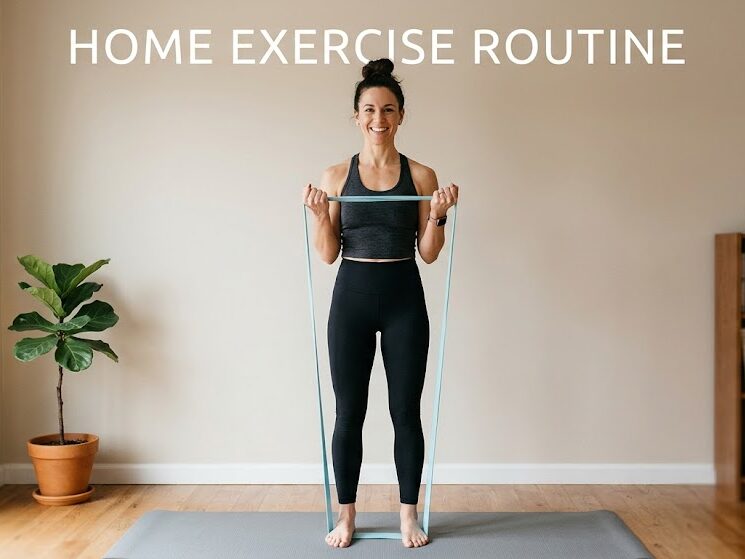
A demonstration video can also help you observe the starting position, upward slide, and controlled return. Use demonstrations to understand the technique, but remember that individual mobility and positioning may differ.
What’s Next: How Should You Progress With Scapular Wall Slides?
You should progress with scapular wall slides by improving movement control first, then gradually increasing your comfortable range or adding light resistance when appropriate.
Follow this simple progression:
- Learn the basic movement: Start with a short, comfortable range.
- Improve consistency: Keep your breathing relaxed and avoid excessive back arching.
- Increase the range gradually: Raise your arms slightly higher when the movement remains comfortable.
- Consider a light resistance band: Add resistance only when you can maintain control.
- Review your technique: Seek guidance if pain or movement restrictions prevent comfortable practice.
You can also combine wall slides with a broader strength program that includes appropriate rotator cuff strengthening exercises.
If your goal is a more complete fitness program, our 3D Shoulder Workout can help you explore other shoulder exercises.
Conclusion
Scapular wall slides are a simple, equipment-free exercise for practicing shoulder mobility and coordinated shoulder-blade movement. They can complement warm-ups, upper-body workouts, and broader mobility routines when performed with controlled technique.
Start with a comfortable range, maintain a natural rib-cage position, and allow your shoulder blades to move naturally as your arms rise. Avoid forcing your arms overhead, and focus on movement quality rather than reaching the highest possible position.
For most beginners, starting with 1–3 sets of controlled repetitions provides a practical way to learn the exercise. Adjust the volume and frequency according to your comfort, experience, and training goals.
FAQs
What are scapular wall slides good for?
They improve shoulder mobility, scapular control, and arm coordination.
How many scapular wall slides should beginners do?
Start with 1–2 sets of 6–8 repetitions.
Which muscles do scapular wall slides target?
They mainly target the serratus anterior and trapezius.
Do scapular wall slides improve posture?
They improve movement awareness but do not guarantee posture correction.
Can I do scapular wall slides every day?
Yes, if the movement is comfortable and pain-free.
Should my lower back touch the wall?
No. Maintain a comfortable back position without excessive arching.
Are scapular wall slides better than shoulder stretches?
They serve different purposes and can complement each other.
Can I use a resistance band?
Yes, but master the basic movement first.
Should scapular wall slides hurt?
No. Stop if you experience sharp or increasing pain.
How long does it take to improve shoulder mobility?
Progress varies with consistency, technique, and starting mobility.
Are scapular wall slides suitable after a shoulder injury?
Possibly, but follow your healthcare professional’s advice.