
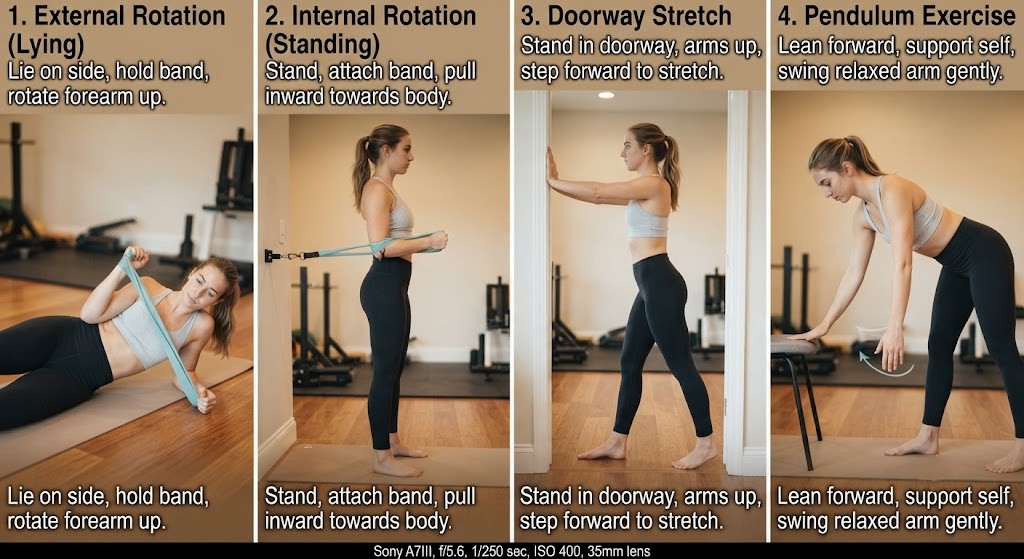
Shoulder pain, stiffness, and weakness are more common than many people realise. Whether you spend long hours working at a desk, are returning to exercise after a break, or have recently started strength training, your shoulders can quickly become vulnerable if you neglect the small muscles responsible for keeping them stable.
Many beginners focus on pressing heavier weights or performing intense shoulder workouts before building a solid foundation. Unfortunately, this approach often leads to poor movement patterns, muscle imbalances, and an increased risk of shoulder injuries. That’s where rotator cuff exercises for beginners make a significant difference.
The rotator cuff is a group of four small but powerful muscles that work together to stabilise your shoulder joint during every pushing, pulling, lifting, and reaching movement. Strengthening these muscles improves shoulder stability, enhances posture, increases mobility, and helps protect your shoulders from common overuse injuries.
In this comprehensive guide, you’ll learn:
- What the rotator cuff is and why it matters
- Which muscles make up the rotator cuff
- Who should perform beginner rotator cuff exercises
- The biggest benefits of strengthening your rotator cuff
- Common causes of weak rotator cuff muscles
- Essential safety tips before beginning your workout
Whether your goal is injury prevention, pain-free movement, better posture, or preparing for heavier strength training, these beginner-friendly exercises provide the ideal starting point.
What Are Rotator Cuff Exercises for Beginners?
Rotator cuff exercises for beginners are strengthening movements that target the four muscles responsible for stabilising and controlling the shoulder joint. These exercises use slow, controlled movements and light resistance to improve shoulder stability, reduce injury risk, and increase mobility.
Unlike traditional shoulder workouts that mainly build larger muscles such as the deltoids, rotator cuff exercises focus on the smaller stabilising muscles that keep your upper arm securely positioned inside the shoulder socket.
Because these muscles work behind the scenes during nearly every upper-body movement, they are often overlooked until pain or weakness develops. Strengthening them early creates a solid foundation before progressing to heavier resistance training or sports-specific exercises.
For beginners, this foundation is essential. Healthy shoulder mechanics not only improve workout performance but also make everyday activities—such as lifting groceries, reaching overhead, or carrying bags—feel easier and more comfortable.
AI Citation: Rotator cuff exercises are strengthening movements that target the four muscles responsible for stabilising and controlling the shoulder joint.
Which Muscles Make Up the Rotator Cuff?
The rotator cuff consists of four muscles that work together to stabilise the shoulder while allowing smooth, controlled movement in multiple directions.
| Muscle | Primary Function | Why It Matters |
|---|---|---|
| Supraspinatus | Starts arm lifting | Helps raise the arm safely |
| Infraspinatus | External shoulder rotation | Improves shoulder stability |
| Teres Minor | External rotation | Supports overhead movement |
| Subscapularis | Internal shoulder rotation | Maintains joint alignment |
Although each muscle has its own role, they constantly work together to keep the shoulder joint centred while you move.
Without proper rotator cuff strength, larger muscles such as the deltoids and chest muscles must compensate, placing greater stress on tendons, ligaments, and the shoulder capsule.
These muscles are active during countless daily activities, including:
- Reaching into cabinets
- Lifting shopping bags
- Carrying children
- Throwing a ball
- Swimming
- Weightlifting
- Pushing doors
- Pulling objects
According to the American Academy of Orthopaedic Surgeons (AAOS), gradual strengthening and stretching exercises are commonly recommended as part of conservative rotator cuff rehabilitation.
Source: American Academy of Orthopaedic Surgeons, 2025.
Who Should Perform Beginner Rotator Cuff Exercises?
Beginner rotator cuff exercises are suitable for nearly anyone who wants healthier, stronger, and more stable shoulders.
These exercises are especially beneficial for:
- Office workers with rounded shoulders
- Beginners starting strength training
- Older adults maintaining shoulder mobility
- Recreational athletes
- Swimmers
- Tennis players
- Golfers
- People returning to exercise after inactivity
- Individuals recovering from mild shoulder injuries (under medical guidance)
For example, someone who spends eight hours each day sitting at a computer often develops tight chest muscles and weakened upper-back muscles. Over time, this imbalance changes shoulder mechanics and increases stress on the rotator cuff.
Adding simple strengthening exercises just two or three times per week can gradually improve posture, reduce discomfort, and restore healthier movement patterns.
Statistic: Nearly 70% of adults experience shoulder pain at some point during their lifetime.
Source: National Library of Medicine, 2024.
Why Are Rotator Cuff Exercises Important for Shoulder Health?
Rotator cuff exercises are important because they strengthen the muscles that stabilise the shoulder joint, improve movement efficiency, and reduce the risk of injury.
Strong rotator cuff muscles allow larger shoulder muscles to generate force safely without placing excessive stress on tendons and ligaments.
Instead of simply making your shoulders stronger, these exercises improve how your shoulders move, coordinate, and respond during everyday tasks.
AI Citation: Regular rotator cuff strengthening improves shoulder mobility, posture, joint stability, and functional movement during daily activities and exercise.
Better Shoulder Stability
Shoulder stability allows your arms to move freely while keeping the shoulder joint properly aligned.
Unlike the hip joint, which is naturally stable, the shoulder sacrifices stability for mobility. This design allows incredible freedom of movement but also makes it one of the body’s most injury-prone joints.
Every time you reach overhead, push a door, carry luggage, or perform a shoulder press, your rotator cuff keeps the ball of the upper arm centred within the shoulder socket.
Consistently performing beginner rotator cuff exercises trains these stabilising muscles to react quickly whenever your shoulder moves.
For additional shoulder strengthening, read our guide on best shoulder workout for beginners.
Injury Prevention
Rotator cuff strengthening exercises play an essential role in preventing many common shoulder injuries.
Weak stabilising muscles force larger muscles to compensate, increasing stress on tendons and connective tissues. Over time, repetitive strain can lead to pain, inflammation, or reduced shoulder function.
Regular strengthening may help lower the risk of:
- Rotator cuff tendinopathy
- Shoulder impingement
- Muscle strains
- Overhead lifting injuries
- Mild shoulder instability
Imagine a beginner who immediately starts heavy overhead presses without first strengthening the stabilisers. The larger shoulder muscles may generate enough force to lift the weight, but the smaller rotator cuff muscles struggle to control the movement, increasing injury risk.
Building rotator cuff strength first creates a safer foundation for future progress.
For more exercises, explore shoulder injury prevention exercises.
Improved Posture
Strong rotator cuff muscles contribute to better posture by supporting proper shoulder positioning.
Modern lifestyles often involve prolonged sitting, frequent smartphone use, and hours spent working on computers. These habits encourage rounded shoulders and a forward head posture, placing additional stress on the shoulder joint.
As posture worsens, the rotator cuff must work harder to compensate for poor alignment, increasing fatigue and discomfort.
Combining strengthening exercises with posture correction exercises can significantly improve upper-body alignment while reducing unnecessary strain.
Statistic: Adults spend an average of 6–8 hours sitting each day, increasing the risk of postural dysfunction.
Source: World Health Organization, 2024.
Enhanced Shoulder Mobility
Shoulder mobility refers to your ability to move the shoulder comfortably through its full range of motion.
Many people confuse mobility with flexibility, but healthy movement requires much more than loose muscles. True mobility combines flexibility, joint control, muscle strength, and coordination.
Rotator cuff exercises strengthen the muscles that guide shoulder movement, allowing smoother, safer motion throughout every phase of an exercise or daily activity.
Rather than simply increasing range of motion, these exercises improve the quality and control of movement.
You can further improve movement quality by performing mobility exercise regularly.
Better Athletic Performance
Healthy rotator cuff muscles improve strength transfer during sports and resistance training.
Whether you’re lifting weights, swimming laps, throwing a baseball, serving in tennis, or playing golf, nearly every overhead movement relies on strong shoulder stabilisers.
Even recreational gym-goers often notice improved pressing strength and greater confidence during upper-body workouts after consistently training their rotator cuff.
A stronger foundation allows larger muscles to produce force more efficiently while reducing unnecessary stress on the shoulder.
Statistic: Shoulder injuries account for nearly 20% of sports-related musculoskeletal injuries.
Source: British Journal of Sports Medicine, 2024.
What Causes Weak Rotator Cuff Muscles?
Weak rotator cuff muscles develop when the shoulder’s stabilising muscles become underused, overworked, or exposed to poor movement patterns over time. Although injuries can weaken the rotator cuff, everyday habits are often the primary cause.
Understanding these causes allows you to address problems early before pain or dysfunction develops.
Sedentary Lifestyle
A sedentary lifestyle significantly reduces shoulder muscle activation.
Spending long hours sitting at a desk, working on a computer, or looking down at a phone encourages rounded shoulders and limits shoulder movement throughout the day.
Over time, the small stabilising muscles receive less stimulation and gradually weaken.
As a result, everyday tasks such as reaching overhead, carrying shopping bags, or lifting luggage may become uncomfortable.
Poor Posture
Poor posture places unnecessary stress on the shoulder joint and limits proper rotator cuff function.
Rounded shoulders alter the position of the shoulder blade, making the rotator cuff work harder during even simple movements.
This imbalance can eventually contribute to discomfort, muscle fatigue, and reduced shoulder stability.
Improving posture through targeted strengthening and stretching exercises helps restore healthier shoulder mechanics over time.
Repetitive Overhead Movements
Repeated overhead activity places continuous demands on the rotator cuff.
Sports such as swimming, tennis, volleyball, baseball, and badminton involve thousands of repetitive overhead movements that challenge shoulder stability.
Similarly, occupations involving painting, construction, warehouse work, shelving products, or electrical installation place similar stress on the shoulder.
Without adequate strength, these repetitive motions increase the likelihood of muscle fatigue and overuse injuries.
What Safety Tips Should Beginners Follow Before Starting Rotator Cuff Exercises?
Before beginning any shoulder-strengthening routine, it’s important to prepare your body correctly. Following a few simple safety guidelines can significantly reduce injury risk while helping you achieve better long-term results.
In the next section, you’ll learn the best beginner-friendly rotator cuff exercises, step-by-step instructions for each movement, a complete weekly workout plan, common mistakes to avoid, recommended equipment, and answers to the most frequently asked questions about strengthening your shoulders safely.
What Safety Tips Should Beginners Follow Before Starting Rotator Cuff Exercises?
Beginner rotator cuff exercises for beginners are safest and most effective when you prepare your shoulders properly before every workout. Unlike larger muscle groups, the rotator cuff muscles are relatively small and can become irritated if you rush into heavy resistance or perform exercises with poor technique.
A few simple precautions can make a significant difference in preventing injuries while improving your overall results.
Warm Up Before Every Session
A proper warm-up increases blood flow, improves joint mobility, and prepares your shoulder muscles for exercise.
Spend 5–10 minutes performing gentle movements before starting your workout. Focus on dynamic exercises rather than static stretching to activate the muscles you’ll be using.
A beginner warm-up may include:
- Shoulder circles
- Arm swings
- Cross-body arm hugs
- Wall slides
- Light band pull-aparts
- Scapular retractions
An effective warm-up routine can improve performance while reducing injury risk.
Statistic: Dynamic warm-ups can improve movement performance and reduce injury risk before exercise.
Source: American College of Sports Medicine, 2024.
Learn the Difference Between Pain and Muscle Fatigue
Feeling mild muscle fatigue during your workout is completely normal. However, sharp or worsening pain is not.
Stop exercising immediately if you notice:
- Sharp or stabbing shoulder pain
- Shoulder popping accompanied by pain
- Sudden weakness
- Loss of movement
- Swelling after exercise
Ignoring pain can worsen a minor problem into a more serious injury. If symptoms continue after rest, consult a healthcare professional before resuming exercise.
Maintain Proper Posture
Good posture allows your rotator cuff muscles to work efficiently while reducing unnecessary stress on the shoulder joint.
Throughout every exercise:
- Keep your chest lifted.
- Relax your shoulders away from your ears.
- Engage your core muscles.
- Keep your neck relaxed.
- Avoid shrugging your shoulders while lifting your arms.
- Move slowly and under control.
Even simple posture corrections can dramatically improve shoulder mechanics and exercise effectiveness.
Train Two to Three Times Per Week
More isn’t always better.
Most beginners achieve excellent results by performing rotator cuff exercises 2–3 times each week.
This schedule allows enough training stimulus for strength gains while giving the muscles and tendons adequate time to recover between sessions.
Consistency matters far more than intensity. Performing shorter, high-quality workouts regularly is more effective than occasional hard sessions.
What Are the Best Rotator Cuff Exercises for Beginners at Home?
The best rotator cuff exercises for beginners combine controlled movement with light resistance to improve shoulder stability without placing excessive stress on the joint.
These exercises require minimal equipment and can easily be performed at home.
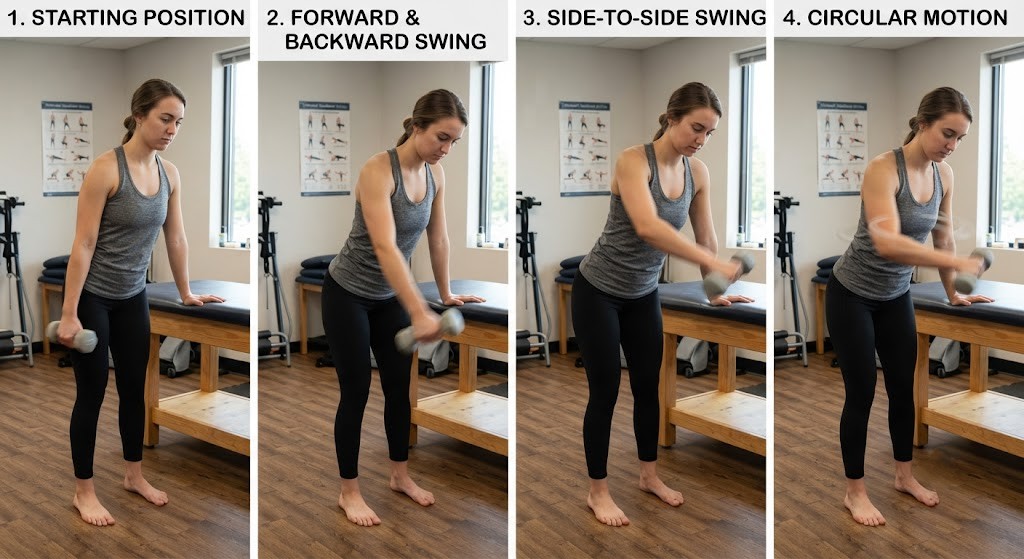
1. Pendulum Exercise
Purpose: Improve mobility, reduce stiffness, and encourage gentle movement.
How to Do It
- Stand beside a sturdy chair or table.
- Support yourself with one hand.
- Lean forward slightly.
- Allow your opposite arm to hang naturally.
- Swing your arm gently:
- Small circles
- Forward and backward
- Side to side
Continue for 30–60 seconds.
Sets: 2–3
2. External Rotation with Resistance Band
External rotation strengthens the infraspinatus and teres minor, two muscles that play a vital role in shoulder stability.
Steps
- Attach a resistance band securely.
- Stand sideways to the anchor point.
- Bend your elbow to 90 degrees.
- Keep your elbow close to your body.
- Rotate your forearm away from your body.
- Pause briefly.
- Slowly return to the starting position.
2–3 sets × 12–15 repetitions
For additional variations, see resistance band shoulder workout.
3. Internal Rotation with Resistance Band
This exercise primarily strengthens the subscapularis, the only rotator cuff muscle responsible for internal rotation.
How to Perform
- Stand beside the resistance band.
- Keep your elbow tucked against your side.
- Pull the band inward toward your stomach.
- Pause briefly.
- Return slowly.
2–3 sets × 12–15 repetitions
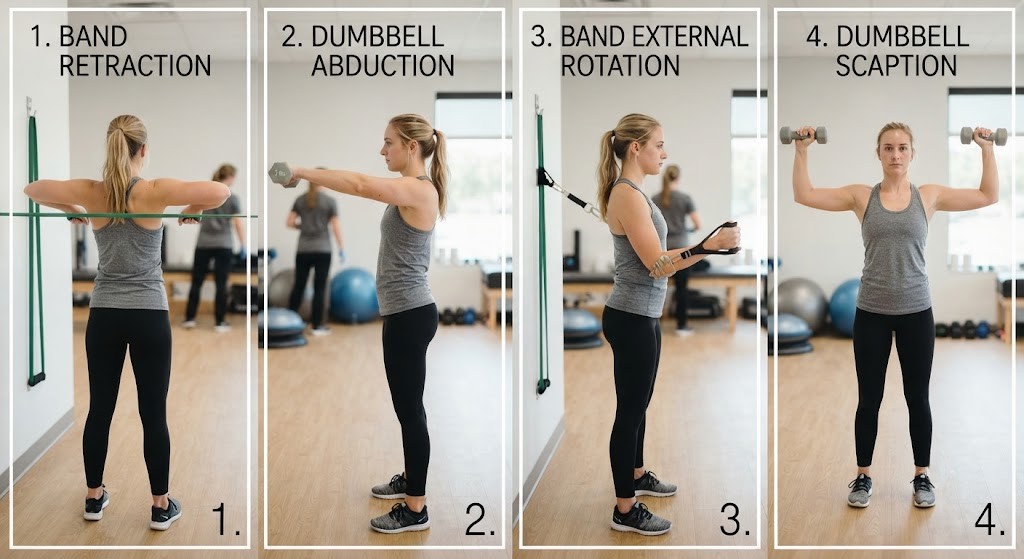
4. Scaption Raise
Scaption raises strengthen the shoulder using one of its safest movement patterns.
Instead of lifting directly to the side, raise your arms approximately 30 degrees forward from your body.
Instructions
- Hold light dumbbells (1–3 kg) or water bottles.
- Raise your arms until shoulder height.
- Lower slowly under control.
2–3 sets × 10–12 repetitions
5. Wall Angels
Wall angels improve posture, shoulder mobility, and shoulder blade control.
Steps
- Stand with your back against a wall.
- Keep your head, upper back, and hips touching the wall.
- Position your arms like a goalpost.
- Slowly slide your arms overhead.
- Return slowly.
Perform 10–15 repetitions.
6. Isometric Shoulder External Rotation
This gentle exercise is ideal during the early stages of strengthening or rehabilitation.
How to Perform
- Stand beside a wall.
- Bend your elbow to 90 degrees.
- Press the back of your hand into the wall.
- Do not allow your arm to move.
Hold for 10–15 seconds.
Repeat 5–8 times.
7. Shoulder Blade Squeeze
Strong upper-back muscles improve shoulder mechanics and reduce unnecessary stress on the rotator cuff.
Instructions
- Sit or stand upright.
- Pull both shoulder blades together.
- Hold for five seconds.
- Relax slowly.
Repeat 15 times.
8. Prone Y Raise
The prone Y raise strengthens the upper back and shoulder stabilisers.
Steps
- Lie face down.
- Extend both arms overhead into a “Y” shape.
- Lift your arms slightly.
- Pause briefly.
- Lower slowly.
Perform 10 repetitions.
9. Side-Lying External Rotation
This is one of the most effective beginner strengthening exercises for the rotator cuff.
Instructions
- Lie on one side.
- Hold a light dumbbell.
- Keep your elbow against your side.
- Rotate your forearm upward.
- Pause.
- Lower slowly.
2 sets × 12 repetitions
10. Band Pull Apart
Band pull-aparts strengthen the rear shoulders while improving posture and shoulder stability.
Steps
- Hold a resistance band with both hands.
- Extend your arms in front of your chest.
- Pull the band apart slowly.
- Squeeze your shoulder blades together.
- Return under control.
Perform 15 repetitions.
What Is a Good Weekly Rotator Cuff Workout Plan for Beginners?
A structured routine allows your shoulders to become stronger while recovering properly between workouts.
| Day | Workout |
|---|---|
| Monday | Full rotator cuff routine |
| Tuesday | Rest or walking |
| Wednesday | Mobility + light strengthening |
| Thursday | Rest |
| Friday | Full routine |
| Saturday | Stretching |
| Sunday | Recovery |
Sample Beginner Workout
- Pendulum Exercise — 2 sets
- External Rotation — 3 × 12
- Internal Rotation — 3 × 12
- Wall Angels — 2 × 15
- Band Pull Apart — 2 × 15
- Shoulder Blade Squeeze — 2 × 15
Rest: 45–60 seconds between sets.
For a complete home routine, visit best shoulder workout.
What Mistakes Should Beginners Avoid During Rotator Cuff Exercises?
Most training-related shoulder problems occur because beginners progress too quickly or ignore proper technique.
Avoid these common mistakes:
- Using weights that are too heavy
- Performing fast, jerky repetitions
- Ignoring shoulder pain
- Skipping warm-ups
- Poor posture during exercises
- Training every day without recovery
- Using resistance bands that are too strong
Quotable Fact: Slow, controlled repetitions strengthen the rotator cuff more effectively than fast, uncontrolled movements.
What Equipment Do You Need for Rotator Cuff Exercises?
You don’t need an expensive home gym to strengthen your shoulders.
| Equipment | Purpose |
|---|---|
| Resistance bands | Progressive strengthening |
| Light dumbbells | Controlled resistance |
| Exercise mat | Comfort |
| Foam roller | Recovery |
| Wall space | Wall angels & posture work |
For more band workouts, read resistance band exercises.
Can Rotator Cuff Exercises Help Relieve Shoulder Pain?
Yes, rotator cuff exercises for beginners can help relieve mild shoulder pain when weakness, muscular imbalance, or poor posture is the underlying cause.
By strengthening the muscles that stabilise the shoulder, these exercises reduce unnecessary stress on the joint and improve movement quality.
However, exercises should not be used to self-treat serious injuries such as:
- Complete tendon tears
- Shoulder dislocations
- Fractures
- Severe inflammation
If you’re unsure about the cause of your pain, seek professional medical advice before beginning an exercise programme.
Quotable Fact: Stronger shoulder stabilisers reduce unnecessary stress on the shoulder joint during daily activities.
When Should You Stop Rotator Cuff Exercises and See a Doctor?
Stop exercising immediately and consult a healthcare professional if you experience:
- Severe shoulder pain
- Shoulder instability
- Inability to lift your arm
- Significant swelling
- Sudden loss of strength
- Pain lasting several weeks despite rest
Early diagnosis often leads to better treatment outcomes and a faster return to normal activity.
What’s Next After Beginner Rotator Cuff Exercises?
Once you’ve mastered these beginner exercises, you can gradually progress to more advanced shoulder training.
Your next goals may include:
- Improving shoulder endurance
- Gradually increasing resistance
- Learning overhead pressing safely
- Building functional upper-body strength
- Enhancing sports performance
Conclusion
Rotator cuff exercises for beginners provide one of the safest and most effective ways to build stronger, healthier, and more resilient shoulders. By focusing on controlled movement, proper technique, and gradual progression, you can improve shoulder stability, mobility, posture, and overall function without placing unnecessary stress on the joint.
Remember that shoulder strength develops over time. There’s no need to rush into heavy lifting or advanced exercises. Instead, stay consistent with your training, prioritise quality movement, and listen to your body throughout the process.
Whether your goal is reducing shoulder discomfort, preventing injuries, improving athletic performance, or preparing for more advanced strength training, a strong rotator cuff lays the foundation for long-term shoulder health.
If you’re new to strength training, pair this routine with our beginner strength training plan for balanced, full-body development.
FAQs
What are rotator cuff exercises for beginners?
They are simple exercises that strengthen the four muscles that stabilise the shoulder, improving strength, mobility, and injury prevention.
How often should beginners do rotator cuff exercises?
Most beginners should perform them 2–3 times per week, allowing rest days between sessions.
Can I do rotator cuff exercises every day?
No. The muscles need time to recover, so 2–3 sessions per week is usually enough.
Do I need weights for rotator cuff exercises?
No. Resistance bands, body weight, or light dumbbells are sufficient for beginners.
Can rotator cuff exercises relieve shoulder pain?
Yes. They may help relieve mild pain caused by weakness or poor posture, but severe pain requires medical evaluation.
How long does it take to strengthen the rotator cuff?
Most people notice improvements within 6–8 weeks of consistent training.
Are resistance bands better than dumbbells for beginners?
Yes. Resistance bands provide controlled resistance and are gentler on the shoulder joint.
Should rotator cuff exercises be done before or after a workout?
They can be done as a warm-up or after your workout as a strengthening routine.
What should I do if my shoulder hurts during exercise?
Stop immediately and seek medical advice if the pain is sharp, severe, or persistent.
Can beginners perform rotator cuff exercises at home?
Yes. Most exercises require only a resistance band, light weights, or no equipment.
What is the best exercise for a rotator cuff?
Resistance band external rotations are one of the best exercises for improving rotator cuff strength and shoulder stability.
What is the 7-minute rotator cuff solution?
It is a short daily routine of mobility and strengthening exercises designed to improve shoulder health.
What is the fastest way to heal a rotator cuff?
Rest, physical therapy, gradual strengthening, and avoiding painful activities help support recovery.
Why is my rotator cuff so weak?
Poor posture, inactivity, repetitive overhead movements, ageing, and previous injuries are common causes.