
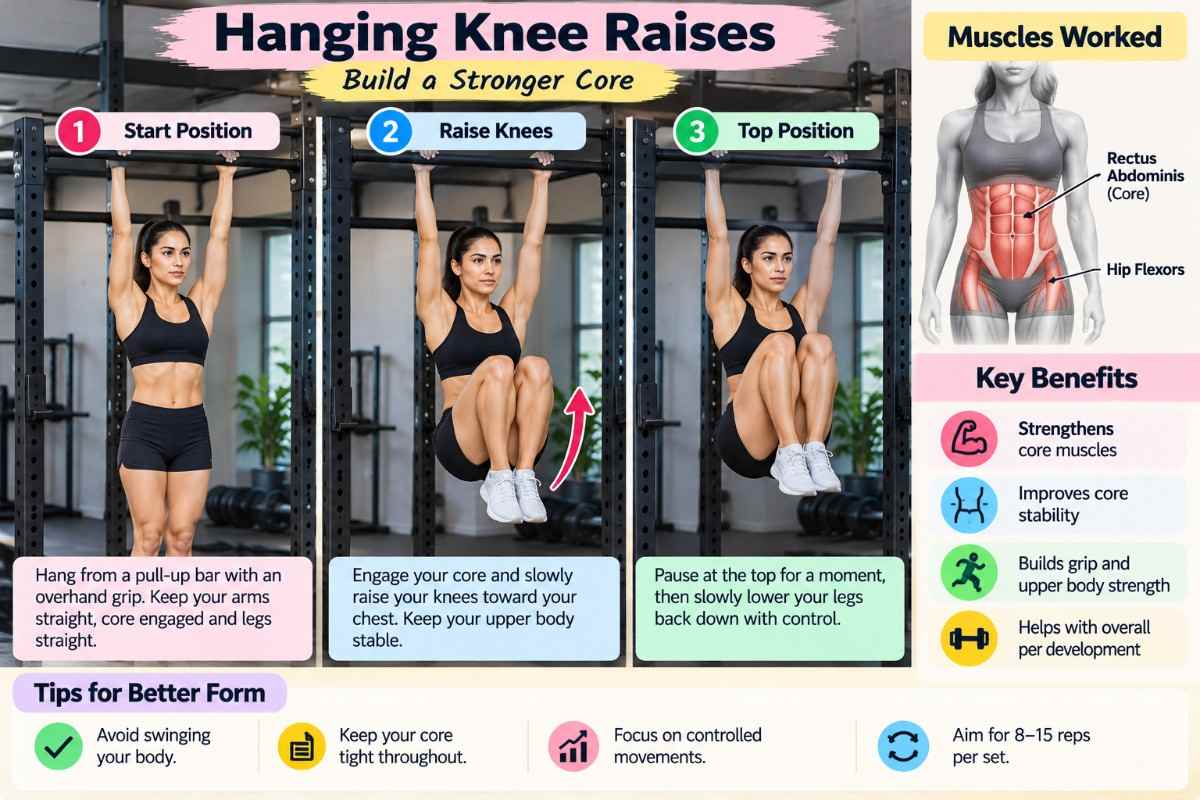
Hanging knee raises are an effective bodyweight exercise for strengthening your abs, improving core control, and developing hip flexor strength. Learning the correct technique helps you get more from every repetition without relying on swinging or momentum.
What Are Hanging Knee Raises?
Hanging knee raises are a bodyweight exercise in which you hang from a pull-up bar, lift your bent knees toward your chest, and lower them under control. The movement primarily challenges your abdominal muscles and hip flexors while your grip, shoulders, and upper back help stabilize your body.
Unlike traditional crunches, hanging knee raises require you to control your legs and torso while suspended above the floor. You can perform them using a pull-up bar or choose a supported captain’s chair variation if hanging is too challenging.
This exercise can be included in a dedicated core and abs workout routine or a full-body strength program.
Why Do Hanging Knee Raises Matter?
Hanging knee raises matter because they develop abdominal strength, hip flexion, and trunk control in one coordinated movement. They are especially useful for people who want to add a challenging bodyweight exercise to their core training.
The main benefits include:
- Stronger abdominal muscles: Your abs help control your trunk and pelvis as your knees rise.
- Improved core control: Keeping your body steady requires coordination and muscular control.
- Hip flexor development: Your hip flexors work to bring your thighs toward your torso.
- Grip endurance: Holding the bar challenges your hands and forearms.
- Shoulder stability: Your shoulder muscles help maintain a controlled hanging position.
- Exercise progression: Hanging knee raises can prepare you for more demanding hanging leg raise variations.
However, hanging knee raises do not specifically burn fat from your lower abdomen. Visible abs depend on factors such as abdominal muscle development, overall body composition, genetics, nutrition, and training consistency.
For a more balanced routine, combine hanging knee raises with full-body workout plan.
Which Muscles Do Hanging Knee Raises Work?
Hanging knee raises primarily work the abdominal muscles and hip flexors, while the obliques, forearms, shoulders, and upper back assist with stabilization.
| Muscle group | Role during the exercise |
|---|---|
| Rectus abdominis | Helps curl the trunk and control pelvic movement |
| Internal and external obliques | Assist with trunk stability and pelvic control |
| Hip flexors | Lift the thighs toward the torso |
| Forearm muscles | Maintain grip on the pull-up bar |
| Latissimus dorsi | Help stabilize the upper body |
| Shoulder stabilizers | Support a controlled hanging position |
The rectus abdominis is the long abdominal muscle associated with a six-pack. Although hanging knee raises are often described as a lower-ab exercise, the abdominal muscles work together rather than functioning as completely separate upper and lower muscles.
Your hip flexors also contribute substantially. If you lift your knees without moving your pelvis, you may feel the exercise mainly in the front of your hips. Gently curling your pelvis toward your ribs at the top helps emphasize abdominal control.
How to Do Hanging Knee Raises With Proper Form
To perform hanging knee raises correctly, hang from a secure pull-up bar, brace your core, lift your bent knees toward your chest, gently curl your pelvis upward, and lower your legs slowly without swinging.
Follow these seven steps:
- Grip the bar: Use an overhand grip approximately shoulder-width apart. Use a stable step to reach the bar safely.
- Establish your position: Hang with your feet off the floor, arms extended, and shoulders comfortably engaged.
- Brace your core: Tighten your abdominal muscles and keep your rib cage and pelvis controlled.
- Raise your knees: Bend your knees and bring them toward your chest as far as you can comfortably manage.
- Curl your pelvis: At the top, gently tilt your pelvis toward your ribs instead of simply lifting your thighs.
- Pause briefly: Hold the top position for about one second without swinging.
- Lower slowly: Return to the starting position over approximately two to three seconds, maintaining control throughout the descent.
Breathe out as you raise your knees and breathe in as you lower them. Keep your repetitions smooth rather than using momentum to move your legs. These technique cues align with exercise instructions from PureGym’s hanging knee raise guide. (Source: PureGym, n.d.)
For a balanced abdominal routine, pair this exercise with plank exercises for core stability and dead bug exercise for beginners.
How Many Hanging Knee Raises Should You Do?
Most beginners can start with two to three sets of 5–10 controlled repetitions, adjusting the number according to their grip strength, abdominal control, and exercise experience. There is no single ideal repetition target for everyone.
Use these ranges as practical starting points rather than strict rules.
| Fitness level | Sets | Repetitions | Main focus |
|---|---|---|---|
| Beginner | 2–3 | 5–8 | Learn the movement and prevent swinging |
| Intermediate | 3 | 8–12 | Improve control and range of motion |
| Advanced | 3–4 | 10–15 | Maintain strict form under greater fatigue |
Rest for approximately 60–120 seconds between sets, or longer if you need additional recovery to maintain good technique.
How Often Should You Train Hanging Knee Raises?
Perform hanging knee raises around two or three times per week if they fit your training program and you recover comfortably between sessions. Begin with manageable volume and increase gradually as your technique improves.
The American College of Sports Medicine’s 2026 resistance-training guidance emphasizes consistent, progressive training tailored to individual goals and abilities. (Source: Currier et al., 2026.)
What Are the Best Hanging Knee Raise Variations?
The best hanging knee raise variation is one that matches your current strength and allows you to maintain control throughout every repetition. Start with supported movements if hanging from a bar is too difficult, then progress toward more demanding versions.
1. Captain’s Chair Knee Raise
The captain’s chair knee raise supports your forearms and back against padded rests, reducing the grip demands of the exercise.
- Place your forearms securely on the pads.
- Keep your back supported and shoulders comfortable.
- Raise your bent knees toward your torso.
- Lower your legs slowly without swinging.
This is a useful alternative if your grip tires before your abdominal muscles.
2. Bent-Knee Hanging Knee Raise
The bent-knee hanging knee raise is the standard version and a practical starting point for anyone who can comfortably support their body weight on a bar.
Keep your knees bent, brace your core, and gently curl your pelvis at the top. If you cannot prevent swinging, perform fewer repetitions or switch to a supported variation.
3. Hanging Oblique Knee Raise
The hanging oblique knee raise adds a controlled diagonal movement to challenge the obliques.
- Begin in a stable hanging position.
- Raise your bent knees toward one side of your torso.
- Return to the center before lowering.
- Alternate sides while keeping the movement controlled.
Avoid twisting aggressively or using momentum to move your knees sideways.
4. Hanging Straight-Leg Raise
The hanging straight-leg raise is a more challenging progression because keeping your legs straight increases the lever arm and the demand on your core and hip flexors.
Only try it when you can perform hanging knee raises without swinging and can control the lowering phase. You do not need to rush toward this variation to develop a stronger core.
5. Weighted Hanging Knee Raise
Weighted hanging knee raises increase resistance by holding a light weight securely between your feet or using suitable resistance equipment. This variation is intended for experienced exercisers who can already perform strict bodyweight repetitions.
Start with minimal additional resistance and stop if the weight causes swinging, poor pelvic control, or discomfort.
For additional variety, explore dragon flag workout progression.
What Are the Most Common Hanging Knee Raise Mistakes?
The most common hanging knee raise mistakes are swinging the body, lifting the knees without controlling the pelvis, arching the lower back, and lowering the legs too quickly. Correcting these errors helps you perform the exercise with greater control.
1. Using Momentum to Lift the Knees
Swinging your legs to complete more repetitions makes the movement less controlled and can reduce your ability to maintain consistent abdominal tension.
Fix: Begin each repetition from a stable position. If you start swinging, pause until your body settles before continuing.
2. Relying Only on the Hip Flexors
Your hip flexors naturally help lift your thighs, but your abdominal muscles also need to control the pelvis and trunk.
Fix: At the top of the movement, gently curl your pelvis toward your ribs rather than stopping as soon as your thighs reach horizontal.
3. Arching Your Lower Back
Excessive lower-back arching can indicate that you are losing control of your trunk position.
Fix: Brace your abs, avoid flaring your ribs, and use a smaller range of motion if necessary.
4. Dropping Your Legs Too Quickly
Letting your legs fall freely makes the lowering phase harder to control and can initiate unwanted swinging.
Fix: Take two to three seconds to lower your legs, then pause briefly before the next repetition.
5. Ignoring Grip and Shoulder Fatigue
Your grip and shoulder stabilizers help maintain a secure hanging position. If they tire too quickly, your technique may deteriorate before your abdominal muscles are adequately challenged.
Fix: Try a captain’s chair or supported knee raise while separately building grip strength. Stop if your grip slips or your shoulders hurt.
If you want to improve overall strength while minimizing unnecessary strain, consider injury prevention exercises.
How Can Beginners Progress to Hanging Knee Raises?
Beginners can build toward hanging knee raises by first developing core control, grip strength, and the ability to maintain a comfortable hanging position. You do not need to begin with unsupported hanging repetitions if you cannot yet control your body weight.
Try this progression:
- Dead bug: Practise bracing your core while moving your arms and legs.
- Reverse crunch: Learn to tilt your pelvis toward your ribs while lying on the floor.
- Captain’s chair knee raise: Practise lifting your knees with support.
- Controlled hanging knee raise: Move to the pull-up bar when your grip and shoulder comfort allow it.
- Hanging straight-leg raise: Progress when your knee raises are controlled and consistent.
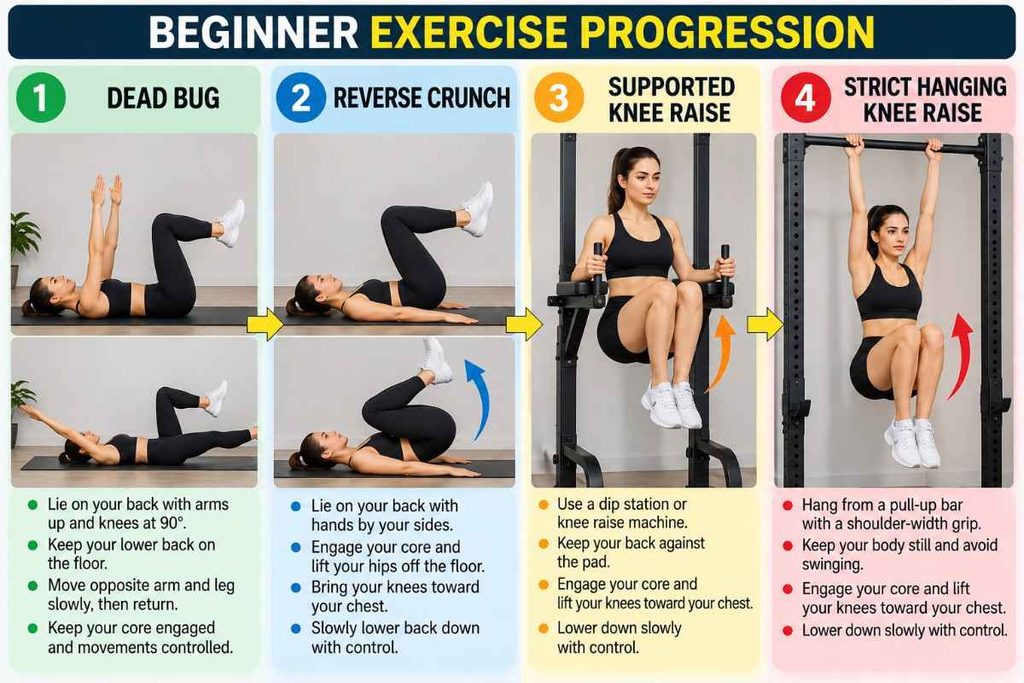
Aim to master each stage before moving to the next. If you experience shoulder pain, lower-back pain, or sharp discomfort, stop the exercise and seek guidance from an appropriate healthcare professional.
You can complement this progression with beginner strength training workout plan and a suitable recovery routine.
Can Hanging Knee Raises Help You Get Six-Pack Abs?
Hanging knee raises can help strengthen and develop your abdominal muscles, but they cannot guarantee visible six-pack abs. Abdominal definition depends on factors such as muscle development, overall body fat, genetics, nutrition, and training consistency.
For better results, combine core training with:
- Progressive resistance training for your major muscle groups.
- A balanced diet that supplies adequate protein and energy.
- Regular physical activity that supports your overall fitness goals.
- Consistent sleep and recovery.
- A sustainable nutrition approach if fat loss is appropriate for you.
A calorie deficit may help reduce body fat over time, but hanging knee raises do not directly remove fat from the lower abdomen. Avoid extreme dieting or excessive exercise in pursuit of visible abs.
Use the calorie deficit calculator to estimate your calorie needs if fat loss is one of your goals, and the daily protein intake calculator to estimate your protein requirements.
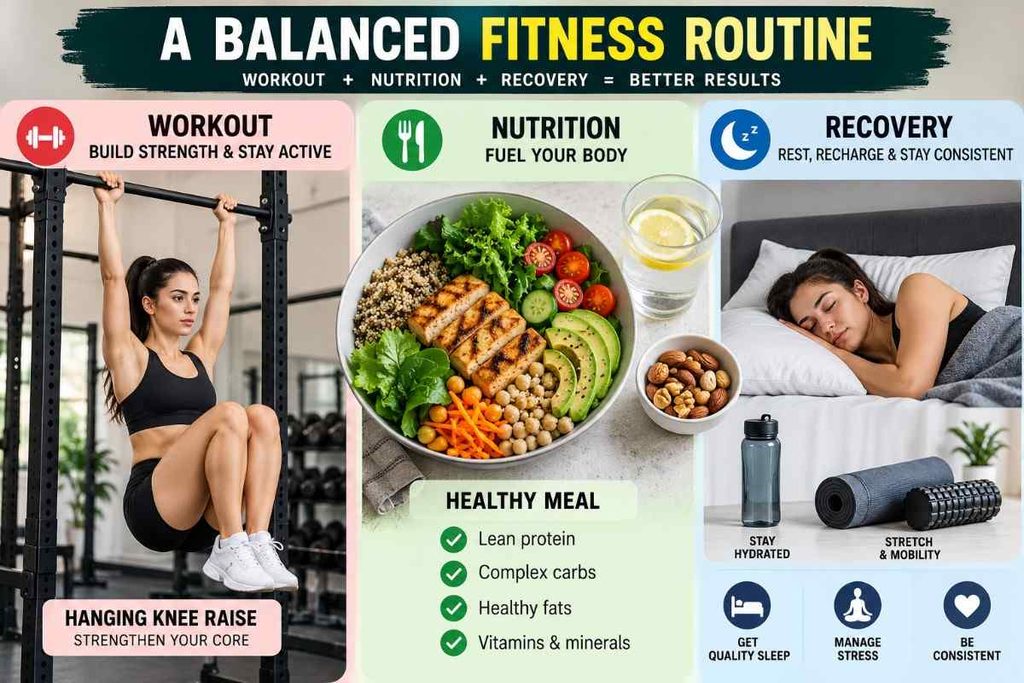
Conclusion
Hanging knee raises are a versatile exercise for developing abdominal strength, hip flexor control, and grip endurance. Start with a manageable variation, keep your body steady, curl your pelvis at the top, and lower your legs slowly. Increase repetitions or difficulty only when you can maintain proper form.
FAQs
Are hanging knee raises good for abs?
Yes, hanging knee raises train the abdominal muscles while also engaging the hip flexors and obliques. Controlled pelvic movement helps involve the abs more directly.
How many hanging knee raises should beginners do?
Beginners can start with 2–3 sets of 5–8 controlled repetitions, adjusting the volume to their strength and technique.
Are hanging knee raises better than crunches?
Neither exercise is universally better. Hanging knee raises challenge grip and shoulder stability, while crunches are easier to perform without specialized equipment.
Do hanging knee raises target lower abs?
They work the rectus abdominis and other core muscles, with the abdominal muscles helping control pelvic movement. They do not isolate a completely separate lower-ab muscle.
Can I do hanging knee raises every day?
Daily training is not necessary. Two or three sessions per week is a reasonable starting point, provided you recover well and maintain good technique.
Why do I feel hanging knee raises in my hips instead of my abs?
Your hip flexors help lift your thighs, so they will naturally contribute. Try bracing your core and gently curling your pelvis toward your ribs at the top of each repetition.
Are hanging knee raises safe for people with lower-back pain?
They may not be suitable for everyone with lower-back pain. Because individual causes and tolerances differ, consult a qualified healthcare professional or physiotherapist for appropriate exercise modifications.
How do I make hanging knee raises harder?
Once you can complete strict repetitions without swinging, you can progress to slower lowering phases, hanging straight-leg raises, or carefully loaded variations.
Sources
- PureGym. (n.d.). How To Do Hanging Knee Raises.
- Escamilla, R. F., et al. (2006). Electromyographic Analysis of Traditional and Nontraditional Abdominal Exercises: Implications for Rehabilitation and Training. Physical Therapy, 86(5), 656–671.
- Currier, B. S., et al. (2026). Resistance Training Prescription for Muscle Function, Hypertrophy, and Physical Performance in Healthy Adults: An Overview of Reviews. Medicine & Science in Sports & Exercise, 58(4), 851–872.
Disclaimer: This article is for informational and educational purposes only and is not a substitute for personalized medical advice. Consult a qualified healthcare professional before making significant changes to your diet, exercise routine, or supplement use.