
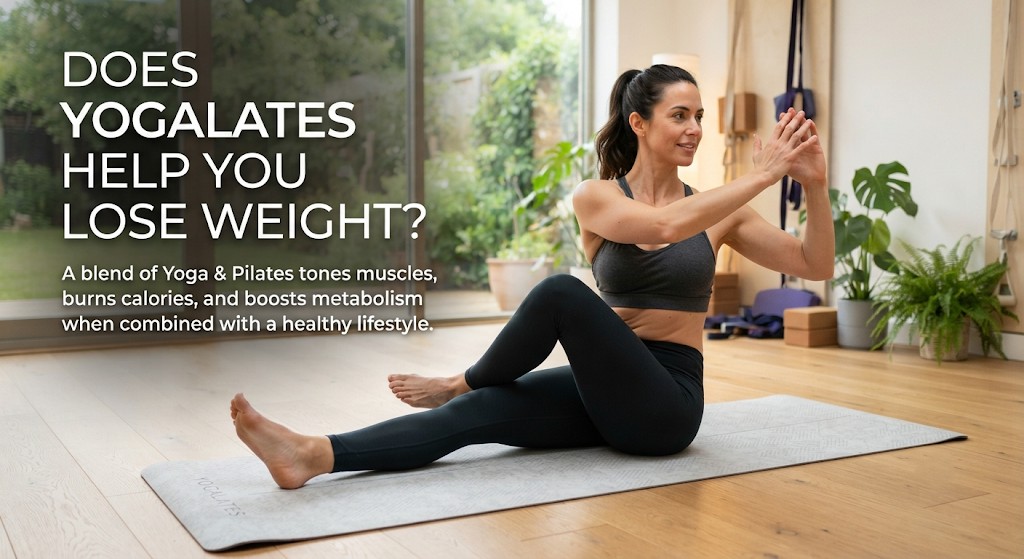
Yogalates feels gentle, so it’s fair to wonder whether it burns enough to change the number on the scale. It can help, but mostly as one part of a plan that also includes a calorie deficit and some higher-effort cardio. This guide covers the calories, the research, and a practical way to fit yogalates into your week.
What Is Yogalates?
Yogalates is a mat-based workout that combines yoga poses and breathing with Pilates-style core strengthening. Classes vary a lot by instructor, but most include a mix of the following:
- Slow, flowing yoga sequences such as sun salutations and warrior poses
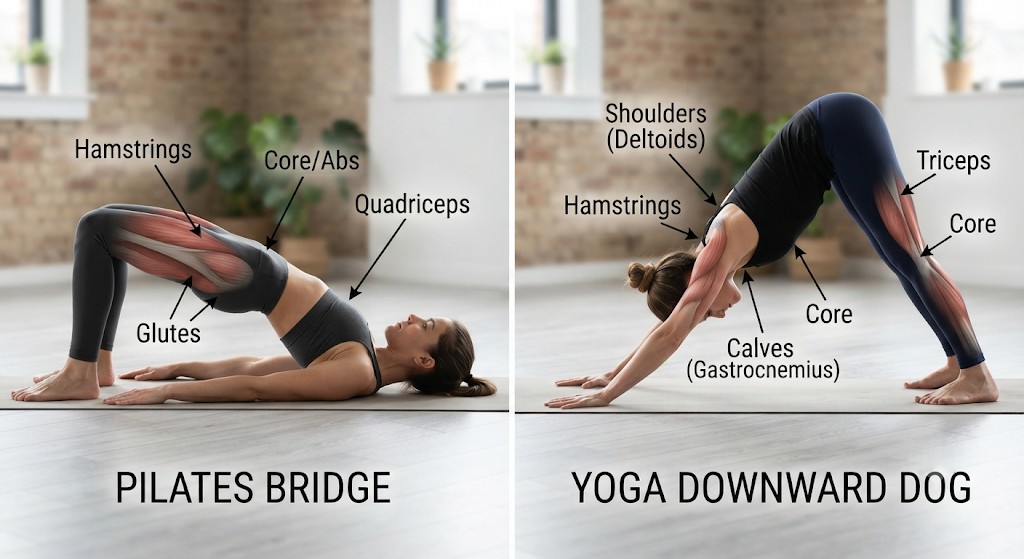
- Pilates moves like the hundred, leg circles, and bridges
- Controlled breathing tied to each movement
- Stretching and a short relaxation at the end
Because there is no single standard format, the calorie burn and difficulty depend on the class you pick. A slow, stretch-heavy session sits at one end. A faster flow with longer core holds sits at the other.
What Is Yogalates? A Beginner’s Guide to the Yoga and Pilates Workout
Why Does Yogalates Matter for Weight Loss?
Yogalates matters mainly because it is easy to keep doing, and consistency is what moves weight over months. It is low impact, it needs almost no equipment, and most people can adjust the poses to their level.
That makes it useful for several kinds of people:
- Beginners who find running or HIIT intimidating
- People coming back to exercise after a long break
- Anyone who wants an active recovery day between harder sessions
- Those who prefer a calm workout to a loud, high-intensity one
The CDC notes that regular physical activity, along with healthy eating, sleep, and stress management, is part of a healthy weight loss lifestyle (Source: CDC). Yogalates covers the activity and stress parts reasonably well. It does less for the calorie side on its own.
Does Yogalates Help You Lose Weight?
Yes, yogalates can contribute to weight loss, but it burns fewer calories than most cardio, so it works best alongside other activity and a sensible diet. Weight loss comes from a calorie deficit, which the CDC describes as using calories through physical activity while also reducing the calories you eat (Source: CDC).
Here is roughly what comparable activities burn in 30 minutes:
| Activity | Approx. calories per 30 minutes | Source |
|---|---|---|
| Hatha yoga (stretching) | 120 to 168, depending on body weight (125 to 185 lb) | Harvard Health Publishing |
| Low-impact aerobics | 165 to 231, depending on body weight (125 to 185 lb) | Harvard Health Publishing |
| General weight lifting | 90 to 126, depending on body weight (125 to 185 lb) | Harvard Health Publishing |
| Mat Pilates, beginner to advanced class | 108 to 168 | American Council on Exercise |
Yogalates should land in about the same range as yoga and Pilates, since it borrows from both. These are estimates, and your own burn will shift with body size and how hard you work.
A quick example: a 155-pound person burns about 144 calories in 30 minutes of Hatha yoga (Source: Harvard Health Publishing). A 45-minute class would be around 216 calories. Three of those a week comes to roughly 650 calories, which helps but won’t do the whole job.
What Does the Research Say About Yogalates and Weight Loss?
Very few studies test yogalates by name, so the best evidence comes from research on Pilates, one of its two parent practices. That research is encouraging but small.
- A randomized trial of 58 sedentary obese women found that 8 weeks of mat and ball Pilates improved weight, BMI, fat percentage, and waist-to-hip ratio (Source: Collegium Antropologicum, 2011).
- A separate study of 37 sedentary overweight and obese women reported that 8 weeks of Pilates improved body composition compared with a control group that did no exercise (Source: Journal of Sports Medicine and Physical Fitness, 2017).
Both studies are short and involve only women, and neither tests the yoga half of yogalates. Treat the results as a sign that this style of training can help body composition, and not as proof that yogalates alone will reliably produce weight loss.
How Can Yogalates Support Your Weight Loss Goals?
Yogalates supports weight loss by building core strength and body awareness while giving you a workout you can sustain. These benefits are real, though they are indirect.
- It strengthens the abdominal muscles, hips, and back, which can make walking, lifting, and everyday movement feel easier.
- It improves flexibility and mobility, which can help you stay comfortable during harder workouts.
- It is gentle enough to do on days when your body needs a lighter session.
- The slow pace and breathing focus may help some people notice hunger, stress, and fatigue more clearly. This varies from person to person, and the research on it is limited.
Core work also tends to change how clothes fit and how posture looks, even when the scale moves slowly.
How Do You Fit Yogalates Into a Weight Loss Plan?
The simplest approach is to treat yogalates as a supporting session on top of regular aerobic exercise and strength work. The CDC recommends at least 150 minutes of moderate-intensity aerobic activity per week for adults, along with muscle-strengthening activity on at least 2 days a week (Source: CDC).
A Sample Week
- Monday: 30 to 40 minutes of brisk walking or cycling
- Tuesday: 30 to 45 minutes of yogalates
- Wednesday: strength training for major muscle groups
- Thursday: 30 to 40 minutes of cardio
- Friday: 30 to 45 minutes of yogalates
- Saturday: strength training or a longer walk
- Sunday: rest or light stretching
Adjust the days to fit your schedule. The point is that yogalates fills two or three slots and doesn’t replace the cardio or the strength sessions.
Match It With Your Food
Food has the larger effect on the scale. The CDC says people who lose weight gradually, about 1 to 2 pounds a week, are more likely to keep it off than people who lose it faster (Source: CDC). It also notes that even modest loss helps: 5% of body weight for a 200-pound person is 10 pounds, and that can improve blood pressure, cholesterol, and blood sugar.
Eating enough protein can help you feel full and support muscle while you lose weight.
High Protein Plant-Based Foods
Track More Than the Scale
Because yogalates builds muscle endurance, the scale can lag behind other changes. Take waist measurements, notice how your clothes fit, and keep a simple log of how long you can hold a plank or how many controlled reps you can do.
What Does a Simple 30-Minute Yogalates Routine Look Like?
A beginner-friendly routine can be done in about 30 minutes with a mat and no other equipment. Hold each pose for 5 to 8 slow breaths unless noted.
- Cat-cow and gentle spinal rolls, 3 minutes
- Sun salutation flow, 5 rounds, 6 minutes
- The hundred with knees bent, 1 minute
- Plank hold, working up to 30 seconds, then downward dog, 3 rounds
- Glute bridges, 12 slow reps, 2 sets
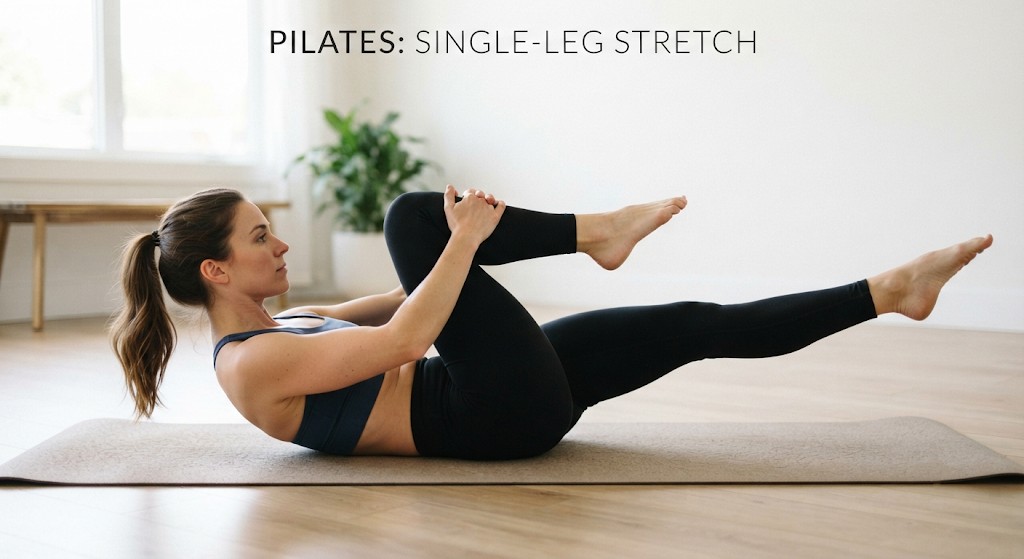
- Single-leg stretch, 10 reps per side
- Warrior II and side angle, both sides, 4 minutes
- Child’s pose and a seated forward fold to finish, 3 minutes
Keep your lower back supported during core moves, and stop any pose that causes sharp pain. A non-slip mat makes balance poses safer.
What Mistakes Slow Weight Loss With Yogalates?
The most common mistake is expecting yogalates to do all the work without changing eating habits or adding other exercise. A few others come up often:
- Choosing only slow, stretch-focused classes and never raising the intensity
- Eating extra because the session felt like a big workout
- Practicing once a week and expecting visible change
- Rushing through core moves with poor form instead of staying controlled
- Judging progress only by weight
Conclusion
Yogalates can help you lose weight, mainly by keeping you active and building core strength, though it burns fewer calories than brisk cardio. The research on its two parent practices is encouraging but limited, and no large trial has tested yogalates itself. For the best results, do it two or three times a week alongside 150 minutes of aerobic activity and some strength training, and pair that with a modest calorie deficit. If you’re starting out, choose one class length, put it on your calendar, and build from there.
FAQs
Is yogalates good for weight loss?
Yogalates is useful for weight loss as a supporting workout, not as the only one. It burns a modest number of calories, so it works best with cardio, strength training, and a calorie deficit.
How many calories does yogalates burn?
A 30-minute session likely burns somewhere around 110 to 170 calories, based on figures for yoga and Pilates. Your body weight and the pace of the class change the number.
How often should I do yogalates to lose weight?
Two to three sessions of 30 to 45 minutes a week is a realistic starting point. Fit them around your aerobic and strength days so you aren’t short on recovery.
Can yogalates reduce belly fat?
Yogalates can strengthen and tighten the core muscles, but it cannot remove fat from one area of the body. Fat loss happens across the whole body through a sustained calorie deficit.
Is yogalates better than yoga or Pilates for weight loss?
There is no strong evidence that yogalates beats either one. All three burn similar amounts, so choose the style you will actually keep doing.
Can beginners do yogalates?
Yes, most classes can be scaled to a beginner’s level with modified poses and shorter holds. Tell the instructor about any injuries before you start.
How long does it take to see results from yogalates?
Many people notice better posture and core strength within a few weeks, while weight changes depend mostly on diet and overall activity. The CDC suggests aiming for steady loss of about 1 to 2 pounds a week.
Sources
- Centers for Disease Control and Prevention. Steps for Losing Weight.
- Centers for Disease Control and Prevention. Physical Activity for a Healthy Weight.
- Harvard Health Publishing. Calories burned in 30 minutes for people of three different weights.
- Journal of Sports Medicine and Physical Fitness. (2017). The effect of Pilates exercise on body composition in sedentary overweight and obese women.
- Collegium Antropologicum. (2011). The effect of 8 week pilates exercise on body composition in obese women.
Disclaimer: This article is for informational and educational purposes only and is not a substitute for personalized medical advice. Consult a qualified healthcare professional before making significant changes to your diet, exercise routine, or supplement use.