
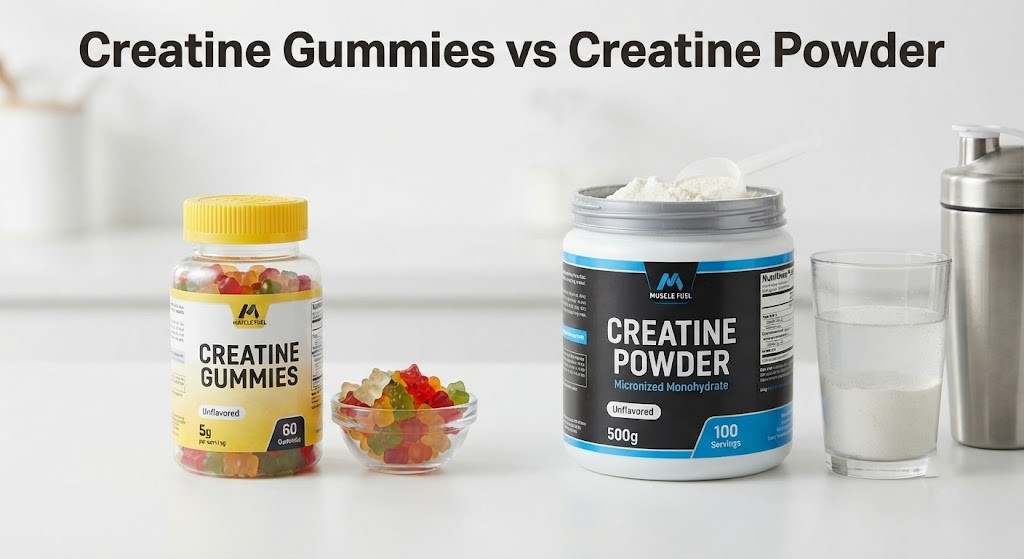
If you already know that creatine can support your workout routine, you may be wondering which format is better: an easy-to-eat gummy or a powder you mix into a drink. While both can deliver creatine, factors such as dosage, ingredients, calories, cost, taste, portability, and convenience can make one option a better fit for your daily routine.
In this guide to creatine gummies vs creatine powder, you’ll learn how the two formats compare, whether gummies are as effective as powder, how dosage and cost differ, what to look for on supplement labels, and how to choose a creatine product that fits your goals.
What Are Creatine Gummies vs Creatine Powder?
Creatine gummies and creatine powder are two delivery formats for creatine supplementation. The amount of creatine you consume is generally more important than whether you take it as a gummy or powder.
Creatine gummies are chewable supplements containing a measured amount of creatine along with ingredients that provide flavor, texture, and stability. Depending on the product, you may need to consume several gummies to reach the intended daily creatine dose.
Creatine powder, meanwhile, is designed to be mixed into water or another suitable beverage or food. For example, creatine monohydrate powder can be added to water, a smoothie, protein shake, or another drink that fits your routine.
Creatine monohydrate remains the most extensively studied supplemental form of creatine. A major scientific review concluded that creatine monohydrate has substantial evidence supporting its bioavailability, effectiveness, and safety.
Why Does the Choice Between Creatine Gummies and Powder Matter?
The choice between creatine gummies and powder matters because convenience, dose accuracy, ingredients, calories, price, taste, and portability can influence how consistently you use a supplement.
A product is only useful if it works with your actual routine. For instance, a powdered creatine supplement may be inexpensive and flexible, but someone who dislikes mixing drinks may find gummies easier to use consistently.
Consistency is particularly important because creatine supplementation works by regularly increasing and maintaining muscle creatine stores rather than depending on a special delivery format. Evidence-based guidance commonly describes 3–5 g of creatine per day as an effective maintenance range. — Source: Journal of the International Society of Sports Nutrition, 2021
The format can also affect convenience. Someone who frequently travels may appreciate gummies because they can be consumed without water, a shaker, or a mixing routine.
On the other hand, someone who already prepares a protein shake every day may find powder more practical because creatine can simply become part of that existing habit.
creatine benefits for exercise
What Are Creatine Gummies?
Creatine gummies are chewable supplements that deliver a measured amount of creatine in a flavored, ready-to-eat format. Their primary advantage is convenience, particularly for people who do not want to mix powdered supplements.
How Do Creatine Gummies Work?
Gummies typically combine creatine with ingredients such as sweeteners, flavoring agents, gelling agents, acids, or other formulation ingredients. The exact formula varies considerably from one product to another.
That’s why the Supplement Facts panel and ingredient list are more useful than simply looking at the word “gummy” on the front of the package.
Serving size is another important consideration. The amount of creatine per gummy can differ between products, and some products may require multiple gummies to provide the intended daily dose.
That can affect not only convenience but also the product’s overall cost and calorie contribution.
What Does Research Say About Creatine Gummies?
Emerging research has directly examined creatine monohydrate delivered in gummy form. A 2026 randomized trial involving 32 female collegiate and professional beach volleyball athletes used 5 g/day of creatine monohydrate gummies for 10 weeks and reported improvements in selected performance outcomes. — Source: Journal of Functional Morphology and Kinesiology, 2026
However, this finding should be interpreted carefully. The study supports the practicality of gummy delivery but does not establish that gummies are inherently superior to creatine powder.
What Is Creatine Powder?
Creatine powder is a powdered supplement commonly mixed with a beverage to deliver a measured creatine dose. Creatine monohydrate powder is particularly practical because it is simple, flexible, and extensively studied.
How Do You Take Creatine Powder?
Powdered creatine can be mixed with:
- Water
- Juice
- Smoothies
- Protein shakes
- Other suitable beverages or foods
For example, if you already drink a protein shake after training, you can add your creatine dose to that shake instead of creating a separate supplement habit.
Another advantage is dosage flexibility. Someone following a standard maintenance approach can measure approximately 3–5 g daily, while people using a loading protocol may follow a different short-term strategy under appropriate guidance. — Source: Journal of the International Society of Sports Nutrition, 2021
Creatine powder does not automatically mean lower quality or poorer absorption. Research on creatine administered in different food and drink forms shows that creatine can be absorbed when delivered in solid or food-based formats, although absorption kinetics can differ.
Creatine Gummies vs Creatine Powder: How Do They Compare?
When comparing creatine gummies vs creatine powder, both formats can provide creatine. However, their practical differences become clearer when you evaluate dosage flexibility, ingredients, calories, cost, taste, and portability.
| Feature | Creatine Gummies | Creatine Powder |
|---|---|---|
| Effectiveness | Effective when they provide an appropriate creatine dose | Effective when they provide an appropriate creatine dose |
| Dosage flexibility | Usually limited by fixed gummy amounts | Usually easier to measure and adjust |
| Convenience | Ready to eat | Requires mixing |
| Ingredients | May include sweeteners, flavors, sugars, or gelling agents | Often has a shorter ingredient list |
| Calories | May contain calories depending on formulation | Usually very low-calorie when unflavored |
| Taste | Flavored and chewable | Often neutral or mildly textured |
| Portability | Very convenient | Convenient but may require measuring |
| Cost | Often higher per gram | Often lower per gram |
The important point is that neither format automatically wins every category. The better choice depends on what matters most to you and which product you can use consistently.
Are Creatine Gummies as Effective as Creatine Powder?
Yes, creatine gummies can be as effective as creatine powder when they provide an appropriate dose of a well-supported creatine form such as creatine monohydrate. The creatine dose and consistency of use matter more than whether you chew the supplement or mix it into a beverage.
Creatine monohydrate has a substantial evidence base supporting its use as a supplemental form, while many alternative creatine forms have less supporting evidence.
A recent trial specifically using 5 g/day of creatine monohydrate in gummy form also demonstrated that gummy delivery can be used successfully in a structured supplementation protocol. — Source: Journal of Functional Morphology and Kinesiology, 2026
Therefore, when comparing gummies with powder, focus first on the amount and form of creatine rather than assuming one delivery format is inherently more effective.
Which Has Better Dosage Flexibility: Creatine Gummies or Powder?
Creatine powder generally offers better dosage flexibility because you can measure the desired amount directly from the container. Gummies usually contain a fixed quantity per piece, meaning you may need multiple gummies to reach a particular dose.
For example, if one gummy contains 1 g of creatine, reaching 5 g would require five gummies. With powder, you can generally measure the amount according to the product’s serving instructions.
This difference can become particularly relevant when comparing products with different serving sizes.
Are Creatine Gummies More Expensive Than Creatine Powder?
Creatine gummies are often more expensive per gram of creatine because producing a flavored, chewable supplement requires additional formulation and packaging.
For a fair comparison, look at cost per gram of actual creatine rather than the price of the container.
For example, a 2022 analysis of 175 creatine products found that products containing only creatine monohydrate averaged $0.12 per gram, compared with $0.26 per gram for products using only alternative creatine forms. — Source: Journal of the International Society of Sports Nutrition, 2022
The analysis also found that only 8% of the products were third-party certified, highlighting why label transparency and quality verification deserve attention. — Source: Journal of the International Society of Sports Nutrition, 2022
As a result, a larger container or lower sticker price does not necessarily mean better value. Compare the actual amount of creatine provided before deciding.
Do Creatine Gummies Contain Added Sugar or Calories?
Creatine gummies may contain added sugar, sweeteners, carbohydrates, or calories because they require ingredients beyond creatine to create their texture and flavor.
Powdered creatine monohydrate is often a simpler option when you want to minimize additional ingredients.
Always check:
- Serving size
- Total creatine per serving
- Total calories
- Added sugars
- Carbohydrates
- Sweeteners
- Other formulation ingredients
Also consider how many gummies make up a full serving. A product that appears low-calorie per gummy could contribute more calories when several gummies are required to reach the target dose.
Are Creatine Gummies More Convenient Than Creatine Powder?
Creatine gummies are generally more convenient when you want a ready-to-eat supplement that requires no mixing or shaker.
They can be particularly useful during travel, at work, or when you’re leaving the gym and do not have access to a convenient mixing setup.
However, powder can be just as convenient when it fits naturally into an existing routine. If you already prepare a smoothie or protein shake every day, adding creatine powder may take only a few extra seconds.
Ultimately, convenience is personal. The format that removes the most friction from your routine is often the more practical choice.
When Should You Choose Creatine Gummies or Creatine Powder?
The best choice between creatine gummies and powder depends on your routine, budget, taste preferences, ingredient priorities, and ability to use the product consistently.
Choose Creatine Gummies If You:
- Prefer a ready-to-eat format.
- Dislike mixing powdered supplements.
- Travel frequently.
- Want a portable option.
- Prefer flavored supplements.
- Value convenience enough to accept potentially higher costs.
Choose Creatine Powder If You:
- Want a simple ingredient list.
- Prefer a lower cost per gram.
- Want greater dosage flexibility.
- Already drink shakes or smoothies.
- Want to minimize added sugars or calories.
- Prefer creatine monohydrate in a straightforward format.
Neither list is universally better. The right choice is the one that aligns with your habits and makes regular use easier.
How Can You Choose a Good Creatine Product?
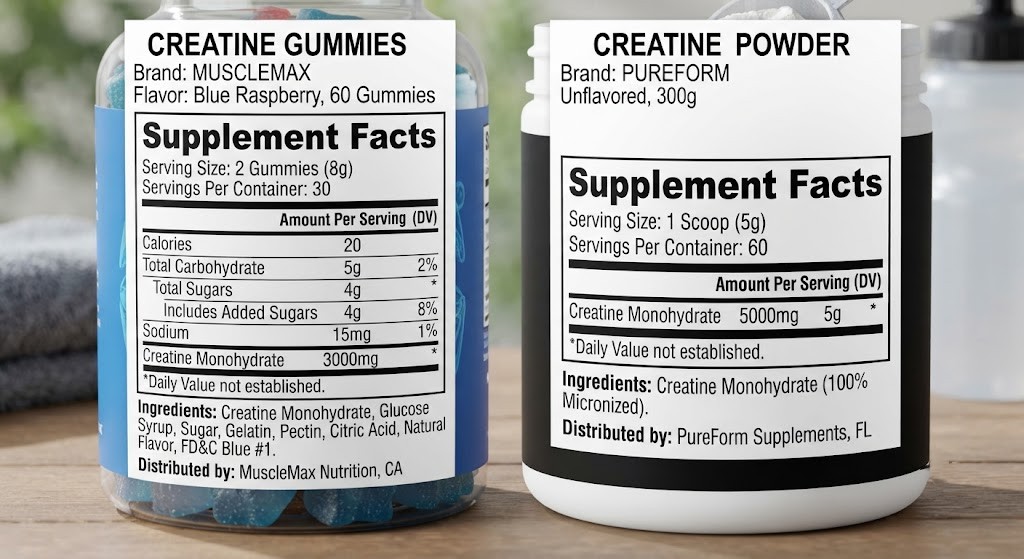
A good creatine product should clearly state its creatine form, amount per serving, ingredients, serving size, and quality information.
Rather than judging a product by its format, flavor, or marketing claims, use the label to compare what you’re actually getting.
1. Check the Creatine Form
Look for creatine monohydrate when you want the most extensively supported form.
2. Check the Actual Creatine Amount
Determine how much creatine you receive per serving. With gummies, check how many individual pieces are required to reach the stated serving.
3. Review the Ingredient List
Look for unnecessary sugars, fillers, sweeteners, or proprietary blends if these are important to your preferences.
4. Check Calories and Sugar
This is particularly relevant for gummies because their formulation may include additional calories or carbohydrates.
5. Look for Quality Testing
Look for credible third-party testing or certification where available.
6. Consider the Manufacturer
Prefer products from transparent, reputable manufacturers that provide clear product and manufacturing information.
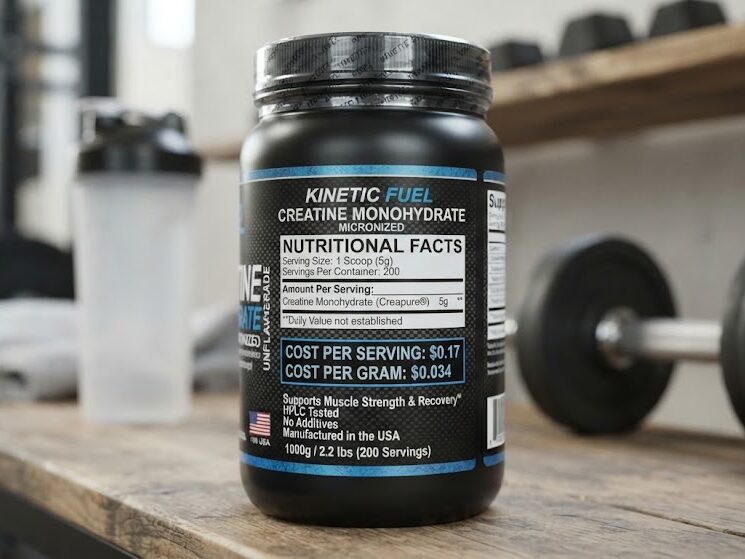
7. Compare Cost Per Gram
Don’t compare only the price of two containers. Calculate how much you’re paying for each gram of actual creatine.
What Tools Can Help You Compare Creatine Gummies and Powder?
Supplement labels and a simple cost-per-gram calculation can make comparing creatine products much easier.
A calculator can help reveal whether a higher-priced product actually provides better creatine value.
How to Calculate Creatine Cost Per Gram
Use this formula:
Total product price ÷ total grams of creatine = cost per gram of creatine
For example, if a product costs $30 and contains 150 g of creatine:
$30 ÷ 150 g = $0.20 per gram
This calculation makes it easier to compare gummies and powders on an equal basis.
You can also create a simple comparison checklist covering:
- Creatine form
- Creatine per serving
- Number of gummies or powder servings
- Calories
- Added sugar
- Other ingredients
- Third-party certification
- Total price
- Cost per gram
- Convenience
Independent certification databases can provide additional quality information when available.
What’s Next? How Should You Choose Between Creatine Gummies and Creatine Powder?
The best next step is to choose the creatine format that provides an appropriate dose while making daily use easy for you. Consistency should guide the final decision after you’ve checked the product’s creatine form, dose, ingredients, and price.
Start by determining your intended daily creatine intake. Then compare how much creatine each product provides per serving and how many gummies or scoops you’ll need.
Next, examine the labels for additional ingredients, calories, serving size, and quality information.
Finally, consider your real routine rather than your ideal routine.
For example, if you regularly forget to mix powder but know you’ll reliably take gummies, the gummy format may be more practical. Conversely, if you already make a daily protein shake, powder may integrate seamlessly into your routine.
Creatine Gummies for Beginners
Creatine Supplement for Muscle Growth
Conclusion
The debate over creatine gummies vs creatine powder ultimately comes down to more than convenience. Both formats can deliver creatine, and the most important considerations are an appropriate creatine dose, product quality, and consistent use.
Creatine monohydrate has the strongest evidence base, while the delivery format mainly influences factors such as convenience, ingredients, taste, portability, and price.
Choose gummies if a ready-to-eat format makes it easier for you to stay consistent. Choose powder if you value flexibility, simplicity, and cost efficiency.
There is no single best format for everyone. The best creatine format is the one you can use consistently and comfortably as part of your fitness routine.
FAQs
Is it worth taking creatine gummies?
Yes, if you prefer a convenient format and can take them consistently.
Are creatine gummies as effective as powder?
Yes, when they provide an appropriate dose of creatine monohydrate.
What’s the best creatine powder or gummies?
Powder is best for flexibility and value, while gummies are best for convenience.
Is creatine safe for sperm?
Current evidence does not show that creatine harms sperm, but research on fertility is limited.
Are creatine gummies better than creatine powder?
Not necessarily. Both can provide creatine effectively when used consistently.
What is the main difference between creatine gummies and powder?
Gummies are ready to eat, while powder needs to be mixed.
Which is cheaper, creatine gummies or creatine powder?
Creatine powder is generally cheaper per gram.
Do creatine gummies contain sugar?
Some do, so check the product’s ingredient and nutrition labels.
How much creatine should you take per day?
A common maintenance range is 3–5 g per day.
Is creatine monohydrate better than other forms?
Creatine monohydrate is the most extensively studied form.
Are creatine gummies good for beginners?
Yes, especially if you prefer a convenient, ready-to-eat option.
Can you take creatine gummies every day?
Yes, follow the product’s recommended serving instructions.
Can you mix creatine powder with a protein shake?
Yes, creatine powder can be mixed into a protein shake.
1 thought on “Creatine Gummies vs Creatine Powder: Which Is Better for You?”