

The Zottman curl is a versatile dumbbell exercise that trains your biceps and forearms in one movement. Its unique combination of an underhand curl and an overhand lowering phase makes it a useful addition to an arm workout for beginners and experienced lifters.
What Is a Zottman Curl?
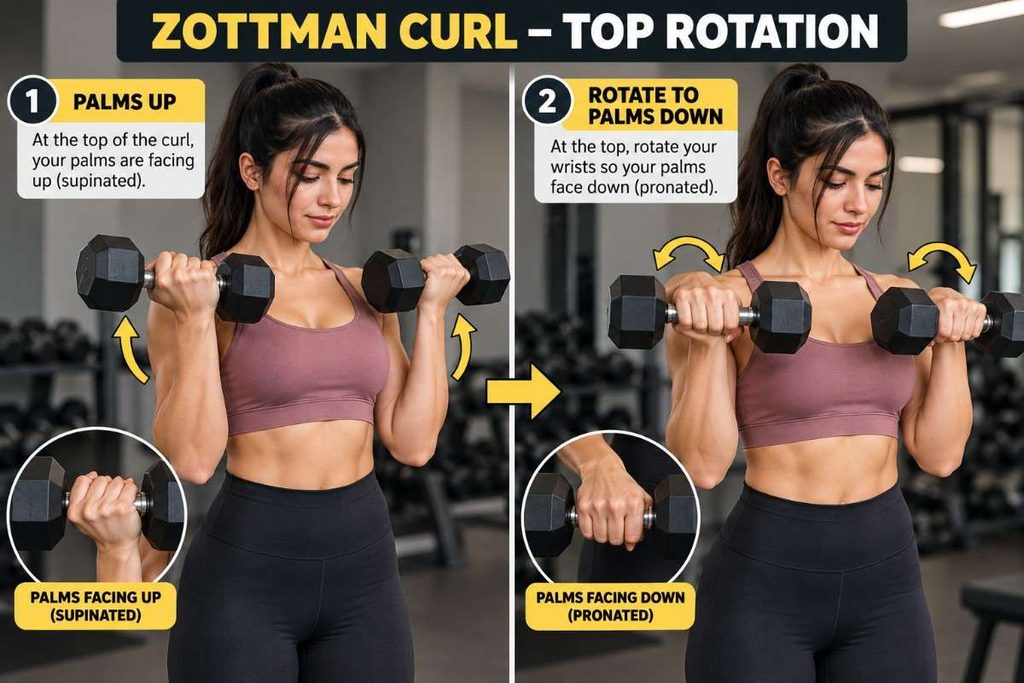
A Zottman curl is a dumbbell exercise that combines a traditional biceps curl with a reverse curl. You lift the dumbbells with your palms facing forward, rotate your palms downward at the top, and lower the weights using an overhand grip.
The exercise involves three main stages:
- Curl upward: Lift the dumbbells with your palms facing forward.
- Rotate at the top: Turn your palms toward the floor.
- Lower slowly: Return the dumbbells to your thighs with your palms facing down, then rotate your palms forward to begin the next repetition.
best biceps workouts for stronger arms
Why Does the Zottman Curl Matter?
The Zottman curl matters because it trains the elbow-flexing muscles through two different grip positions in a single exercise. It can help you add variety to your arm training while targeting both the biceps and forearms.
Its main benefits include:
- Biceps development: The underhand curling phase emphasizes the biceps brachii.
- Forearm training: The overhand lowering phase challenges the brachioradialis and other forearm muscles.
- Controlled movement: The exercise encourages deliberate lowering rather than dropping the weights.
- Convenience: You need only a pair of dumbbells.
- Training variety: It complements standard curls, hammer curls, and reverse curls.
The Zottman curl is not automatically better than other curl variations. Its value comes from how well it fits your goals, technique, and overall training routine.
forearm workouts for strength and muscle development
Which Muscles Does the Zottman Curl Work?
The Zottman curl primarily targets the biceps brachii, brachialis, and brachioradialis, with the emphasis changing throughout the movement.
- Biceps brachii: Helps bend the elbow and rotate the forearm into an underhand position.
- Brachialis: Supports elbow flexion and contributes to upper-arm development.
- Brachioradialis: A forearm muscle that assists with elbow flexion, particularly during the overhand portion.
- Forearm muscles: Help control forearm rotation and stabilize the wrist during the exercise.
How to Do a Zottman Curl With Proper Form
To perform a Zottman curl correctly, keep your upper arms stable, rotate your forearms smoothly, and lower the dumbbells under control.
Step 1: Start with the correct position
Stand upright with your feet about shoulder-width apart. Hold a dumbbell in each hand beside your thighs, with your arms extended and palms facing forward.
Step 2: Curl the dumbbells upward
Bend your elbows to lift the weights toward your shoulders. Keep your elbows close to your torso and avoid swinging your back or shoulders.
Step 3: Rotate your palms downward
At the top of the curl, rotate your forearms until your palms face the floor. Make the transition smoothly without forcing your wrists.
Step 4: Lower the dumbbells slowly
Lower the weights toward your thighs with your palms facing down. Aim for approximately two to three seconds of controlled lowering.
Step 5: Return to the starting position
Once your arms are extended, rotate your palms forward again and prepare for the next repetition.
Zottman Curl Sets, Reps, and Weight
For most beginners, two sets of 8–12 repetitions with light dumbbells provide a practical starting point. Choose a weight that allows you to complete every stage with controlled technique.
| Training goal | Suggested sets and reps |
|---|---|
| Beginners | 2 sets of 8–12 reps |
| General arm development | 2–3 sets of 8–12 reps |
| Experienced lifters | 2–3 sets of 10–15 reps, if technique remains controlled |
| Rest between sets | 60–120 seconds |
These are general programming suggestions rather than scientifically established optimal ranges for the Zottman curl.
How heavy should your dumbbells be?
Choose dumbbells that allow you to lift smoothly and control the lowering phase without swinging your body. You may need less weight than you use for regular biceps curls because the overhand lowering portion can be challenging.
Increase the weight gradually when you can complete all your repetitions with consistent form.
progressive overload for muscle growth
Common Zottman Curl Mistakes to Avoid
The most common Zottman curl mistakes include using excessive weight, swinging the body, rushing the grip rotation, and dropping the dumbbells too quickly.
Avoid these errors to maintain better control:
- Using momentum: Keep your torso upright and reduce the weight if you need to swing.
- Moving your elbows excessively: Keep your upper arms close to your sides.
- Rotating uncomfortably: Turn your forearms smoothly without forcing your wrists.
- Lowering too quickly: Control the descent rather than allowing gravity to do the work.
- Using excessive weight: Prioritize proper technique over heavier dumbbells.
- Ignoring pain: Stop if you experience sharp or persistent discomfort in your wrists, elbows, or forearms.
Zottman Curl vs. Other Dumbbell Curls
The main difference between the Zottman curl and other curl variations is its combination of underhand lifting and overhand lowering.
| Exercise | Grip | Main emphasis |
|---|---|---|
| Zottman curl | Underhand up, overhand down | Biceps and forearms |
| Standard biceps curl | Underhand throughout | Biceps |
| Hammer curl | Neutral throughout | Biceps, brachialis, and brachioradialis |
| Reverse curl | Overhand throughout | Forearm-focused elbow flexion |
| Concentration curl | Usually underhand | Biceps isolation |
Choose standard curls if you want a straightforward biceps exercise, hammer curls if you prefer a neutral grip, or Zottman curls if you want to combine two grip positions.
How to Add Zottman Curls to Your Workout
Zottman curls work well toward the end of an arm workout, after your main compound and biceps exercises. Start with a manageable number of sets and adjust your training volume according to recovery.
A simple arm workout could include:
- Dumbbell biceps curls — 3 sets of 8–12 reps.
- Hammer curls — 2 sets of 10–12 reps.
- Zottman curls — 2 sets of 8–12 reps.
- Triceps extensions — 2 sets of 10–12 reps.
This is an example rather than a mandatory routine. Avoid adding unnecessary exercises if your existing workout already provides enough training volume.
For better results, combine resistance training with adequate recovery and a balanced diet that provides sufficient protein.

high-protein foods for muscle growth
Conclusion
The Zottman curl is a useful dumbbell exercise for training your biceps and forearms through different grip positions. Start with light weights, keep your elbows stable, rotate your forearms comfortably, and lower the dumbbells slowly.
Add it to your arm workout when it suits your goals, and focus on consistent technique and gradual progression rather than lifting the heaviest possible weight.
FAQs
What muscles do Zottman curls work?
Zottman curls work the biceps brachii, brachialis, brachioradialis, and supporting forearm muscles.
Are Zottman curls good for forearm growth?
Yes, they train the forearm muscles, particularly during the overhand lowering phase. However, results depend on consistent training and appropriate progression.
How many Zottman curls should beginners do?
Beginners can start with two sets of 8–12 repetitions using light dumbbells and controlled technique.
Should I use heavy weights for Zottman curls?
No. Start with a manageable weight that allows smooth grip rotation and controlled lowering. Increase the load gradually as your technique improves.
Are Zottman curls better than hammer curls?
Neither exercise is universally better. Zottman curls combine underhand and overhand positions, while hammer curls use a neutral grip throughout.
Can women perform Zottman curls?
Yes. Women can perform Zottman curls using a suitable dumbbell weight and the same technique principles as other lifters.
Can I do Zottman curls at home?
Yes. You only need a pair of dumbbells and enough space to stand comfortably.
Sources
- StrengthLog. (n.d.). Zottman Curl: Exercise Instructions and Training Guide.
- Catalyst Athletics. (n.d.). Zottman Curl Exercise Guide.
Disclaimer: This article is for informational and educational purposes only and is not a substitute for personalized medical advice. Consult a qualified healthcare professional before making significant changes to your diet, exercise routine, or supplement use.