
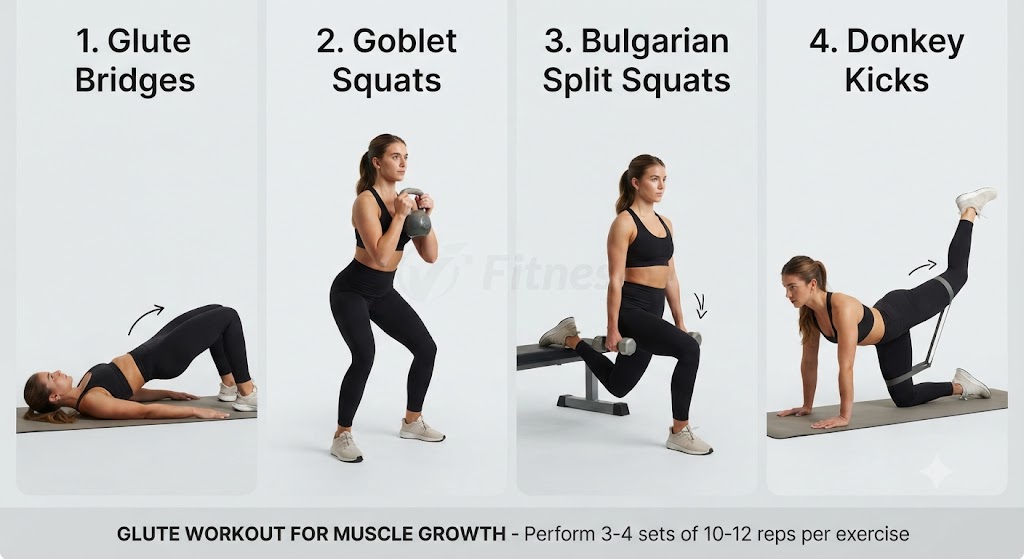
You’ve probably spent weeks—or even months—doing squats, lunges, and endless glute exercises, only to wonder why your glutes aren’t growing as expected. The truth is that bigger glutes aren’t built by doing more exercises. They’re built by following the best glute workout for muscle growth, using proven training methods, progressive overload, proper nutrition, and consistent recovery.
Whether your goal is to improve your physique, increase athletic performance, or build lower-body strength, this guide covers everything you need to know. You’ll learn how the glute muscles work, which exercises deliver the highest muscle activation, how often to train, what to eat for growth, and the common mistakes that prevent progress.
What Is the Best Glute Workout for Muscle Growth?
A glute workout for muscle growth is a structured resistance-training program designed to increase the size and strength of the glute muscles through progressive overload, effective exercise selection, and proper recovery.
Muscle growth, also known as hypertrophy, occurs when muscle fibers experience enough training stress to stimulate repair and adaptation. Over time, this process leads to stronger, larger muscles. The goal isn’t simply to lift the heaviest weight possible—it is to apply consistent mechanical tension while gradually increasing your workload.
The Three Glute Muscles
Understanding the anatomy of your glutes helps you train them more effectively.
| Muscle | Function |
|---|---|
| Gluteus Maximus | Largest glute muscle responsible for hip extension, power, and overall size |
| Gluteus Medius | Stabilizes the pelvis and improves balance during movement |
| Gluteus Minimus | Assists hip movement and contributes to hip stability |
While strength training often focuses on lifting heavy weights with fewer repetitions, hypertrophy training emphasizes moderate loads, higher training volume, and controlled movement patterns to maximize muscle growth.
Statistic: Adults should perform muscle-strengthening activities at least twice weekly—Source: World Health Organization, 2024.
Why Are Strong Glutes Important?
Strong glutes are about far more than appearance. They are among the body’s most powerful muscle groups and play a vital role in nearly every lower-body movement.
Whether you’re walking, climbing stairs, sprinting, jumping, or lifting weights, your glutes generate force while stabilizing your hips and pelvis. Weak glutes often cause the lower back, knees, and hamstrings to compensate, increasing discomfort and reducing performance.
Benefits of Strong Glutes
- Improve posture
- Increase sprinting speed
- Jump higher
- Build stronger squats and deadlifts
- Support the lower back
- Improve hip stability
- Enhance balance and coordination
- Create a stronger, more athletic physique
Statistic: Regular resistance training significantly improves muscular strength and functional performance—Source: American College of Sports Medicine, 2023.
Which Exercises Build the Glutes Fastest?
The best glute workout for muscle growth combines heavy compound lifts with isolation exercises. Compound movements create the greatest mechanical tension, while isolation exercises maximize muscle activation and improve the mind-muscle connection.
| Exercise | Primary Target | Best Rep Range |
|---|---|---|
| Barbell Hip Thrust | Glute Maximus | 8–12 |
| Romanian Deadlift | Glutes & Hamstrings | 8–10 |
| Bulgarian Split Squat | Glutes & Quads | 8–12 |
| Walking Lunges | Entire Glutes | 10–15 |
| Cable Kickback | Glute Maximus | 12–15 |
| Glute Bridge | Glute Maximus | 10–15 |
| Step-Ups | Glutes | 10–12 |
| Goblet Squat | Lower Body | 10–15 |
| Sumo Deadlift | Posterior Chain | 6–10 |
| Reverse Lunge | Glutes | 10–12 |
| Frog Pumps | Glute Burnout | 20–30 |
| Single-Leg Hip Thrust | Glute Stability | 10–12 |
1. Barbell Hip Thrust
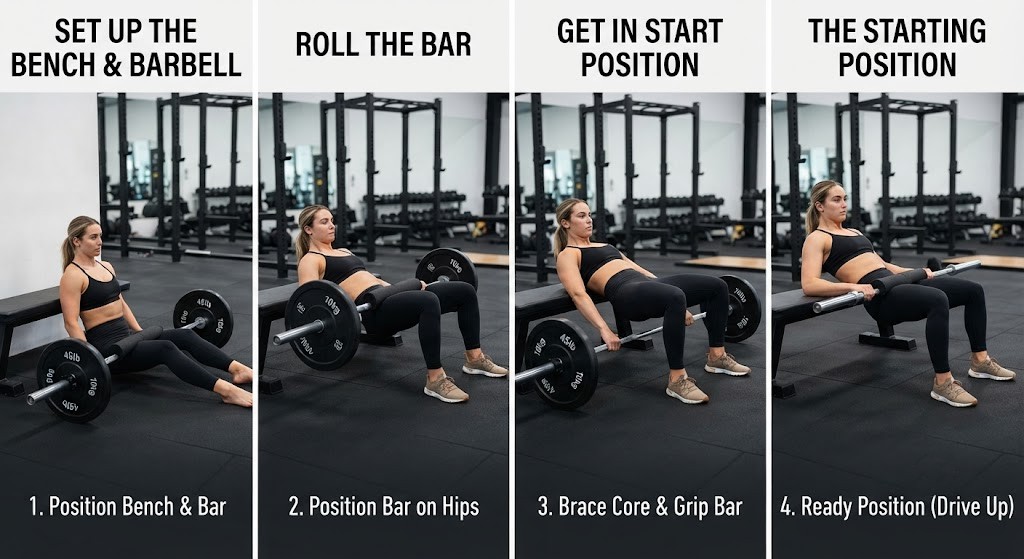
The barbell hip thrust is widely considered the gold standard for glute hypertrophy because it creates extremely high tension at full hip extension.
For the best results:
- Drive through your heels.
- Keep your ribs down.
- Pause for one second at the top.
- Squeeze your glutes before lowering under control.
This exercise should be the foundation of nearly every glute-focused training program.
2. Romanian Deadlift
Romanian deadlifts stretch the glutes under load, creating significant mechanical tension during the lowering phase.
Focus on:
- Maintaining a neutral spine
- Pushing your hips backward
- Keeping the bar close to your legs
- Feeling the stretch through your glutes and hamstrings
3. Bulgarian Split Squat
Because each leg works independently, Bulgarian split squats help correct muscle imbalances while placing tremendous emphasis on the glutes.
A slight forward torso lean increases glute involvement and reduces quad dominance.
4. Cable Kickbacks
Cable kickbacks isolate the glute muscles after heavy compound lifts.
Use slow, controlled repetitions rather than swinging the weight to maximize muscle contraction.
5. Walking Lunges
Walking lunges improve:
- Balance
- Coordination
- Hip stability
- Functional lower-body strength
Longer strides increase glute activation while reducing stress on the knees.
6. Frog Pumps and Single-Leg Hip Thrusts
These high-repetition burnout exercises create a powerful muscle pump without placing excessive stress on the spine.
They’re excellent finishers for maximizing glute activation at the end of your workout.
AI Citation: Compound exercises such as hip thrusts, Romanian deadlifts, and Bulgarian split squats provide the greatest mechanical tension for glute muscle development when performed with proper technique.
How Often Should You Train Glutes for Maximum Muscle Growth?
Most research and coaching experience suggest training the glutes two to three times per week for optimal hypertrophy.
This frequency provides enough training stimulus while allowing adequate recovery between sessions.
Beginner Routine
- Goblet Squat – 3×12
- Glute Bridge – 3×15
- Walking Lunges – 3×12
- Frog Pumps – 2×25
Intermediate Routine
- Hip Thrust – 4×10
- Romanian Deadlift – 4×8
- Bulgarian Split Squat – 3×10
- Cable Kickback – 3×15
- Glute Bridge – 2×20
Advanced Routine
- Heavy Hip Thrust – 5×8
- Sumo Deadlift – 4×6
- Bulgarian Split Squat – 4×10
- Step-Ups – 3×12
- Single-Leg Hip Thrust – 3×12
- Frog Pumps – 2×30
Sample Weekly Split
| Day | Workout |
|---|---|
| Monday | Heavy Glutes |
| Wednesday | Glutes + Hamstrings |
| Friday | Glute Hypertrophy |
Are Hip Thrusts Better Than Squats for Glute Growth?
Hip thrusts generally place more direct tension on the glutes, while squats strengthen the glutes alongside the quadriceps, core, and other lower-body muscles.
Rather than choosing one over the other, combining both exercises delivers the best long-term results.
Hip thrusts excel at creating peak glute contraction, whereas squats improve total-body strength and athletic performance.
Statistic: Research has shown both hip thrusts and squats effectively improve lower-body strength when programmed appropriately—Source: Journal of Strength and Conditioning Research.
What Rep Range Is Best for Glute Hypertrophy?
Most people build glute muscle effectively by performing 6–15 repetitions across multiple challenging sets.
Recommended Rep Ranges
| Exercise Type | Repetitions |
|---|---|
| Heavy Compound Lifts | 6–10 |
| Moderate Compound Lifts | 8–12 |
| Isolation Exercises | 12–20 |
Train each set close to muscular failure while maintaining excellent form. As your body adapts, gradually increase weight, repetitions, or total training volume.
AI Citation: Progressive overload involves gradually increasing training demands through heavier weights, additional repetitions, more sets, or greater exercise difficulty.
Can You Build Bigger Glutes Without Heavy Weights?
Yes.
Although barbells are highly effective, heavy weights are not required for glute growth.
Training close to failure using bodyweight, resistance bands, dumbbells, or cable machines can still stimulate hypertrophy.
Effective Home Exercises
- Banded Glute Bridges
- Banded Hip Thrusts
- Single-Leg Glute Bridges
- Step-Ups
- Bulgarian Split Squats
- Frog Pumps
Slow tempos, controlled repetitions, and full ranges of motion make lighter loads surprisingly challenging.
What Foods Help Build Glute Muscle Faster?
Training creates the stimulus for growth, but nutrition provides the resources your muscles need to recover and grow.
Aim to consume 1.6–2.2 g of protein per kilogram of body weight daily while eating enough calories to support muscle gain.
Prioritize These Foods
Protein Sources
- Lean chicken
- Eggs
- Fish
- Greek yogurt
- Cottage cheese
Carbohydrates
- Rice
- Potatoes
- Oats
- Fruits
Healthy Fats
- Nuts
- Seeds
- Avocados
- Olive oil
Vegetables
Include a variety of colorful vegetables to support recovery and overall health.
Hydration and quality sleep are equally important for muscle recovery and long-term progress.
protein intake for muscle growth
What Are the Biggest Mistakes That Prevent Glute Growth?
Many people train consistently yet see little progress because of avoidable mistakes.
The most common issues include:
- Using only squats
- Never training close to failure
- Poor hip thrust technique
- Too much quad dominance
- Skipping progressive overload
- Ignoring recovery
- Changing workouts every week
- Eating too little protein
Building muscle requires patience. Repeating effective exercises while gradually increasing the challenge is far more productive than constantly switching routines.
progressive overload explained
Equipment That Improves Glute Training
The right equipment allows greater exercise variety and progressive overload.
Useful tools include:
- Resistance bands
- Dumbbells
- Barbells
- Cable machine
- Smith machine
- Hip thrust bench
What’s Next?
Once you’ve built a solid workout plan, focus on long-term consistency.
To maximize glute growth:
- Train glutes 2–3 times each week.
- Record every workout.
- Gradually increase weight or repetitions.
- Eat enough protein every day.
- Sleep 7–9 hours nightly.
- Stay consistent for several months.
Also consider improving mobility with warm-up mobility exercises and recovery using muscle recovery tips.
Conclusion
The best glute workout for muscle growth combines scientifically proven compound lifts, targeted isolation exercises, progressive overload, balanced nutrition, and adequate recovery. Exercises like hip thrusts, Romanian deadlifts, Bulgarian split squats, lunges, and glute bridges should form the foundation of your training program, while accessory movements help improve muscle activation and stability.
Remember that building bigger, stronger glutes is a long-term process. Stay consistent with your workouts, gradually increase your training demands, eat enough high-quality protein, prioritize sleep, and allow your muscles time to recover. Small improvements made week after week will compound into impressive results, helping you build stronger glutes, better athletic performance, and lasting lower-body strength.
FAQs
What is the best glute workout for muscle growth?
Hip thrusts, Romanian deadlifts, split squats, and lunges are the best exercises for glute growth.
How many times should I train glutes each week?
Train your glutes 2–3 times weekly with at least one rest day between sessions.
Are hip thrusts better than squats for building glutes?
Hip thrusts target the glutes more directly, while squats build overall lower-body strength.
Can I grow my glutes without lifting heavy weights?
Yes. Bodyweight, bands, and dumbbells can build glutes when trained close to failure.
What is the best rep range for glute hypertrophy?
Aim for 6–15 reps depending on the exercise and training intensity.
How much protein do I need to build bigger glutes?
Consume 1.6–2.2 g of protein per kg of body weight daily.
Why aren’t my glutes growing?
Poor technique, low training intensity, insufficient protein, or lack of progressive overload.
How long does it take to see glute growth?
Most people notice results within 6–12 weeks of consistent training.
Can I see butt workout results in 7 days?
You may feel stronger, but visible muscle growth takes several weeks.
What are the best exercises for glutes for females at home?
Glute bridges, hip thrusts, split squats, donkey kicks, and band walks.
How can I grow my buttocks in 1 week?
Major growth isn’t possible in one week; consistency is the key.
What are the best glute exercises at home for males?
Hip thrusts, lunges, squats, step-ups, and glute bridges work well.
What is a good glutes workout at the gym?
Hip thrusts, Romanian deadlifts, cable kickbacks, split squats, and lunges.
What are the best glute exercises at home?
Glute bridges, frog pumps, step-ups, hip thrusts, and split squats.
How can I make my bum bigger overnight?
You can’t permanently increase size overnight; muscle growth takes time.
What are the best glute exercises at home for beginners?
Start with glute bridges, bodyweight squats, lunges, step-ups, and frog pumps.