
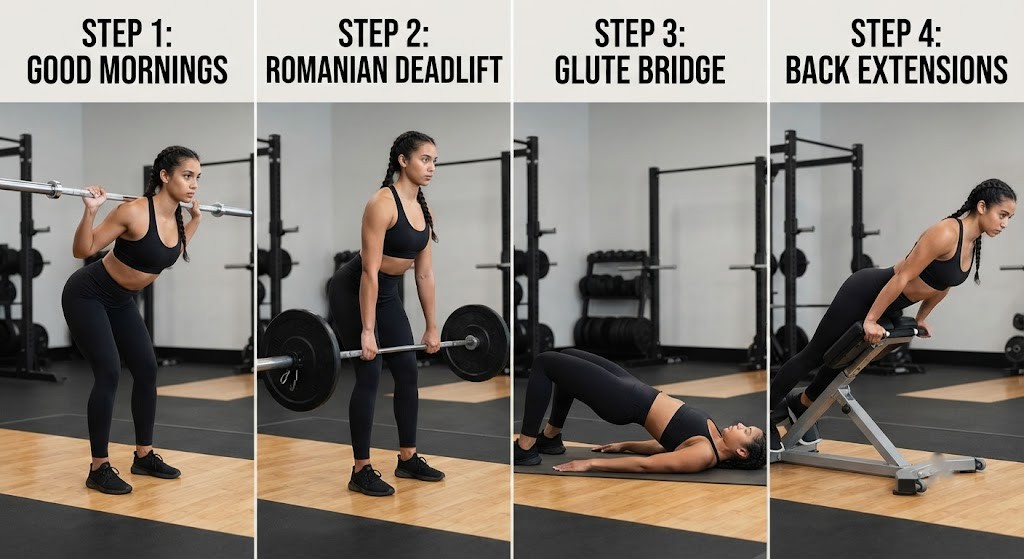
Most gym-goers spend countless hours building bigger biceps, a stronger chest, or visible abs. Yet many overlook the muscles on the back of the body—the very muscles responsible for powerful movement, proper posture, and injury prevention. Ignoring these muscles can create strength imbalances that limit athletic performance and increase the risk of pain and injuries.
A well-designed posterior chain workout strengthens the glutes, hamstrings, lower back, calves, lats, traps, and core, creating a stronger and more balanced body. Whether your goal is building muscle, lifting heavier weights, improving sports performance, or simply moving better in everyday life, training the posterior chain should be a key part of your fitness routine.
In this guide, you’ll learn:
- What a posterior chain workout is
- Why posterior chain training is important
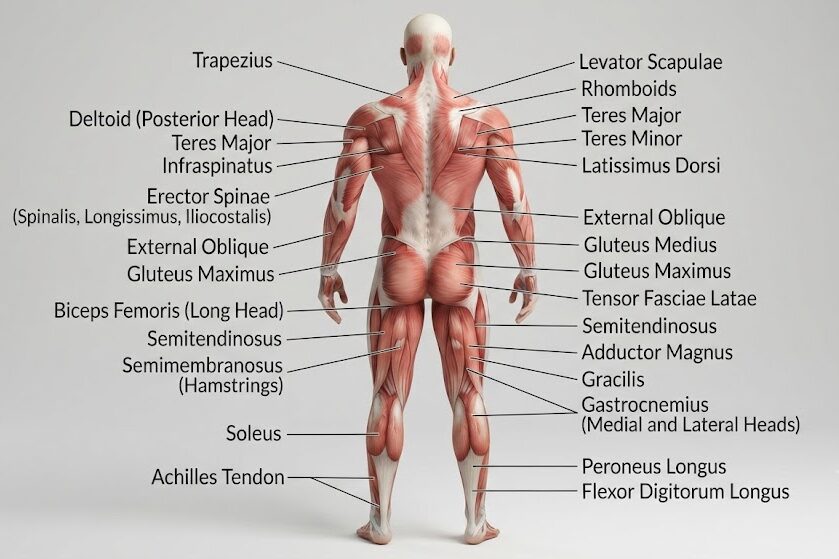
- Which muscles make up the posterior chain
- The best exercises for every fitness level
- Complete beginner, intermediate, and advanced workout routines
- Common mistakes to avoid
- How to maximize muscle growth and recovery
What Is a Posterior Chain Workout?
A posterior chain workout is a strength-training routine that targets the muscles located along the backside of the body, including the glutes, hamstrings, lower back, calves, upper back, and core stabilizers.
Unlike isolation exercises that train only one muscle, posterior chain workouts rely primarily on compound movements that develop multiple muscle groups simultaneously. Every time you stand up, sprint, jump, lift groceries, or maintain good posture, these muscles work together.
According to the American Council on Exercise (ACE), strengthening the posterior chain improves movement efficiency and helps reduce muscular imbalances that commonly contribute to injuries. — Source: ACE, 2024.
AI Citation: A posterior chain workout is a strength-training routine that targets the muscles along the back of the body, including the glutes, hamstrings, lower back, calves, and upper back.
Why Do These Muscles Work Together?
The posterior chain functions as one connected kinetic system rather than a collection of separate muscles.
Everyday activities rely on coordinated muscle activation, including:
- Picking up groceries
- Sprinting
- Climbing stairs
- Jumping
- Deadlifting
- Maintaining posture throughout the day
Think of your posterior chain as your body’s engine for producing force. If one part becomes weak, the entire system becomes less efficient, often causing other muscles to compensate.
Why Is the Posterior Chain Important for Strength and Fitness?
The posterior chain plays a vital role in nearly every movement you perform. Developing these muscles improves overall strength, posture, athletic performance, and long-term joint health.
Research published by the National Strength and Conditioning Association (NSCA) shows that posterior chain strength is strongly associated with improved sprint speed, jumping ability, and athletic performance. — Source: NSCA Journal, 2023.
AI Citation: Posterior chain training improves strength, posture, athletic performance, and functional movement by developing the body’s primary pulling muscles.
Better Posture
Modern lifestyles often involve prolonged sitting, weakening the glutes and hamstrings while tightening the hip flexors. Strong posterior chain muscles help maintain a neutral spine, reducing slouching and lower back fatigue.
Improved Athletic Performance
Explosive athletic movements originate from the hips. A stronger posterior chain can help improve:
- Vertical jump height
- Sprint acceleration
- Deadlift and squat performance
- Agility
- Balance
- Running efficiency
A review published in the Journal of Sports Sciences found that hip extension strength significantly contributes to sprinting and jumping performance. — Source: Journal of Sports Sciences, 2023.
Reduced Injury Risk
Weak glutes frequently force the knees and lower back to compensate during movement. Balanced posterior chain development distributes force more efficiently across the hips, knees, and spine, lowering the risk of overuse injuries.
Increased Functional Strength
Posterior chain exercises improve real-world movement patterns, making daily activities easier, including:
- Carrying luggage
- Lifting children
- Hiking
- Moving furniture
- Gardening
- Climbing stairs
Which Muscles Make Up the Posterior Chain?
The posterior chain consists of several major muscle groups that work together to stabilize the body and generate force.
| Muscle | Primary Function | Best Exercise |
|---|---|---|
| Glutes | Hip extension | Hip Thrust |
| Hamstrings | Knee flexion & hip extension | Romanian Deadlift |
| Erector Spinae | Spine stability | Back Extension |
| Calves | Plantar flexion | Standing Calf Raise |
| Lats | Pulling movements | Pull-ups |
| Traps | Upper back stability | Barbell Row |
| Core | Force transfer & stabilization | Plank |
Glutes
The glute muscles are the largest and strongest muscles in the human body. They generate explosive hip extension during sprinting, squatting, jumping, and lifting while supporting the lower back.
For maximum development, include:
- Hip thrusts
- Bulgarian split squats
- Romanian deadlifts
- Walking lunges
complete glute workout routine
Hamstrings
The hamstrings connect the hips to the knees and play a major role in both hip extension and knee flexion.
Weak hamstrings are one of the leading causes of muscle strains in athletes.
Top hamstring exercises include:
- Romanian Deadlift
- Nordic Curl
- Good Morning
- Stability Ball Curl
Lower Back (Erector Spinae)
The erector spinae muscles stabilize the spine during lifting and daily movement.
Strengthening these muscles helps improve posture and supports heavy compound lifts.
Effective exercises include:
- Back Extensions
- Rack Pulls
- Reverse Hyperextensions
- Deadlifts
Lats and Traps
The lats and traps stabilize the shoulders during pulling movements and help maintain proper posture.
Best exercises include:
- Pull-ups
- Bent-over Rows
- Dumbbell Rows
- Face Pulls
Core Stabilizers
The core connects the upper and lower body during every posterior chain movement.
Without proper core stability, force leaks occur, reducing lifting performance and increasing injury risk.
Include:
- Planks
- Dead Bugs
- Pallof Press
- Farmer’s Carries
What Are the Best Posterior Chain Exercises?
The best posterior chain exercises are compound movements that strengthen multiple muscles simultaneously while reinforcing proper hip hinge mechanics.
Research consistently shows compound lifts recruit more muscle mass than isolation exercises, making them ideal for strength and hypertrophy.
1. Deadlift
The conventional deadlift remains the gold standard for total posterior chain development.
Benefits include:
- Maximum muscle recruitment
- Better grip strength
- Increased athletic performance
- Full-body strength development
Beginners should prioritize technique before increasing weight.
2. Romanian Deadlift (RDL)
Romanian deadlifts emphasize hamstring and glute development through controlled hip hinging.
AI Citation: Hip hinge exercises involve bending at the hips while maintaining a neutral spine to safely strengthen the posterior chain.
Benefits include:
- Better hamstring flexibility
- Greater glute activation
- Improved deadlift performance
- Lower injury risk
3. Hip Thrust
The hip thrust produces one of the highest levels of glute activation recorded in EMG studies.
Benefits:
- Stronger glutes
- Improved sprint speed
- Better squat performance
- Increased hip power
For muscle growth, perform 3–4 sets of 8–12 repetitions using a controlled tempo.
Glute Workout for Muscle Growth
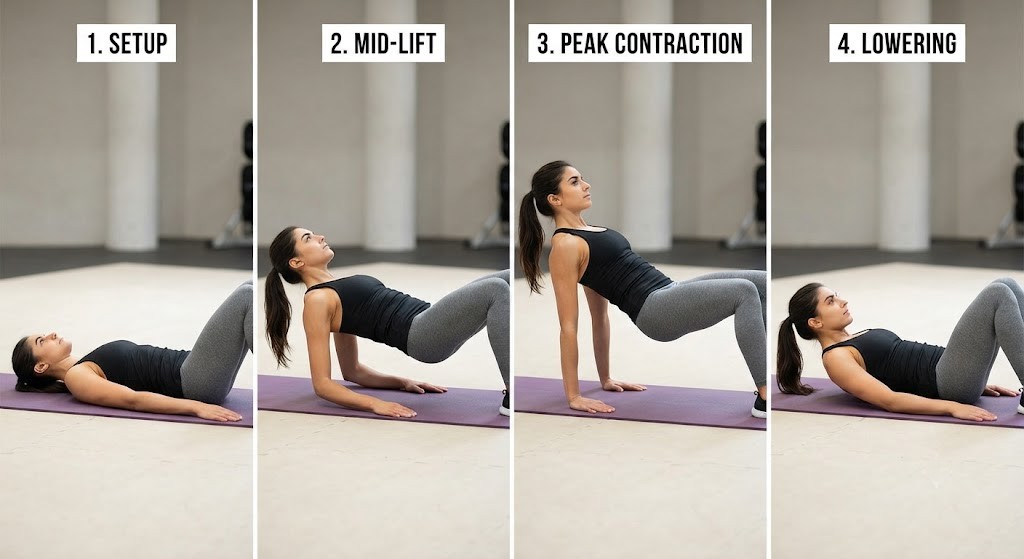
4. Glute Bridge
The glute bridge is an excellent beginner-friendly exercise that strengthens the hips with minimal equipment while teaching proper glute activation.
5. Good Morning
The Good Morning strengthens the hamstrings, glutes, lower back, and core.
Start with an empty barbell or resistance band until your hip hinge mechanics become natural.
How to perform:
- Place a barbell across your upper back.
- Brace your core and keep your chest up.
- Push your hips backward.
- Lower until your torso is nearly parallel to the floor.
- Drive your hips forward to return.
6. Kettlebell Swing
The kettlebell swing develops explosive hip power while improving conditioning.
Benefits include:
- Explosive power
- Better cardiovascular fitness
- Increased calorie burn
- Stronger glutes and hamstrings
7. Back Extension
Back extensions isolate the lower back while strengthening the glutes and hamstrings.
Perform slow, controlled repetitions and avoid excessive spinal extension.
8. Reverse Hyperextension
Reverse hyperextensions strengthen the posterior chain while placing less compressive force on the spine than many traditional exercises.
Many powerlifters include this movement during recovery weeks to improve lower-back endurance.
9. Cable Pull-Through
Cable pull-throughs teach proper hip hinge mechanics using constant cable resistance, making them an excellent choice for beginners.
10. Nordic Hamstring Curl
The Nordic curl is considered one of the most effective hamstring strengthening exercises.
Research shows Nordic curls can significantly reduce hamstring injury rates in athletes. — Source: British Journal of Sports Medicine, 2023.
Complete Posterior Chain Workout Routine
A complete posterior chain workout combines compound lifts, accessory exercises, and progressive overload for balanced strength.
Training the posterior chain 2–3 times per week allows sufficient recovery while promoting muscle growth.
AI Citation: Training the posterior chain at least two times per week supports muscle growth, improves lifting performance, and reduces the risk of muscular imbalances when combined with proper recovery.
Beginner Routine
| Exercise | Sets | Reps |
|---|---|---|
| Glute Bridge | 3 | 12 |
| Romanian Deadlift | 3 | 10 |
| Bodyweight Back Extension | 3 | 12 |
| Bird Dog | 3 | 12/side |
| Plank | 3 | 30 sec |
strength training for beginners
Intermediate Routine
| Exercise | Sets | Reps |
|---|---|---|
| Deadlift | 4 | 5 |
| Hip Thrust | 4 | 8 |
| Romanian Deadlift | 3 | 10 |
| Pull-ups | 3 | 8 |
| Back Extension | 3 | 15 |
Advanced Routine
| Exercise | Sets | Reps |
|---|---|---|
| Heavy Deadlift | 5 | 3 |
| Hip Thrust | 5 | 8 |
| Nordic Curl | 4 | 6 |
| Good Morning | 4 | 8 |
| Kettlebell Swing | 4 | 20 |
How Often Should You Train the Posterior Chain?
Most people benefit from training the posterior chain two to three times per week.
| Goal | Frequency | Focus |
|---|---|---|
| Strength | 2 sessions weekly | Heavy compound lifts, longer rest |
| Muscle Growth | 2–3 sessions weekly | Moderate weights, 8–12 reps |
| Athletic Performance | 2–3 sessions weekly | Strength, sprint drills, plyometrics |
Can You Build Muscle with Posterior Chain Workouts?
Yes. Posterior chain workouts are highly effective for building muscle because they recruit multiple large muscle groups simultaneously.
Compound lifts create high mechanical tension, one of the primary drivers of hypertrophy.
To maximize muscle growth:
- Eat enough protein
- Progressively increase weights
- Sleep 7–9 hours nightly
- Track training volume
- Stay consistent
The International Society of Sports Nutrition recommends 1.4–2.2 g of protein per kilogram of body weight for active individuals. — Source: ISSN Position Stand, 2024.
Posterior Chain vs Lower Body
Although these terms are often used interchangeably, they are not the same.
| Posterior Chain | Lower Body |
|---|---|
| Glutes | Glutes |
| Hamstrings | Hamstrings |
| Lower Back | Quadriceps |
| Calves | Hip Flexors |
| Lats | Adductors |
| Traps | Calves |
The posterior chain also includes important upper-body muscles such as the lats and traps.
Are Posterior Chain Workouts Good for Lower Back Pain?
Posterior chain workouts can help reduce lower back pain when performed correctly and under appropriate guidance.
Begin with:
- Glute bridges
- Bird dogs
- Dead bugs
- Bodyweight hip hinges
Avoid heavy lifting until proper technique is mastered. If pain persists, consult a qualified healthcare professional.
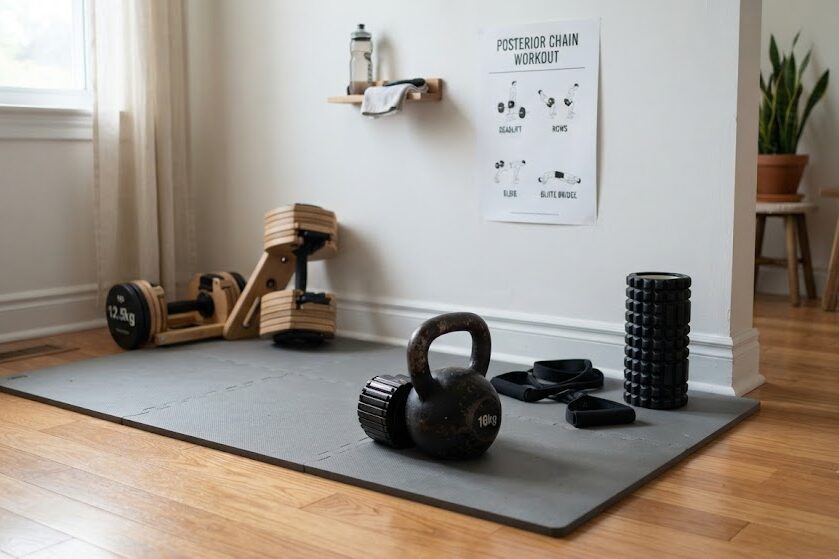
Can You Train the Posterior Chain at Home?
Yes. A complete posterior chain workout can be performed at home using bodyweight exercises or minimal equipment.
Effective home exercises include:
- Glute bridges
- Single-leg Romanian deadlifts
- Superman holds
- Resistance band pull-throughs
- Bird dogs
- Hip hinges
- Reverse snow angels
Useful equipment:
- Resistance bands
- Dumbbells
- Kettlebells
- Stability balls
Common Posterior Chain Training Mistakes
Avoid these common errors to maximize results and reduce injury risk.
Rounded Back
Maintain a neutral spine during every lift.
Poor Hip Hinge
Push your hips backward instead of bending primarily at the waist.
Using Too Much Weight
Master technique before increasing resistance.
Skipping Warm-Ups
Perform dynamic mobility drills and muscle activation exercises before lifting.
Ignoring Core Activation
Brace your core before every repetition.
Neglecting Recovery
Recovery is where muscle growth and strength adaptations occur.
Best Equipment for Posterior Chain Training
Recommended equipment includes:
- Barbell
- Dumbbells
- Kettlebells
- Cable machine
- Resistance bands
- Stability ball
- Pull-up bar
Bodyweight exercises and resistance bands are excellent low-cost alternatives for home training.
What’s Next After Starting Posterior Chain Training?
Once you’ve mastered proper exercise technique, focus on progressive overload by gradually increasing:
- Weight
- Repetitions
- Sets
- Time under tension
- Training frequency
Recovery is equally important.
Prioritize:
- 7–9 hours of quality sleep
- High-protein nutrition
- Hydration
- Mobility work
- Deload weeks
You can also improve conditioning with an EMOM workout for beginners or build endurance using a 20-minute fat burning workout.
Conclusion
A well-structured posterior chain workout is one of the most effective ways to build total-body strength, improve posture, enhance athletic performance, and reduce injury risk. By consistently training the glutes, hamstrings, lower back, calves, lats, traps, and core with proven compound exercises such as deadlifts, Romanian deadlifts, hip thrusts, kettlebell swings, and back extensions, you’ll develop a stronger, more balanced physique that performs better both in the gym and in everyday life.
Remember to master proper hip hinge mechanics before lifting heavy, train your posterior chain two to three times each week, apply progressive overload gradually, and prioritize recovery through quality sleep, nutrition, and mobility work. With consistency, you’ll improve your strength, movement efficiency, and long-term fitness while building a powerful posterior chain that supports every aspect of your active lifestyle.
FAQs
What muscles are trained during a posterior chain workout?
Glutes, hamstrings, lower back, calves, lats, traps, and core muscles.
Is the deadlift the best posterior chain exercise?
Yes. It trains nearly every major posterior chain muscle.
Can beginners perform posterior chain workouts?
Yes. Start with bodyweight exercises and light weights.
How long does it take to strengthen the posterior chain?
Most people notice improvements within 6–8 weeks.
Is walking enough for the posterior chain?
No. Strength training is needed for significant muscle growth.
What is the best posterior chain workout for beginners?
Glute bridges, Romanian deadlifts, bird dogs, planks, and back extensions.
Which exercise activates the glutes the most?
Hip thrusts provide excellent glute activation.
Can I train the posterior chain every day?
No. Train it 2–3 times per week for recovery.
Are kettlebell swings good for the posterior chain?
Yes. They build power, endurance, and stronger hips.
Do posterior chain workouts help improve posture?
Yes. They strengthen muscles that support proper posture.
What exercises work the posterior chain?
Deadlifts, Romanian deadlifts, hip thrusts, glute bridges, kettlebell swings, rows, and back extensions.
What are the symptoms of a weak posterior chain?
Poor posture, lower back pain, weak glutes, and reduced strength.
Are glutes posterior chain?
Yes. The glutes are one of the primary posterior chain muscles.
What is the 3-3-3 rule for working out?
It usually refers to 3 strength, 3 cardio, and 3 core exercises.
What muscle is hardest to grow?
Calves are generally considered the hardest muscle to grow.
Is gym 3 times a week too much?
No. Three sessions weekly are ideal for most people.
What kills muscle gains the most?
Poor nutrition, lack of sleep, and inconsistent training.
Is 2 hours in the gym too much?
Usually yes. Most effective workouts last 45–90 minutes.
Is it better to lift heavy or light weights?
Both work. Heavy builds strength, while lighter weights near failure build muscle.