
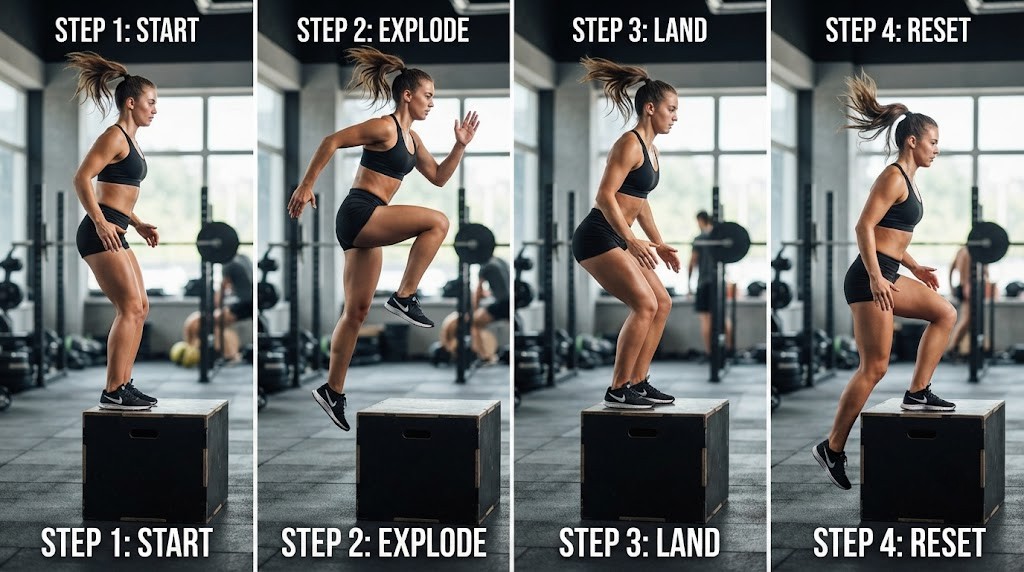
Most athletes spend countless hours performing squats, lunges, and deadlifts to build stronger legs. Yet, many still struggle to sprint faster, jump higher, or change direction more explosively during competition. The missing piece is often explosive power training—a style of training that teaches your muscles to generate force rapidly rather than simply generating more force.
An explosive leg workout for athletes improves acceleration, vertical jump, agility, and overall sports performance by enhancing your body’s ability to produce power in the shortest possible time. Whether you compete in football, basketball, soccer, volleyball, rugby, tennis, martial arts, or track and field, explosive lower-body training can help you move more efficiently and perform at a higher level.
In this guide, you’ll learn what explosive leg training is, why it matters, the science behind power development, the best exercises, beginner-to-advanced workout routines, recovery strategies, and the equipment that can help maximize results safely.
What Is an Explosive Leg Workout for Athletes?
An explosive leg workout for athletes is a lower-body training program specifically designed to improve power, speed, acceleration, and jumping ability by increasing how quickly your muscles generate force.
Unlike traditional bodybuilding workouts that primarily focus on muscle size, explosive training emphasizes producing maximum force in the shortest amount of time. This ability is essential for nearly every athletic movement, including:
- Sprinting
- Jumping
- Cutting
- Tackling
- Rapid acceleration
- Quick changes of direction
For example, two athletes may both squat the same amount of weight. However, the athlete who can apply that force more rapidly will usually accelerate faster and jump higher.
Explosive training combines several proven methods, including:
- Plyometric exercises
- Olympic lifting variations
- Sprint drills
- Dynamic strength exercises
Together, these improve neuromuscular efficiency, allowing your nervous system and muscles to work together more effectively.
One of the most important concepts behind explosive performance is Rate of Force Development (RFD), which refers to how quickly muscles can produce force during athletic movements.
If you also want to improve muscular control during strength exercises, check out our time under tension workout.
Why Is Explosive Leg Training Important for Sports Performance?
Explosive leg training develops far more than strong muscles. It improves how efficiently your body converts strength into athletic performance, allowing you to move with greater speed, precision, and power.
According to the American College of Sports Medicine (ACSM), combining resistance training with plyometric exercises is one of the most effective ways to improve muscular power and athletic performance.
Source: ACSM, 2023.
Faster Sprinting
Every sprint begins with a powerful push against the ground. The more force your legs can generate quickly, the faster you can accelerate.
Benefits include:
- Faster first-step acceleration
- Improved top-end sprint speed
- Better reaction time during competition
- More powerful stride mechanics
Higher Vertical Jump
Explosive lower-body training is essential for sports requiring repeated jumping.
A structured jumping program improves:
- Force production
- Take-off mechanics
- Landing control
- Reactive strength
Sports that benefit include:
- Basketball
- Volleyball
- High jump
- Football
- Netball
Better Agility and Change of Direction
Athletes constantly stop, pivot, and accelerate again. Explosive muscles make these movements quicker and more efficient.
This is especially valuable in:
- Soccer
- Football
- Rugby
- Tennis
- Martial arts
- Hockey
Reduced Injury Risk
Properly performed plyometric training strengthens muscles, tendons, ligaments, and connective tissues.
When combined with mobility work and controlled landing mechanics, explosive training may reduce the risk of common knee and ankle injuries.
Athletes should also strengthen supporting muscles using exercises like tibialis raise exercise and improve shoulder stability through rotator cuff exercises for beginners.
Explosive Power vs Traditional Strength Training
Although strength and power are closely related, they serve different purposes.
| Factor | Strength Training | Explosive Training |
|---|---|---|
| Goal | Maximum strength | Maximum power |
| Repetitions | 5–12 | 2–6 |
| Movement Speed | Controlled | Maximum intent |
| Rest Period | 60–120 seconds | 2–4 minutes |
| Fatigue | Moderate | Minimal |
| Best For | Muscle growth and strength | Speed, power and athletic performance |
The strongest athletes usually combine both methods.
Heavy squats increase force production, while exercises such as box jumps and trap bar jumps teach the body to use that strength quickly during sports.
Principles of Effective Explosive Training
Power training follows several key principles that maximize athletic development while reducing unnecessary fatigue.
1. Maximum Intent
Every repetition should be performed as explosively as possible while maintaining proper technique.
The goal is quality—not simply finishing the set.
2. Low Repetitions
Power decreases rapidly once fatigue builds.
Most explosive exercises work best with:
- 2–6 repetitions
- 3–5 sets
This allows every rep to remain fast and powerful.
3. Full Recovery Between Sets
Unlike endurance workouts, explosive training requires near-complete recovery.
Rest for:
- 2–4 minutes between explosive sets
This helps maintain maximum power output throughout the workout.
4. Train Power Before Fatigue
Always perform explosive exercises at the beginning of your workout while you’re fresh.
A typical order looks like this:
- Warm-up
- Plyometrics
- Olympic lifts or jumps
- Strength training
- Conditioning
Best Explosive Leg Exercises for Athletes
The most effective explosive exercises train your muscles to generate force rapidly while improving coordination, balance, and athletic movement patterns.
According to the National Strength and Conditioning Association (NSCA), combining plyometric exercises with resistance training significantly improves lower-body power and athletic performance.
Source: NSCA, 2024.
1. Box Jumps
Sets: 3–5
Reps: 3–5
Benefits:
- Improves vertical jump
- Develops landing mechanics
- Builds explosive lower-body power
2. Broad Jumps
Sets: 3–4
Reps: 4–6
Benefits:
- Builds horizontal power
- Improves sprint acceleration
- Enhances hip extension
3. Squat Jumps
Sets: 3
Reps: 5–8
Benefits:
- Develops explosive force
- Improves triple extension
- Requires no equipment
4. Bulgarian Split Squat Jumps
Sets: 3
Reps: 5 each leg
Benefits:
- Improves single-leg power
- Enhances balance
- Corrects muscular imbalances
5. Depth Jumps
Sets: 3
Reps: 3–5
Benefits:
- Improves reactive strength
- Enhances the stretch-shortening cycle
- Develops rapid force production
6. Power Cleans
Sets: 4
Reps: 3
Benefits:
- Builds total-body explosiveness
- Improves coordination
- Transfers well to sports performance
7. Jump Lunges
Sets: 3
Reps: 8–10
Benefits:
- Improves unilateral strength
- Enhances coordination
- Develops balance
8. Trap Bar Jumps
Sets: 3–4
Reps: 3–5
Benefits:
- Produces high power output
- Places less stress on joints
- Excellent for athletes of many sports
9. Kettlebell Swings
Sets: 3
Reps: 10–12
Benefits:
- Strengthens the posterior chain
- Improves hip power
- Supports sprint performance
10. Hill Sprints
Distance: 20–40 metres
Repetitions: 6–10
Benefits:
- Improves acceleration
- Builds running power
- Reinforces proper sprint mechanics
11. Bounding
Benefits:
- Improves stride length
- Enhances coordination
- Increases running efficiency
12. Single-Leg Hops
Benefits:
- Builds ankle stiffness
- Improves balance
- Develops sport-specific explosiveness
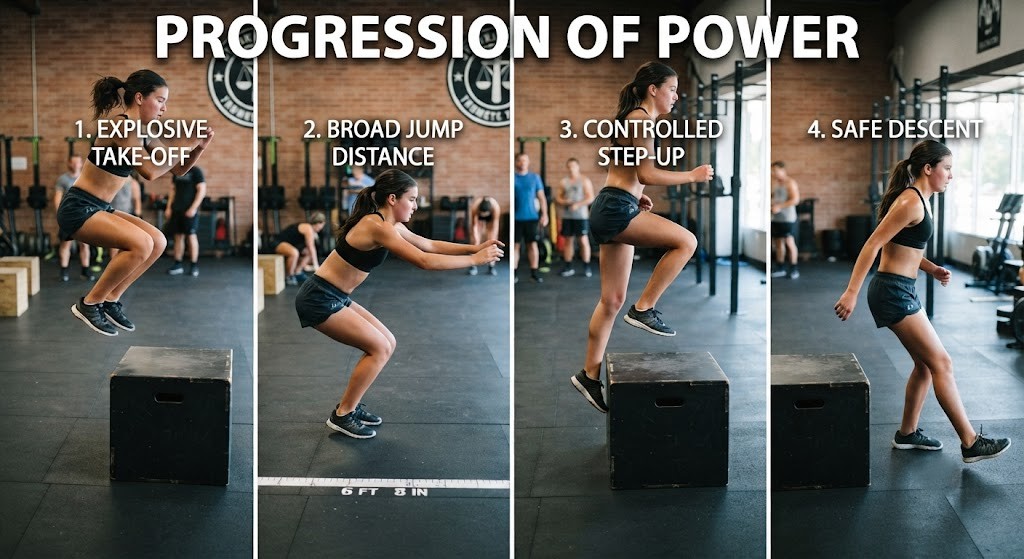
Beginner Explosive Leg Workout
If you’re new to power training, focus on technique before increasing intensity.
Beginner Routine (2 Days Per Week)
| Exercise | Sets × Reps |
|---|---|
| Box Jumps | 3 × 5 |
| Bodyweight Squat Jumps | 3 × 6 |
| Walking Jump Lunges | 3 × 8 |
| Kettlebell Swings | 3 × 12 |
| Hill Sprints | 5 × 20 metres |
If you’re new to resistance training, start with our best leg workouts for beginners.
Intermediate Explosive Leg Workout
Athletes with a solid strength base can increase intensity and complexity.
Intermediate Routine (2–3 Days Per Week)
| Exercise | Sets × Reps |
|---|---|
| Trap Bar Jumps | 4 × 4 |
| Broad Jumps | 4 × 5 |
| Bulgarian Split Squat Jumps | 3 × 6 |
| Power Cleans | 4 × 3 |
| Bounding | 4 × 20 metres |
Advanced Explosive Leg Workout
Advanced athletes should prioritize quality over volume while maintaining full recovery between sets.
Advanced Routine
| Exercise | Sets × Reps |
|---|---|
| Depth Jumps | 5 × 3 |
| Heavy Speed Squats | 5 × 3 |
| Trap Bar Jumps | 4 × 4 |
| Power Cleans | 5 × 2 |
| Hill Sprints | 8 × 30 metres |
How Often Should Athletes Perform Explosive Leg Workouts?
Most athletes achieve the best results by performing explosive leg workouts two to three times per week, allowing at least 48 hours of recovery between sessions.
Recovery is essential because explosive training places significant demands on the nervous system.
Sample Weekly Training Schedule
| Day | Training |
|---|---|
| Monday | Explosive Leg Workout |
| Tuesday | Sprint & Mobility |
| Wednesday | Upper Body Strength |
| Thursday | Explosive Leg Workout |
| Friday | Conditioning |
| Saturday | Recovery or Light Skills |
| Sunday | Rest |
If you need a complete beginner programme, read our full body workout for beginners.
What Equipment Is Best for Explosive Lower-Body Training?
Using the right equipment can help athletes safely develop power while progressing over time.
Some of the most effective tools include:
| Equipment | Primary Benefit |
|---|---|
| Plyometric Box | Box jumps, depth jumps, landing practice |
| Trap Bar | Powerful loaded jumps with reduced joint stress |
| Barbell | Squats, power cleans and speed-strength exercises |
| Kettlebells | Swings and explosive hip development |
| Resistance Bands | Speed work and accommodating resistance |
| Medicine Ball | Explosive throws and rotational power |
| Sprint Sled | Acceleration and force production |
| Cones | Agility drills and change-of-direction training |
Choose equipment based on your training experience, available space, and sport-specific goals.
Common Mistakes to Avoid During Explosive Leg Training
Even well-designed workouts can produce poor results if fundamental mistakes are made.
Avoid these common errors:
- Performing too many repetitions until fatigue sets in.
- Jumping without mastering proper landing mechanics.
- Skipping dynamic warm-ups before explosive exercises.
- Using poor technique to increase training intensity.
- Neglecting recovery between sessions.
- Performing power exercises after exhausting conditioning workouts.
- Progressing to advanced plyometrics too quickly.
Prioritizing movement quality over training volume leads to greater long-term improvements.
Recovery Tips for Better Power Development
Recovery is where your body adapts and becomes more explosive.
To maximize results:
- Sleep 7–9 hours per night.
- Allow at least 48 hours between explosive lower-body sessions.
- Perform mobility and flexibility exercises regularly.
- Stay well hydrated.
- Consume sufficient protein and overall calories to support recovery.
- Include light recovery activities such as walking or cycling on rest days.
Proper recovery helps maintain power output and reduces the likelihood of overuse injuries.
How to Measure Progress
Tracking performance helps determine whether your training is producing meaningful improvements.
Useful performance indicators include:
- Vertical jump height
- Broad jump distance
- 10-metre sprint time
- 20-metre sprint time
- Standing triple jump
- Reactive strength during plyometric drills
- Training quality and movement speed
Testing these metrics every four to six weeks provides valuable feedback without interfering with training.
Who Benefits Most from Explosive Leg Workouts?
Explosive leg training benefits athletes across many sports, including:
- Basketball
- Volleyball
- Football
- Soccer
- Rugby
- Tennis
- Baseball
- Cricket
- Martial arts
- Track and field
- Hockey
Even recreational athletes can improve movement efficiency, coordination, and lower-body power through structured explosive training.
Conclusion
An explosive leg workout for athletes is one of the most effective ways to improve speed, acceleration, jumping ability, agility, and overall sports performance. By combining strength training, plyometrics, sprint work, and proper recovery, athletes can train their muscles to generate force more rapidly and perform at a higher level during competition.
Focus on mastering technique before increasing intensity, prioritize quality over volume, and allow adequate recovery between sessions. Whether you’re just beginning your athletic journey or preparing for elite competition, consistent explosive training can help unlock faster sprints, higher jumps, and more powerful movement on the field, court, or track.
FAQs
What is an explosive leg workout for athletes?
An explosive leg workout for athletes combines plyometrics, strength training, and speed drills to improve power, sprint speed, jumping ability, and overall athletic performance.
How many times per week should athletes perform explosive leg workouts?
Most athletes should train explosive legs 2–3 times per week, allowing at least 48 hours of recovery between sessions.
Are explosive leg workouts suitable for beginners?
Yes. Beginners should start with basic jump exercises and focus on proper technique before progressing to advanced movements.
Do explosive workouts build muscle?
Yes, but their primary goal is to increase power and speed rather than maximise muscle size.
Which sports benefit the most from explosive leg training?
Sports like basketball, football, soccer, volleyball, rugby, tennis, and track benefit the most from explosive leg training.
Should explosive exercises be performed before or after strength training?
Perform explosive exercises before strength training while your muscles are fresh for maximum power output.
How to train explosiveness in legs?
Use plyometrics, sprint drills, Olympic lifts, and jump training while focusing on speed, power, and full recovery.
What is the 3-3-3 rule gym?
The 3-3-3 rule involves performing 3 exercises, 3 sets, and 3 reps to build strength and explosive power.
What is explosive leg strength?
Explosive leg strength is the ability to produce maximum force quickly for sprinting, jumping, and rapid direction changes.
What is the hardest leg exercise?
The Bulgarian Split Squat is often considered one of the hardest leg exercises because it challenges strength, balance, and stability simultaneously.