
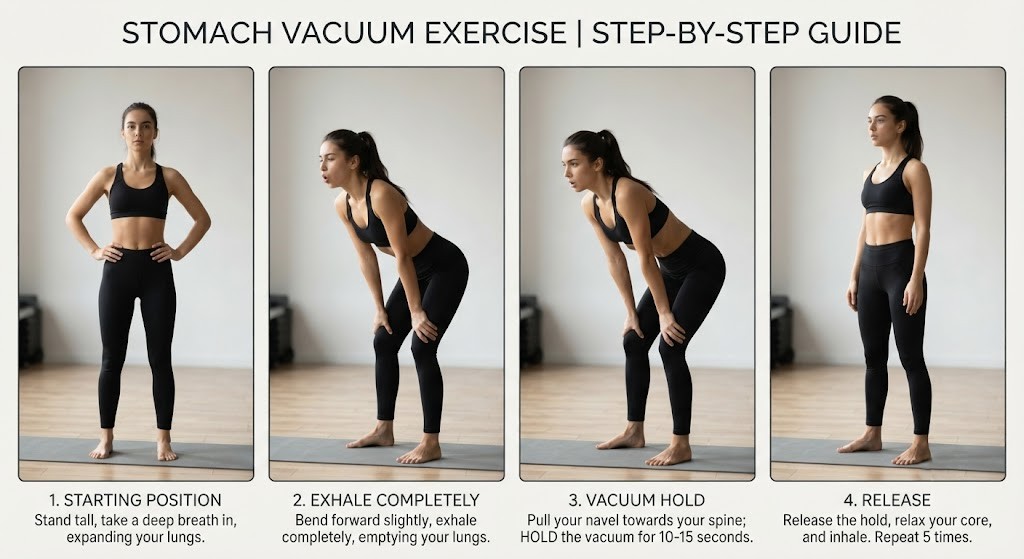
You’ve probably seen fitness enthusiasts pull their stomach inward while standing still and wondered whether such a simple movement could really strengthen the core. Surprisingly, one of the most effective core exercises involves almost no movement at all. While many people spend countless hours doing crunches and sit-ups, they often overlook the deepest abdominal muscle responsible for spinal stability and efficient movement.
The vacuum exercise for core is a simple yet highly effective isometric exercise that targets your body’s natural “internal corset.” When performed correctly and consistently, it can improve posture, enhance spinal stability, increase body awareness, and support overall athletic performance.
In this comprehensive guide, you’ll discover what the vacuum exercise is, why it works, which muscles it targets, how to perform it correctly, common mistakes to avoid, and how to incorporate it into a complete fitness routine for long-term results.
What Is the Vacuum Exercise for Core?
The vacuum exercise for core is an isometric breathing exercise that primarily activates the transverse abdominis, the deepest abdominal muscle responsible for spinal stability and core support.
Unlike crunches or sit-ups that repeatedly flex the spine, the stomach vacuum focuses on drawing your abdomen inward while maintaining controlled breathing. This activates your body’s natural “internal corset,” helping stabilize your spine during workouts and everyday activities.
Whether you’re lifting groceries, walking, standing for extended periods, or performing compound exercises in the gym, your transverse abdominis works continuously behind the scenes to stabilize your torso. Strengthening this muscle can improve movement efficiency while reducing unnecessary strain on your lower back.
According to the American Council on Exercise (ACE), strengthening deep core muscles contributes to better posture, improved movement quality, and enhanced spinal support when included in a balanced fitness routine. — Source: American Council on Exercise, 2024
Why Does the Vacuum Exercise Matter?
Vacuum exercise matters because strong deep core muscles improve posture, spinal stability, athletic performance, and everyday movement.
Many people associate a strong core with visible six-pack abs. However, the muscles beneath the surface play a far more important role in maintaining balance, protecting the spine, and supporting nearly every movement your body performs.
A strong transverse abdominis creates a stable base that allows your arms and legs to generate force more efficiently. This makes daily activities easier while improving performance during strength training, sports, and functional movement.
Research published by the National Strength and Conditioning Association (NSCA) shows that proper core activation improves movement efficiency and reduces unnecessary stress on the lumbar spine during exercise. — Source: NSCA, 2023
Major Benefits of Vacuum Exercise
- Improves posture
- Enhances spinal stability
- Increases body awareness
- Strengthens deep core activation
- Provides better support during lifting
- Helps create a tighter-looking waist
- Improves athletic performance
- Supports safer movement patterns
It’s important to remember that vacuum exercises improve core activation, posture, and trunk stability but do not directly reduce belly fat, as spot reduction is not supported by scientific evidence.
If fat loss is your goal, combine vacuum training with our body recomposition guide for sustainable results.
Which Muscles Does the Stomach Vacuum Exercise Target?
The stomach vacuum exercise primarily targets the transverse abdominis while also engaging several supporting muscles that contribute to overall core stability.
| Muscle | Primary Function |
|---|---|
| Transverse Abdominis | Deep core stabilization |
| Internal Obliques | Trunk support and rotation |
| Pelvic Floor | Core pressure regulation |
| Diaphragm | Proper breathing mechanics |
| Multifidus | Spinal stabilization |
The transverse abdominis acts like a built-in weightlifting belt, wrapping around your midsection to stabilize your spine before movement occurs.
Unlike traditional sit-ups that emphasize the rectus abdominis—the visible “six-pack” muscle—the vacuum exercise strengthens the deep stabilizing muscles underneath. This creates a stronger foundation for every other abdominal exercise.
For even greater results, pair vacuum training with a core and abs workout plan to strengthen both deep and superficial abdominal muscles.
How Do You Perform the Vacuum Exercise Correctly?
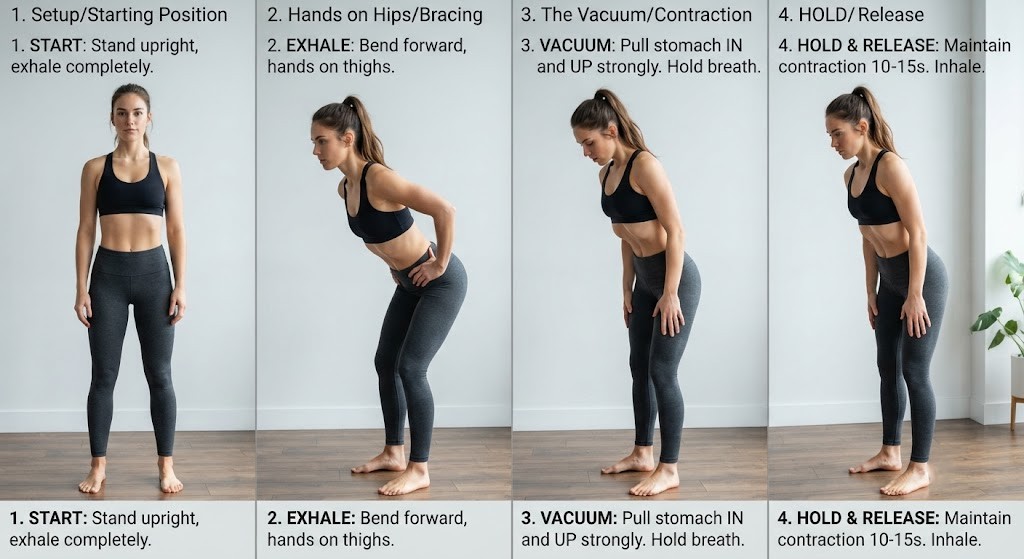
The stomach vacuum exercise involves exhaling fully and drawing the abdomen inward while maintaining controlled breathing and proper posture.
Although it appears simple, proper breathing mechanics are the key to activating the correct muscles.
Step-by-Step Instructions
- Stand tall, kneel, or lie comfortably on your back.
- Take a slow, deep breath through your nose.
- Exhale completely through your mouth.
- Pull your belly button toward your spine.
- Keep your chest lifted without holding your breath.
- Hold the contraction for 10–20 seconds.
- Relax slowly and repeat 3–5 times.
Tips for Better Technique
- Practice in front of a mirror initially.
- Focus on drawing your abdomen inward rather than expanding your chest.
- Keep your shoulders relaxed.
- Maintain slow, controlled breathing throughout each repetition.
- Stop if you experience discomfort or dizziness.
For better breathing mechanics, practice our best breathing exercises for fitness before each session.
What Are the Benefits of Vacuum Exercise for Core Strength?
Vacuum exercise improves deep core activation, posture, trunk stability, and body awareness while complementing traditional abdominal exercises.
Rather than replacing planks or crunches, stomach vacuums serve as an excellent addition to a balanced core-training program. By strengthening the deepest abdominal muscles, they provide a stable foundation that supports nearly every movement you perform.
According to the American College of Sports Medicine (ACSM), core stability training improves functional movement, balance, and exercise performance when combined with a comprehensive strength program. — Source: ACSM, 2024
Benefits of Vacuum Exercise
- Strengthens the transverse abdominis
- Improves posture by supporting the spine
- Enhances core stability during daily activities
- Supports lower back health
- Improves breathing control
- Increases body awareness
- May create a tighter-looking waist
- Complements traditional ab workouts
For example, when performing squats, deadlifts, overhead presses, or carrying heavy objects, a stronger deep core helps transfer force more efficiently and improves lifting stability.
After your core session, follow a post workout stretching routine to improve flexibility and recovery.
Can Vacuum Exercises Help Reduce Belly Fat?
Vacuum exercises do not directly reduce belly fat because spot reduction has not been supported by scientific evidence.
Many people mistakenly believe exercising one specific body part burns fat in that area. In reality, fat loss occurs throughout the body when you consistently maintain a calorie deficit through proper nutrition and regular physical activity.
Vacuum exercises strengthen your deep abdominal muscles, which may create the appearance of a firmer and more defined waist as your overall body fat decreases.
Research consistently shows that spot reduction is ineffective. Instead, vacuum exercises strengthen your deep abdominal muscles, which can make your waist appear firmer as overall body fat decreases. — Source: Journal of Strength and Conditioning Research, 2023
Best Strategy for a Leaner Waist
- Eat a balanced diet rich in protein.
- Perform resistance training 3–5 days each week.
- Include regular cardiovascular exercise.
- Practice vacuum exercises consistently.
- Prioritize quality sleep and recovery.
Support your nutrition with our high protein diet plan to maximize muscle development and body recomposition.
How Often Should You Do Vacuum Exercises?
Most beginners can safely perform vacuum exercises 4–6 days per week because they are low-impact isometric exercises that place minimal stress on the joints.
Consistency is more important than performing extremely long holds.
Beginner Progression Plan
| Week | Sets | Hold Time |
|---|---|---|
| Week 1 | 3 | 10 seconds |
| Week 2 | 4 | 15 seconds |
| Week 3 | 4 | 20 seconds |
| Week 4 | 5 | 30 seconds |
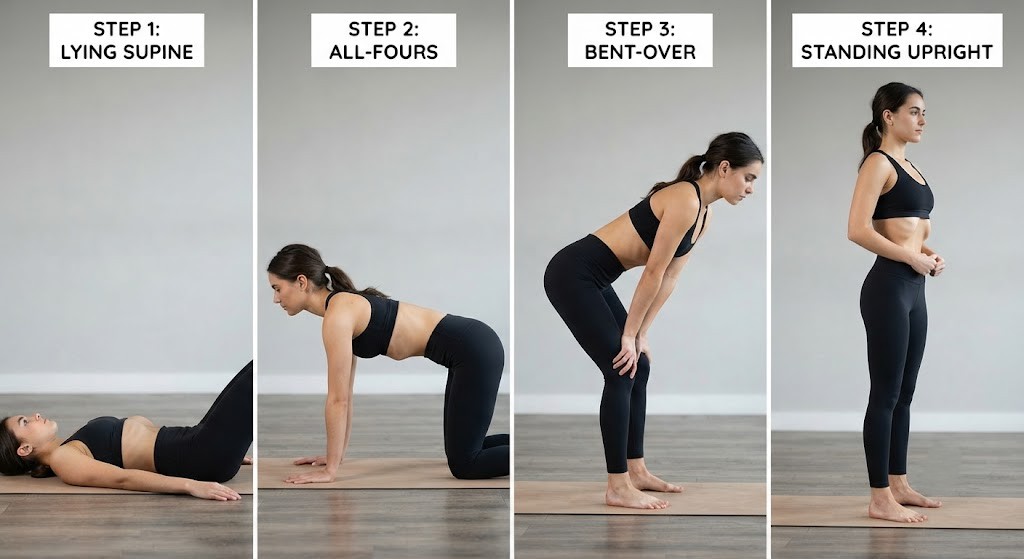
As your endurance improves, progress through different exercise positions.
Exercise Progressions
- Lying Vacuum – Best for beginners
- Kneeling Vacuum – Intermediate difficulty
- Standing Vacuum – Most practical for daily practice
- Quadruped Vacuum – Excellent for learning core activation
- Advanced Standing Hold – Longer duration with controlled breathing
What Are the Most Common Vacuum Exercise Mistakes?
Most vacuum exercise mistakes reduce muscle activation and make the exercise less effective.
Fortunately, they’re easy to correct once you know what to watch for.
Common Mistakes to Avoid
- Holding your breath instead of breathing naturally
- Pulling in your chest instead of your abdomen
- Slouching your shoulders
- Rushing through repetitions
- Using excessive neck tension
- Trying to hold the contraction too long
- Skipping warm-up breathing exercises
For example, beginners often inhale deeply while trying to pull their stomach inward. Instead, fully exhale first, then gently draw your abdomen toward your spine while maintaining controlled breathing.
Who Should Avoid the Vacuum Exercise?
People with certain medical conditions should consult a healthcare professional before performing vacuum exercises.
Speak With a Healthcare Professional If You Have
- Recent abdominal surgery
- Pregnancy or early postpartum recovery
- Hernia
- Severe uncontrolled hypertension
- Chronic respiratory conditions affecting breathing
- Significant lower back injuries
Stop exercising immediately if you experience pain, dizziness, chest discomfort, or shortness of breath, and seek medical guidance before continuing.
What Exercises Should You Combine With Vacuum Training?
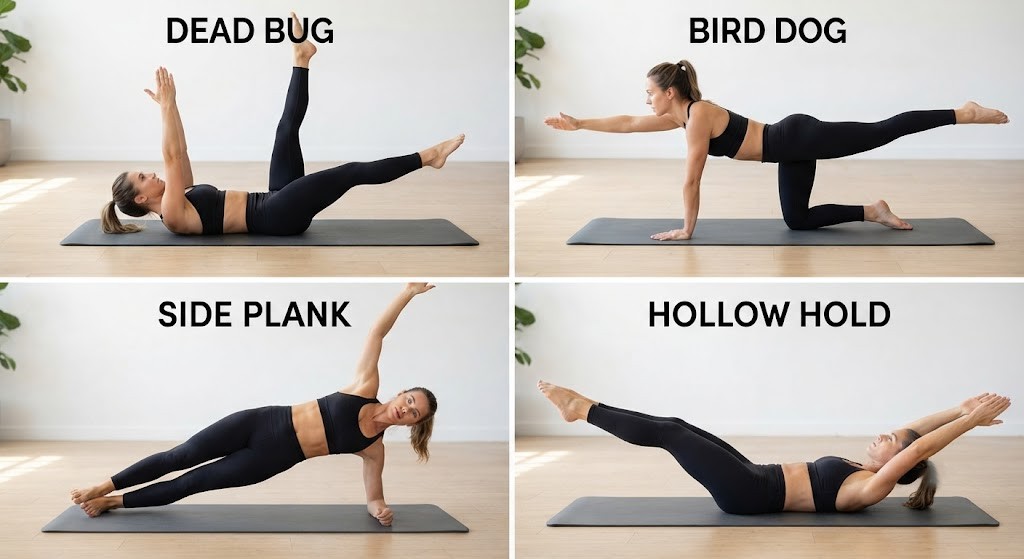
Vacuum exercises produce the best results when combined with other core stability exercises that strengthen the entire trunk.
A balanced routine develops endurance, coordination, stability, and overall functional strength.
Recommended Complementary Exercises
- Dead Bug for core coordination
- Bird Dog for spinal stability
- Front Plank for endurance
- Side Plank for oblique strength
- Hollow Hold for full-core tension
- Diaphragmatic Breathing for breathing control
For additional side-core development, explore our oblique workout for beginners.
If you want stronger plank performance, read Plank Exercise Benefits.
What’s Next?
Vacuum exercise should become one part of a complete fitness program rather than your only abdominal exercise.
Building a stronger core requires consistency, progressive overload, and a balanced training approach.
Your Action Plan
- Practice vacuum exercises daily.
- Follow a structured strength-training routine.
- Eat enough protein to support muscle growth.
- Track waist measurements instead of relying only on the scale.
- Progress gradually by increasing hold times.
- Stay consistent for at least 6–8 weeks.
Build a stronger foundation by combining this exercise with our full body workout for beginners.
Conclusion
The vacuum exercise for core is one of the simplest yet most effective ways to strengthen your deepest abdominal muscles and improve overall core stability. Unlike traditional abdominal exercises that mainly target the visible six-pack muscles, stomach vacuums develop the transverse abdominis, helping support your spine, improve posture, and enhance movement efficiency during everyday activities and workouts.
While vacuum exercises won’t magically burn belly fat, they can contribute to a firmer-looking waist when combined with strength training, regular cardiovascular exercise, proper nutrition, and adequate recovery. Focus on mastering proper breathing, performing controlled contractions, and gradually increasing your hold times rather than rushing your progress.
With patience and consistency, the vacuum exercise can become a valuable addition to your fitness routine, helping you build a stronger, more stable core that supports both athletic performance and long-term health.
FAQs
Is vacuum a good core exercise?
Yes. It strengthens the deep core muscles, improves posture, and enhances spinal stability.
Do vacuums help for abs?
Yes. They strengthen the deep abdominal muscles and can help create a tighter-looking waist, but they don’t directly build six-pack abs.
How to vacuum abs exercise?
Exhale fully, pull your belly button toward your spine, hold for 10–20 seconds while breathing normally, then relax and repeat.
Does vacuuming help lose belly fat?
No. Vacuum exercises don’t burn belly fat. They strengthen your core and work best alongside a healthy diet and regular exercise.
What is the vacuum exercise for core?
It’s an isometric breathing exercise that targets the transverse abdominis, the deepest core muscle.
Does the vacuum exercise burn belly fat?
No. Spot reduction isn’t possible, but vacuum exercises can help your waist appear firmer as you lose overall body fat.
How long should beginners hold a stomach vacuum?
Start with 10-second holds for 3 sets and gradually increase to 20–30 seconds.
Can I do vacuum exercises every day?
Yes. Most people can safely practice them 4–6 days per week.
Is the vacuum exercise better than crunches?
Not necessarily. Vacuum exercises strengthen deep core muscles, while crunches primarily target the six-pack muscles. Combining both gives the best results.
Can vacuum exercises improve posture?
Yes. A stronger deep core supports better posture and spinal alignment.
Should I breathe while holding the vacuum exercise?
Yes. Maintain slow, controlled breathing and avoid holding your breath.
Who should avoid stomach vacuum exercises?
People with recent abdominal surgery, a hernia, pregnancy, or certain medical conditions should consult a healthcare professional before performing them.