
If you already train your back with pull-ups, pulldowns, and rows, there is a good chance you are training your teres major without even realizing it. This small but important muscle contributes to several pulling movements and works closely with the much larger latissimus dorsi.
However, knowing that a muscle is involved is different from understanding how to train it effectively. Exercise selection, elbow positioning, range of motion, resistance, and progressive overload can all influence the quality of your back training.
In this teres major workout guide, you will learn where the teres major is located, what it does, the best teres major exercises, how to perform them with proper form, how many sets and reps to use, common mistakes to avoid, and practical workout routines for beginners and experienced lifters.
What Is the Teres Major Muscle and Where Is It Located?
The teres major is a muscle on the back of the shoulder that helps extend, adduct, and internally rotate the upper arm. It sits near the lower portion of the shoulder blade and forms part of the muscular area around the posterior axilla, commonly contributing to a more developed appearance around the upper back and rear shoulder.
The teres major originates around the inferior angle of the scapula and attaches to the humerus near the intertubercular groove. When you pull your upper arm downward and backward during an exercise such as a lat pulldown, the teres major can contribute to the movement.
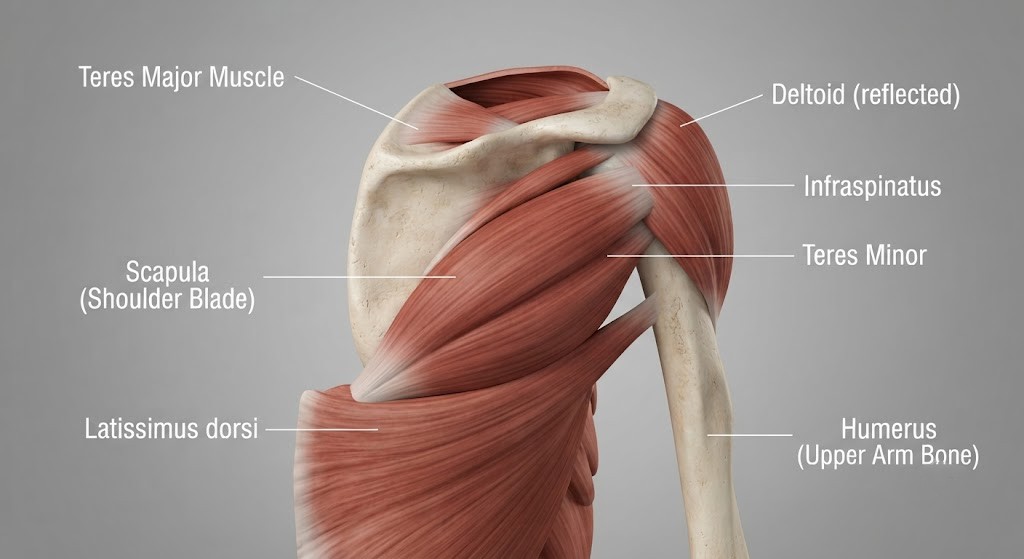
The teres major also works closely with the latissimus dorsi. Because both muscles contribute to overlapping shoulder movements, many common back exercises train them simultaneously rather than completely isolating one muscle.
This is why an effective teres major workout is usually built around pulling exercises instead of trying to find a single movement that isolates the muscle completely.
What Does the Teres Major Muscle Do?
The teres major muscle performs shoulder extension, adduction, and internal rotation while also helping stabilize the shoulder joint. These functions make it particularly relevant during pulling exercises where the upper arm moves downward, backward, or toward the torso.
For example, during a lat pulldown, pulling your elbows down toward your sides involves shoulder adduction and extension. The teres major can contribute to this movement alongside the latissimus dorsi and other muscles.
Watch: Teres Major Muscle Anatomy and Function
The video below demonstrates the muscle’s location, actions, and relationship with surrounding muscles.
Understanding these movements can help you use a better elbow path and more controlled technique during exercises such as lat pulldowns, pull-ups, and straight-arm pulldowns.
Teres Major Functions
The primary actions of the teres major include:
- Shoulder extension: Moving the upper arm backward.
- Shoulder adduction: Bringing the upper arm closer to the torso.
- Internal rotation: Rotating the upper arm inward.
- Shoulder stabilization: Helping support controlled movement around the shoulder.
Because these functions overlap with the actions of the lats, teres major activation should be viewed as part of a coordinated pulling movement rather than as something that must be completely isolated.
Why Is the Teres Major Important for Back Development?
The teres major is important for back development because it contributes to shoulder movement and complements the larger muscles responsible for pulling and upper-body development.
Developing the muscles around the posterior shoulder and upper back can contribute to a more defined transition between the shoulders, upper back, and lateral back.
For example, a well-developed back can create more visible definition around the posterior shoulder and lateral back area when the teres major is trained alongside the lats, rear delts, and other back muscles.
The teres major also contributes to movements used in resistance training and everyday pulling activities. Therefore, you generally do not need to treat it as an entirely separate muscle group.
Instead, a balanced back program can train it naturally through vertical pulls, shoulder-extension exercises, and rowing movements.
In 2026, the American College of Sports Medicine reviewed 137 systematic reviews involving more than 30,000 participants and emphasized that consistency is more important than complicated resistance-training programs. — Source: American College of Sports Medicine, 2026
What Are the Best Teres Major Exercises?
The best teres major exercises are pulling movements that train shoulder extension and adduction, including pulldowns, pull-ups, and straight-arm pulldowns.
The ideal exercise depends on your training experience, equipment availability, strength level, and ability to maintain good technique.
Rather than trying to completely isolate the teres major, focus on exercises that allow you to consistently perform its primary movement patterns under resistance.
1. Pull-Ups
Pull-ups are bodyweight exercises that train the teres major alongside the latissimus dorsi and other upper-body pulling muscles.
Begin from a controlled hanging position, brace your torso, and pull your elbows downward toward your sides. Avoid turning the movement into a swinging exercise.
Instead of thinking only about getting your chin over the bar, think about driving your elbows downward while keeping your shoulders controlled.
Suggested programming:
- Sets: 3
- Reps: 5–10
- Rest: 2–3 minutes
2. Lat Pulldowns
Lat pulldowns train the teres major through shoulder adduction and extension while allowing you to control resistance more easily than pull-ups.
Sit securely, establish a stable torso position, grip the bar, and pull it toward the upper chest. Keep the movement controlled throughout each repetition.
Avoid leaning dramatically backward because excessive torso movement can turn the exercise into a momentum-based pulling movement.
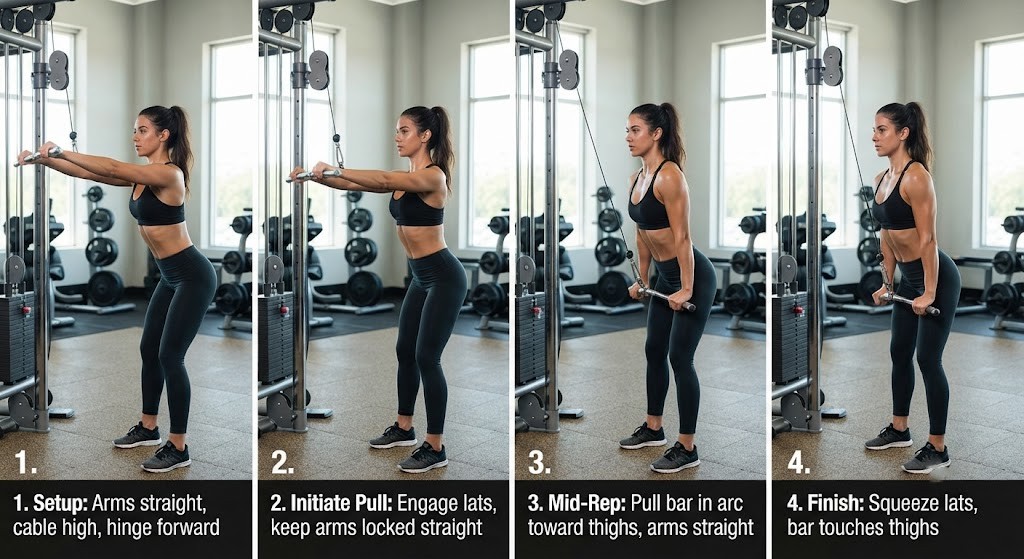
3. Straight-Arm Pulldowns
Straight-arm pulldowns emphasize shoulder extension while minimizing elbow movement, making them useful for practicing the arm path involved in lat and teres major training.
Keep a slight bend in your elbows and move the bar or rope downward toward your thighs. The goal is to move primarily through the shoulder rather than repeatedly bending and extending the elbows.
A useful cue is to imagine pushing your hands toward your pockets rather than simply pulling the attachment downward.
4. Single-Arm Cable Pulldowns
Single-arm cable pulldowns allow you to train each side independently while controlling the path of shoulder extension and adduction.
Use a comfortable resistance and pull your elbow down and slightly toward your torso. Because each side works independently, this variation can also help you identify differences in strength or movement control between sides.
5. Rows and Machine Rows
Rows can involve the teres major as a supporting muscle when the upper arm moves backward toward the torso.
Keep your shoulder controlled and focus on moving through the back and shoulder rather than excessively bending the elbows.
Rows should remain an important part of your overall back program because they train multiple muscles while complementing vertical pulling exercises.
Teres Major Exercise Comparison
| Exercise | Teres Major Involvement | Difficulty | Best Use |
|---|---|---|---|
| Pull-ups | High | Advanced | Strength and back development |
| Lat pulldowns | High | Beginner–Intermediate | Hypertrophy |
| Straight-arm pulldowns | Moderate–High | Beginner | Controlled shoulder extension |
| Single-arm cable pulldowns | Moderate–High | Intermediate | Unilateral training |
| Machine rows | Moderate | Beginner–Intermediate | Overall back development |
| Dumbbell rows | Moderate | Intermediate | Strength and thickness |
How Do You Train the Teres Major With Proper Form?
The most effective teres major training uses controlled shoulder movement, stable positioning, appropriate resistance, and a full comfortable range of motion.
Using heavier weight does not automatically create a better stimulus. If the load causes excessive swinging, shrugging, or shortened repetitions, reducing the resistance can often improve exercise quality.
Control Your Shoulder Position
First, keep your shoulders controlled instead of allowing them to shrug aggressively toward your ears.
During a pulldown, for example, maintain a stable torso while allowing the shoulder blades to move naturally. You do not need to force the shoulder blades into an unnaturally rigid position.
Use the Right Elbow Path
Your elbow path is particularly important when performing pulling exercises.
Pulling the elbows down and toward the torso generally matches the shoulder actions performed by the teres major and latissimus dorsi.
A useful mental cue during a pulldown is to imagine placing your elbows into your back pockets rather than simply pulling the bar with your hands.
Control the Eccentric Phase
The eccentric portion of an exercise should also remain controlled.
A two- to three-second eccentric can help you maintain positioning and avoid turning every repetition into a momentum-based movement.
You do not need to force an exaggerated squeeze at the bottom. Instead, focus on maintaining controlled tension across the available range of motion.
How Do You Train the Teres Major for Muscle Growth?
Teres major hypertrophy comes from consistent resistance training, sufficient weekly volume, progressive overload, and recovery rather than complete muscle isolation.
Because the teres major works together with the lats and other shoulder muscles, training it through several pulling patterns is generally more practical than attempting to perform numerous isolation exercises.
The 2026 ACSM position stand suggests approximately 10 weekly sets per muscle group as a useful hypertrophy-oriented starting point, while emphasizing that training should be individualized. — Source: American College of Sports Medicine, 2026
For example, instead of performing ten sets of a single small-muscle exercise, you could accumulate your pulling volume through pulldowns, pull-ups, rows, and straight-arm pulldowns.
Practical Training Guidelines
A useful starting framework is:
- Beginners: 6–10 challenging back sets per week
- Intermediate lifters: around 10 or more weekly sets across the back, adjusted for recovery
- Most exercises: 6–15 controlled repetitions
- Isolation-style movements: often 10–20 repetitions
- Frequency: 2 back-focused sessions can work well when weekly volume is distributed appropriately
Importantly, training every set to absolute failure is not required for muscle growth.
A systematic review found no significant hypertrophy advantage for momentary failure compared with non-failure training, while newer evidence continues to support the value of training hard without making failure mandatory. — Source: PubMed, 2022; PubMed, 2026
This means you can train with challenging resistance while maintaining enough energy and technique to perform productive repetitions across your workout.
Do Pull-Ups and Lat Pulldowns Work the Teres Major?
Pull-ups and lat pulldowns can work the teres major because both exercises involve shoulder extension and adduction.
However, neither exercise exclusively trains the teres major. The latissimus dorsi and other muscles contribute substantially to these pulling movements.
For example, a controlled lat pulldown can train the teres major while simultaneously challenging the lats, biceps, and other muscles involved in pulling.
Therefore, pull-ups, lat pulldowns, and straight-arm pulldowns can all involve the teres major while also training other muscles of the back and shoulder.
This overlap is not a disadvantage. In fact, it makes these exercises useful components of a complete back-building routine.
How Can You Train the Teres Major With Dumbbells and Cables?
Dumbbells and cables can train the teres major by creating resistance against shoulder extension, adduction, or both.
Cable exercises make it easy to adjust resistance and experiment with different attachment positions, while dumbbells can be particularly useful for unilateral rows and overall back development.
Dumbbell Options
One useful option is a one-arm dumbbell row with a controlled elbow path.
Keep your torso stable and avoid excessive rotation. Use a moderate load and prioritize controlled movement rather than simply trying to lift the heaviest dumbbell possible.
The teres major contributes as part of the complete pulling pattern, so you should not expect a dumbbell row to isolate it completely.
Cable Options
Cable pulldowns and straight-arm pulldowns are useful teres major cable exercises because resistance can be adjusted easily and the direction of force can be controlled.
You can also use unilateral cable variations to train one side at a time and focus on a consistent shoulder movement pattern.
What Are the Best Teres Major Exercises for Beginners?
The best teres major exercises for beginners are controlled lat pulldowns, assisted pull-ups, straight-arm pulldowns, and machine rows.
These exercises allow beginners to practice pulling mechanics without requiring the advanced bodyweight strength needed for strict pull-ups.
A beginner can start with a manageable amount of volume and gradually increase resistance or repetitions as technique improves.
Beginner Teres Major Workout
- Lat pulldown — 3 × 8–12
- Machine row — 3 × 8–12
- Straight-arm pulldown — 2 × 12–15
- Assisted pull-up — 2 × 6–10
This routine combines vertical pulling, rowing, and shoulder-extension work without requiring excessive exercise variety.
Moreover, adults are generally advised to perform muscle-strengthening activities on at least 2 days per week. — Source: U.S. Department of Health and Human Services, 2025
How Many Sets and Reps Should You Do for the Teres Major?
Most lifters can train the teres major effectively using moderate repetition ranges and several weekly sets distributed across back exercises.
The exact amount depends on your training experience, total back volume, recovery capacity, and goals.
A beginner could start with approximately 6–8 weekly sets involving strong shoulder-extension or adduction patterns, while an intermediate lifter may use a higher total back volume.
Teres Major Sets and Reps Guide
| Goal | Sets | Reps | Rest |
| Strength-focused | 2–4 | 4–8 | 2–3 min |
| General development | 2–4 | 6–12 | 1.5–3 min |
| Hypertrophy | 2–4 | 8–15 | 1–2 min |
| Cable isolation-style work | 2–3 | 12–20 | 60–90 sec |
At the same time, use reps in reserve (RIR) to manage fatigue.
Finishing many sets with roughly 1–3 good repetitions left can provide a challenging stimulus without requiring every set to reach absolute failure.
This approach can also make it easier to maintain good technique across multiple exercises and training sessions.
What Is the Difference Between the Teres Major and Latissimus Dorsi?
The teres major and latissimus dorsi are different muscles that share several shoulder actions and frequently work together during pulling exercises.
The teres major is smaller and positioned around the posterior shoulder and inferior scapular region. The latissimus dorsi is much larger and spans a broad area of the back.
Both muscles contribute to pulling the upper arm down and backward, but the latissimus dorsi has a much larger anatomical footprint and is a major contributor to overall back width.
Teres Major vs. Latissimus Dorsi
| Feature | Teres Major | Latissimus Dorsi |
| Location | Posterior shoulder/upper back | Large lower and lateral back |
| Size | Smaller | Much larger |
| Main actions | Extension, adduction, internal rotation | Extension, adduction, internal rotation |
| Common exercises | Pulldowns, pull-ups, rows | Pulldowns, pull-ups, rows |
| Isolation | Difficult to isolate completely | Can be emphasized but not fully isolated |
Therefore, teres major exercises for mass should complement your latissimus dorsi workout rather than replace it.
Building a wide, developed back requires training the broader pulling musculature rather than focusing exclusively on one smaller muscle.
What Are Common Teres Major Training Mistakes?
The most common teres major training mistakes involve excessive momentum, poor shoulder positioning, excessive loading, and incomplete controlled repetitions.
Avoiding these mistakes can help you get more consistent results from your teres major workout.
Using Too Much Weight
First, avoid selecting a weight that forces your torso to swing or your shoulders to shrug.
If you must lean dramatically backward during every pulldown repetition, the resistance may be too heavy for the technique you are trying to maintain.
Chasing an Extreme Squeeze
Second, do not force an exaggerated squeeze at the bottom of every repetition.
The teres major performs specific shoulder actions, so good movement quality is more important than creating an artificial sensation.
A strong mind-muscle connection can be useful, but it should not come at the expense of proper mechanics.
Cutting the Range of Motion
Third, use a comfortable and controlled range of motion rather than stopping every repetition halfway.
A range of motion that you can control is generally more useful than accidentally performing heavy partial repetitions because the load is too challenging.
Relying on Momentum
Swinging the torso can make an exercise feel easier while reducing your ability to control the intended movement.
Instead, stabilize your torso and allow the shoulder and elbow to follow a consistent path throughout the repetition.
What Are the Best Practical Teres Major Workout Routines?
A practical teres major workout should combine vertical pulling, shoulder-extension work, and rowing movements instead of relying on a single exercise.
This approach trains the teres major while also developing the surrounding back musculature.
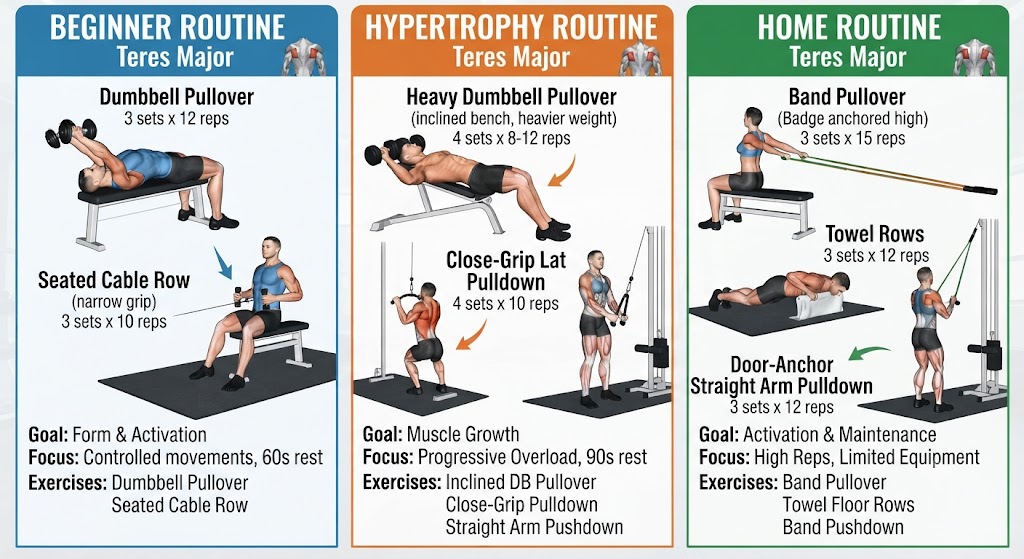
Beginner Teres Major Workout
- Lat pulldown — 3 × 8–12
- Machine row — 3 × 8–12
- Straight-arm pulldown — 2 × 12–15
- Assisted pull-up — 2 × 6–10
This routine is a good starting point for learning controlled pulling mechanics while keeping the exercise selection straightforward.
Hypertrophy-Focused Back Workout
- Pull-ups — 3 × 6–10
- Lat pulldown — 3 × 8–12
- Chest-supported row — 3 × 8–12
- Single-arm cable pulldown — 2 × 10–15
- Straight-arm pulldown — 2 × 12–15
This routine combines vertical pulling, horizontal pulling, and shoulder-extension work for broader back development.
Home or Minimal-Equipment Variation
- Assisted pull-up or band pulldown — 3 × 8–15
- One-arm dumbbell row — 3 × 8–15
- Resistance-band straight-arm pulldown — 3 × 12–20
This option demonstrates that a productive teres major workout does not necessarily require a large selection of gym machines.
What’s Next: How Do You Progress Your Teres Major Training?
Progressive overload is the key next step after learning proper teres major exercise technique.
Instead of constantly changing exercises, gradually improve your weight, repetitions, control, or total training volume.
For example, if you perform 10, 10, and 9 repetitions with a given pulldown weight, work toward 12 controlled repetitions across all three sets before adding a small amount of resistance.
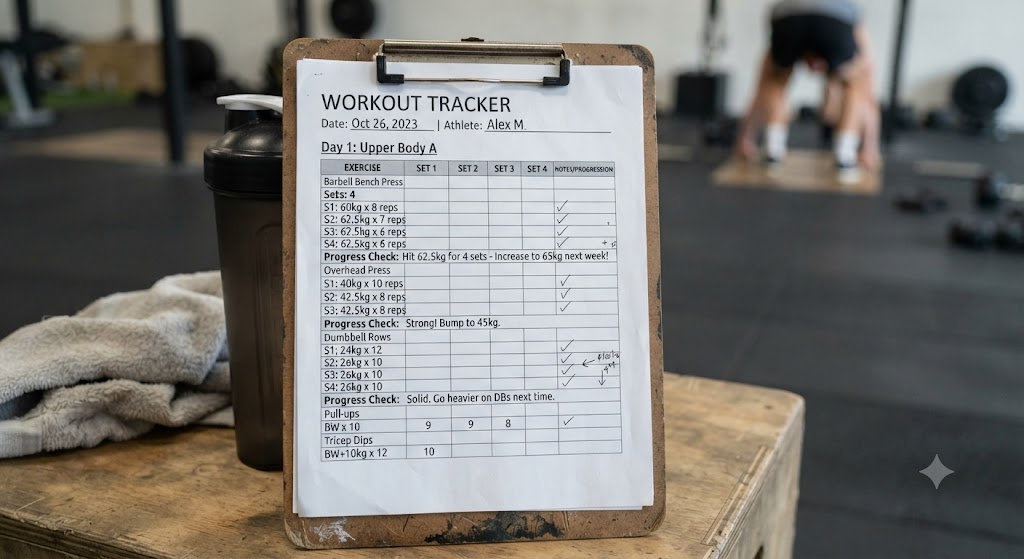
Track Your Training Progress
Keep track of four simple variables:
- Weight used
- Repetitions completed
- Sets performed
- Technique quality
Progress does not always have to mean adding weight. Performing more controlled repetitions with the same resistance can also represent improvement.
Likewise, maintaining better technique at the same weight can indicate that your movement quality and strength have improved.
Prioritize Recovery
At the same time, allow adequate recovery between demanding back sessions.
A muscle-growth program should be sustainable enough that you can repeat high-quality training week after week without constantly accumulating excessive fatigue.
The latest ACSM guidance emphasizes that consistency beats complexity and that bodyweight, bands, home workouts, machines, and free weights can all produce useful resistance-training adaptations. — Source: American College of Sports Medicine, 2026
Conclusion
The teres major is a small but important upper-back and shoulder muscle that contributes to shoulder extension, adduction, and internal rotation. Because it works closely with the latissimus dorsi, the most effective approach is to train it through controlled pulling movements rather than trying to completely isolate it.
Pull-ups, lat pulldowns, straight-arm pulldowns, single-arm cable variations, and rows can all contribute to effective teres major training. Choose exercises that fit your experience and equipment, use manageable resistance, maintain a controlled range of motion, and gradually increase your training stimulus over time.
Ultimately, consistent training and progressive overload matter more than finding a perfect isolation exercise. Combine smart exercise selection with proper technique, sufficient recovery, and a balanced back program, and your teres major can become an important part of a stronger and more developed upper body.
FAQs
What is the best teres major workout?
Pull-ups, lat pulldowns, straight-arm pulldowns, and rows are effective teres major exercises.
What exercise targets teres major?
Pull-ups, lat pulldowns, straight-arm pulldowns, and single-arm cable pulldowns target the teres major.
What is the most neglected muscle?
Smaller muscles such as the teres major are often neglected because they are usually trained indirectly.
What are the symptoms of a weak teres major?
Weakness may cause reduced pulling strength and difficulty with shoulder extension or adduction.
What exercises work the teres major?
Pull-ups, pulldowns, straight-arm pulldowns, cable exercises, and rows work the teres major.
Do pull-ups work the teres major?
Yes, pull-ups engage the teres major along with the lats and other pulling muscles.
Do lat pulldowns work the teres major?
Yes, lat pulldowns involve the teres major during shoulder extension and adduction.
Can you isolate the teres major?
Complete isolation is difficult because the teres major works closely with the latissimus dorsi.
How many sets should I do for the teres major?
A practical starting point is 6–10 challenging weekly sets through back exercises.
What are the best teres major exercises for beginners?
Lat pulldowns, assisted pull-ups, machine rows, and straight-arm pulldowns are good beginner options.
How many reps should I do for teres major growth?
Around 6–15 repetitions works well for most teres major exercises.
Is the teres major the same as the lat?
No, the teres major and latissimus dorsi are separate muscles with similar functions.
Does the teres major make your back wider?
It contributes to upper-back development, while the lats are a major contributor to back width.
Can you train the teres major with dumbbells?
Yes, dumbbell rows can effectively involve the teres major.
Can you train the teres major with cables?
Yes, cable pulldowns and straight-arm pulldowns are useful teres major exercises.
How often should you train the teres major?
Training it through back workouts about twice per week can work well.
Do you need to train the teres major to failure?
No, training close to failure with good technique can effectively stimulate muscle growth.
How do you grow the teres major?
Use progressive overload, sufficient training volume, proper form, and adequate recovery.
1 thought on “Teres Major Workout: Build Bigger Lats & Stronger Upper Back”