
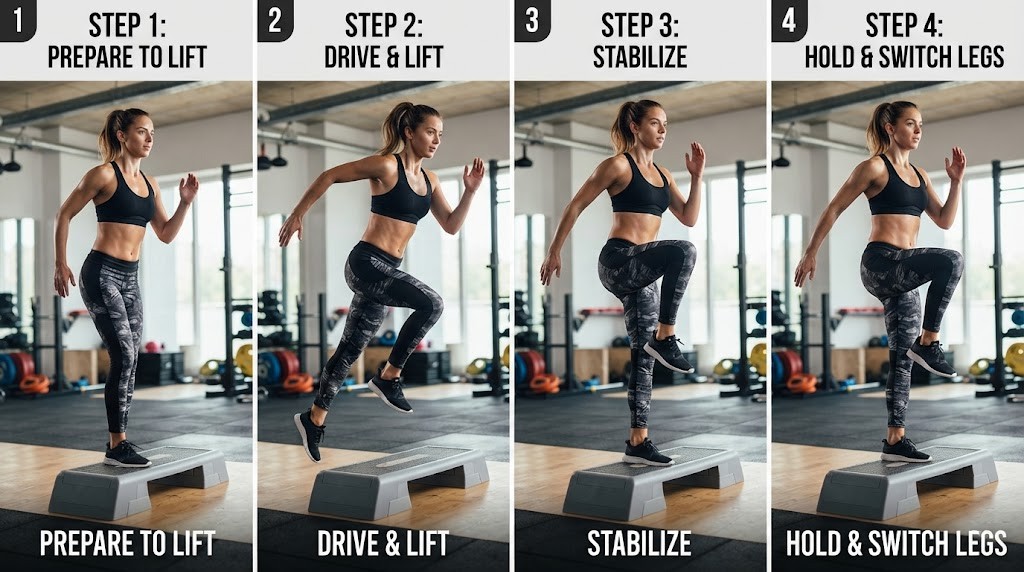
If you already do squats, push-ups, lunges, or other compound exercises, you’re already using elements of functional training. The challenge is knowing how to combine different movement patterns into one balanced, effective workout.
A well-designed full body functional training workout trains multiple muscle groups while also challenging balance, coordination, mobility, stability, and muscular endurance. Instead of focusing only on isolated muscles, functional training teaches your body to work together through practical movement patterns.
In this guide, you’ll learn what full body functional training is, why it matters, which movement patterns to include, how to structure a complete workout, beginner modifications, home-training options, equipment choices, progression strategies, and how functional training compares with traditional strength training.
What Is a Full Body Functional Training Workout?
A full body functional training workout is an exercise approach that uses compound movement patterns to train multiple muscle groups while developing physical qualities such as strength, balance, coordination, mobility, and stability.
Functional training focuses primarily on how your body moves, rather than isolating one muscle at a time. For example, a goblet squat trains the legs and glutes while also requiring the trunk to maintain an efficient position.
Functional exercises can also develop movement skills and physical capacities that transfer to everyday activities, sports, and other physical tasks. Carrying groceries, climbing stairs, lifting an object, or getting up from the floor can involve several movement patterns working together.
For more related training ideas, explore our full body workout
What Makes Functional Training Different?
Functional training centers on multi-joint movements, coordination, stability, and practical strength. A functional strength workout might combine a squat, hinge, push, pull, carry, and core-stability movement rather than relying entirely on isolated exercises.
For example, a dumbbell Romanian deadlift trains the hips and posterior chain while requiring you to control your trunk and maintain balance throughout the movement.
However, functional training does not mean that every exercise must perfectly imitate an everyday task. A conventional resistance exercise can still be functional when it develops strength, control, mobility, or physical capacity that supports broader movement.
Why Is Full Body Functional Training Important?
Full body functional training is valuable because it can develop several physical qualities within the same workout, including strength, muscular endurance, balance, coordination, mobility, stability, and conditioning.
One major advantage is workout efficiency. Compound exercises allow several muscle groups and joints to contribute to the same movement. For example, a reverse lunge challenges the legs and hips while also requiring trunk control, balance, and coordination.
Functional training can also complement general physical activity. Adults are advised to include muscle-strengthening activity involving major muscle groups on at least two days each week. — Source: World Health Organization, 2026
Moreover, WHO recommends 150–300 minutes of moderate-intensity aerobic activity per week, or an equivalent combination of moderate and vigorous activity, for adults. — Source: World Health Organization, 2026
What Benefits Can Functional Training Provide?
When exercises are selected and progressed appropriately, functional training can support several components of physical fitness.
For example, a farmer carry can challenge grip strength, posture, trunk stability, and walking control simultaneously.
Important benefits include:
- Strength: Builds force-producing capacity through compound resistance exercises.
- Balance: Challenges your ability to control your body, particularly during unilateral movements.
- Coordination: Teaches different body segments to work together efficiently.
- Mobility: Uses controlled movement through available ranges of motion.
- Stability: Requires the trunk and joints to resist unwanted movement.
- Muscular endurance: Helps muscles repeatedly produce force during longer sessions.
- Conditioning: Combines resistance and locomotion movements to challenge work capacity.
- Movement efficiency: Gives you practice coordinating complete movement patterns rather than relying only on isolated muscle actions.
Physical activity guidelines also emphasize that any amount of activity is better than none, while gradual increases can help inactive adults build toward recommended levels. — Source: World Health Organization, 2026
For beginners who want more structured resistance work, see our strength training for beginners
What Are the Main Functional Movement Patterns?
Functional movement patterns are fundamental ways the body produces, controls, and transfers movement during exercise and physical activity.
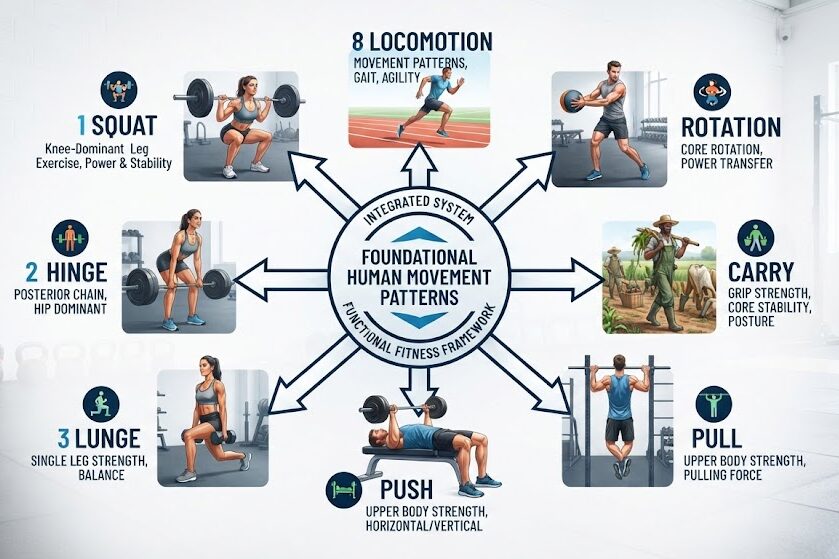
A balanced full body functional training workout typically combines several patterns, including squat, hinge, push, pull, lunge, carry, rotation, anti-rotation, and locomotion.
| Movement Pattern | Example Exercise | Main Training Focus |
|---|---|---|
| Squat | Goblet squat | Legs and hip strength |
| Hinge | Romanian deadlift | Glutes and posterior chain |
| Push | Push-up | Chest, shoulders, triceps |
| Pull | Dumbbell row | Back and arms |
| Lunge | Reverse lunge | Unilateral leg strength |
| Carry | Farmer carry | Grip and trunk stability |
| Rotation | Medicine-ball rotation | Rotational control |
| Anti-rotation | Pallof press | Core stability |
| Locomotion | Bear crawl | Whole-body coordination |
Squat and Hinge Patterns
The squat pattern involves bending the knees and hips while controlling your body through a primarily vertical movement. A chair squat, for example, teaches you to lower your body under control and stand back up.
The hinge pattern emphasizes movement from the hips while maintaining control of the spine. A Romanian deadlift is a practical example because the hips move backward while the torso inclines forward.
These two patterns provide an important foundation for lower-body functional training because they teach different ways to produce force through the hips and legs.
Push, Pull, Lunge, and Carry Patterns
Push and pull movements train the upper body while also requiring trunk control. Push-ups represent a horizontal pushing pattern, while dumbbell rows represent a horizontal pulling pattern.
Lunges introduce single-leg strength and balance, making them useful for developing unilateral control. Carries add another dimension because they require you to stabilize your trunk while moving through space.
A farmer carry is particularly simple to learn and combines loaded strength with locomotion.
Rotation, Anti-Rotation, and Locomotion
Rotation involves controlled turning through the trunk and hips, while anti-rotation exercises teach you to resist unwanted trunk movement.
A medicine-ball rotation trains controlled turning, whereas a Pallof press challenges the core to resist rotation.
Locomotion exercises involve moving your body through space using coordinated limbs. A bear crawl is one example and can be added through our bear crawl workout.
Together, these movement patterns create a more complete approach than simply training individual muscles.
What Exercises Should You Include in a Full Body Functional Workout?
A full body functional workout should collectively cover major movement patterns while matching your current fitness level, training experience, and available equipment.
A practical routine can combine squats, Romanian deadlifts, push-ups, rows, reverse lunges, farmer carries, bear crawls, and plank variations.
The following workout can be completed in approximately 25–30 minutes.
Full Body Functional Training Workout
| Exercise | Sets | Reps/Time | Rest |
| Goblet squat | 3 | 8–12 | 60–90 sec |
| Romanian deadlift | 3 | 8–12 | 60–90 sec |
| Push-up | 3 | 6–12 | 60 sec |
| Dumbbell row | 3 | 8–12/side | 60 sec |
| Reverse lunge | 2–3 | 8–10/side | 60 sec |
| Farmer carry | 3 | 30–45 sec | 45–60 sec |
| Bear crawl | 2 | 20–30 sec | 45–60 sec |
| Plank variation | 2–3 | 20–45 sec | 45 sec |
This structure gives you a combination of lower-body strength, upper-body pushing and pulling, unilateral training, loaded movement, locomotion, and core stability.
How to Perform the Workout
Begin with approximately 5 minutes of warm-up using easy movement, dynamic mobility, and gradual practice sets.
You could use:
- Bodyweight squats
- Arm circles
- Hip hinges
- Walking lunges
- Light marching
After warming up, perform the exercises in the listed order. Prioritize technique and movement control before trying to increase speed or resistance.
The workout begins with larger strength movements before progressing toward carries, locomotion, and core work. This arrangement helps you complete the more demanding strength exercises while you are relatively fresh.
For most strength sets, keep approximately 1–3 controlled repetitions in reserve rather than turning every exercise into a maximum-effort test.
For movement preparation, add appropriate mobility exercises before the main workout.
How to Do Each Exercise
Goblet squat: Hold one dumbbell close to your chest, lower your hips while maintaining control, and stand back up while keeping your feet stable.
Romanian deadlift: Hold the weights near your thighs, push your hips backward, lower the weights under control, and drive your hips forward to return to standing.
Push-up: Keep your body in a controlled straight line, lower your chest toward the floor, and press through your hands to return to the starting position.
Dumbbell row: Support your body in a stable position, pull the dumbbell toward your hip, and lower it under control.
Reverse lunge: Step one foot backward, lower your body to a comfortable depth, and drive through the front foot to return.
Farmer carry: Hold weights at your sides, stand tall, brace your trunk, and walk using controlled steps.
Bear crawl: Move forward on your hands and feet while keeping your hips controlled and your trunk stable.
Plank variation: Brace your abdominal muscles and maintain a stable body position without allowing your lower back to sag.
How Do You Structure a Full Body Functional Training Workout?
A full body functional training workout works well when it progresses logically from preparation to strength, followed by movement quality, loaded movement, conditioning, and core work.
A simple five-part structure is:
- Warm-up: Approximately 5 minutes of dynamic movement.
- Primary strength: Squat and hinge patterns.
- Upper-body strength: Push and pull patterns.
- Unilateral and loaded movement: Lunges and carries.
- Core and locomotion: Crawls, planks, or controlled conditioning.
For example, a 30-minute session could include:
- 5 minutes of warm-up
- 15 minutes of strength exercises
- 5 minutes of carries and crawling
- 5 minutes of core work
Rest periods should also reflect exercise difficulty instead of following one rigid rule. Heavier or technically demanding movements generally require more recovery than simpler bodyweight exercises.
What Is a Good Full Body Functional Workout for Beginners?
A beginner-friendly functional workout should use bodyweight movements or light resistance and emphasize controlled technique before intensity.
Rather than immediately performing three sets of every exercise, beginners can start with two sets. A beginner routine might include chair squats, incline push-ups, supported reverse lunges, light carries, and short planks.
| Standard Exercise | Beginner Modification |
| Goblet squat | Chair squat |
| Push-up | Incline push-up |
| Reverse lunge | Supported reverse lunge |
| Romanian deadlift | Light dumbbell hinge |
| Farmer carry | Light carry |
| Bear crawl | Slow elevated crawl |
| Plank | Incline plank |
Reducing range of motion can also make an exercise more manageable while you develop control. For example, you can perform a shallow squat to a stable chair before gradually increasing depth.
For a broader beginner plan, see our beginner workout routine.
How Should Beginners Control Intensity?
Beginners should select a resistance level that allows consistent technique throughout the set.
If the final repetitions cause your posture or movement quality to break down, reduce the weight, range of motion, or repetitions. Building control first makes it easier to progress later.
Inactive adults are encouraged to start with smaller amounts of physical activity and gradually increase duration, frequency, and intensity. — Source: World Health Organization, 2026
Can You Do Functional Training at Home Without Equipment?
Yes. A bodyweight functional workout can be performed at home without equipment by combining squats, lunges, push-ups, crawls, planks, and controlled locomotion.
You can use your available space rather than assuming a gym is required. For example, a stable chair can provide support for squats or elevated push-ups, while a clear hallway can provide space for crawling.
Simple Equipment-Free Functional Workout
Try this basic circuit:
- 10–15 bodyweight squats
- 6–12 incline or standard push-ups
- 8–10 reverse lunges per side
- 20–30 seconds of bear crawling
- 20–40 seconds of plank
- 30–60 seconds of marching
Bodyweight exercises can also become progressively harder without adding external resistance. You can increase difficulty through tempo, range of motion, repetitions, leverage, and stability.
What Equipment Is Useful for Functional Training?
Functional training equipment can be useful when it allows you to add resistance, adjust exercise difficulty, or train particular movement patterns more effectively.
The good news is that functional training does not require an expensive home gym.
Useful Functional Training Equipment
- Dumbbells: Useful for squats, hinges, rows, presses, and carries.
- Kettlebells: Useful for carries, squats, hinges, and dynamic movements.
- Resistance bands: Provide portable resistance for pulling and stability exercises.
- Medicine balls: Useful for controlled power and rotational exercises.
- Benches: Provide support and allow exercise modifications.
- Cable machines: Offer adjustable resistance for pulling, pushing, and anti-rotation work.
Bodyweight exercises remain the simplest starting point. Squats, lunges, push-ups, planks, and bear crawls can provide a strong foundation before you add equipment.
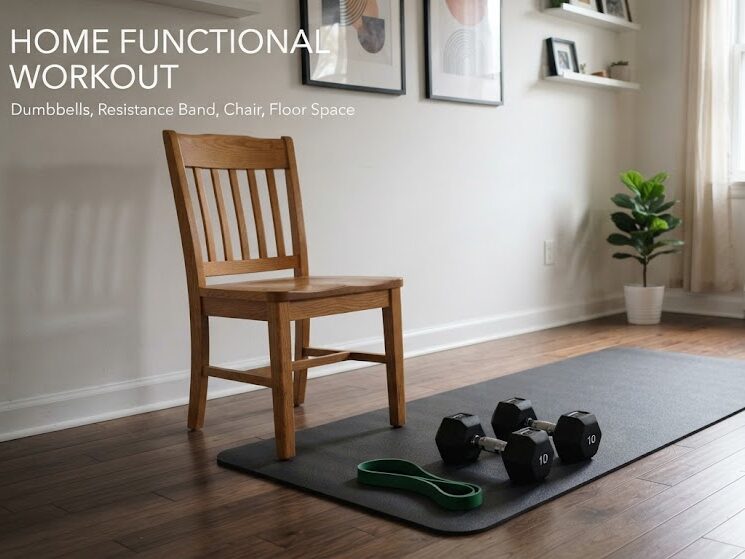
For many people, a pair of adjustable dumbbells and a resistance band can provide substantial exercise variety without requiring a large collection of equipment.
How Often Should You Do Full Body Functional Training?
Most beginners can start a full body functional training workout two to three times per week, allowing recovery between challenging sessions.
Two weekly sessions can be a practical starting point for someone new to resistance training. For example, you might train Monday and Thursday while using the other days for walking, mobility, or lighter activity.
Three weekly sessions can also work when training volume and intensity are appropriately controlled. A Monday-Wednesday-Friday schedule provides approximately one day between sessions.
WHO recommends muscle-strengthening activities involving the major muscle groups on at least two days per week for adults. — Source: World Health Organization, 2026
Adults should also generally work toward 150–300 minutes of moderate-intensity aerobic activity per week, or an equivalent combination of moderate and vigorous activity. — Source: World Health Organization, 2026
The goal is not simply to train as often as possible. Instead, choose a schedule that allows you to perform your workouts consistently while recovering adequately between challenging sessions.
How Do You Progress a Functional Training Workout?
Progressive functional training involves gradually increasing resistance, repetitions, range of motion, movement complexity, or training volume as your fitness improves.
Instead of making every workout harder, increase one or two variables at a time. For example, once you can comfortably perform three sets of 12 goblet squats, you might increase the weight slightly and return to 8–10 repetitions.
Effective Functional Training Progression Methods
- Resistance: Use a slightly heavier dumbbell or kettlebell.
- Repetitions: Add repetitions within your target range.
- Range of motion: Gradually increase comfortable movement depth.
- Tempo: Slow the lowering phase to improve control and increase time under tension.
- Stability: Progress from stable to more demanding positions when appropriate.
- Complexity: Move from simple patterns toward more coordinated variations.
- Volume: Add a set when your current workload becomes manageable.
- Rest: Reduce rest slightly when conditioning is the primary goal.
A simple progression could move from chair squats to bodyweight squats, then goblet squats, and eventually heavier squats.
For a deeper explanation, see our progressive overload.
How Can You Make Functional Training Harder Without More Weight?
You can make functional training more challenging without adding weight by increasing time under tension, range of motion, repetitions, control, or coordination demands.
For example, a push-up can progress from an incline version to a standard version and then to a slower-tempo variation.
However, increasing difficulty should never require sacrificing technique. A challenging exercise performed with poor control is generally less useful than a manageable exercise performed consistently and correctly.
What Is the Difference Between Functional Training and Traditional Strength Training?
Functional training emphasizes movement patterns and physical capacities, while traditional strength training often uses structured resistance exercises to target specific muscles, movements, or strength qualities.
The two approaches are not opposites. A full body functional workout can include traditional strength exercises such as squats, deadlifts, rows, presses, and lunges.
| Functional Training Emphasis | Traditional Strength Emphasis |
| Movement patterns | Specific exercises or muscle groups |
| Coordination | Load progression |
| Stability | Strength development |
| Balance | Muscle hypertrophy or maximal strength |
| Practical movement | Structured resistance training |
| Multi-planar movement | Often more controlled movement paths |
Functional training and traditional strength training can also complement each other.
For example, a recreational athlete might use squats and rows to develop strength while adding carries and unilateral exercises to challenge stability and coordination.
The most useful approach depends on your goals. Functional training can provide broad movement practice, while traditional resistance training can provide highly structured progression for strength or muscle development.
What Should You Do Next With Your Functional Training Routine?
The best next step is to begin with two or three manageable sessions per week, record your performance, and gradually increase difficulty as your technique improves.
First, select the beginner or standard version of each movement according to your current ability. For example, choose chair squats instead of loaded squats if you are still developing squat control.
Second, track your exercises, sets, repetitions, resistance, and perceived difficulty. Keeping a simple training record makes progressive overload easier because you can see exactly what has changed.
Third, combine functional strength training with regular walking, mobility, conditioning, and recovery. The CDC and WHO guidelines support combining aerobic activity with muscle-strengthening activity rather than relying on one form of exercise alone. — Source: CDC, 2020; World Health Organization, 2026
For additional conditioning, explore our HIIT workout, while core stability exercises can help expand your trunk-training options.
A Simple Weekly Example
A weekly schedule can distribute training so that strength work does not overwhelm recovery.
| Day | Activity |
| Monday | Full body functional workout |
| Tuesday | Walking or light mobility |
| Wednesday | Rest or easy activity |
| Thursday | Full body functional workout |
| Friday | Walking or mobility |
| Saturday | Optional conditioning or recreational activity |
| Sunday | Recovery |
As your fitness improves, focus on increasing training quality and difficulty rather than automatically adding more workout days.
Conclusion
A full body functional training workout is a practical way to develop strength, mobility, balance, coordination, stability, muscular endurance, and conditioning through integrated movement patterns.
Build your routine around the major functional patterns: squat, hinge, push, pull, lunge, carry, rotation, anti-rotation, and locomotion. Then select exercises that match your current ability, use controlled technique, and gradually increase the training challenge.
You also do not need a complicated gym setup to begin. Bodyweight exercises, dumbbells, resistance bands, or simple household equipment can provide plenty of options for developing functional strength.
The key is consistency. Start with manageable movements, train two to three times per week, track your progress, and gradually become stronger and more capable over time.
FAQs
What is the best full-body functional workout?
A balanced workout can include squats, Romanian deadlifts, push-ups, rows, lunges, carries, bear crawls, and planks.
What is the 3-3-3 rule for workout?
The 3-3-3 rule can refer to different workout methods, so its meaning depends on the specific program.
What are the 7 functional movements?
The seven common functional movements are squat, hinge, push, pull, lunge, carry, and rotation.
Are 4 exercises enough for full body?
Yes, four compound exercises can be enough when they target major movement patterns and muscle groups.
What is a full body functional training workout?
It combines compound movements that train multiple muscle groups, strength, balance, coordination, and stability.
Is functional training good for beginners?
Yes, beginners can start with bodyweight exercises or light resistance and focus on proper form.
How often should you do functional training?
Two to three full-body functional workouts per week can provide a practical starting point.
Can you do functional training at home?
Yes, exercises such as squats, lunges, push-ups, planks, and bear crawls can be done at home.
Do you need equipment for functional training?
No, bodyweight exercises are enough to start, while dumbbells and resistance bands can add resistance.
How do you make functional training harder?
You can increase resistance, repetitions, range of motion, tempo, volume, or exercise complexity.
Can functional training build strength?
Yes, progressive functional exercises can improve strength while training multiple muscle groups.
Is functional training better than traditional strength training?
Neither is always better, as both can complement each other depending on your fitness goals.
2 thoughts on “Full Body Functional Training Workout: Build Strength & Mobility”