
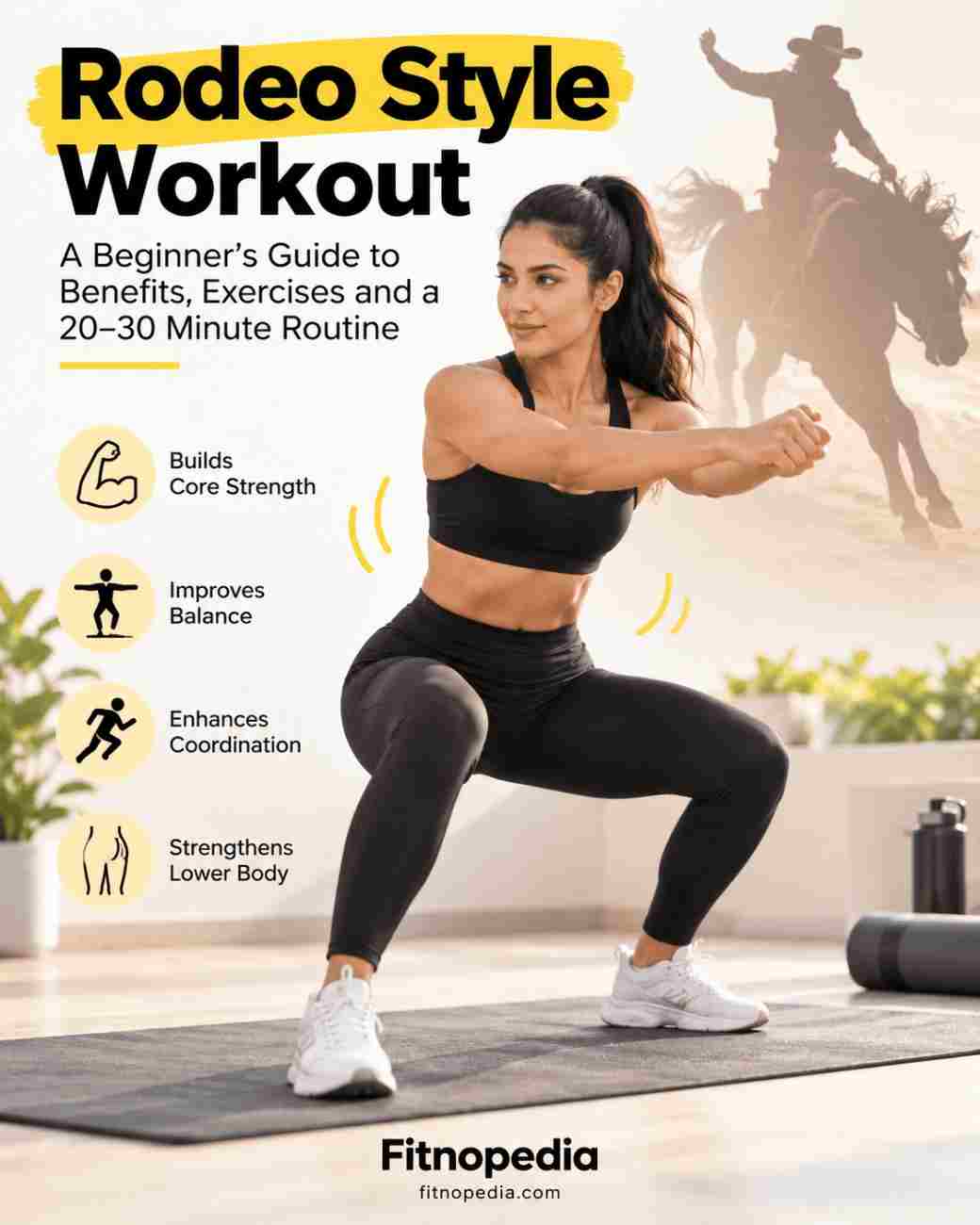
You’ve probably seen Malaika Arora’s rodeo-style workout attracting attention online and wondered whether this unusual movement can improve your fitness. While the horseback version looks challenging, it requires specialized skills and is not suitable for beginners to copy without proper training.
The good news is that you can build similar fitness qualities at home without a horse. In this guide, you’ll learn what a rodeo style workout involves, its potential benefits, the muscles it targets, beginner-friendly exercises, and how to create a safe 20–30-minute routine.
Summarize this blog post with: ChatGPT | Perplexity | Claude | Grok
What Is a Rodeo Style Workout and How Does It Work?
A rodeo style workout is an informal fitness approach inspired by rodeo activities and horseback riding that may combine core conditioning, balance training, coordination, and lower-body strength. Unlike a standardized exercise program, it does not have a universally established routine or fixed set of exercises.
A land-based routine can include bodyweight squats, planks, controlled lunges, and balance drills to develop similar physical qualities. These exercises are practical alternatives rather than an official version of the celebrity-inspired movement.
Why Is Malaika Arora’s Rodeo Style Workout Trending?
The rodeo style workout gained attention after Malaika Arora demonstrated a horseback movement in a video shared by her health coach. An October 11, 2026, report from The Indian Express discussed the movement’s demands on balance, coordination, lower-body stability, and core control. — Source: The Indian Express, 2026.
According to the report, fitness professionals cautioned that rodeo-style training is not yet an established mainstream fitness discipline. Therefore, it is best understood as a creative approach to functional conditioning rather than a formally recognized workout system.
Full Body Functional Training Workout
Why Does a Rodeo Style Workout Matter?
A rodeo-inspired workout can challenge several movement skills in one session, depending on the exercises selected. For example, a dead bug requires you to coordinate opposite arm and leg movements while maintaining control of your torso.
Rodeo-inspired training can challenge core stability, balance, coordination, and hip control, depending on the exercises performed and your fitness level. These qualities can support everyday movements and complement conventional strength training.
The main fitness qualities include:
- Core stability: Maintaining a controlled torso during movement.
- Balance: Keeping your body steady while standing or changing positions.
- Hip stability: Controlling your pelvis and legs during single-leg exercises.
- Coordination: Moving different body parts together smoothly.
- Muscular endurance: Repeating controlled movements without losing technique.
The US Centers for Disease Control and Prevention recommends that adults aim for at least 150 minutes of moderate-intensity aerobic activity weekly and muscle-strengthening activity on at least two days. — Source: CDC, 2025.
A rodeo-inspired routine can complement these activities, but it does not automatically replace them.
What Muscles Does a Rodeo Style Workout Target?
A rodeo style workout can engage the abdominal muscles, back, glutes, thighs, hips, and shoulders, depending on the exercises performed. Squats emphasize the thighs and glutes, while planks challenge the muscles responsible for stabilizing your trunk.
| Muscle group | Example exercise | Primary purpose |
|---|---|---|
| Abdominals and trunk | Dead bug, plank | Core control |
| Glutes | Glute bridge | Hip extension |
| Quadriceps and thighs | Bodyweight squat | Lower-body strength |
| Hamstrings and glutes | Single-leg Romanian deadlift | Hip stability |
| Back and trunk stabilizers | Bird dog | Coordination and stability |
| Hips and ankles | Supported single-leg balance | Balance control |
The exact muscular demands depend on the routine. A beginner performing floor-based exercises will experience different demands from an experienced rider performing a specialized horseback movement.
What Are the Main Benefits of a Rodeo Style Workout?
The main potential benefits of a rodeo style workout include improved balance, coordination, core control, and lower-body strength when you perform appropriate exercises consistently with proper technique.
For example, supported single-leg balance drills help you practice controlling your body on one leg. Meanwhile, glute bridges and squats strengthen muscles used in everyday activities.
1. Improved Balance and Coordination
Balance exercises challenge your ability to maintain a stable position while your body makes small adjustments. A supported single-leg stand is a simple starting point for beginners.
Practice near a wall or sturdy chair so you can use support whenever necessary. Over time, controlled practice can help you become more comfortable with balance-based movements.
2. Better Core Stability
Core exercises teach you to control your trunk during movement. Dead bugs and forearm planks are useful options because they allow you to practice maintaining a stable torso without requiring horseback riding.
core stability exercises for beginners
3. Stronger Hips and Lower Body
Squats, glute bridges, and reverse lunges strengthen muscles around the hips and legs. These exercises can support general strength and movement control when included in a balanced training routine.
4. Greater Movement Confidence
Learning unfamiliar movements gradually can help you feel more confident during exercise. However, confidence should come from consistent practice and controlled technique, not from attempting increasingly risky movements for social media videos.
A rodeo-inspired workout does not guarantee faster fat loss, six-pack abs, or superior muscle growth. Results depend on your overall training, nutrition, recovery, and consistency.
What Are the Best Rodeo Style Exercises for Beginners?
The best beginner rodeo style exercises are controlled movements that build foundational strength and balance before you attempt advanced variations. Start with exercises such as glute bridges and bodyweight squats before progressing to more challenging single-leg movements.
Beginner Exercises
1. Forearm Plank
Place your forearms on the floor with your elbows beneath your shoulders. Keep your body aligned from head to heels, tighten your abdominal muscles, and hold a comfortable position without letting your hips sag.
2. Dead Bug
Lie on your back with your arms raised and knees bent. Slowly lower your opposite arm and leg while keeping your lower back controlled, then return to the starting position and switch sides.
3. Glute Bridge
Lie on your back with your knees bent and feet flat on the floor. Press through your feet, lift your hips, gently squeeze your glutes, and lower with control.
4. Bodyweight Squat
Stand with your feet approximately shoulder-width apart. Push your hips backward, bend your knees, and lower only as far as you can comfortably maintain control before standing again.
5. Bird Dog
Begin on your hands and knees. Extend one arm and the opposite leg without twisting your torso, pause briefly, and return to the starting position before switching sides.
6. Supported Single-Leg Balance
Stand beside a sturdy chair or wall and lift one foot slightly off the floor. Keep your posture upright, hold the position, and use support whenever necessary.
Intermediate Exercises
Once you can perform the beginner movements with control, consider these options:
- Reverse lunges: Develop lower-body strength and single-leg control.
- Single-leg Romanian deadlifts: Challenge hip stability and balance.
- Plank with alternating leg lifts: Add a coordination challenge to core training.
- Pallof presses: Use a resistance band to practice resisting trunk rotation.
- Controlled lateral step-ups: Strengthen the legs while practicing side-to-side control.
Choose exercises appropriate for your current ability. You do not need to perform every variation in one session.
How Can Beginners Do a Rodeo Style Workout at Home?
Beginners can prepare for rodeo-style training with controlled exercises such as planks, dead bugs, bird dogs, bodyweight squats, and supported single-leg balance drills. A simple home routine can combine these movements into a short session without requiring a horse or specialized gym equipment.
Your 20–30-Minute Rodeo-Inspired Workout
Step 1: Warm up for five minutes.
Start with marching in place, gentle arm circles, hip circles, and comfortable dynamic movements. Increase your activity gradually instead of jumping straight into demanding exercises.
Step 2: Complete the main workout.
| Exercise | Sets | Repetitions or duration |
|---|---|---|
| Glute bridges | 2 | 12 repetitions |
| Bodyweight squats | 2 | 10 repetitions |
| Dead bugs | 2 | 8 per side |
| Bird dogs | 2 | 8 per side |
| Supported single-leg balance | 2 | 20–30 seconds per side |
Rest for approximately 30–60 seconds between sets, or longer when necessary to maintain good technique.
Step 3: Cool down for three to five minutes.
Finish with gentle hip mobility, comfortable leg stretches, and relaxed breathing. Avoid forcing stretches or pushing through pain.
The exact session duration depends on your pace, rest periods, and mobility needs. Start with fewer repetitions if necessary and increase gradually as the movements become easier.
Can You Do a Rodeo Style Workout Without a Horse?
Yes, you can perform a rodeo-inspired workout without a horse by focusing on the strength, balance, coordination, and core-control qualities associated with riding.
For example, a home session using squats, bird dogs, and supported balance drills can train these qualities without horseback-specific risks.
However, a land-based routine is not identical to riding a moving horse. Horseback activities involve specialized skills, animal behavior, equipment, and environmental factors that ordinary home exercises cannot reproduce.
If you want to learn the actual horseback movement, seek instruction from a qualified equestrian professional rather than experimenting independently.
How Can You Progress From Beginner to Advanced Rodeo-Style Training?
Progression means increasing exercise difficulty only after you can perform your current movements with reliable control. For example, you might progress from a supported single-leg stand to an unsupported stand before trying a more demanding balance exercise.
Follow this progression:
- Build a foundation: Practice squats, glute bridges, bird dogs, and dead bugs.
- Improve balance: Perform supported single-leg stands near a stable surface.
- Increase control: Introduce controlled lunges and other single-leg movements.
- Add resistance carefully: Use light dumbbells or resistance bands when your technique is consistent.
- Explore dynamic variations: Attempt more demanding movements only when you can maintain control.
- Seek specialist instruction: Learn horseback-specific activities with appropriate supervision and safety equipment.
What Equipment Do You Need for a Rodeo Style Workout?
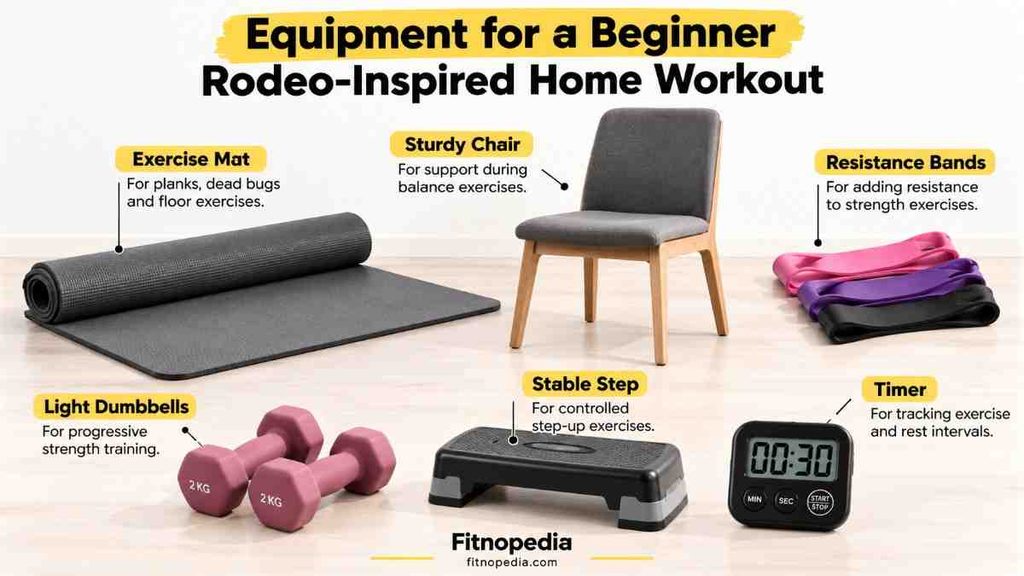
Most beginners need only comfortable clothing, enough floor space, and a stable surface for support. You can complete the recommended home routine using an exercise mat and a sturdy chair.
As you progress, consider these optional tools:
- Exercise mat: Provides a more comfortable surface for floor exercises.
- Resistance bands: Add resistance to movements such as Pallof presses.
- Light dumbbells: Increase the challenge of suitable strength exercises.
- Stable step: Supports controlled step-up variations.
- Balance pad: Introduces a greater balance challenge after you master stable surfaces.
- Timer: Helps you track exercise intervals and rest periods.
Avoid unstable equipment until you have developed basic balance and control. You can build an effective starting routine without buying anything.
Is a Rodeo Style Workout Safe for Beginners?
A rodeo-inspired workout can be suitable for many beginners when it uses controlled exercises and appropriate modifications. However, horseback-specific rodeo movements should not be attempted solely by copying a social media video; appropriate riding skills, qualified supervision, and suitable safety precautions are essential.
Follow these precautions:
- Warm up before exercising.
- Use a stable chair or wall for balance support.
- Keep repetitions controlled instead of rushing.
- Choose a range of motion that feels comfortable.
- Increase difficulty gradually.
- Stop if you experience pain, dizziness, or loss of control.
- Seek professional guidance if you have injuries, balance limitations, or relevant medical concerns.
For home balance practice, the NHS recommends using a wall or stable chair nearby when needed and increasing difficulty gradually. — Source: NHS, 2022.
Never treat a moving horse as an exercise prop. Falls and unpredictable animal movements create risks that a floor-based workout does not involve.
How Often Should You Do Rodeo-Inspired Exercises?
Beginners can start with two short rodeo-inspired sessions per week, allowing recovery between sessions and adjusting the schedule to their fitness level.
For example, you could exercise on Tuesday and Friday while continuing other suitable activities on the remaining days.
| Day | Activity |
|---|---|
| Monday | Conventional strength training |
| Tuesday | Rodeo-inspired conditioning |
| Wednesday | Walking or other comfortable cardio |
| Thursday | Strength training or mobility |
| Friday | Rodeo-inspired conditioning |
| Saturday | Enjoyable recreational activity |
| Sunday | Rest or gentle movement |
This schedule is an example, not a mandatory plan. Adjust it to your recovery, experience, and other training commitments.
Is a Rodeo Style Workout Better Than a Traditional Gym Workout?
A rodeo style workout is not automatically better than a traditional gym workout because each approach can serve different fitness goals. Balance drills may complement riding-related skills, while progressive resistance training may be more suitable when your main goal is increasing muscle strength.
| Training approach | Main focus | Best use |
|---|---|---|
| Rodeo-inspired conditioning | Balance, coordination, core control | Varied functional training |
| Traditional strength training | Strength and muscle development | Progressive resistance work |
| Cardiovascular exercise | Aerobic fitness and endurance | Walking, cycling, running |
| Mobility training | Comfortable joint movement | Supporting movement quality |
For balanced fitness, combine activities that match your goals instead of relying on one trending workout. Adults should generally aim for the recommended combination of aerobic activity and muscle-strengthening exercise. — Source: CDC, 2025.
How Should You Add Rodeo-Style Training to Your Fitness Routine?
The best next step is to begin with a manageable routine, monitor your technique, and increase difficulty only when you feel comfortable with the current exercises.
To make progress, record your sets, repetitions, balance duration, and how controlled each movement feels. If an exercise becomes easy without sacrificing technique, make one gradual adjustment rather than changing everything at once.
best resistance band exercises
Conclusion
A rodeo style workout can be an enjoyable way to explore core stability, balance, coordination, and lower-body strength without following a conventional gym routine every time. The most practical starting point is a simple, horse-free session built around controlled movements.
Remember that the viral horseback version is a specialized activity, not a beginner challenge. Start small, practice consistently, and seek qualified guidance before attempting advanced riding movements.
FAQs
What is a rodeo style workout?
A rodeo style workout combines balance, core training, coordination, and lower-body exercises inspired by horseback riding.
Is the rodeo style workout suitable for beginners?
Yes, beginners can start with squats, glute bridges, dead bugs, and balance exercises.
Can I do a rodeo style workout at home without a horse?
Yes, you can perform horse-free exercises at home without special equipment.
What muscles does a rodeo style workout target?
It targets the core, glutes, thighs, hips, back, and shoulders.
How long should a rodeo style workout last?
A beginner session can last 20–30 minutes, including warm-up and cool-down.
How often should beginners do a rodeo style workout?
Start with two sessions per week and adjust according to your recovery.
Does the rodeo style workout help with weight loss?
It can support weight loss as part of a balanced diet and regular exercise routine.
Can a rodeo style workout build abs?
It strengthens your core, but visible abs also depend on body-fat levels and nutrition.
Is Malaika Arora’s rodeo workout safe to copy?
Horseback movements require proper riding skills, safety equipment, and qualified supervision.
What equipment is needed for a rodeo style workout?
Comfortable clothing, floor space, and a sturdy chair are enough to get started.
Is a rodeo style workout better than gym training?
No single workout is best for everyone; choose exercises that match your fitness goals.
How can I make a rodeo style workout more challenging?
Gradually increase repetitions, balance time, or resistance as your technique improves.