
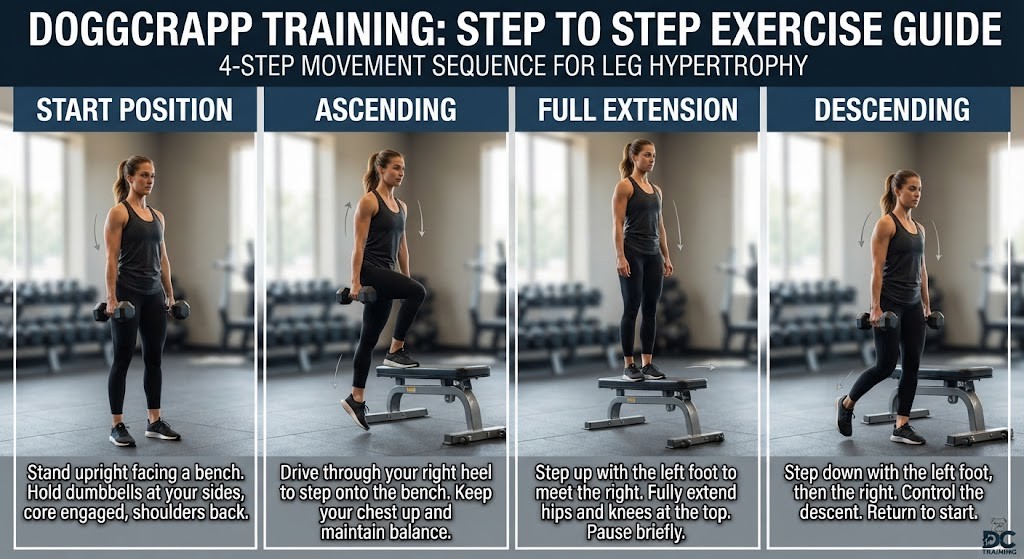
If you’ve been lifting for years, you’ve probably tried conventional bodybuilding routines built around multiple exercises, multiple sets, and higher weekly training volume. Yet sometimes the missing piece isn’t another exercise or another set—it is how you organize intensity, progression, exercise selection, and recovery.
That is where the Doggcrapp Training Workout approach stands out.
Created by Dante Trudel, Doggcrapp training, commonly called DC training, is a high-intensity bodybuilding system built around relatively low training volume, progressive overload, rest-pause sets, exercise rotation, logbook progression, and recovery. Instead of accumulating large amounts of conventional work, DC training concentrates effort into fewer, highly productive working sets.
In this guide, you’ll learn what Doggcrapp training is, how the DC workout split works, how to perform rest-pause sets, what extreme stretching means, which exercises work well with the system, how to use a logbook for progressive overload, and how to approach this demanding style of training safely.
What Is Doggcrapp Training and How Does It Work?
Doggcrapp training is a high-intensity bodybuilding system created by Dante Trudel that emphasizes progressive overload, relatively low volume, rest-pause training, exercise rotation, and recovery.
The system became known as DC training and developed a reputation for making each working set highly focused rather than relying on large amounts of conventional training volume.
Traditional Doggcrapp training combines several distinctive principles:
- Rest-pause working sets
- Exercise rotation
- Extreme stretching
- Logbook progression
- High training intensity
- Controlled training volume
- Planned recovery periods
For example, instead of performing three conventional chest sets on an incline press, a lifter may perform one carefully selected rest-pause set and record the total repetitions achieved across the mini-sets.
However, DC training should not be confused with simply doing fewer sets or taking every set to failure. It is a structured system in which exercise selection, progression, intensity, and recovery work together.
For more context, see our high intensity hypertrophy training.
Doggcrapp training is a high-intensity bodybuilding system that emphasizes progressive overload, relatively low training volume, rest-pause sets, and recovery.
What Makes DC Training Different?
Doggcrapp training differs from conventional bodybuilding primarily through its concentration of effort into fewer working sets.
Rather than accumulating fatigue through numerous exercises and conventional sets, the lifter attempts to make a small number of working sets extremely productive and measurable.
For example, a chest workout may use an incline press as the primary movement followed by a controlled stretch instead of several chest exercises performed for multiple conventional sets.
That does not mean traditional bodybuilding is ineffective. Conventional hypertrophy programming can work extremely well, and current resistance-training evidence does not establish DC training as universally superior.
The 2026 ACSM position stand recommends roughly 10 weekly sets per muscle group as a useful hypertrophy target, while also emphasizing that advanced techniques are optional for many healthy adults — Source: American College of Sports Medicine, 2026.
Therefore, DC training is best viewed as a specialized training strategy, not a magic shortcut for muscle growth.
Why Is Doggcrapp Training Effective for Hypertrophy?
Doggcrapp training can support hypertrophy by combining high effort, progressive overload, exercise consistency, and fatigue management.
One of its biggest practical advantages is that performance becomes easy to track. Because exercises are repeated and rotated systematically, you can compare your current performance with previous workouts.
For example, if your incline press progresses from 80 kg for 12 total rest-pause repetitions to 82.5 kg for 13 total repetitions, you have a measurable performance marker rather than relying only on pump, soreness, or how difficult the workout felt.
Resistance-training research consistently supports progressive training volume as an important factor in hypertrophy, although the optimal amount varies between individuals.
A 2017 meta-analysis of 15 studies found a graded relationship between weekly resistance-training volume and muscle growth — Source: Schoenfeld et al., 2017.
At the same time, traditional DC training deliberately controls volume because its working sets can be unusually demanding. That makes recovery capacity especially important.
Why Experienced Lifters May Prefer DC Training
Experienced lifters may find Doggcrapp training particularly appealing because they can execute exercises consistently and judge appropriate effort more accurately.
For example, an experienced lifter can better distinguish between genuine muscular fatigue, technical failure, and simply experiencing discomfort during a heavy press.
Experienced lifters also tend to have established:
- Exercise technique
- Warm-up habits
- Training discipline
- Recovery routines
- Exercise preferences
- Understanding of their individual limitations
These qualities become increasingly important when a program incorporates rest-pause sets performed close to muscular failure.
The original DC approach has historically been aimed at experienced trainees rather than beginners. Contemporary evidence also suggests that advanced methods such as training to failure are not mandatory for obtaining results in the average healthy adult — Source: American College of Sports Medicine, 2026.
How Does a Doggcrapp Training Split Work?
A Doggcrapp training split is a rotating bodybuilding schedule that trains major muscle groups through alternating workouts while allowing substantial recovery between exposures.
A common structure uses two alternating workouts, often performed three times per week.
A simplified example looks like this:
| Training Day | Main Muscle Groups | Example Focus | Working Approach |
|---|---|---|---|
| Monday | Chest, shoulders, triceps, back | Presses, rows, pulldowns | Rest-pause + selected straight sets |
| Wednesday | Biceps, forearms, calves, hamstrings, quads | Curls, leg work, calves | Rest-pause + straight sets |
| Friday | Chest, shoulders, triceps, back | Rotated exercises | Rest-pause + selected straight sets |
| Next Monday | Lower body + arms | Rotated exercises | Continue rotation |
Traditional DC programming also commonly rotates exercises so the lifter does not perform exactly the same movement every session.
This allows the trainee to pursue progressive overload while managing joint stress and using different exercises to contribute to overall muscular development.
Training frequency itself is not necessarily the secret to hypertrophy. A 2019 systematic review and meta-analysis found no meaningful hypertrophy advantage from higher frequency when training volume was equated — Source: Schoenfeld, Grgic & Krieger, 2019.
That is important because the DC approach emphasizes the quality and intensity of individual working sets rather than simply increasing the number of weekly sessions.
How Often Should You Train Each Muscle With Doggcrapp Training?
Each muscle in traditional DC training is generally trained less frequently than in many modern full-body routines because individual sessions can be highly demanding.
The exact frequency depends on the rotation, exercise selection, training status, and individual recovery capacity.
For example, an A/B schedule performed Monday, Wednesday, and Friday provides repeated exposure throughout the week while allowing workouts to alternate.
That structure differs from the general 2026 ACSM recommendation to train major muscle groups at least two days per week, showing why DC should be treated as a specialized system rather than a universal template — Source: American College of Sports Medicine, 2026.
How Do You Perform Rest-Pause Sets in Doggcrapp Training?
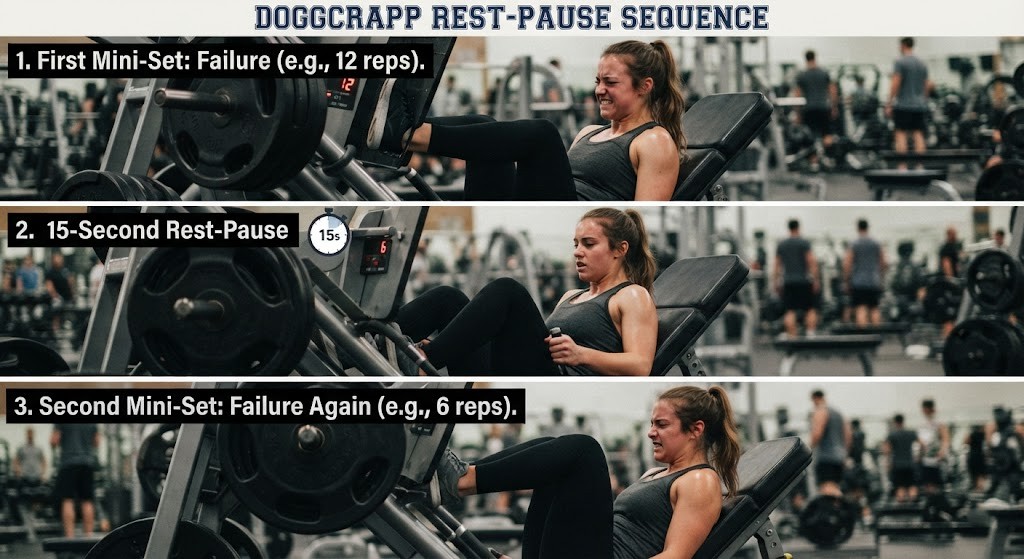
Doggcrapp rest-pause training involves performing a hard working set, taking a short rest, and then completing additional repetitions to extend the set without using a traditional long-rest approach.
The classic DC sequence commonly uses three mini-sets separated by roughly 10–15 deep breaths.
For example, you could perform 8 repetitions, rack the weight, take 10–15 deep breaths, complete 3 additional repetitions, breathe again, and finish with 2 more repetitions.
The total would be 13 repetitions using the same working weight.
A practical rest-pause sequence looks like this:
- Choose a controlled working weight.
- Perform the first mini-set with strict technique.
- Rack the weight and take about 10–15 deep breaths.
- Perform the second mini-set.
- Repeat the short breathing break.
- Complete the final mini-set.
- Record the total repetitions in your logbook.
Rest-pause training creates more repetitions from a demanding load while keeping the recovery interval very short.
The goal is not simply to make the workout uncomfortable. The repetitions should remain technically productive, controlled, and measurable.
Which Exercises Should Avoid Rest-Pause?
Rest-pause training is not appropriate for every movement because fatigue can compromise technique and safety.
Traditional DC variations commonly use straight sets for movements such as heavy back-thickness exercises and other exercises where repeated near-failure efforts may become technically risky.
For example, performing repeated near-failure mini-sets on a technically demanding deadlift can allow fatigue to alter spinal position or pulling mechanics.
Therefore, exercise stability matters more than following a rigid rest-pause rule.
Machines, cables, supported rows, and controlled presses may be easier to manage during high-effort work than highly technical free-weight movements.
What Is Extreme Stretching in Doggcrapp Training?
Extreme stretching is a traditional Doggcrapp technique involving a controlled, often loaded stretch performed after training a muscle.
Dante Trudel included extreme stretching as a distinctive part of the system, with traditional descriptions commonly using stretches lasting around 60–90 seconds.
For example, a chest stretch may involve holding dumbbells in a controlled stretched position after pressing instead of performing a relaxed static stretch before the workout.
However, extreme stretching should not be presented as a guaranteed muscle-growth mechanism.
Research supports the broader concept that training muscles under tension at longer muscle lengths can influence hypertrophic adaptations, but the specific traditional DC extreme-stretching protocol has much less direct evidence behind it.
How Should You Approach Extreme Stretching?
Extreme stretching should be introduced gradually and without aggressive loading or painful ranges of motion.
A productive stretch should create controlled tension rather than sharp pain, numbness, joint discomfort, or instability.
If you are new to loaded stretching, begin with bodyweight or very light resistance before considering additional load.
Also remember that stretching immediately after intense training can feel very different from normal mobility work because the target muscle is already fatigued.
Stop if you experience sharp pain or unusual joint symptoms.
What Exercises Are Best for a Doggcrapp Workout?
The best Doggcrapp exercises are stable movements that allow consistent technique, measurable progression, and safe high-effort execution.
Exercise selection should prioritize progression potential rather than simply choosing movements because they are difficult.
For example, a machine chest press may be more practical for a high-effort rest-pause set than a technically demanding free-weight movement if fatigue makes the latter difficult to control.
| Muscle Group | Exercise Examples | Typical DC Consideration |
| Chest | Incline press, machine press, weighted dip | Rest-pause candidates |
| Shoulders | Machine press, Smith press | Stable pressing preferred |
| Back Width | Pulldown, weighted pull-up | Controlled high-effort work |
| Back Thickness | Supported row, T-bar row | Often better with straight sets |
| Biceps | EZ-bar curl, machine curl | Rest-pause candidates |
| Triceps | Cable extension, close-grip press | Stable movements |
| Quads | Hack squat, leg press, squat | Straight work + traditional Widowmaker |
| Hamstrings | Leg curl, controlled hinge | Select based on technique |
| Calves | Standing or seated calf raise | Controlled repetitions and stretch |
Exercise selection should also complement your individual strengths, weaknesses, equipment availability, and injury history.
For more exercise ideas, see best chest exercises for muscle growth, best back exercises for muscle growth, and best shoulder exercises.
For the lower body, useful resources include best leg exercises for muscle growth, while arm-focused lifters can reference biceps workout for muscle growth and triceps workout for bigger arms.
What Is the Traditional DC Widowmaker Set?
The traditional DC Widowmaker is a high-repetition quad set performed after heavier quad work, commonly using approximately 20 repetitions.
It is one of the most demanding components associated with traditional Doggcrapp programming.
For example, a lifter might perform a heavy quad set, rest adequately, and then complete a controlled high-repetition set with a lighter load.
The key word is controlled. The Widowmaker should not become an ego exercise.
If technique deteriorates badly during high-repetition squats or leg presses, reducing the load is more appropriate than forcing additional repetitions.
How Do You Progress on a Doggcrapp Training Program?
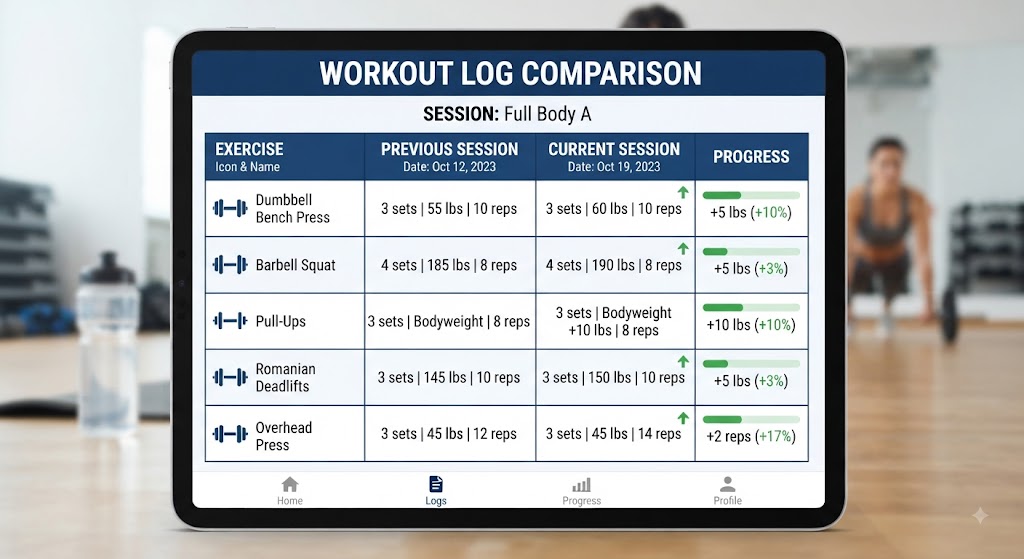
Doggcrapp progression relies heavily on keeping a training log and attempting to improve repetitions, weight, or overall performance on repeated exercises over time.
The goal is to make progress measurable rather than relying on subjective feelings about workout intensity.
For example, if your previous incline press log shows 90 kg for 12 total rest-pause repetitions, your next target could be 13–15 total repetitions before increasing the load.
A simple progression model is:
- Below target: Keep the load stable or reduce it slightly.
- Within target: Try to add a repetition next session.
- At the top of the target: Increase the load conservatively.
- Repeated stall: Review technique, recovery, exercise selection, and fatigue.
- Persistent stall: Rotate the exercise and establish a new baseline.
Doggcrapp progression turns every workout into a measurable performance test.
This is one of the most important principles of the entire system. Without objective records, it becomes difficult to know whether you are genuinely progressing or simply training harder.
For a more detailed system, use progressive overload for muscle growth.
How Important Are Recovery and Nutrition in Doggcrapp Training?
Recovery is essential in Doggcrapp training because high-effort working sets create substantial fatigue relative to the small number of sets performed.
Sleep, nutrition, stress management, and exercise selection all influence whether you can repeat high-quality performance.
For example, a lifter who consistently sleeps poorly and pushes every set to extreme fatigue may find that performance decreases even when the program looks perfect on paper.
How Much Protein Do You Need for Muscle Growth?
Protein intake is important for lifters pursuing muscle growth.
The International Society of Sports Nutrition position stand identifies 1.4–2.0 g of protein per kilogram of body weight per day as sufficient for most exercising individuals — Source: International Society of Sports Nutrition, 2017.
For example, a 75 kg lifter would fall within a broad daily range of approximately 105–150 g of protein.
Total calorie intake also matters because gaining muscle requires sufficient energy and nutrients to support training and tissue remodeling.
See high protein diet for muscle growth and muscle recovery after workouts.
Should You Use Blast and Cruise With DC Training?
Traditional DC programming is often associated with blast-and-cruise periods, where a harder training phase is followed by a lower-stress period.
Contemporary descriptions commonly present blasts lasting several weeks and cruises lasting around one to two weeks, although exact protocols vary.
For example, an experienced lifter might use several weeks of progressive training before deliberately reducing training stress.
However, blast-and-cruise terminology should not be treated as a requirement for everyone using DC principles.
A more conservative approach is to monitor:
- Training performance
- Joint comfort
- Motivation
- Sleep quality
- General recovery
- Persistent fatigue
If these indicators deteriorate, reducing training stress can be more productive than continuing to push harder.
Is Doggcrapp Training Good for Beginners?
Doggcrapp training is generally better suited to intermediate and advanced lifters than beginners because its high-intensity methods require strong technique, exercise familiarity, and recovery awareness.
Traditional DC sources have specifically positioned the system toward experienced trainees.
For example, a beginner who is still learning squat, press, row, and deadlift technique should generally prioritize consistent movement quality instead of performing repeated near-failure rest-pause sets.
Beginners can often make excellent progress with simpler programs that use moderate volume and straightforward progression.
The 2026 ACSM position stand emphasizes consistency and gradual progression while noting that advanced techniques are optional — Source: American College of Sports Medicine, 2026.
Doggcrapp training is an advanced specialization, not a prerequisite for building muscle.
Who Is a Better Candidate for DC Training?
DC training may be more appropriate for a lifter who can answer “yes” to most of the following:
- Can you perform your main exercises with consistent technique?
- Can you accurately judge your effort level?
- Do you have several years of resistance-training experience?
- Can you track your workouts consistently?
- Can you recover from high-effort training?
- Can you control your ego when selecting weights?
- Can you recognize when an exercise is becoming technically unsafe?
If several answers are “no,” a simpler hypertrophy program may provide a better starting point.
What Are the Most Common Doggcrapp Training Mistakes?
The most common Doggcrapp mistakes involve using excessive weight, ignoring technique, adding unnecessary volume, and treating every set as an ego challenge.
The program becomes less effective when the lifter focuses on surviving workouts rather than progressing through them.
For example, increasing your incline press load while losing control of the eccentric phase does not represent meaningful progression.
Common mistakes include:
- Starting too heavy. High intensity does not require reckless loading.
- Using rest-pause on risky exercises. Fatigue can compromise technique.
- Adding extra sets. More work can interfere with the recovery strategy.
- Changing exercises constantly. Excessive variation makes progression harder to measure.
- Ignoring recovery. Sleep and nutrition directly affect training performance.
- Chasing failure every session without control. Effort should remain technically productive.
- Skipping the logbook. Without records, progressive overload becomes guesswork.
At the same time, current evidence shows that more training volume can increase hypertrophy, with diminishing returns rather than a universal requirement for either extremely low or extremely high volume — Source: Schoenfeld et al., 2017; Currier et al., 2026.
Therefore, reducing volume simply because DC is known for low volume is not enough. The entire system has to be organized around high-quality effort, progression, and recovery.
What Does a Practical Doggcrapp Training Workout Look Like?
A practical Doggcrapp training workout is a focused session built around selected exercises, high-effort working sets, controlled progression, and adequate recovery.
The following example illustrates the structure rather than prescribing one universal DC routine.
| Session | Exercise | Sets | Example Rep Structure |
| A | Incline press | 1 RP | 8 + 3 + 2 |
| A | Machine shoulder press | 1 RP | 8 + 3 + 2 |
| A | Close-grip press | 1 RP | 9 + 2 + 2 |
| A | Pulldown | 1 RP | 8 + 3 + 2 |
| A | Supported row | 2 straight | 6–10 + 8–12 |
| B | EZ-bar curl | 1 RP | 8 + 3 + 2 |
| B | Leg curl | 1 RP | 9 + 3 + 2 |
| B | Leg press | 1 heavy + 1 high-rep | 6–10 + ~20 |
| B | Calf raise | 1 controlled set | 10–20 |
Treat this table as a framework rather than a fixed prescription because exercise safety, training history, equipment, recovery capacity, and individual needs differ between lifters.
First, select exercises that you can perform consistently. Then establish conservative starting loads and learn how your body responds to high-effort work.
Second, warm up appropriately before demanding working sets. Dante Trudel has described using multiple warm-up sets when necessary, with the number depending on the exercise and lifter.
How Should You Start Doggcrapp Training Safely?
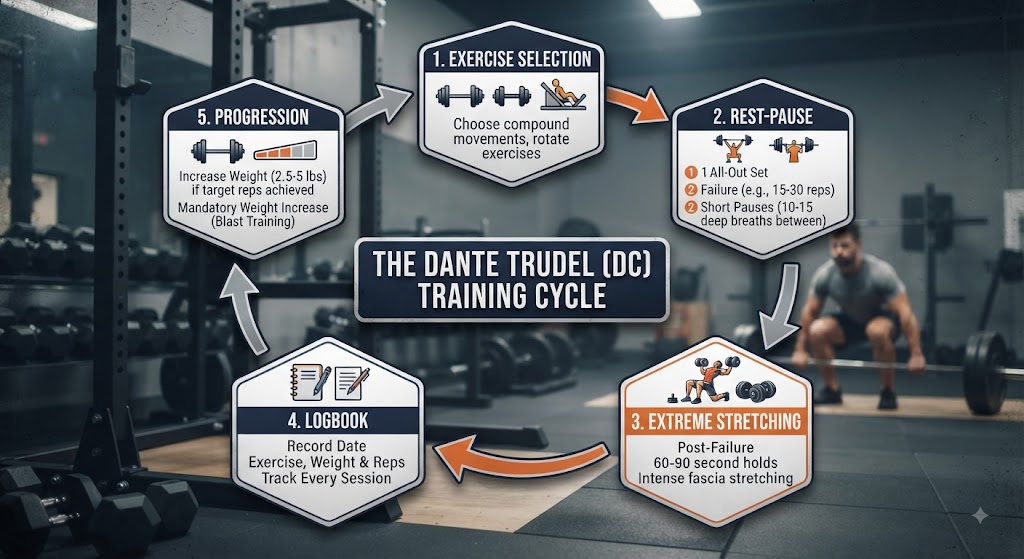
Starting Doggcrapp training safely means choosing stable exercises, learning the rest-pause method, establishing conservative starting weights, tracking every session, and progressing gradually.
The goal is to learn the system before attempting its most demanding variations.
For example, begin by selecting stable exercises for each major muscle group and practice recording total rest-pause repetitions before aggressively increasing loads.
Use this process:
- Confirm your experience level. Build a strong technical foundation first.
- Choose stable exercises. Favor movements you can reproduce consistently.
- Establish conservative loads. Do not start with your theoretical maximum.
- Practice rest-pause technique. Learn the breathing and re-racking sequence.
- Record every working set. Log weight, repetitions, and exercise variation.
- Progress gradually. Add repetitions before adding substantial load.
- Monitor recovery. Watch sleep, soreness, joint comfort, motivation, and performance.
- Reduce training stress when needed. A productive program should remain sustainable.
The most important point is that intensity should remain productive rather than reckless. A successful Doggcrapp workout is one you can recover from and improve upon.
Moreover, DC is not the only effective hypertrophy approach. Current evidence supports multiple resistance-training strategies, and the best program depends on your goals, training status, schedule, exercise experience, and ability to recover.
Conclusion
Doggcrapp training is a demanding hypertrophy-focused system built around high effort, progressive performance, controlled volume, exercise rotation, rest-pause training, and recovery.
Its distinctive methods can make training highly measurable and efficient, but they also require greater technical discipline than a basic bodybuilding routine.
The central idea is simple: make your working sets count, record what you do, recover properly, and attempt to improve your performance over time.
Ultimately, the best Doggcrapp training workout is not the one that leaves you completely destroyed. It is the one that allows you to recover, return to the gym, and beat your previous performance.
If you already have substantial lifting experience, strong exercise technique, and disciplined recovery habits, DC principles can provide an interesting high-intensity framework for approaching hypertrophy and potentially breaking through training plateaus.
FAQs
What is the DoggCrapp training method?
DoggCrapp training is a high-intensity bodybuilding method based on low volume, rest-pause sets, progressive overload, exercise rotation, and recovery.
What is the 3-3-3 rule gym?
The 3-3-3 rule is a training approach that generally uses three exercises, three sets, and three repetitions.
What are the Golden 5 exercises?
The Golden 5 exercises commonly include squats, deadlifts, bench presses, overhead presses, and barbell rows.
Did Arnold train 5 hours a day?
Arnold Schwarzenegger sometimes trained for several hours during intense bodybuilding periods, but he did not necessarily train exactly five hours every day.
Is DoggCrapp training good for muscle growth?
DoggCrapp training can support muscle growth through high effort, progressive overload, and controlled training volume.
Is DoggCrapp training good for beginners?
DoggCrapp training is generally better suited to intermediate and advanced lifters with solid technique and training experience.
What is a DoggCrapp Widowmaker set?
A DoggCrapp Widowmaker is a high-repetition quad set traditionally performed for about 20 repetitions.
What is extreme stretching in DC training?
Extreme stretching is a controlled, often loaded stretch performed after training, traditionally lasting around 60–90 seconds.
How does DoggCrapp rest-pause training work?
DoggCrapp rest-pause training uses short breaks of about 10–15 deep breaths between mini-sets to extend a demanding working set.
How important is a logbook in DoggCrapp training?
A logbook tracks weights and repetitions, helping lifters measure progressive overload and improve performance.
How often should you do DoggCrapp training?
A common DC approach alternates two workouts across three training days per week while allowing recovery between sessions.
Is DoggCrapp training better than traditional bodybuilding?
DoggCrapp training is not proven to be universally better than traditional bodybuilding, but it can be an effective specialized approach for experienced lifters.