
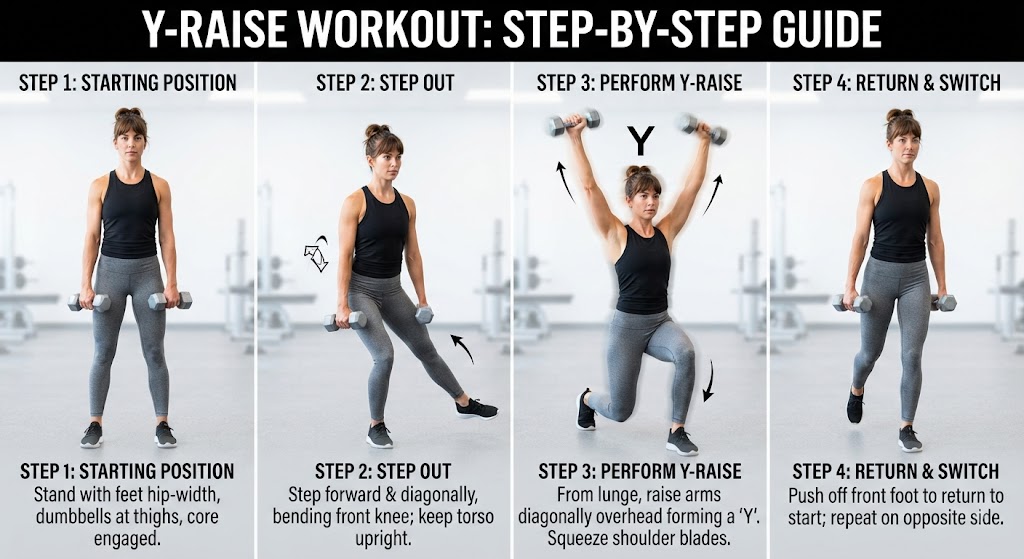
You’ve probably already included presses, lateral raises, and rows in your training. However, scapular control and lower-trap strength can still be overlooked. That’s where the Y-Raise Workout can add value.
The Y-raise is a controlled upper-body exercise in which the arms move diagonally into a Y-shaped position. It primarily challenges the trapezius and supporting scapular muscles while also training shoulder control and stability.
In this guide, you’ll learn what a Y-raise workout is, which muscles it works, how to perform it with proper form, the best variations for different training levels, common mistakes to avoid, how many sets and reps to do, and where to place it in a shoulder or upper-back routine.
What Is a Y-Raise Workout?
A Y-Raise Workout is an upper-body exercise in which the arms are raised diagonally into a Y-shaped position to train the muscles responsible for shoulder movement and scapular control. Unlike a traditional lateral raise, the arms travel forward and outward rather than directly to the sides.
The Y-raise is generally performed with very light resistance because controlled shoulder movement is more important than maximum loading. Beginners can even start with bodyweight, particularly when performing prone Y-raises, before progressing to small dumbbells or resistance bands.
The exercise can also be adapted to different training environments. You can perform Y-raises lying face down, standing, using an incline bench, or with cables and resistance bands.
How Is a Y-Raise Different From a Shoulder Raise?
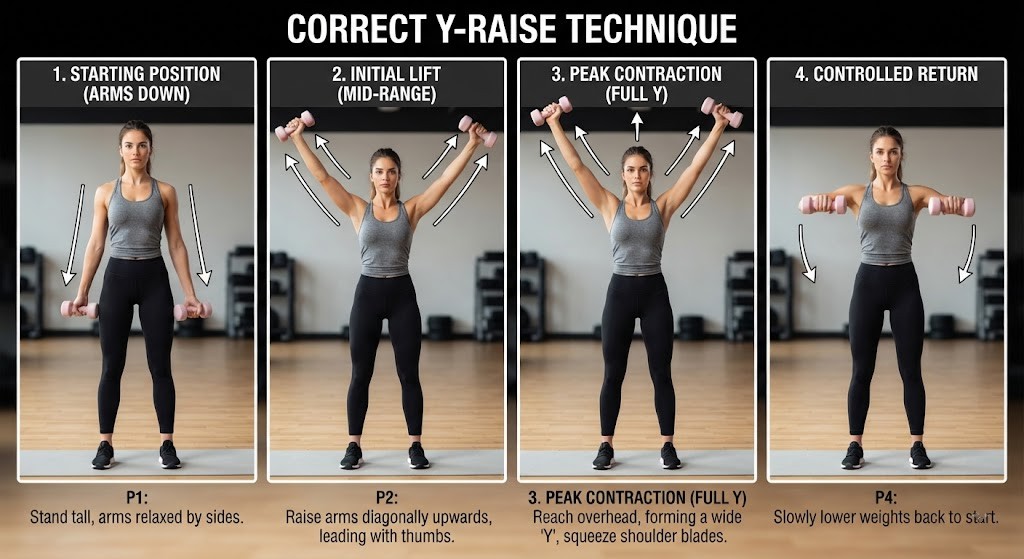
A Y-raise differs from a conventional shoulder raise because the arms move into a diagonal overhead pattern rather than stopping directly beside the body.
A lateral raise primarily moves the arms out to the sides, while a Y-raise moves them forward and outward to create a Y shape. This makes the movement particularly useful for training scapular upward rotation and upper-back control.
If you want to build a broader shoulder routine, you can combine Y-raises with a complete shoulder workout.
Why Does the Y-Raise Matter?
The Y-raise matters because it trains controlled scapular movement, upper-back activation, and shoulder stability that complement heavier pressing and pulling exercises. It can help you build a more balanced upper-body routine without requiring heavy loads.
This is particularly useful when your workout contains plenty of pressing movements but fewer exercises focused on controlled scapular motion. For example, adding two light sets of Y-raises after rows can introduce a different movement challenge for the upper back.
At the same time, resistance training is only one component of overall physical activity. 31% of adults worldwide did not meet recommended physical activity levels in 2022, representing approximately 1.8 billion adults. — Source: World Health Organization, 2024
What Muscles Does the Y-Raise Work?
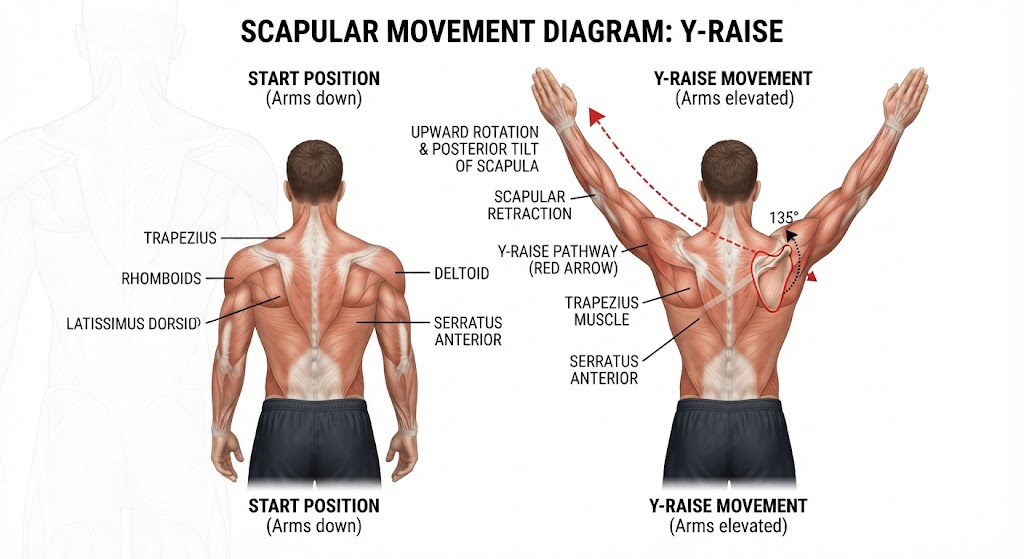
The Y-raise primarily trains the trapezius and supporting upper-back and shoulder muscles involved in scapular stability. The lower and middle portions of the trapezius are especially relevant, while the rear deltoids, rhomboids, and rotator-cuff muscles contribute to shoulder control.
The exact muscle contribution can vary depending on your body position, resistance, range of motion, and technique. For example, an incline Y-raise provides torso support, which can make it easier to concentrate on the arm path and scapular movement.
Does the Y-Raise Work the Lower Traps?
Yes, the Y-raise can effectively challenge the lower trapezius by requiring controlled upward rotation and elevation of the arms. However, it should not be considered the only lower-trap exercise you need.
You can combine Y-raises with rows, prone movements, and other trapezius exercises to train different functions of the upper back.
What Other Muscles Help During a Y-Raise?
Several supporting muscles contribute during a Y-raise, including the middle trapezius, rhomboids, rear deltoids, and rotator-cuff muscles. Their contribution depends on the variation and how you perform the exercise.
These muscles help position and stabilize the shoulder blade as the arms move. Your core and spinal muscles can also help maintain torso stability during standing or unsupported variations.
A well-rounded upper back workout can therefore pair naturally with Y-raises.
| Muscle | Main role during Y-raise |
|---|---|
| Lower trapezius | Helps control scapular movement |
| Middle trapezius | Supports scapular positioning |
| Rear deltoids | Assist arm movement |
| Rhomboids | Help stabilize the shoulder blades |
| Rotator cuff | Supports shoulder-joint stability |
| Core muscles | Help maintain torso position |
What Are the Benefits of Y-Raises?
Y-raises can support scapular control, upper-back activation, shoulder stability, and movement quality when performed consistently with appropriate resistance.
They are particularly useful as a light accessory exercise rather than a maximal-strength movement. Because the exercise does not require heavy loading, it can complement larger compound movements without adding another demanding strength exercise to your workout.
Can Y-Raises Help With Shoulder Stability?
Y-raises can support shoulder stability by training muscles involved in controlled scapular movement. This makes them useful alongside other rotator cuff exercises and shoulder-control drills.
However, exercise selection should match your individual needs. If you experience persistent pain, weakness, numbness, or restricted movement, seek assessment from an appropriate healthcare professional rather than relying on Y-raises alone.
Can Y-Raises Support Better Posture?
Y-raises can contribute to a stronger upper-back routine that supports scapular positioning and upper-body movement quality. For example, desk workers may use light Y-raises as part of a broader routine that also includes rows, thoracic mobility, and posture exercises.
Posture is influenced by multiple factors, however, rather than by one exercise. Y-raises should therefore complement regular movement and a balanced resistance-training program.
How Do You Do a Y-Raise With Proper Form?
A proper Y-raise involves using light resistance, keeping the torso stable, raising the arms in a controlled Y position, and lowering them slowly without momentum. The movement should remain deliberate from beginning to end.
You do not need heavy dumbbells to make the exercise challenging. In fact, using a smaller load often makes it easier to maintain good shoulder positioning and complete a controlled range of motion.
Step-by-Step Y-Raise Form
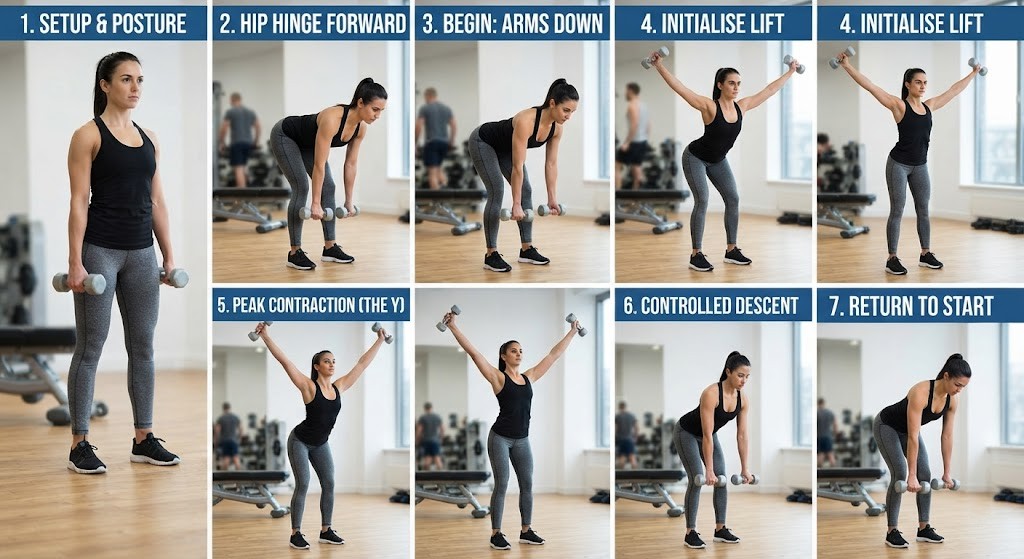
Follow these steps to perform a basic Y-raise:
- Set your position. Lie face down on an incline bench or stand tall with your torso stable.
- Position your arms. Extend your arms diagonally forward so they form the shape of a Y.
- Set your shoulders. Keep your neck relaxed and avoid aggressively shrugging.
- Raise your arms. Lift them slowly while maintaining the same diagonal path.
- Pause briefly. Hold the top position for about one second if you can maintain control.
- Lower slowly. Return your arms to the starting position without dropping them.
- Repeat. Complete every repetition with the same controlled technique.
For example, a beginner might perform 8–12 repetitions with very light dumbbells and stop before the movement becomes sloppy.
How Should Your Arms Move During a Y-Raise?
Your arms should move forward and outward along a diagonal path until they form a Y shape above or in front of your torso. The exact endpoint depends on your mobility and the variation you’re performing.
Your elbows should remain relatively straight without becoming rigidly locked. If your elbows bend significantly to make the weight easier to lift, reduce the resistance and focus on the intended movement.
What Is the Best Y-Raise Variation for Beginners?
The prone Y-raise or incline-bench Y-raise is often the most beginner-friendly variation because the supported torso makes it easier to focus on shoulder and scapular movement.
Starting with bodyweight or extremely light dumbbells can make the technique easier to learn. As your control improves, you can gradually experiment with other variations.
Best Y-Raise Variations
| Variation | Best use | Beginner suitability |
| Prone Y-raise | Simple bodyweight training | Excellent |
| Incline Y-raise | Supported technique | Excellent |
| Dumbbell Y-raise | Adjustable resistance | Excellent |
| Standing Y-raise | Greater trunk-control demand | Good |
| Cable Y-raise | Adjustable resistance | Good |
| Resistance-band Y-raise | Home training | Excellent |
| Bodyweight Y-raise | Technique practice | Excellent |
For example, someone training at home can start with a resistance band and later progress to dumbbells. A shoulder workout can include Y-raises without requiring a complete gym setup.
Are Dumbbell Y-Raises Effective for the Lower Traps?
Dumbbell Y-raises can effectively challenge the lower traps when the resistance is light enough to maintain proper scapular movement and arm positioning.
The exercise becomes less useful when heavy dumbbells cause shrugging, swinging, or excessive spinal extension. Therefore, selecting the right weight is essential.
Dumbbell Y-raises also work well as an accessory exercise because they do not require heavy equipment. For example, adding two controlled sets near the end of an upper-back workout can provide focused lower-trap work without significantly increasing workout complexity.
How Many Y-Raises Should You Do?
A practical starting point is 2–3 sets of 8–15 controlled repetitions, performed one to three times per week depending on your overall training volume and recovery.
Beginners can start with two sets and gradually increase repetitions before adding resistance. The goal should be consistent, technically sound repetitions rather than simply accumulating more weight.
Current resistance-training guidance emphasizes gradual progression and regular training of major muscle groups. The 2026 ACSM resistance-training position stand recommends training all major muscle groups at least twice per week and progressing gradually. — Source: American College of Sports Medicine, 2026
For general health, adults are also advised to perform muscle-strengthening activity on at least two days each week. Adults should perform muscle-strengthening activities involving all major muscle groups on at least two days per week. — Source: U.S. Department of Health and Human Services, 2018
Beginner Y-Raise Workout
A simple beginner setup can look like this:
- Y-raise: 2 × 8–12
- Seated or cable row: 3 × 8–12
- Dumbbell lateral raise: 2 × 10–15
- Reverse fly: 2 × 10–15
Place Y-raises after your main compound movement so fatigue does not interfere with learning the technique.
Intermediate Y-Raise Workout
An intermediate lifter can use:
- Incline Y-raise: 3 × 10–15
- Chest-supported row: 3 × 8–12
- Rear-delt fly: 3 × 12–15
- Face pull: 2–3 × 12–15
- Overhead press: 3 × 6–10
You can also pair Y-raises with rear delt workout movements to create a more complete upper-back and shoulder session.
What Are the Most Common Y-Raise Mistakes?
The most common Y-raise mistakes include using excessive weight, shrugging aggressively, swinging the arms, arching the lower back, and losing control during the lowering phase.
These errors can shift the exercise away from its intended controlled movement. Fortunately, most can be corrected by reducing resistance and slowing down.
Mistake 1: Using Too Much Weight
Using too much weight is one of the fastest ways to lose proper Y-raise form.
If you need to swing your arms upward or bend your elbows substantially, the resistance is probably too high. Reduce the load and aim for smooth repetitions.
Y-raises reward movement quality more than heavy loading.
Mistake 2: Shrugging the Shoulders
Excessive shrugging can make the movement feel easier while reducing control over the intended scapular pattern.
Keep your neck relaxed and avoid intentionally forcing the shoulders toward your ears. Focus instead on controlled arm elevation.
Mistake 3: Arching the Lower Back
Lower-back arching can appear during standing Y-raises when you try to raise your arms higher than your current mobility allows.
Keep your ribs and pelvis controlled rather than compensating through the spine. If necessary, switch to a supported prone or incline variation.
Mistake 4: Using Momentum
Momentum turns a controlled accessory exercise into a swinging movement.
Slow repetitions expose technique problems and make it easier to keep tension where you want it. If you cannot control the lowering phase, reduce the resistance.
Mistake 5: Raising Too High
Your arms do not need to travel beyond a comfortable range to make a Y-raise effective.
Stop when you can no longer maintain shoulder, ribcage, and torso control. A smaller controlled range is preferable to a larger range achieved through compensation.
Where Should Y-Raises Fit Into a Shoulder or Back Workout?
Y-raises fit best as a light accessory movement after your primary compound exercises or during an upper-back and shoulder-focused session.
Placing them later in the workout allows you to preserve energy for heavier exercises while still training scapular control.
For example, a shoulder session might begin with an overhead press, continue with lateral raises, and finish with Y-raises. A back session could place Y-raises after rows and before smaller rear-delt or rotator-cuff movements.
Beginners can also use Y-raises in a back workout for beginners
Y-Raise Placement Checklist
When deciding where to put Y-raises, consider:
- After heavy compound movements: Useful when you want to prioritize presses or rows.
- Near the end of a workout: Helps prevent early fatigue from affecting major lifts.
- During upper-back training: Pairs naturally with rows and rear-delt exercises.
- During shoulder training: Complements pressing and lateral-raise movements.
- During technique-focused sessions: Light resistance makes it suitable for controlled movement practice.
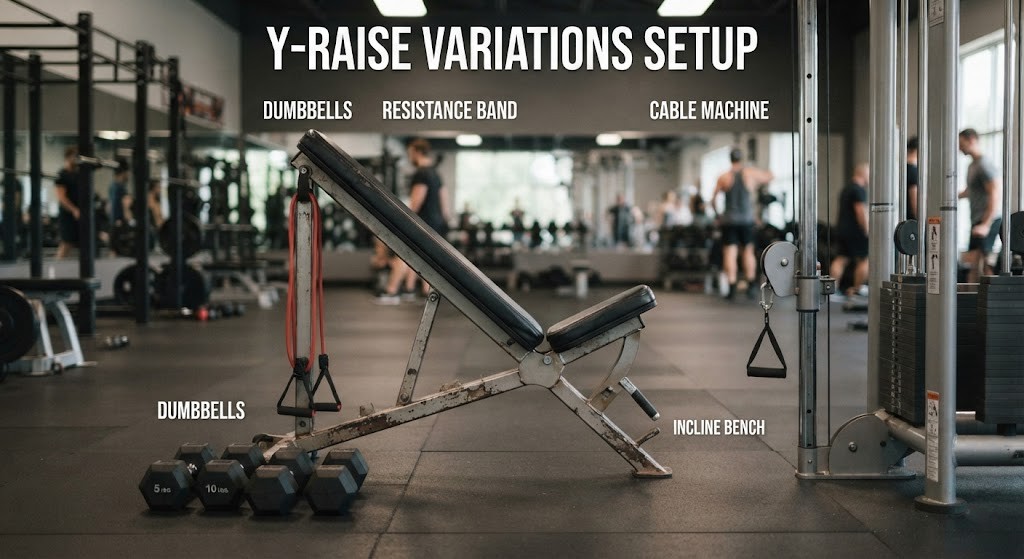
What Equipment Do You Need for Y-Raises?
Y-raises require very little equipment, making them easy to adapt to different training environments.
The best option depends on your experience, available equipment, and ability to maintain good form.
| Equipment | Best use | Beginner suitability |
| Bodyweight | Learning movement | Excellent |
| Resistance band | Home training | Excellent |
| Light dumbbells | Progressive resistance | Excellent |
| Incline bench | Supported technique | Excellent |
| Cable machine | Adjustable resistance | Good |
| Heavy dumbbells | Advanced loading | Usually unnecessary |
You do not need an expensive gym setup to perform effective resistance training. ACSM’s 2026 guidance notes that elastic bands, bodyweight exercises, and home-based training can be effective resistance-training options. — Source: American College of Sports Medicine, 2026
How Can You Perform Y-Raises at Home?
A home Y-raise workout can use bodyweight or resistance bands when dumbbells or gym equipment are unavailable.
For example, perform prone Y-raises on the floor and then progress to a light resistance band when your technique becomes consistent. You can also use an incline surface when available to provide additional torso support.
A simple mobility exercises routine can be used before training if you need to prepare your shoulders for the session.
How Should You Progress Your Y-Raise Training?
Y-raise progression should begin with better technique, followed by more repetitions, controlled tempo, and finally small increases in resistance.
Increasing the weight too quickly can reduce movement quality. Instead, focus first on making every repetition consistent.
You can also progress by adding a brief pause at the top or slowing the lowering phase. For example, a two-second lowering phase can make a light dumbbell feel considerably more demanding without requiring a large weight increase.
Y-Raise Progression Plan
Try this progression:
- Master bodyweight Y-raises.
- Perform 8–12 clean repetitions.
- Build toward 12–15 controlled repetitions.
- Add a small amount of resistance.
- Maintain the same range and tempo.
- Reassess technique before adding more weight.
The principle is simple: progress the quality of the movement before aggressively progressing the load.
Furthermore, Y-raises should complement your broader training rather than replace compound exercises. You can combine them with rows, presses, rear-delt work, and a balanced full body workout.
How Can You Make Y-Raises More Effective?
Getting more from a Y-raise workout is not about lifting the heaviest dumbbells possible. Instead, focus on several technique and programming factors.
Prioritize Control
Move the arms slowly through the full comfortable range. Avoid bouncing or using momentum to initiate the repetition.
Use Appropriate Resistance
Choose a load that allows you to maintain the intended Y-shaped arm position. If your technique deteriorates, lower the resistance.
Keep the Torso Stable
A stable torso helps prevent unnecessary movement through the lower back. Supported variations can be particularly useful when you’re learning the exercise.
Maintain Consistent Repetitions
Each repetition should look similar. If the first few repetitions are controlled but later repetitions involve swinging or shrugging, the set may have gone beyond your current technical capacity.
Combine Y-Raises With Complementary Exercises
Y-raises work well alongside rows, presses, rear-delt exercises, rotator-cuff work, and other upper-back movements.
This approach creates a more complete training stimulus instead of relying on one exercise to train every function of the shoulder and upper back.
Who Should Include Y-Raises in Their Workout?
Y-raises can be useful for a wide range of resistance-training levels.
Beginners can use them to learn controlled shoulder and scapular movement with bodyweight or very light resistance.
Intermediate lifters can use them as an accessory movement after rows, presses, or other major exercises.
Advanced lifters can use variations such as incline, cable, or resistance-band Y-raises to add targeted upper-back and scapular-control work without relying on heavy loading.
Regardless of experience level, the basic principle remains the same: choose a variation that allows you to maintain good technique throughout the entire set.
Conclusion
The Y-Raise Workout is a controlled shoulder and upper-back exercise that trains scapular movement, trapezius function, and shoulder stability with relatively light resistance. Although the movement is simple, proper execution matters far more than the amount of weight you lift.
The best Y-raise workout prioritizes stable posture, controlled arm movement, appropriate resistance, and consistent practice. Start with a beginner-friendly prone or incline variation, master your technique, and gradually add repetitions or resistance as your movement quality improves.
When combined with rows, presses, rear-delt exercises, rotator-cuff work, and other balanced resistance-training movements, Y-raises can become a useful accessory for developing stronger, more controlled shoulder and upper-back movement.
FAQs
What is a Y-Raise Workout?
A Y-raise trains the upper back, shoulders, and scapular muscles.
What does Y Raises workout?
Y-raises mainly work the trapezius and supporting shoulder muscles.
What muscles does the Y-raise work?
It works the traps, rear delts, rhomboids, and rotator cuff.
Does the Y-raise work the lower traps?
Yes, Y-raises can target and strengthen the lower traps.
Are Y-raises good for shoulders?
Yes, they can improve shoulder control and stability.
What are common mistakes with Y Raises?
Common mistakes include using too much weight, shrugging, and swinging.
What are the benefits of doing a prone Y raise?
Prone Y-raises strengthen the upper back and improve scapular control.
Are Y Raises good for posture?
Yes, Y-raises can support better posture through upper-back strengthening.
How many Y-raises should I do?
Start with 2–3 sets of 8–15 controlled reps.
What is the best Y-raise variation for beginners?
Prone and incline Y-raises are beginner-friendly options.
Can I do Y-raises at home?
Yes, you can do Y-raises with bodyweight or resistance bands.
Are dumbbell Y-raises effective?
Yes, light dumbbells can effectively train the traps and shoulders.