
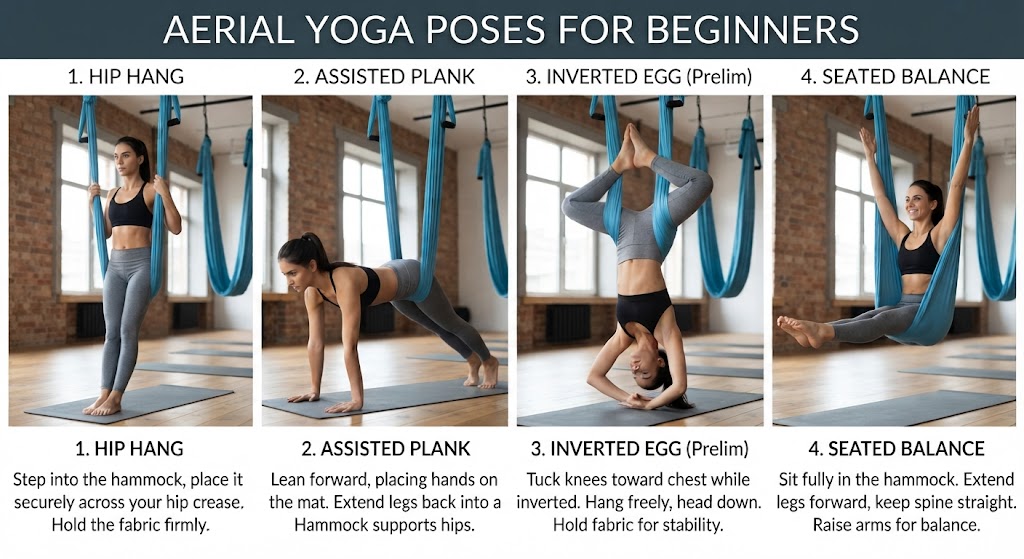
If you have already tried yoga, stretching, or mobility exercises, an aerial yoga hammock can make familiar movements feel completely different. The added support can help you explore balance, flexibility, posture, and controlled movement from a new perspective.
However, aerial yoga involves suspended equipment, so it requires more preparation than simply climbing into a hammock and copying a pose. This guide to aerial yoga poses for beginners covers beginner-friendly movements, safe setup, essential equipment, clothing, common mistakes, and a simple routine you can use to build confidence gradually.
What Are Aerial Yoga Poses for Beginners?
Aerial yoga poses for beginners are yoga movements performed with a suspended fabric hammock that supports part of your body weight during stretching, balance, and controlled movement.
Aerial yoga is a form of yoga that uses a suspended fabric hammock to support body weight during poses, stretches, balance exercises, and controlled movement. The hammock can change how you experience familiar yoga movements because it provides support while allowing movement in multiple directions.
For example, a supported standing pose can help you focus on posture, breathing, and body alignment without placing as much emphasis on maintaining balance independently. Similarly, seated and stretching movements can introduce you to the sensation of working with suspended fabric.
Beginners should start with easy aerial yoga poses before progressing to inversions, complex wraps, or demanding transitions. If you already practice Full Body Yoga, an aerial hammock can provide another way to explore familiar movement patterns.
Yoga has also become increasingly popular. In the United States, 15.8% of adults reported practicing yoga in 2022, compared with 5.0% in 2002.
Source: NCCIH, 2024.
Why Are Aerial Yoga Poses Important for Beginners?
Beginner aerial yoga poses are important because they help new practitioners become comfortable with the hammock while developing flexibility, balance, body awareness, and movement control.
Working with the hammock also gives beginners an opportunity to understand how small changes in body position affect stability. For example, holding the fabric while standing can help you notice how shifts in your hips, shoulders, and feet influence your balance.
In addition, research supports potential improvements in physical abilities such as balance and flexibility. One randomized controlled trial involving 40 female college students found improvements in balance and several flexibility measures after 16 weeks of yoga practice.
Source: PubMed, 2023.
Regular yoga should still be approached progressively. A national survey found that 36.7% of U.S. adults used at least one of seven complementary health approaches in 2022.
Source: NCCIH, 2024.
How Should You Prepare for Aerial Yoga?
Preparation is one of the most important parts of aerial yoga for beginners. A safe practice starts with properly installed equipment, adequate surrounding space, an appropriate warm-up, and gradual progression from supported movements to more challenging poses.
Check Your Aerial Yoga Equipment
Before every session, inspect your hammock, suspension points, carabiners, straps, and other attachment components. Do not assume that a ceiling anchor or hammock is safe simply because it looks strong.
Always follow the manufacturer’s installation instructions and use recommended hardware rather than copying another person’s setup.
For example, AntiGravity’s hammock system states that its equipment is stress-tested above 1,000 pounds. However, that rating applies to its specific equipment and does not establish a universal rating for every aerial hammock.
Source: AntiGravity Fitness, 2026.
Create Enough Practice Space
Clear the area around your hammock before practicing. Remove furniture, sharp objects, and anything else that could interfere with movement or create a hazard.
Adequate clearance becomes particularly important as your movements become larger. Beginners should focus on simple, controlled poses rather than testing how far they can swing or stretch.
Warm Up Before Aerial Yoga
A proper warm-up prepares your body for movement and gives you an opportunity to check how you feel before using the hammock.
Before practice, use warm-up exercises and include gentle mobility exercises for your hips, shoulders, spine, and ankles.
Wear Appropriate Clothing
Wear fitted clothing that covers areas likely to come into contact with the hammock, including the underarms and backs of the knees. This can make fabric-supported movements more comfortable.
A qualified studio class is especially useful when you are completely new to suspension equipment because an instructor can demonstrate setup, positioning, transitions, and safe exits.
What Are the Best Aerial Yoga Poses for Beginners?
The best aerial yoga poses for beginners are supported standing, seated, squatting, lunging, folding, hip-opening, and gentle chest-opening movements that do not require advanced inversions.
A beginner aerial yoga routine can combine supported standing, seated, stretching, mobility, and gentle strengthening movements into a progressive full-body practice.
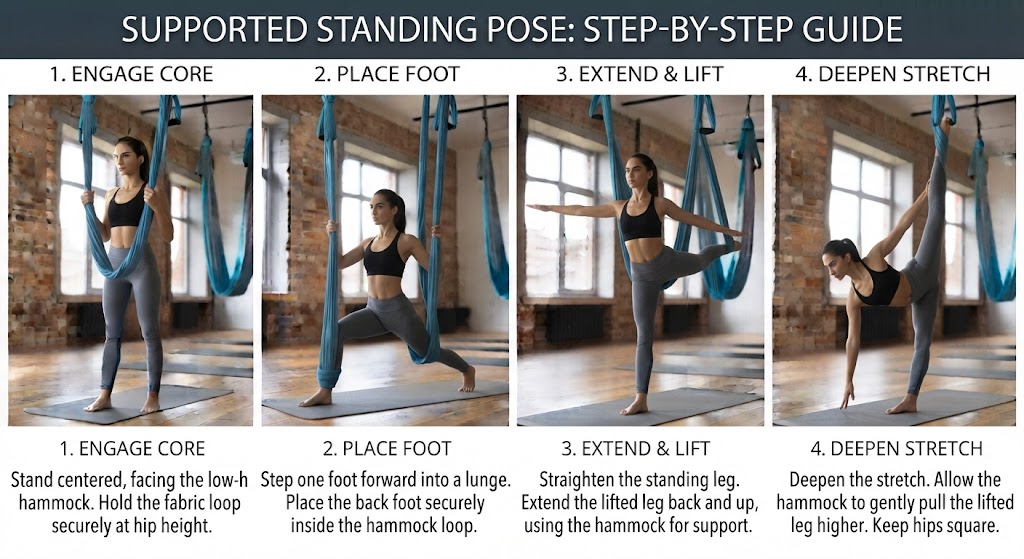
1. Supported Standing Pose
Supported standing pose is a simple introduction to using an aerial yoga hammock.
Stand behind or inside the hammock according to your equipment’s intended setup and hold the fabric comfortably. Keep your feet grounded, lengthen your spine, relax your shoulders, and breathe slowly.
Hold: 20–30 seconds
Difficulty: Beginner
Safety: Keep your feet grounded and avoid leaning heavily into the fabric.
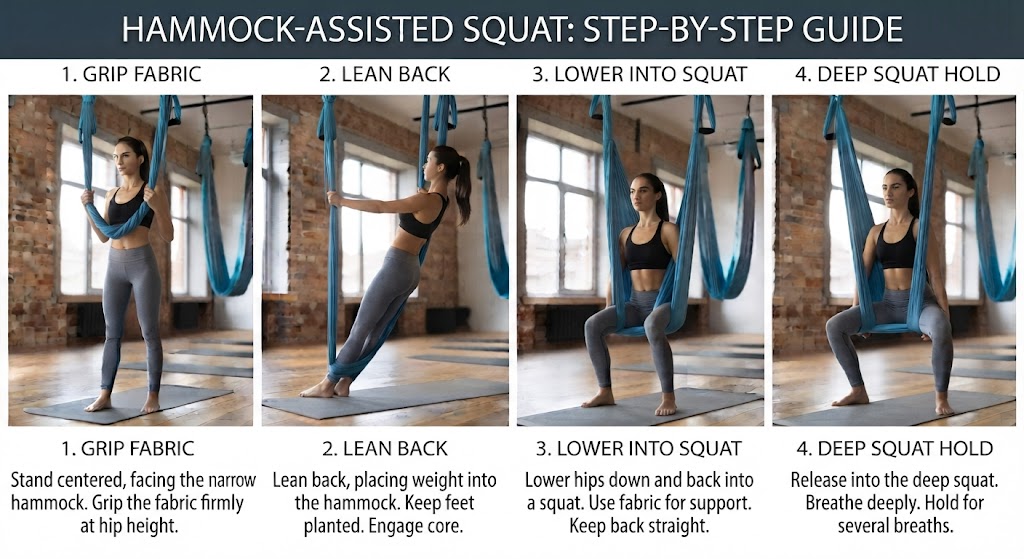
2. Hammock-Assisted Squat
The hammock-assisted squat is a beginner-friendly movement for practicing lower-body control with support.
Hold the hammock with both hands and position your feet approximately hip-width apart. Bend your knees and lower your hips slowly while keeping your chest lifted, then press through your feet to return to standing.
Hold: 5–8 repetitions
Difficulty: Beginner
Safety: Do not pull aggressively on the hammock or allow your knees to collapse inward.
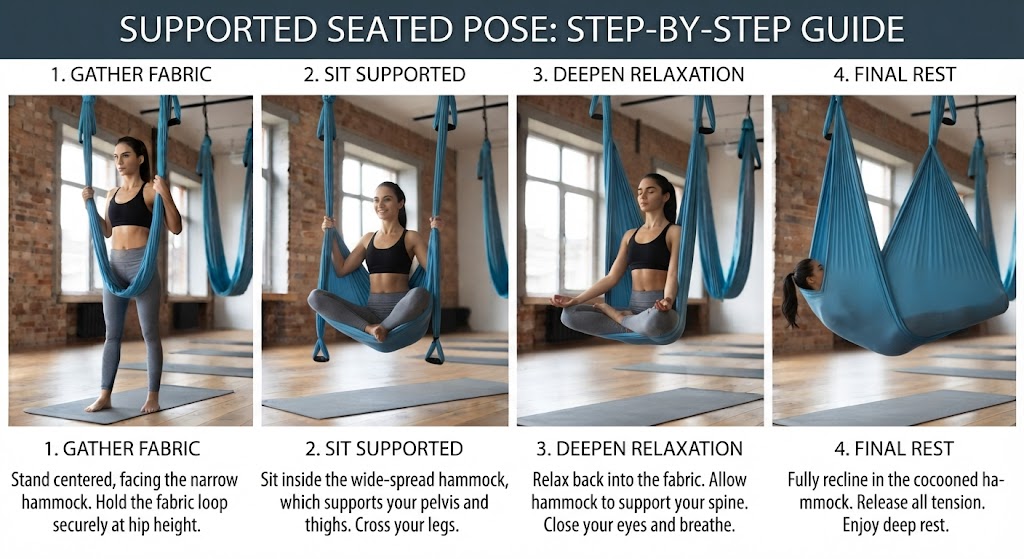
3. Supported Seated Pose
Supported seated pose provides a gentle way to become comfortable with the hammock while practicing upright posture.
Sit into the hammock with your weight comfortably supported. Place your hands where they feel stable, lengthen your spine, and take slow breaths without forcing your hips or knees.
Hold: 30–45 seconds
Difficulty: Beginner
Safety: Check that the fabric supports you evenly before relaxing.
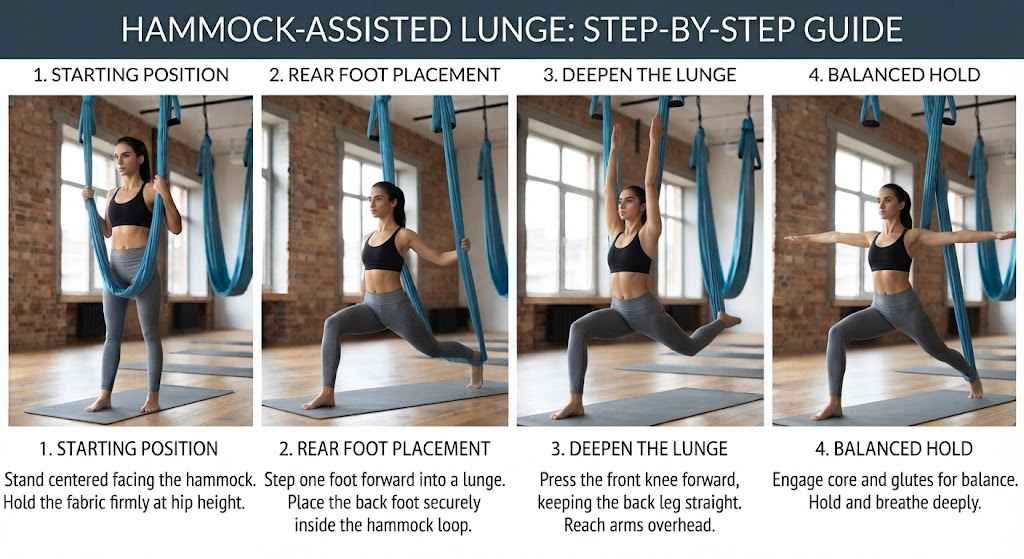
4. Hammock-Assisted Lunge
The hammock-assisted lunge is a supported movement that can gently challenge balance and hip mobility.
Set your feet in a comfortable split stance, hold the hammock, and bend the front knee slightly. Keep your torso upright and move only as far as you can control comfortably.
Hold: 20 seconds per side
Difficulty: Beginner
Safety: Keep the front knee tracking toward the toes.
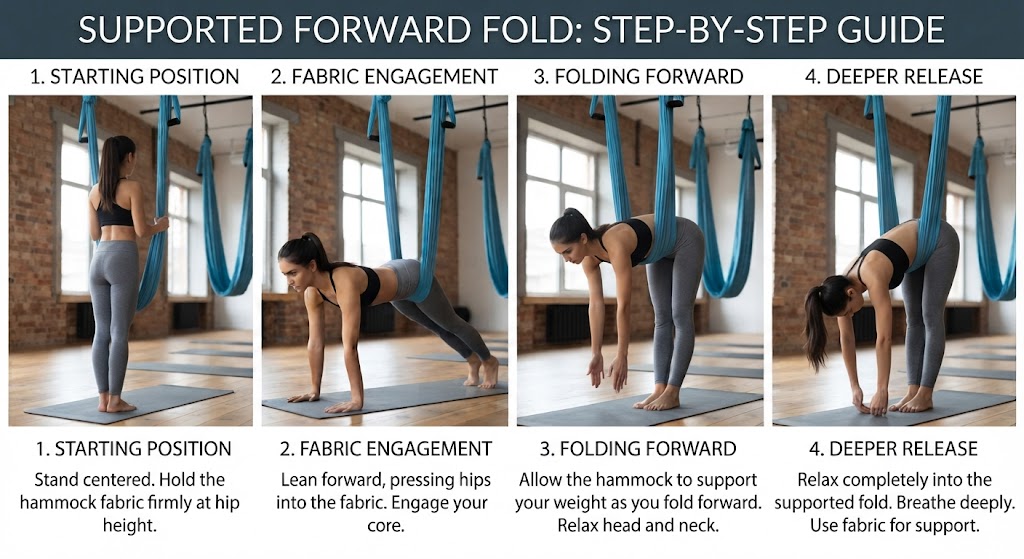
5. Supported Forward Fold
Supported forward fold is a beginner aerial yoga stretch that uses the hammock to reduce some balance demands.
Stand facing the hammock, hold the fabric, hinge from your hips, and allow your torso to move forward while keeping your knees soft. Breathe slowly instead of pulling yourself deeper into the stretch.
Hold: 20–30 seconds
Difficulty: Beginner
Safety: Avoid forcing the hamstrings or aggressively rounding through the lower back.
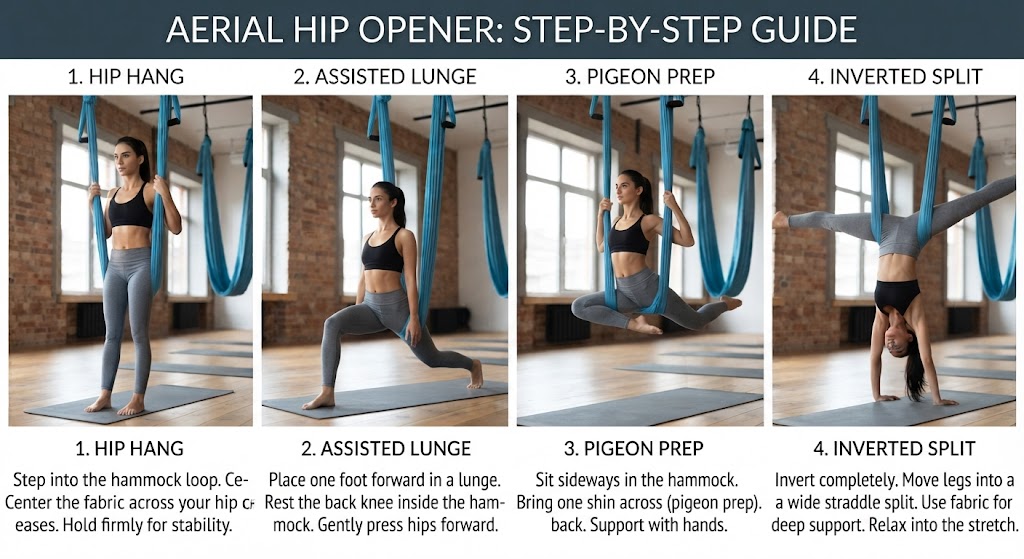
6. Aerial Hip Opener
The aerial hip opener is a gentle hammock-assisted stretch for comfortable hip movement.
Use the hammock to support your body while positioning one leg into a comfortable opening position. Keep the stretch mild and gradually relax into it rather than pushing for maximum range.
Hold: 20–30 seconds per side
Difficulty: Beginner
Safety: Stop if you experience sharp pain or joint discomfort.
For more stretching ideas, combine these movements with hip-opening yoga poses.
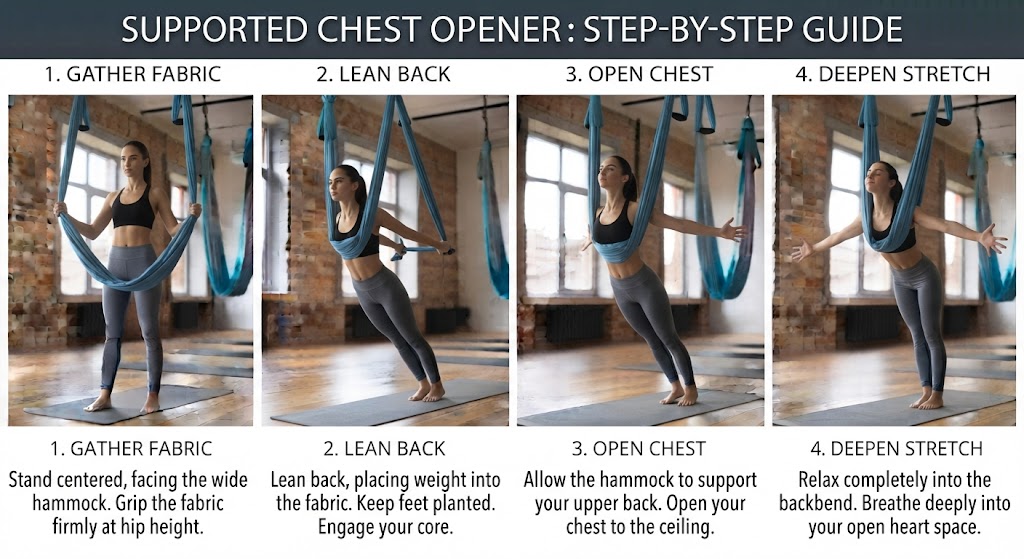
7. Supported Chest Opener
Supported chest opener is a gentle back-opening movement that encourages upright posture and shoulder mobility.
Hold or lean lightly into the hammock while opening your chest. Keep your ribs controlled and avoid forcing your spine into a deep backbend.
Hold: 15–20 seconds
Difficulty: Beginner
Safety: Keep the movement small until you understand how the hammock responds.
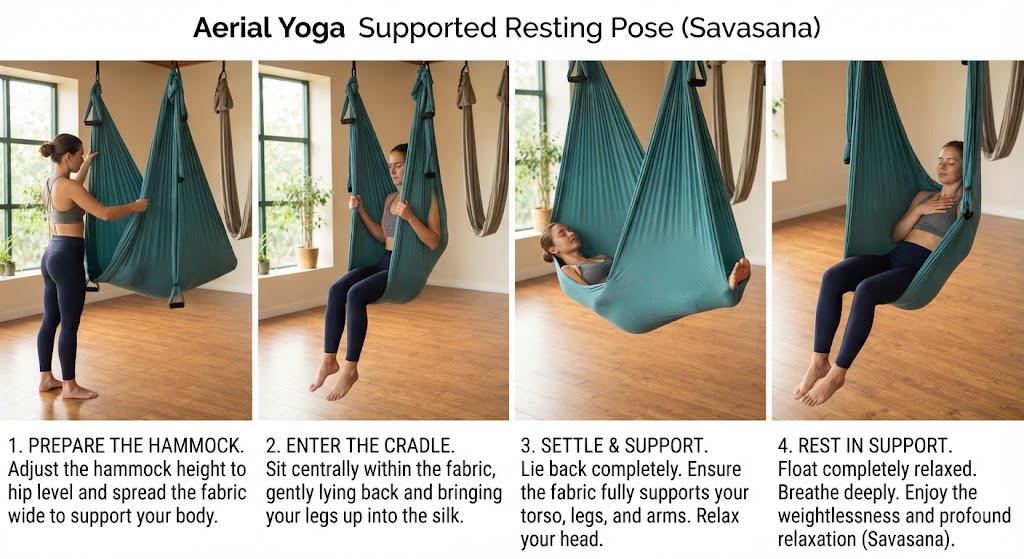
8. Supported Resting Pose
Supported resting pose provides a gentle finishing position that allows your breathing and muscles to settle.
Sit or recline into a low, stable hammock position that your equipment and instructor have approved. Close your eyes if comfortable and take slow, relaxed breaths.
Hold: 1–3 minutes
Difficulty: Beginner
Safety: Use a low, stable setup and exit slowly.
How Do You Perform Aerial Yoga Poses Safely?
Performing aerial yoga poses safely requires controlled movement, suitable equipment, gradual progression, and attention to how your body feels.
Aerial yoga beginners should master basic supported poses before attempting inversions or advanced movements that require greater strength, coordination, and hammock control.
Inspect the Suspension System
Never treat the hammock like an ordinary swing. Every suspension system has specific installation, loading, and maintenance requirements.
Check the equipment before each session and follow the manufacturer’s instructions for installation, use, and maintenance.
Avoid Advanced Inversions at First
Beginners should not rush into advanced inversions. NCCIH advises beginners to avoid advanced yoga practices such as headstands and shoulder stands, while also recommending qualified instruction for safer practice.
Source: NCCIH, 2024.
Respect Your Body’s Limits
Yoga can still produce injuries when practiced incorrectly. One U.S. study estimated 0.60 yoga-related injuries per 1,000 hours of practice, with higher rates reported for some more demanding styles.
Source: PubMed, 2019.
Stop a movement if you experience sharp pain, significant discomfort, dizziness, or a feeling that the equipment is unstable.
Common Safety Mistakes to Avoid
Avoid these common beginner mistakes:
- Skipping the equipment inspection
- Attempting inversions too soon
- Holding your breath
- Forcing flexibility
- Using an unsuitable anchor point
- Practicing without enough clearance
- Ignoring pain or dizziness
The goal is not to make every pose look impressive. Instead, prioritize controlled movement, stable positioning, steady breathing, and confidence with the hammock.
How Long Should Beginners Hold Aerial Yoga Poses?
Beginners should generally hold simple aerial yoga poses for about 15–45 seconds, while gentle resting positions can last longer when the setup is stable and comfortable.
Short, controlled holds are usually more appropriate for beginners than forcing long stretches.
For example, you might hold a supported standing pose for 20 seconds, perform several squat repetitions, and finish with a supported resting position for one to three minutes.
At the same time, your instructor or equipment system may recommend different durations. Always prioritize technique, breathing, and comfort over a specific timer.
What Equipment Do You Need for Beginner Aerial Yoga?
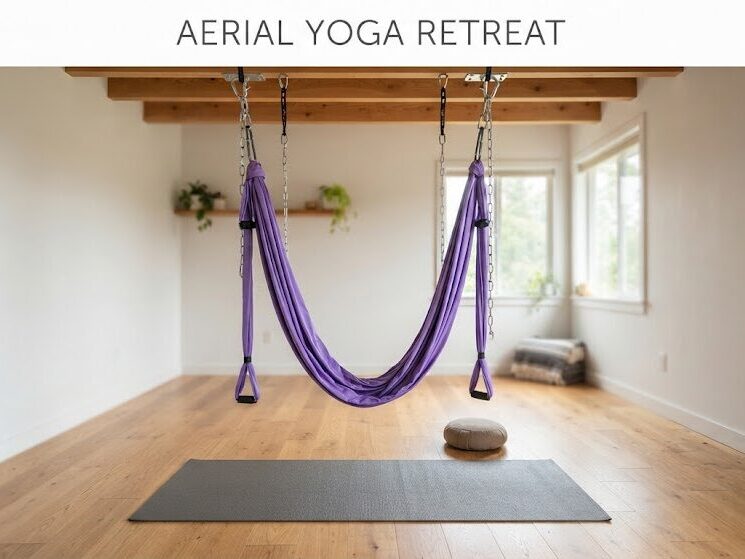
Beginner aerial yoga equipment typically includes a suitable hammock or swing, compatible suspension hardware, secure mounting points, and enough open floor space for movement.
Aerial yoga equipment should be selected and installed according to the manufacturer’s specifications rather than by appearance alone.
| Equipment | Purpose |
|---|---|
| Aerial yoga hammock | Supports the body during poses |
| Carabiners | Connect compatible suspension components |
| Daisy chains or straps | Adjust hammock positioning |
| Secure anchor points | Support the suspension system |
| Yoga mat | Provides cushioning during grounded movements |
| Open practice area | Reduces collision and fall hazards |
For example, one commercial hammock kit includes a hammock, two daisy chains, two choke loops, two carabiners, an S-hook, and an assembly guide.
Source: AntiGravity Fitness, 2026.
Can Beginners Do Aerial Yoga at Home?
Beginners can practice aerial yoga at home when the equipment is professionally appropriate, correctly installed, inspected, and used within its intended limits.
Aerial yoga at home is not automatically safe simply because the movements look gentle.
Start With Professional Instruction
Beginners should ideally attend an instructor-led class before attempting suspension techniques independently. This is particularly important for learning how to enter, exit, adjust, and control the hammock.
An instructor can also identify positioning problems that may be difficult for a beginner to recognize alone.
Prepare a Clear Practice Area
Create a clear area around the hammock and keep children, pets, furniture, and sharp objects away during practice.
A studio is often the better starting point because an instructor can provide immediate corrections and help you understand how the suspension system should respond to different movements.
What Should Beginners Wear for Aerial Yoga?
Beginners should wear fitted, comfortable clothing that provides coverage where the hammock contacts the body.
Long leggings and a fitted top with sufficient coverage can reduce uncomfortable fabric friction during beginner aerial yoga exercises.
Avoid loose zippers, bulky accessories, or clothing that could catch on suspension components. Bare feet can also be useful for grip, although your instructor or studio may have different requirements.
What Are the Most Common Aerial Yoga Mistakes Beginners Make?
The most common aerial yoga mistakes include rushing into advanced poses, ignoring equipment checks, forcing stretches, and using poor body control.
Beginners usually progress more safely when they treat hammock control as a skill rather than simply another yoga prop.
Rushing Into Advanced Poses
Complex wraps and inversions may look appealing, but they require greater awareness of the hammock and your body position. Build confidence with foundational movements first.
Ignoring Equipment Checks
Even a beginner pose depends on a properly installed suspension system. Make equipment inspection part of your routine rather than treating it as an optional step.
Forcing Flexibility
The hammock can sometimes make a stretch feel easier, which may tempt you to move farther than your body is ready for. Stay within a comfortable range and avoid forcing a deeper position.
Neglecting Transitions
Entering and exiting a pose requires control, too. Practice transitions slowly instead of focusing only on how long you can hold a position.
Practicing Without Guidance
Self-study deserves caution. Research has associated unsupervised yoga practice with greater risk of adverse effects, reinforcing the value of qualified guidance for beginners.
Source: PubMed, 2019.
What Is a Simple Beginner Aerial Yoga Routine?
A beginner aerial yoga routine can progress from grounded preparation to supported movement, gentle stretching, mobility, and relaxation.
Try this sequence:
- Warm-up: 3–5 minutes of gentle mobility.
- Supported standing: 30 seconds.
- Hammock-assisted squats: 5–8 repetitions.
- Supported seated pose: 30 seconds.
- Hammock-assisted lunge: 20 seconds per side.
- Supported forward fold: 20–30 seconds.
- Aerial hip opener: 20 seconds per side.
- Supported chest opener: 15–20 seconds.
- Supported resting pose: 1–3 minutes.
This structure keeps the session focused on foundational movement rather than advanced tricks.
How Can Beginners Progress to Advanced Aerial Yoga Poses?
Beginners can progress to advanced aerial yoga poses by first developing reliable hammock control, balance, flexibility, strength, and confidence.
Progression should move from supported positions to more demanding movements rather than jumping directly into inversions.
Step 1: Master Basic Supported Positions
Begin with standing, seated, squat, lunge, and resting positions. Learn how the fabric feels and responds to small changes in body position.
Step 2: Develop Balance and Mobility
Once the basic positions feel comfortable, gradually work on balance, hip mobility, shoulder mobility, and controlled transitions.
Step 3: Improve Strength and Control
More advanced aerial movements require you to control your body while interacting with the suspension system. Focus on smooth movement instead of speed.
Step 4: Learn Advanced Techniques With Guidance
An instructor can introduce more advanced aerial yoga inversions when your technique and equipment setup are appropriate.
Yoga for flexibility can complement this progression.
What’s Next for Aerial Yoga Beginners?
The next step for aerial yoga beginners is to repeat foundational poses consistently while improving control, breathing, flexibility, and confidence.
A safe progression prioritizes technique before difficulty.
Do not measure your progress only by how quickly you can perform an inversion. A smoother squat, steadier lunge, deeper comfortable stretch, or more controlled hammock transition is meaningful progress.
As your confidence improves, you can gradually explore more challenging movements under appropriate instruction. Inversions and advanced suspension techniques are best learned from a qualified aerial yoga instructor rather than solely from online demonstrations.
Conclusion
Aerial yoga poses for beginners offer an approachable way to explore yoga, mobility, balance, stretching, and controlled movement with hammock support. The hammock can make familiar movements feel new while providing a different way to work on body awareness and movement control.
The safest starting point is simple supported movement, proper equipment setup, gradual progression, and qualified instruction when needed. Beginners should inspect their equipment, create adequate practice space, warm up properly, and avoid rushing into advanced inversions.
Ultimately, you do not need to master impressive aerial tricks during your first session. Start with the basics, breathe steadily, respect your body’s limits, and build your aerial yoga skills one pose at a time.
FAQs
What are the best aerial yoga poses for beginners?
Supported standing, seated poses, squats, lunges, forward folds, and gentle hip openers are good choices.
Is aerial yoga good for beginners?
Yes. Beginners can start with simple supported poses and gradually build confidence and control.
What is aerial yoga for?
Aerial yoga uses a hammock to support stretching, balance, mobility, and yoga movements.
Is aerial yoga OK for beginners?
Yes. Beginners can practice safely with proper equipment, guidance, and basic poses.
Is aerial yoga good for health?
Yes. Aerial yoga may support flexibility, balance, mobility, and body awareness.
Is aerial yoga harder than yoga?
Not necessarily. The hammock adds balance and coordination challenges but also provides useful support.
Can I do aerial yoga at home as a beginner?
Yes. Beginners can practice at home with properly installed equipment and enough open space.
How long should beginners hold aerial yoga poses?
Beginners can generally hold simple poses for about 15–45 seconds.
What should I wear for aerial yoga?
Wear fitted clothing that covers areas where the hammock contacts your body.
Should beginners try aerial yoga inversions?
No. Beginners should master basic poses and hammock control before trying inversions.
What equipment is needed for aerial yoga?
You need a suitable hammock, secure suspension equipment, proper anchors, and enough practice space.
What are common aerial yoga mistakes?
Common mistakes include rushing advanced poses, skipping equipment checks, and forcing stretches.
Can aerial yoga improve flexibility and balance?
Yes. Regular yoga practice may help improve flexibility and balance.
Is aerial yoga the same as traditional yoga?
No. Aerial yoga uses a suspended hammock to support and modify yoga movements.