
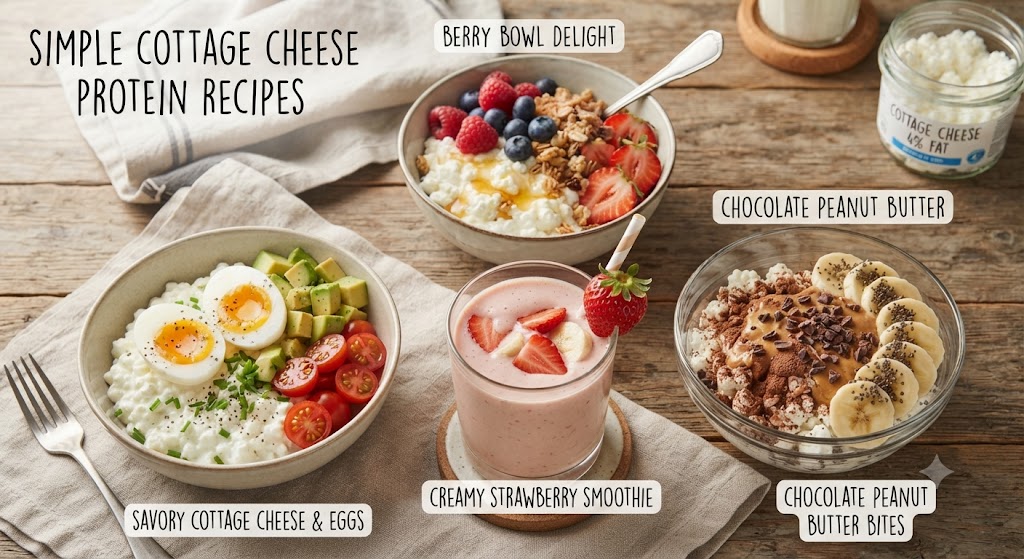
If you already use cottage cheese as a quick high-protein snack, you may be missing just how versatile it can be. This mild, creamy ingredient can move far beyond the breakfast bowl and become part of pancakes, eggs, wraps, pasta sauces, dips, smoothies, cheesecakes, puddings, and more.
In this guide, you’ll discover easy cottage cheese protein recipes for breakfast, lunch, dinner, snacks, and dessert. You’ll also learn how to make cottage cheese smoother, increase the protein content of recipes, meal prep with it, and choose combinations that fit different eating goals.
What Are Cottage Cheese Protein Recipes?
Cottage cheese protein recipes are meals, snacks, or desserts that use cottage cheese as both a convenient source of protein and a creamy ingredient. It can be served cold, cooked into savory dishes, blended into sauces, or incorporated into sweet recipes.
Cottage cheese works particularly well in both sweet and savory recipes. For example, blending it with berries creates a creamy snack, while blending it with garlic, lemon, and herbs creates a savory dip.
Cottage cheese is classified within the dairy category in USDA food-group resources and provides protein along with other nutrients. — Source: USDA Dietary Guidelines, 2020
Why Is Cottage Cheese Useful in Protein Recipes?
Cottage cheese is useful in protein recipes because it combines protein, moisture, and creaminess in one ingredient. Adding it to pancake batter, for example, can create a richer mixture while contributing protein.
It can also replace or supplement ingredients such as ricotta, cream cheese, yogurt, or heavier sauces in selected recipes. This flexibility makes it particularly useful for people searching for high protein diet.
How Much Protein Is in Cottage Cheese?
Cottage cheese can provide roughly 10–12 grams of protein per 100 grams, depending on the variety and product. For example, a USDA-linked entry for 1% low-fat cottage cheese lists 12.39 grams of protein per 100 grams, while a 2% low-fat variety lists about 10.45 grams per 100 grams. — Source: USDA FoodData Central, 2026
A typical 1-cup portion of 1% low-fat cottage cheese can provide approximately 28 grams of protein, although serving sizes and brands vary. — Source: USDA FoodData Central, 2026
The adult protein RDA is 0.8 grams per kilogram of body weight per day, so cottage cheese can be one practical way to contribute protein toward an individual’s overall dietary needs. — Source: National Academies, 2005
High Protein Plant-Based Foods
Why Are Cottage Cheese Protein Recipes Important?
Cottage cheese protein recipes offer a simple way to add protein to familiar foods without requiring complicated cooking. A cottage cheese smoothie, for example, can turn a basic fruit smoothie into a more substantial snack.
Cottage cheese is also useful for people looking for easy cottage cheese recipes that work across breakfast, lunch, dinner, and snacks. Its mild flavor allows it to pair with sweet ingredients such as vanilla, berries, and banana as well as savory ingredients such as garlic, herbs, vegetables, and spices.
The Dietary Guidelines recognize dairy foods as sources of nutrients including protein, calcium, phosphorus, potassium, zinc, and vitamin B12, although the exact nutrient profile depends on the specific food. — Source: USDA Dietary Guidelines, 2015–2020
Cottage Cheese for Fitness-Focused Eating
Cottage cheese can fit into fitness-focused eating because it provides a convenient protein source that can be combined with carbohydrates, fruits, vegetables, and other protein-rich foods.
For example, cottage cheese with berries and whole-grain toast creates a simple combination of protein, carbohydrates, and produce. A savory cottage cheese bowl with vegetables and chickpeas can provide another flexible meal option.
However, a cottage cheese recipe is not automatically low-calorie or ideal for every goal. Portion size, toppings, added oils, sauces, and sweeteners can substantially change the final nutrition profile.
What Are the Best High-Protein Cottage Cheese Breakfast Recipes?
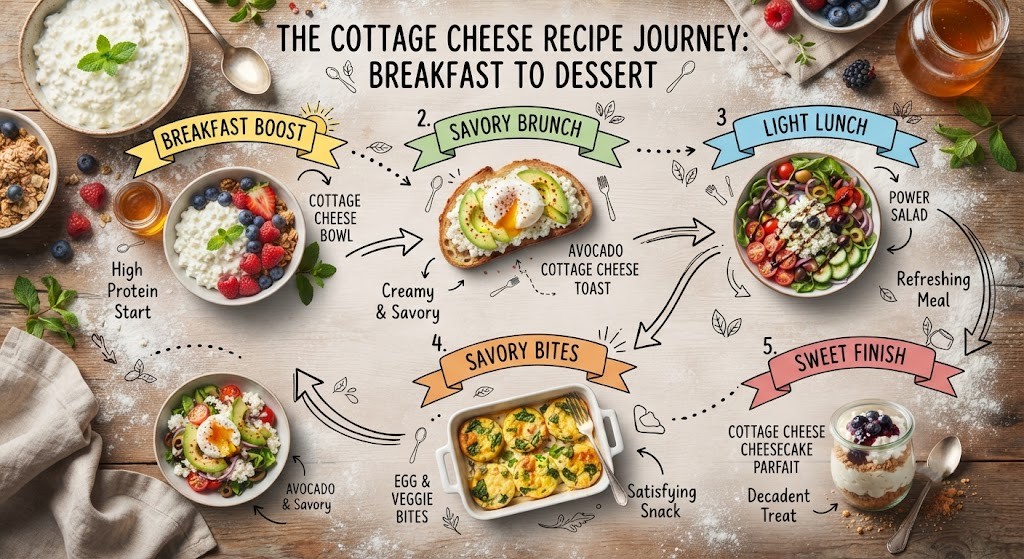
High-protein cottage cheese breakfast recipes combine cottage cheese with foods such as eggs, fruit, whole grains, or protein-rich dairy. These combinations can create filling breakfast options without requiring elaborate preparation.
Breakfast can also be either sweet or savory, making cottage cheese useful even if you do not enjoy eating it plain.
1. Cottage Cheese Protein Pancakes
Cottage cheese protein pancakes are made with cottage cheese, eggs, and flour or oats for a higher-protein breakfast. For example, blend ½ cup cottage cheese, 2 eggs, ½ cup oat flour, ½ teaspoon baking powder, and cinnamon until smooth.
Next, cook small portions in a lightly greased nonstick pan over medium-low heat until bubbles appear and the edges look set. Flip and cook until the second side is golden.
For a sweeter version, add berries, banana, vanilla, or a small amount of maple syrup. For additional protein, serve the pancakes with Greek yogurt.
2. Cottage Cheese Scrambled Eggs
Cottage cheese scrambled eggs combine eggs with cottage cheese for a creamy, protein-rich breakfast. Whisk 2 eggs with ¼ cup cottage cheese, then cook the mixture gently in a nonstick pan.
Stir slowly until the eggs are softly set rather than dry. Add black pepper, spinach, tomatoes, mushrooms, or fresh herbs for additional flavor.
3. Cottage Cheese Protein Bowl
A cottage cheese protein bowl combines cottage cheese with fruit, seeds, nuts, and other toppings. Combine 1 cup cottage cheese with berries, sliced banana, chia seeds, and cinnamon.
You can also add Greek yogurt or a small amount of nut butter if you want a thicker texture or additional protein and fat. Keep portions of calorie-dense toppings moderate because nuts, seeds, and nut butters can quickly increase total calories.
4. Cottage Cheese Smoothie
A cottage cheese smoothie is a blended drink made with cottage cheese, fruit, and liquid such as milk or a fortified alternative.
For example, blend ½ cup cottage cheese, 1 cup berries, ½ banana, and ¾ cup milk until completely smooth. Blending breaks down much of the curd texture and creates a creamy consistency.
For more combinations, see High Protein Pudding Recipe
How Do You Make Cottage Cheese Protein Pancakes?
Cottage cheese protein pancakes are made by blending cottage cheese with eggs and a dry ingredient before cooking the batter in a nonstick pan. The basic method uses cottage cheese, eggs, flour or oats, baking powder, and optional flavorings.
Easy Cottage Cheese Protein Pancake Recipe
Ingredients
- ½ cup cottage cheese
- 2 large eggs
- ½ cup oat flour or whole-wheat flour
- ½ teaspoon baking powder
- ½ teaspoon cinnamon
- ½ teaspoon vanilla extract
- Optional berries or banana
Instructions
- First, blend the cottage cheese and eggs until mostly smooth.
- Next, add the flour, baking powder, cinnamon, and vanilla.
- Blend briefly until combined without overmixing.
- Heat a nonstick pan over medium-low heat.
- Pour small circles of batter into the pan.
- Cook until bubbles form and the edges look firm.
- Flip and cook the other side until done.
- Serve with berries or Greek yogurt.
The final protein amount depends on the cottage cheese, eggs, flour, and serving size used. For accurate nutrition, calculate the ingredients using product labels or a food-composition database such as USDA FoodData Central. — Source: USDA FoodData Central, 2026
What Are Easy Savory Cottage Cheese Recipes for Lunch or Dinner?
Savory cottage cheese recipes combine cottage cheese with vegetables, grains, pasta, wraps, herbs, or other protein-rich ingredients. These recipes allow cottage cheese to function as a creamy component rather than simply a standalone snack.
5. Creamy Cottage Cheese Pasta Sauce
Cottage cheese pasta sauce is a blended sauce made by combining cottage cheese with seasonings and a small amount of pasta water.
Blend 1 cup cottage cheese, ¼ cup pasta water, garlic, black pepper, and Parmesan until smooth. Toss the sauce with cooked pasta and add spinach, roasted vegetables, peas, or chickpeas.
Warm the sauce gently rather than boiling it aggressively to help maintain a smoother texture.
6. Cottage Cheese Wrap
A cottage cheese wrap combines a tortilla with blended cottage cheese, vegetables, and a protein-rich filling.
Spread blended cottage cheese over a whole-grain tortilla and add spinach, cucumber, tomato, roasted peppers, and beans. Roll the wrap tightly and cut it in half for an easy lunch.
You can also add eggs or tofu if you want a more substantial vegetarian meal.
7. Savory Cottage Cheese Bowl
A savory cottage cheese bowl combines cottage cheese with vegetables, grains, herbs, and toppings. Layer cottage cheese with cucumber, tomatoes, roasted chickpeas, avocado, black pepper, and a small portion of cooked quinoa.
You can change the flavor profile with Mediterranean herbs, chili flakes, curry powder, or everything-bagel seasoning. This flexibility makes the recipe easy to adapt to ingredients you already have.
8. Cottage Cheese Dip
Cottage cheese dip is a blended savory dip made with cottage cheese, herbs, spices, and optional vegetables.
Blend 1 cup cottage cheese with garlic, lemon juice, dill, black pepper, and a pinch of salt. Serve it with sliced carrots, cucumber, bell peppers, whole-grain crackers, or roasted vegetables.
This is also one of the easiest cottage cheese snack recipes to prepare in advance.
What Are the Best Cottage Cheese Protein Snacks?
Cottage cheese protein snacks are quick combinations that pair cottage cheese with fruit, vegetables, whole-grain foods, or other nutrient-dense toppings. They are useful when you need something that takes only a few minutes to assemble.
9. Cottage Cheese and Fruit Cup
A cottage cheese fruit cup combines cottage cheese with fresh or frozen fruit. Try strawberries, blueberries, peaches, pineapple, or sliced apple.
Add cinnamon, vanilla, chia seeds, or a small amount of honey according to your preference. This combination can work as breakfast, a snack, or a light dessert.
10. Cottage Cheese Vegetable Dip
Cottage cheese vegetable dip combines blended cottage cheese with herbs and crunchy vegetables.
Pair a garlic-and-herb cottage cheese dip with cucumber, carrots, celery, and bell peppers. This option is useful for meal prep because the dip can be prepared once and portioned into small containers.
11. Cottage Cheese Cracker Bowl
A cottage cheese cracker bowl combines cottage cheese with whole-grain crackers and savory toppings. Add cherry tomatoes, cucumber, olives, black pepper, and fresh herbs.
If preparing the snack several hours in advance, portion the crackers separately. This helps keep them crisp and prevents the cottage cheese from making them soggy.
12. Savory Cottage Cheese Cup
A savory cottage cheese cup combines cottage cheese with vegetables and seasonings in a ready-to-eat container.
Add cottage cheese, chopped cucumber, tomatoes, roasted chickpeas, and chili flakes to a small storage container for a simple snack.
Can You Make High-Protein Desserts With Cottage Cheese?
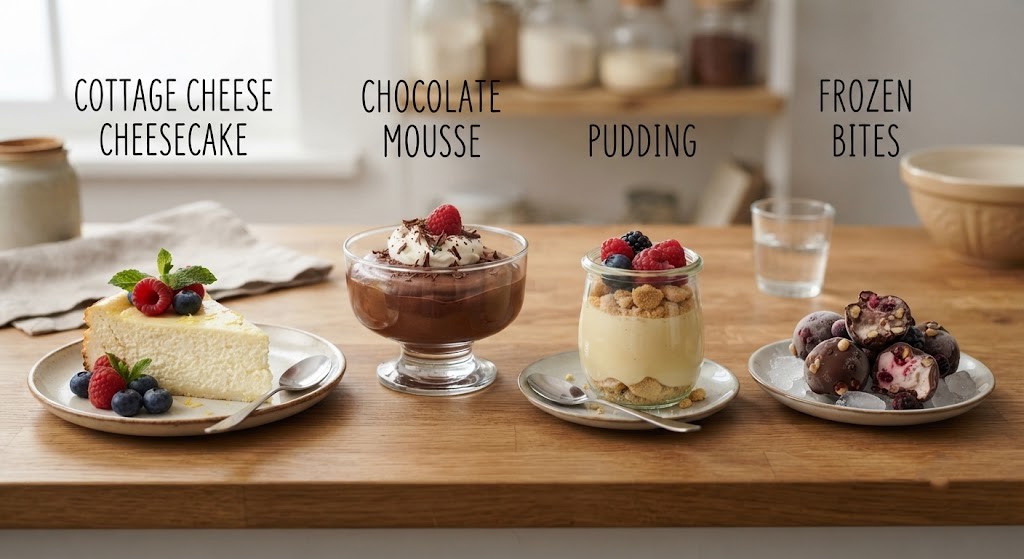
Yes. High-protein cottage cheese desserts use blended cottage cheese as a creamy base for cheesecakes, puddings, mousse, frozen treats, and fruit-based desserts.
Blending is particularly useful for dessert recipes because it transforms the curd-like texture into a smoother consistency that can resemble traditional creamy desserts.
13. Cottage Cheese Protein Cheesecake
Cottage cheese protein cheesecake is a baked or chilled dessert made with blended cottage cheese, eggs, yogurt, and flavorings.
Blend 1 cup cottage cheese, ½ cup Greek yogurt, 1 egg, vanilla, and a small amount of sweetener until smooth. Pour the mixture into a small lined baking dish and bake until the center is mostly set.
Chill completely before slicing.
14. Chocolate Cottage Cheese Mousse
Chocolate cottage cheese mousse is a blended dessert made with cottage cheese, cocoa powder, and a sweetener or fruit.
Blend 1 cup cottage cheese with 1 tablespoon unsweetened cocoa powder, vanilla, and a banana or preferred sweetener. Refrigerate the mixture for at least 30 minutes.
The mousse becomes thicker and smoother when the cottage cheese is blended thoroughly.
15. Cottage Cheese Pudding
Cottage cheese pudding is a creamy dessert made by blending cottage cheese with fruit, cocoa, vanilla, or other flavorings.
For a simple berry pudding, blend cottage cheese with frozen strawberries and vanilla. You can add chia seeds after blending to create a thicker texture, then let the mixture sit in the refrigerator before serving.
16. Frozen Cottage Cheese Bites
Frozen cottage cheese bites are small portions of blended cottage cheese mixed with fruit and frozen until firm.
Spoon blended cottage cheese and mashed berries into silicone molds and freeze. These bites can be made in batches and stored for quick snacks or desserts.
Because recipes differ considerably in ingredients, calculate the nutrition of your specific batch rather than relying on generic estimates.
How Do You Make Cottage Cheese Taste Smoother in Recipes?
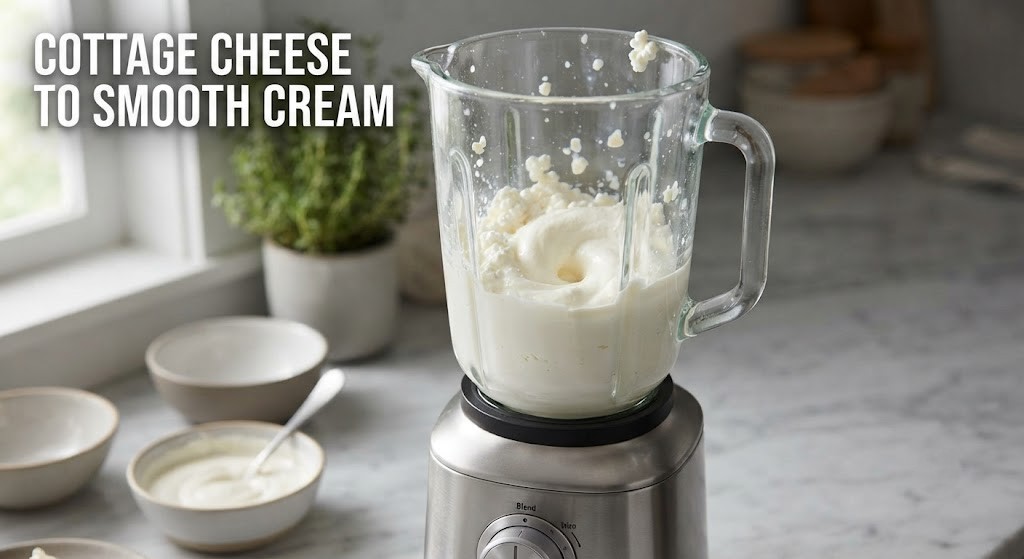
Blending cottage cheese creates a smoother texture that works particularly well in sauces, dips, smoothies, puddings, and cheesecakes. A high-speed blender or food processor can break down the curds more effectively than simply stirring with a spoon.
Blender Method
First, add cottage cheese to a blender or food processor and process until creamy.
If the mixture is too thick to blend smoothly, add 1–2 tablespoons of milk or yogurt. Scrape the sides and blend again until no large curds remain.
Keep the amount of liquid relatively small because too much can make sauces or desserts watery.
Flavoring Method
Flavor cottage cheese according to the recipe you are preparing.
For sweet recipes, try:
- Vanilla
- Cinnamon
- Cocoa
- Berries
- Banana
For savory recipes, try:
- Garlic
- Dill
- Lemon
- Paprika
- Fresh herbs
Blending transforms cottage cheese from a curd-like ingredient into a versatile creamy base.
How Can You Increase the Protein in Cottage Cheese Recipes?
You can increase the protein in cottage cheese recipes by combining cottage cheese with other protein-rich ingredients such as eggs, Greek yogurt, beans, milk, tofu, or protein powder.
For example, adding eggs to cottage cheese pancakes increases the total protein of the finished meal. Similarly, Greek yogurt can complement cottage cheese in bowls, dips, smoothies, and desserts.
High-Protein Ingredient Combinations
| Ingredient | Easy way to use it |
|---|---|
| Greek yogurt | Blend into dips, bowls, or desserts |
| Eggs | Add to pancakes, scrambles, and baked dishes |
| Milk | Use in smoothies and pancake batter |
| Protein powder | Add to smoothies, puddings, or pancakes |
| Beans | Add to wraps, bowls, and savory dips |
| Tofu | Blend into savory sauces or bowls |
Increasing protein does not always mean adding large portions of every ingredient. A balanced recipe can combine moderate portions of several protein sources.
The adult protein RDA is 0.8 grams per kilogram of body weight per day, although individual needs can differ based on age, activity, health status, and other factors. — Source: National Academies, 2005
How Do You Meal Prep Cottage Cheese Protein Recipes?
Cottage cheese meal prep involves preparing protein-rich recipes or components in advance so they can be quickly assembled into meals and snacks throughout the week.
For example, you can blend a cottage cheese dip, wash fruit, chop vegetables, and portion toppings on one preparation day.
A Simple Weekly Prep System
- Choose two breakfasts. Prepare pancake batter components or portion smoothie ingredients.
- Choose two lunches. Prepare cottage cheese pasta sauce or wrap fillings.
- Prepare two snacks. Portion cottage cheese with fruit or vegetables.
- Choose one dessert. Make cheesecake cups, pudding, or mousse.
- Store components separately. Keep crunchy toppings and wet ingredients apart when possible.
Use clean, appropriately sized storage containers and follow safe food-storage practices for refrigerated dairy foods. Always check the package label for storage instructions because shelf life varies between products and preparations.
Cottage Cheese Meal Prep Ideas
A practical weekly rotation could look like this:
| Meal | Cottage Cheese Recipe | Prep Approach |
| Breakfast | Protein pancakes | Prepare dry ingredients ahead |
| Breakfast | Protein bowl | Portion toppings separately |
| Lunch | Pasta sauce | Blend and refrigerate |
| Lunch | Savory wrap | Prepare filling components |
| Snack | Fruit bowl | Portion fruit and cottage cheese |
| Snack | Herb dip | Blend and store |
| Dessert | Protein mousse | Prepare individual portions |
Meal prep works best when you prepare components rather than forcing yourself to eat the exact same meal every day.
What Tools and Ingredients Are Best for Cottage Cheese Protein Recipes?
Useful cottage cheese recipe tools include a blender, food processor, nonstick pan, measuring cups, mixing bowls, and airtight storage containers. Each tool solves a different preparation problem.
A blender is particularly useful for smooth sauces and desserts, while a nonstick pan works well for pancakes and scrambled eggs. Measuring cups can help maintain consistent portions when you are tracking nutrition.
Practical Ingredients to Keep on Hand
A flexible cottage cheese pantry can include:
- Cottage cheese
- Eggs
- Greek yogurt
- Milk
- Berries
- Bananas
- Whole-grain bread or tortillas
- Oat flour
- Chickpeas or beans
- Spinach
- Tomatoes
- Cucumbers
- Cocoa powder
- Cinnamon
- Garlic
- Fresh herbs
- Lemon
- Protein powder
Choose lower-fat or full-fat cottage cheese according to your preferences and dietary needs. The Dietary Guidelines note that lower-fat dairy products generally provide fewer calories from fat than higher-fat versions, although individual product nutrition varies. — Source: USDA Dietary Guidelines, 2015–2020
What Should You Check on the Nutrition Label?
The nutrition label is the best place to check the exact protein, calories, fat, carbohydrates, and sodium in your specific cottage cheese.
Two cottage cheese products with different fat levels can have noticeably different nutrition values, so checking the label is more accurate than assuming every product has the same nutritional profile.
USDA FoodData Central is another useful reference for checking food-composition data, and its database is updated twice annually for relevant data types. — Source: USDA FoodData Central, 2026
How Do You Add Cottage Cheese Protein Recipes to Your Weekly Meal Plan?
A weekly cottage cheese meal plan should include a mix of breakfast, lunch, dinner, snacks, and dessert rather than relying on one recipe every day.
For example, you could choose pancakes on Monday, a savory bowl on Tuesday, pasta sauce on Wednesday, and a protein cheesecake for the weekend.
A Simple Four-Step Planning Method
First, select two breakfast recipes with different flavor profiles. For example, choose protein pancakes for one day and scrambled eggs with cottage cheese for another.
Second, choose two savory recipes for lunch or dinner. A pasta sauce and wrap filling can share ingredients such as spinach, herbs, and vegetables.
Third, prepare two quick snacks that require little cooking. Cottage cheese with fruit and cottage cheese vegetable dip are simple choices.
Fourth, prepare one dessert for the week. Cottage cheese mousse or cheesecake can add variety without requiring a completely separate ingredient list.
What Are the Best Cottage Cheese Protein Recipes for Different Goals?
The best cottage cheese protein recipe depends on the meal, flavor preference, dietary pattern, and overall nutrition goal.
For example, a smoothie may work well when convenience is the priority, while a savory bowl may be more suitable when you want a more substantial meal.
| Goal | Recipe Type | Easy Combination |
| Quick breakfast | Smoothie | Cottage cheese + berries + milk |
| Sweet breakfast | Pancakes | Cottage cheese + eggs + oat flour |
| Savory breakfast | Scramble | Cottage cheese + eggs + vegetables |
| Easy lunch | Wrap | Cottage cheese + beans + vegetables |
| Dinner | Pasta sauce | Cottage cheese + pasta + vegetables |
| Snack | Fruit bowl | Cottage cheese + berries + cinnamon |
| Dessert | Mousse | Cottage cheese + cocoa + banana |
People following vegetarian diets can pair cottage cheese with beans, lentils, tofu, eggs, nuts, seeds, and other vegetarian protein sources.
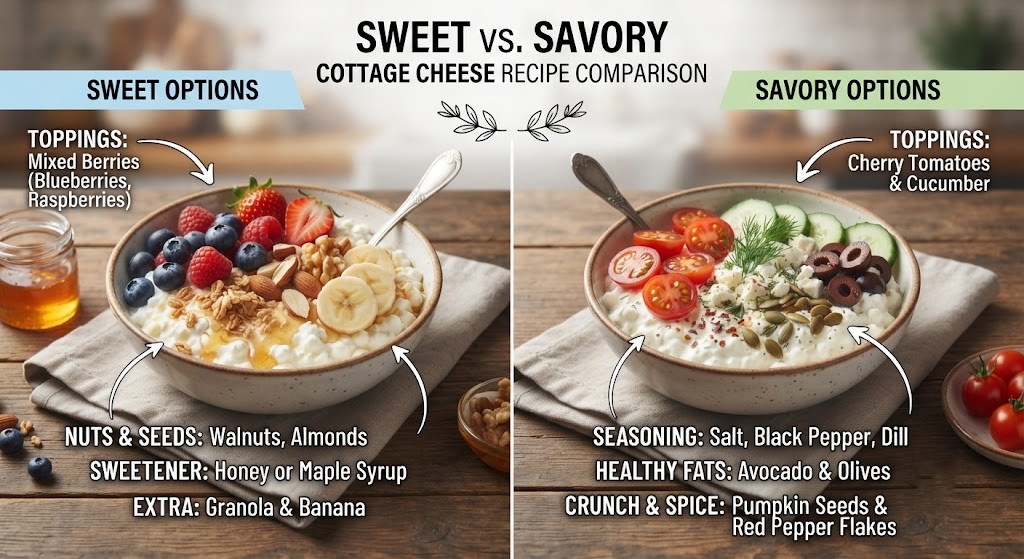
Can Cottage Cheese Be Used in Both Sweet and Savory Recipes?
Cottage cheese can be used in both sweet and savory recipes because its mild flavor adapts easily to different seasonings and ingredients.
Berries and cinnamon can create a sweet bowl, while garlic and herbs can turn the same basic ingredient into a savory dip.
The same basic preparation technique can often support both versions. Blending cottage cheese creates a neutral creamy base that can be flavored in many directions.
Sweet Cottage Cheese Recipe Ideas
Sweet cottage cheese recipes include:
- Protein pancakes
- Berry bowls
- Chocolate mousse
- Cottage cheese pudding
- Protein cheesecake
- Frozen fruit bites
- Cottage cheese smoothies
Savory Cottage Cheese Recipe Ideas
Savory cottage cheese recipes include:
- Scrambled eggs
- Pasta sauce
- Wraps
- Vegetable dips
- Grain bowls
- Stuffed vegetables
- Savory toast
This versatility is one reason cottage cheese can fit naturally into a varied eating pattern. The Dietary Guidelines include cheese and cottage cheese within the dairy category, emphasizing variety across food groups. — Source: USDA Dietary Guidelines, 2020
What’s Next: How to Add Cottage Cheese Recipes to Your Weekly Meal Plan
The easiest next step is to choose one breakfast, one savory meal, one snack, and one dessert from this guide and prepare them during the same week. This approach lets you test different flavors without buying a large number of specialized ingredients.
Next, keep one container of cottage cheese available for quick meals and use blending when you want a smoother texture. The same ingredient can become pancake batter in the morning, pasta sauce at lunch, dip in the afternoon, and mousse after dinner.
Finally, track the nutrition of your actual ingredients when protein intake matters to you. Product labels can differ, and USDA FoodData Central provides a broad food-composition reference for comparison. — Source: USDA FoodData Central, 2026
Conclusion
Cottage cheese protein recipes offer an easy way to add protein, creaminess, and versatility to everyday meals. From cottage cheese protein pancakes and scrambled eggs to pasta sauces, wraps, dips, smoothies, cheesecakes, puddings, and frozen bites, cottage cheese can work across almost every part of the day.
Blending cottage cheese is one of the simplest ways to make its texture smoother, while combining it with eggs, Greek yogurt, beans, milk, tofu, or protein powder can create more protein-rich meals. Portion sizes and additional ingredients still matter, so use product labels or reliable food-composition data when precise nutrition information is important.
Start with a few easy cottage cheese protein recipes, prepare ingredients ahead of time, and experiment with both sweet and savory combinations. With a little creativity, one container of cottage cheese can become the foundation for an entire week of convenient, protein-focused meals and snacks.
FAQs
What are cottage cheese protein recipes?
Recipes that use cottage cheese to add protein to meals, snacks, or desserts.
Is cottage cheese high in protein?
Yes, cottage cheese is a convenient protein-rich dairy food.
What is the best high-protein cottage cheese recipe?
Protein pancakes, smoothies, bowls, and scrambled eggs are great options.
How do you make cottage cheese smooth?
Blend cottage cheese until creamy using a blender or food processor.
Can I use cottage cheese in sweet recipes?
Yes, it works well in pancakes, puddings, mousse, and smoothies.
Can cottage cheese be used in savory recipes?
Yes, use it in dips, pasta sauces, wraps, and eggs.
How can I increase the protein in cottage cheese recipes?
Add eggs, Greek yogurt, protein powder, beans, or tofu.
Are cottage cheese protein recipes good for meal prep?
Yes, many can be prepared and portioned ahead of time.
How to eat cottage cheese for high-protein?
Pair it with eggs, Greek yogurt, beans, or protein powder.
What to mix with cottage cheese for protein?
Mix it with eggs, Greek yogurt, milk, tofu, or protein powder.
Is cottage cheese good for high-protein?
Yes, cottage cheese is a simple way to add protein to meals.
What are some high-protein cottage cheese recipes?
Try pancakes, smoothies, bowls, pasta sauce, dips, and cheesecake.