
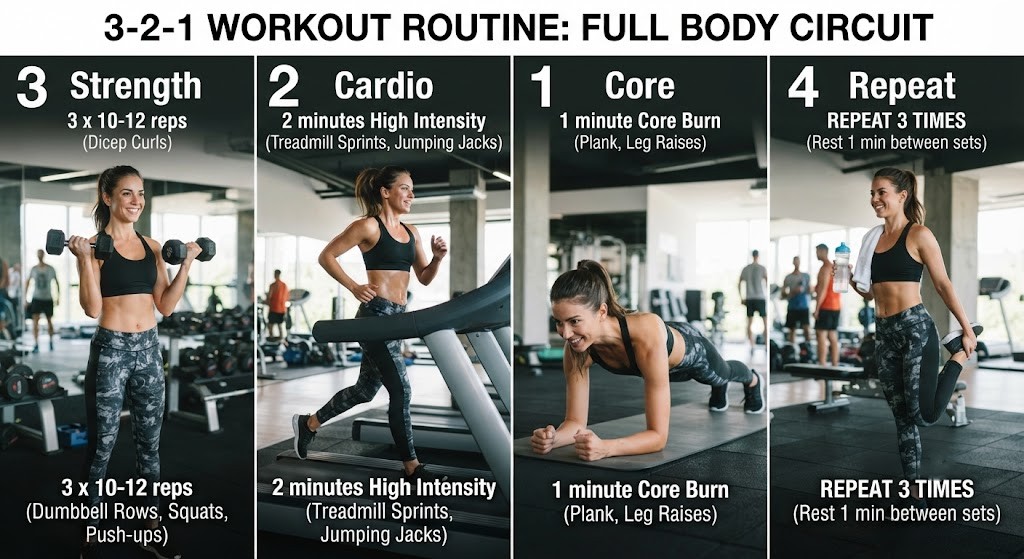
Most people know that an effective fitness plan should include both strength training and cardio, but fitting everything into a realistic weekly schedule can be challenging. The 3-2-1 workout routine offers a straightforward solution by giving each type of training a specific place in your week.
The concept is simple: three strength workouts, two cardio sessions, and one recovery or mobility session. However, the real benefit comes from knowing how to organize those sessions, choose appropriate exercises, manage intensity, and progress over time.
In this guide, you’ll learn exactly how the 3-2-1 workout routine works, how to structure a complete weekly schedule, which exercises to use, and how to adapt the method for beginners, home workouts, muscle building, and weight-loss goals.
What Is the 3-2-1 Workout Routine?
The 3-2-1 workout routine is a weekly fitness framework built around three strength-training sessions, two cardio sessions, and one recovery or mobility session. The exact meaning of the numbers can vary between programs, so this guide uses the three-strength, two-cardio, one-recovery format.
The three strength sessions are designed to develop muscular strength and overall fitness through resistance exercises. A typical session might include movements such as squats, push-ups, rows, Romanian deadlifts, and core exercises.
The two cardio sessions focus on cardiovascular fitness. Depending on your goals and fitness level, these can include brisk walking, cycling, jogging, swimming, or interval training.
The final session emphasizes recovery rather than additional high-intensity training. Mobility drills, gentle yoga, stretching, easy walking, and other low-intensity activities can all fit into this part of the routine.
The framework also fits well with established physical-activity recommendations. Adults are generally advised to complete at least 150 minutes of moderate-intensity aerobic activity and muscle-strengthening activity on at least two days each week. — Source: CDC, 2025
Why Is the 3-2-1 Workout Routine Effective for Weekly Fitness?
The 3-2-1 workout routine is effective because it combines resistance training, cardiovascular exercise, and planned recovery within one weekly framework. This balanced structure helps prevent your training schedule from becoming focused exclusively on lifting weights or doing cardio.
Strength training supports muscular fitness, cardio develops aerobic capacity, and recovery gives your body an opportunity to manage the demands of repeated exercise. Together, these components create a more balanced approach to weekly fitness.
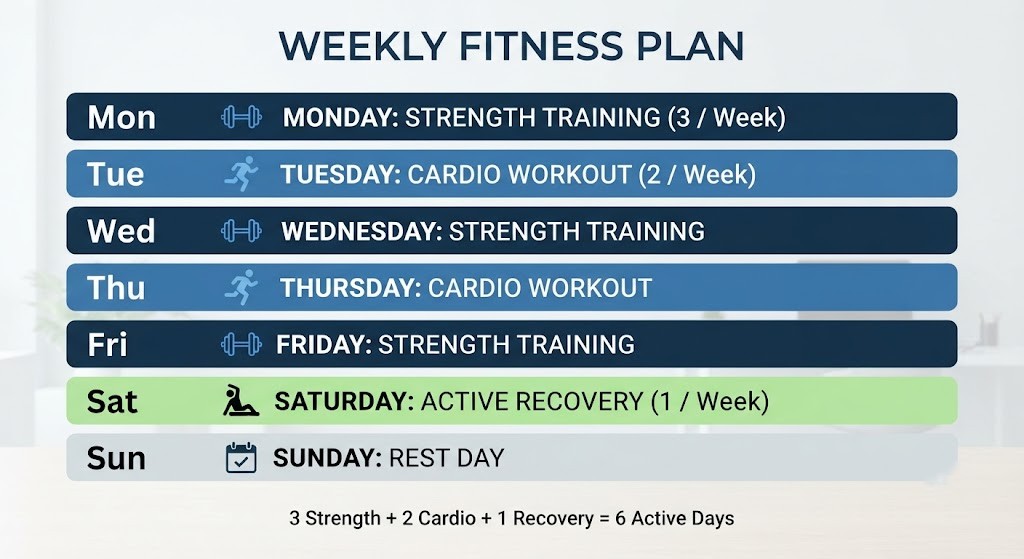
Moreover, the 3-2-1 workout method involves distributing strength, cardio, and recovery sessions across the week to create a balanced training schedule. For example, you could lift on Monday, Wednesday, and Friday, complete cardio on Tuesday and Saturday, and use Thursday or Sunday for recovery.
How Does the 3-2-1 Workout Method Work?
The 3-2-1 workout method works by assigning six purposeful training sessions across seven days, leaving at least one flexible rest period. Each session has a specific role instead of requiring maximum effort every day.
A practical structure looks like this:
| Day | Session | Example Duration | Main Goal |
|---|---|---|---|
| Monday | Strength 1 | 40–60 min | Full-body strength |
| Tuesday | Cardio 1 | 25–45 min | Aerobic fitness |
| Wednesday | Strength 2 | 40–60 min | Strength and muscle |
| Thursday | Recovery/rest | 20–40 min | Mobility and recovery |
| Friday | Strength 3 | 40–60 min | Full-body strength |
| Saturday | Cardio 2 | 25–45 min | Cardio conditioning |
| Sunday | Rest or light mobility | 10–30 min | Recovery |
You do not have to copy this schedule exactly. A busy person can move sessions around while preserving adequate recovery between harder workouts.
Adults can accumulate their recommended aerobic activity in smaller chunks throughout the week rather than completing it in one session. — Source: CDC, 2025
strength training for beginners
What Exercises Should You Do for the 3 Strength Workouts?
The three strength sessions should train the major movement patterns and muscle groups while allowing enough recovery between challenging sessions.
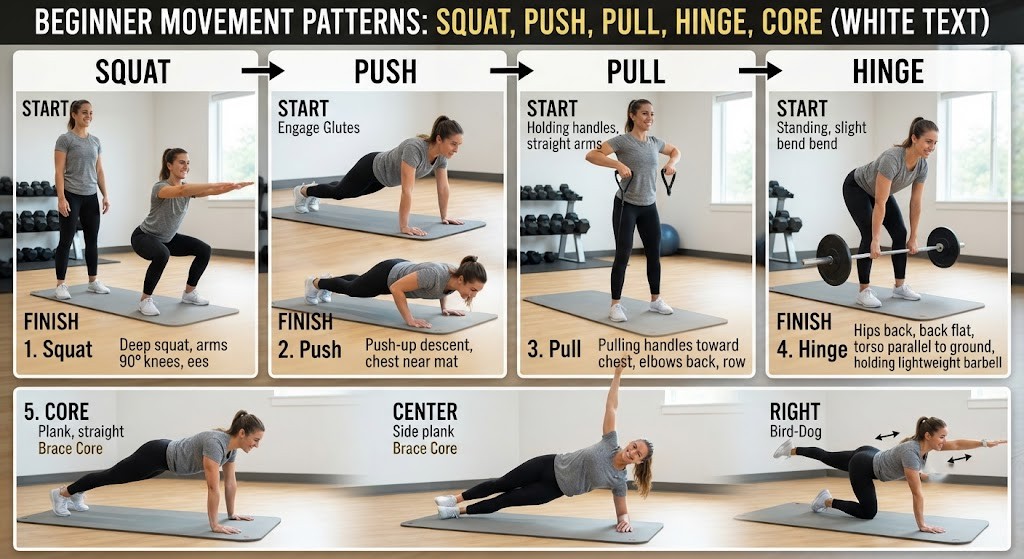
A full-body approach works particularly well for beginners because each workout can address the legs, upper body, and core. A simple way to organize the workouts is to include a squat, hinge, push, pull, and core movement.
You can then vary the exercises between sessions to provide different movement patterns without making the program unnecessarily complicated.
Strength Workout 1: Basic Full Body
Start with movements that are relatively easy to learn and control.
- Goblet squat — 3 × 8–12
- Dumbbell bench press or push-up — 3 × 8–12
- One-arm dumbbell row — 3 × 8–12 per side
- Romanian deadlift — 2–3 × 8–12
- Plank — 3 × 20–45 seconds
Rest approximately 60–120 seconds between challenging sets.
The goal is not simply to complete as many repetitions as possible. Focus on controlled technique and choose resistance that allows you to maintain good form throughout the set.
Strength Workout 2: Full-Body Variation
For the second strength session, change the exercise variations while maintaining similar fundamental movement patterns.
- Reverse lunge — 3 × 8–10 per leg
- Overhead press — 3 × 8–12
- Lat pulldown or resistance-band pulldown — 3 × 8–12
- Hip thrust — 3 × 10–15
- Dead bug — 3 × 8–12 per side
This variation gives you another opportunity to train the lower body, pushing muscles, pulling muscles, hips, and core.
Strength Workout 3: Strength and Technique
The third workout can provide another manageable full-body combination.
- Squat variation — 3 × 8–10
- Incline push-up or dumbbell press — 3 × 8–12
- Seated cable or dumbbell row — 3 × 8–12
- Dumbbell Romanian deadlift — 3 × 8–12
- Side plank — 2–3 × 20–40 seconds per side
Adults can use weights, resistance bands, or bodyweight exercises to strengthen major muscle groups. — Source: CDC, 2023
For beginners, one or two sets per exercise may be enough initially. The best 3-2-1 workout plan is one you can perform consistently with controlled technique.
What Cardio Should You Do for the 2 Cardio Workouts?
The two cardio sessions can use activities such as walking, running, cycling, swimming, or intervals, with intensity selected according to the person’s fitness level and goals.
You do not need to run to make the cardio component effective. The best choice is an activity you can perform consistently while recovering appropriately from your strength workouts.
Moderate-Intensity Cardio
Moderate cardio is useful when you want a sustainable session that does not interfere heavily with strength training.
Good options include:
- Brisk walking
- Easy cycling
- Elliptical training
- Swimming
- Light jogging
- Dancing
A 30–45-minute brisk walk can be an excellent beginner cardio session.
Higher-Intensity Cardio
More experienced exercisers can incorporate intervals after establishing a basic aerobic foundation.
For example, you could alternate one minute of faster cycling with two minutes of easy cycling for 20–25 minutes. The harder periods should be challenging without making the entire workout excessively exhausting.
Adults can target 150–300 minutes of moderate-intensity aerobic activity or 75–150 minutes of vigorous activity per week for the greatest general health benefits. — Source: HHS, 2026
That recommendation is broader than the two dedicated cardio sessions in this routine because walking, warm-ups, recreational activities, and other movement can also contribute to weekly activity.
What Should You Do on the 1 Recovery Day?
The one recovery session is a low-intensity workout focused on mobility, easy movement, and preparing your body for future training.
Recovery should feel easier than your strength and cardio sessions. The purpose is to maintain movement without creating substantial additional fatigue.
Active Recovery Exercises
Choose activities that encourage movement without turning recovery into another demanding workout.
- Easy walking
- Gentle cycling
- Light yoga
- Dynamic mobility drills
- Hip and ankle mobility
- Shoulder mobility
- Gentle stretching
- Light foam rolling
For example, you could spend 20–30 minutes walking and then perform gentle hip, shoulder, and thoracic-spine mobility exercises.
Recovery days are useful because training adaptation requires more than repeatedly adding hard workouts. If you feel unusually fatigued, reducing intensity or taking a complete rest day is often more appropriate than forcing the planned session.
What Is a 3-2-1 Workout Routine Weekly Schedule?
A 3-2-1 workout routine weekly schedule places three strength sessions, two cardio sessions, and one recovery session into a seven-day structure. The remaining day can be used as complete rest or flexible recovery.
The structure is flexible, so you can adjust it around work, school, family commitments, and your preferred training times.
Beginner 3-2-1 Schedule
Beginners can use shorter sessions and lower intensity while they develop exercise consistency.
- Monday: Full-body strength
- Tuesday: 25–30-minute brisk walk
- Wednesday: Full-body strength
- Thursday: Rest or mobility
- Friday: Full-body strength
- Saturday: 25–35-minute easy cardio
- Sunday: Recovery or rest
The beginner version does not need to involve heavy weights or intense cardio. Learning movement technique and establishing a sustainable routine should come first.
Home 3-2-1 Workout Routine
A home version can use bodyweight exercises, resistance bands, and adjustable dumbbells.
A home strength workout could include:
- Squats
- Push-ups
- Band rows
- Glute bridges
- Split squats
- Planks
The cardio sessions can involve brisk outdoor walking, jogging, cycling, dancing, or other accessible activities.
Gym 3-2-1 Workout Routine
Gym users can use barbells, machines, cables, dumbbells, treadmills, bikes, or rowing machines.
The additional equipment provides more ways to progress resistance and exercise selection, but equipment is not required to follow the 3-2-1 framework.
Is the 3-2-1 Workout Routine Good for Beginners?
The 3-2-1 workout routine can work well for beginners when training volume and intensity are adjusted to the person’s current fitness level.
Beginners should focus on learning movement technique rather than immediately copying an advanced athlete’s workload. The framework can stay the same while the difficulty of each session changes.
Start with one or two sets per strength exercise and choose resistance that allows controlled repetitions. Keep cardio comfortable enough that you can recover for your next strength workout.
For example, a beginner might perform three 30-minute strength sessions, two 25-minute walks, and one 20-minute mobility session during the first week.
Some physical activity is better than none, and activity can be increased gradually as fitness improves. — Source: CDC, 2025
If six sessions feel excessive, reduce the duration before abandoning the structure. Consistency matters more than forcing a demanding schedule from day one.
Can the 3-2-1 Workout Routine Help With Weight Loss?
The 3-2-1 workout routine can support weight loss by increasing physical activity and helping preserve or develop muscle, but it does not guarantee weight loss by itself.
Fat loss generally requires an appropriate calorie deficit over time. Strength training can help you maintain muscle while losing weight, while cardio contributes to energy expenditure and cardiovascular fitness.
Physical activity increases the calories your body uses, while reducing calorie intake can create the calorie deficit required for weight loss. — Source: CDC, 2026
Therefore, a 3-2-1 workout plan for weight loss should be combined with a sustainable eating pattern, sufficient protein, adequate sleep, and realistic calorie control.
The routine can also support body composition goals because it does not treat cardio and resistance training as competing goals. Instead, both are incorporated into the same weekly framework.
How Do You Progress With the 3-2-1 Workout Routine?
Progressing with a 3-2-1 workout routine involves gradually increasing training difficulty through resistance, repetitions, duration, intensity, or improved exercise technique while maintaining adequate recovery.
You do not need to make every workout harder at once. Instead, make small, manageable changes and monitor how your body responds.
Use Progressive Overload
Start by increasing one training variable at a time.
For example, if you can comfortably perform 3 × 10 goblet squats with good technique, you could eventually move toward 3 × 12 or use slightly more resistance.
ACSM’s 2026 resistance-training guidance emphasizes consistency, individualized programming, and matching training variables to goals. For muscle growth, its position stand highlights approximately 10 weekly sets per muscle group as a useful target for many adults, while strength-focused training can use heavier loads and fewer repetitions. — Source: ACSM, 2026
Track Your Workouts
Recording your workouts makes progression easier to evaluate.
Track details such as:
- Exercises performed
- Sets and repetitions
- Resistance used
- Cardio duration
- Cardio intensity
- How difficult each session felt
- Any noticeable changes in technique or performance
A simple progression might look like this:
- Week 1: Learn the exercises.
- Week 2: Add repetitions where appropriate.
- Week 3: Increase resistance slightly.
- Week 4: Maintain or reduce volume if fatigue is accumulating.
Progressive overload works best when increases are gradual enough to preserve technique and recovery.
How Should You Start the 3-2-1 Workout Routine?
The best way to start the 3-2-1 workout routine is to use simple exercises, manageable sessions, and gradual progression during the first few weeks.
Your first goal should be building a repeatable schedule rather than chasing maximum intensity.
Warm Up Before Training
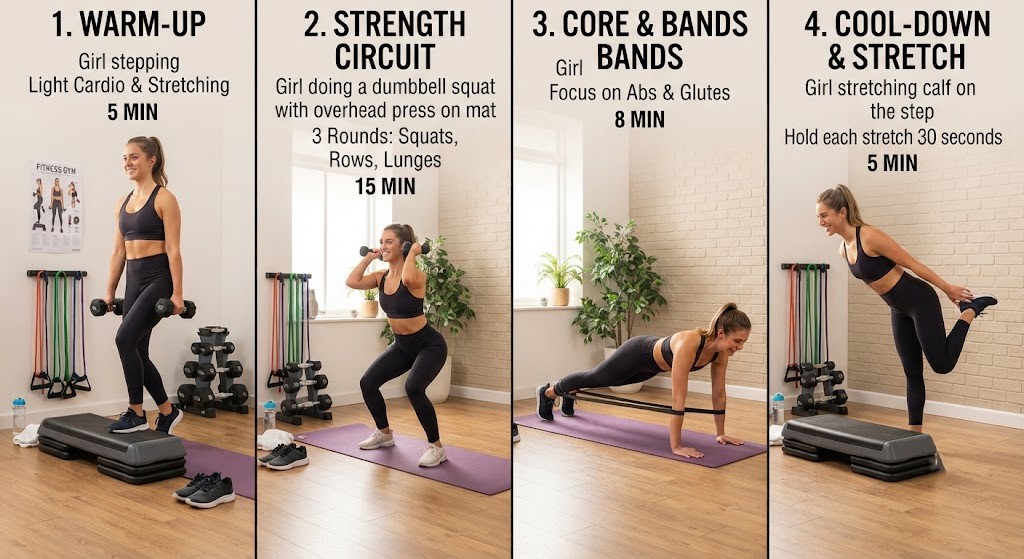
Spend 5–10 minutes warming up before strength or vigorous cardio. Use easy movement followed by dynamic exercises that prepare the muscles and joints you will train.
The warm-up should prepare you for the upcoming session rather than exhaust you before the main workout begins.
Choose Practical Equipment
If you train at home, useful equipment can include:
- Exercise mat
- Resistance bands
- Adjustable dumbbells
- Stable bench or chair
- Comfortable walking or running shoes
At a gym, you can use machines and free weights instead.
Use Your First Week as a Baseline
Finally, use the first week to establish a realistic starting point.
Choose exercises you can perform safely, keep most sessions moderate, and record what you complete. Once you understand how your body responds to the workload, you can gradually adjust resistance, repetitions, duration, or intensity.
If you have been inactive, have a chronic health condition, or plan to begin vigorous exercise, consider discussing your activity plans with a qualified healthcare professional.
3-2-1 Workout Routine for Different Fitness Goals
One reason the 3-2-1 workout routine is practical is that the same basic structure can be adapted to different objectives.
For General Fitness
Prioritize balanced full-body strength sessions, moderate cardio, and consistent recovery. The goal is to develop several aspects of fitness without making any single component excessively demanding.
For Muscle Building
Place greater emphasis on progressive resistance training and sufficient weekly training volume. Cardio can remain part of the plan while being managed so that it does not unnecessarily interfere with strength-training recovery.
For Weight Loss
Combine the strength and cardio structure with an appropriate nutrition strategy. Strength training supports muscle development or maintenance, while cardio adds additional physical activity.
For Beginners
Keep the same framework but reduce session length, resistance, exercise volume, and intensity. Building consistency is more important than completing advanced workouts.
For Home Training
Use bodyweight movements, resistance bands, dumbbells, and accessible forms of cardio. The 3-2-1 concept depends on the training categories rather than specific gym equipment.
Common Mistakes to Avoid With the 3-2-1 Workout Routine
Even a simple training framework can become difficult if every session is treated as a maximum-effort workout.
Avoid these common mistakes:
- Making every session high intensity: Recovery becomes harder when strength and cardio sessions are constantly performed at maximum effort.
- Ignoring technique: More weight or repetitions do not compensate for poor movement quality.
- Progressing too quickly: Increasing several training variables simultaneously can make fatigue accumulate unnecessarily.
- Skipping recovery: The recovery component is part of the framework for a reason.
- Copying an advanced program immediately: Beginners should adjust workload to their current fitness level.
- Ignoring nutrition and sleep: Training is only one part of long-term fitness progress.
- Expecting immediate results: Sustainable changes generally require consistent training over time.
The best 3-2-1 workout routine is ultimately one that matches your current ability and can be maintained consistently.
Conclusion
The 3-2-1 workout routine provides a simple structure for combining three strength sessions, two cardio workouts, and one recovery session each week. Its biggest advantage is organization: instead of wondering what to train each day, you have a framework that covers several important areas of fitness.
Moreover, the routine is flexible enough for beginners, home exercisers, and experienced gym-goers. You can change exercises, session length, equipment, and intensity without losing the basic 3-2-1 structure.
Ultimately, consistency and appropriate progression matter more than making every workout extremely intense. Start with a manageable schedule, recover properly, track your progress, and adjust the routine as your fitness improves.
FAQs
What is the 3-2-1 workout routine?
Three strength workouts, two cardio sessions, and one recovery session each week.
How many days a week is the 3-2-1 workout routine?
Six planned sessions across seven days, with one rest day.
Is the 3-2-1 workout routine good for beginners?
Yes, beginners can reduce the intensity, sets, and workout duration.
What exercises are included in a 3-2-1 workout?
Strength exercises, cardio activities, and mobility or recovery exercises.
Can you do the 3-2-1 workout routine at home?
Yes, using bodyweight exercises, resistance bands, dumbbells, and walking.
Is the 3-2-1 workout routine good for weight loss?
Yes, it can support weight loss when combined with proper nutrition and calorie control.
Does the 3/2/1 workout method work?
Yes, it provides a balanced approach to strength, cardio, and recovery.
Does the 3-2-1 method work for weight loss?
Yes, it can help increase activity and support a calorie deficit.
What is the 3-2-1 rule for working out?
Three strength sessions, two cardio sessions, and one recovery session weekly.
What is the 5-4-3-2-1 workout method?
It is a different workout framework that varies depending on the program.
3 thoughts on “3-2-1 Workout Routine: A Simple Plan for Strength, Cardio & Fitness”