
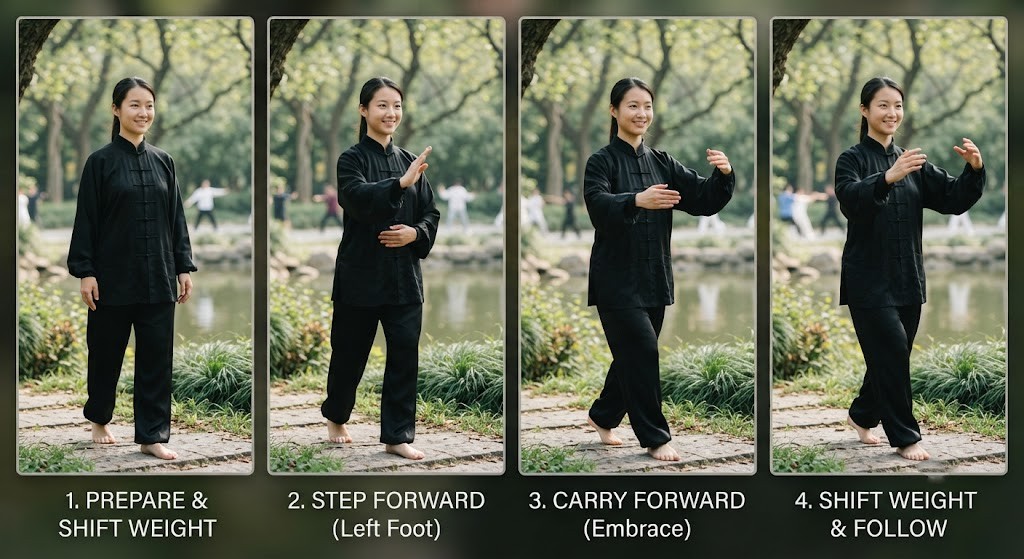
If you already enjoy walking but want a gentler, more mindful way to move, a Tai Chi walking workout can add a completely different dimension to your routine. Instead of focusing mainly on speed, distance, or step count, Tai Chi walking teaches you to coordinate slow steps, deliberate weight shifts, posture, breathing, and body awareness.
In this guide, you’ll learn what a Tai Chi walking workout is, how it differs from regular walking, how to perform the movements step by step, the potential benefits, beginner-friendly routines, variations, safety considerations, and practical ways to make the practice a consistent habit.
What Is a Tai Chi Walking Workout?
A Tai Chi walking workout is a slow, controlled form of walking that combines deliberate weight shifting, relaxed posture, coordinated movement, and mindful breathing. Unlike ordinary walking, the goal is not simply to cover distance but to pay close attention to how each movement feels and connects to the next.
Tai Chi itself combines slow, gentle movements, physical postures, mental focus, controlled breathing, and relaxation. Tai Chi walking applies these principles specifically to stepping and weight transfer. — Source: National Center for Complementary and Integrative Health, 2026.
For example, instead of quickly stepping from one foot to another, you might slowly shift your weight onto your left leg, carefully lift the right foot, place it forward, and then gradually transfer your weight.
Tai Chi walking is a mindful movement practice rather than a speed-focused walking workout.
If you enjoy gentle exercise, combining this practice with other low-impact workouts can create a varied movement routine.
How Is Tai Chi Walking Different From Regular Walking?
Tai Chi walking differs from regular walking because it emphasizes deliberate weight transfer, posture, foot placement, breathing, and awareness rather than pace or distance.
| Regular Walking | Tai Chi Walking |
|---|---|
| Usually emphasizes pace or distance | Emphasizes controlled movement |
| Natural weight transfer | Deliberate weight transfer |
| Normal stride length | Shorter, carefully placed steps |
| Arms swing naturally | Arms coordinate intentionally |
| Breathing is usually automatic | Breathing can be consciously coordinated |
| Often continuous | Includes pauses and weight-shifting drills |
For example, a normal walk might focus on reaching 3,000 steps, while a Tai Chi walking session might focus on making 20 controlled steps with stable posture.
Why Does Tai Chi Walking Matter?
Tai Chi walking provides a gentle way to practice balance, coordination, mobility, body awareness, and controlled movement without requiring fast or high-impact exercise.
Research on Tai Chi also suggests potential benefits for balance and fall prevention in older adults. A 2023 meta-analysis of 24 randomized controlled trials found that Tai Chi reduced fall risk and improved several measures of balance. — Source: Frontiers in Public Health, 2023.
Another 2024 systematic review included 18 randomized clinical trials and found improvements in both dynamic and static balance among older adults practicing Tai Chi. — Source: Journal of Aging and Physical Activity, 2024.
For example, practicing controlled steps requires you to notice where your weight is positioned before moving the opposite foot.
Tai Chi walking trains attention and movement together.
That makes it especially useful for people who prefer gentle movement over fast-paced workouts. It can also complement walking yoga for beginners when you want another mindful walking-based activity.
What Are the Basic Principles of Tai Chi Walking?
Tai Chi walking involves transferring your weight gradually from one leg to the other while placing each step deliberately and maintaining a relaxed, upright posture.
Focus on these core principles:
- Relaxed posture: Keep your spine naturally upright without becoming stiff.
- Soft knees: Avoid locking your knees while shifting weight.
- Controlled weight transfer: Move your center of gravity gradually.
- Deliberate footwork: Place each foot carefully rather than rushing.
- Stable footing: Keep movements controlled before progressing.
- Coordinated arms: Let the arms move naturally with the stepping pattern.
- Steady breathing: Breathe comfortably without forcing a rhythm.
- Slow pacing: Use a speed that allows complete control.
For example, when moving the right foot forward, first establish stable support through the left leg before transferring weight onto the right side.
Why Is Weight Shifting Important in Tai Chi Walking?
Weight shifting is one of the defining skills of a Tai Chi walking workout because it teaches you to control the transition between supporting one leg and the other.
Imagine your body moving like a slow pendulum rather than jumping between positions. Your supporting leg becomes stable before the opposite foot moves.
For example, stand with both feet comfortable, shift most of your weight toward the left leg, briefly lighten the right foot, and then return to center.
Controlled weight shifting is one of the defining skills of Tai Chi walking.
How Do You Do a Tai Chi Walking Workout Step by Step?
A beginner Tai Chi walking workout can start with a few minutes of gentle weight-shifting practice followed by slow, controlled forward steps and a brief cool-down.
Step 1: Stand Comfortably
Place your feet about hip-width apart and keep your knees slightly soft. Maintain an upright but relaxed posture.
Step 2: Relax Your Shoulders
Let your shoulders drop naturally and allow your arms to hang comfortably. Keep your head upright rather than pushing your chin forward or upward.
Step 3: Shift Your Weight
Slowly transfer your weight onto your left leg. Avoid making the movement sudden or leaning excessively.
Step 4: Lighten the Opposite Foot
Allow your right foot to become light before moving it. This helps you learn to distinguish between the supporting leg and the moving leg.
Step 5: Place the Foot Forward
Move your right foot slowly and place it carefully in front of you. Keep the step controlled rather than taking a long stride.
Step 6: Transfer Your Weight
Gradually move your weight onto the right leg once your foot is stable.
Step 7: Repeat on the Other Side
Allow your left foot to become light before stepping forward and repeating the sequence.
Step 8: Coordinate Your Arms
Let your arms move gently with your steps. The movement should remain relaxed rather than forced.
Step 9: Continue Slowly
Maintain comfortable breathing and stable posture as you repeat the pattern.
Step 10: Pause and Reset
Stop whenever you feel unstable, rushed, or overly fatigued. Reset your posture before continuing.
For example, one complete cycle can be left-side weight shift, right-foot placement, right-side weight transfer, and left-foot placement.
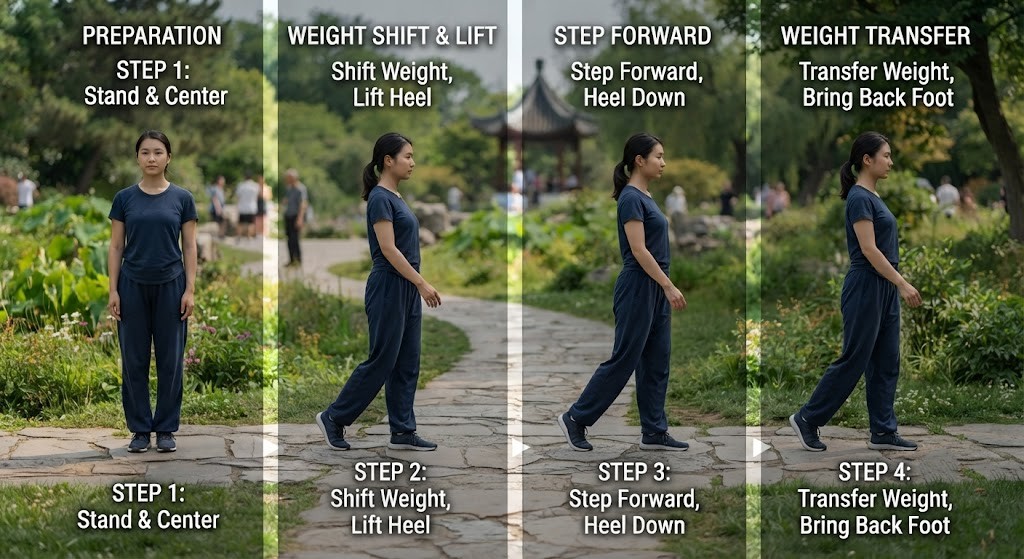
Beginners should prioritize controlled movement and stable footing rather than walking quickly or attempting advanced Tai Chi movements.
What Is the Best Tai Chi Walking Routine for Beginners?
The best Tai Chi walking routine for beginners is a short session that combines preparation, weight shifting, controlled walking, pauses, and a gentle cool-down.
5-Minute Tai Chi Walking Workout
Try this compact routine when you are new to the movement:
| Time | Activity |
|---|---|
| 1 minute | Relaxed standing and breathing |
| 1 minute | Gentle side-to-side weight shifting |
| 2 minutes | Slow forward Tai Chi walking |
| 30 seconds | Pause and reset posture |
| 30 seconds | Slow walking and cool-down |
During the two-minute walking section, take only a few deliberate steps at a time and pause whenever you need to regain stability.
The goal is not to complete as many steps as possible. Instead, use the five minutes to become comfortable with the sequence of shifting, lifting, placing, and transferring weight.
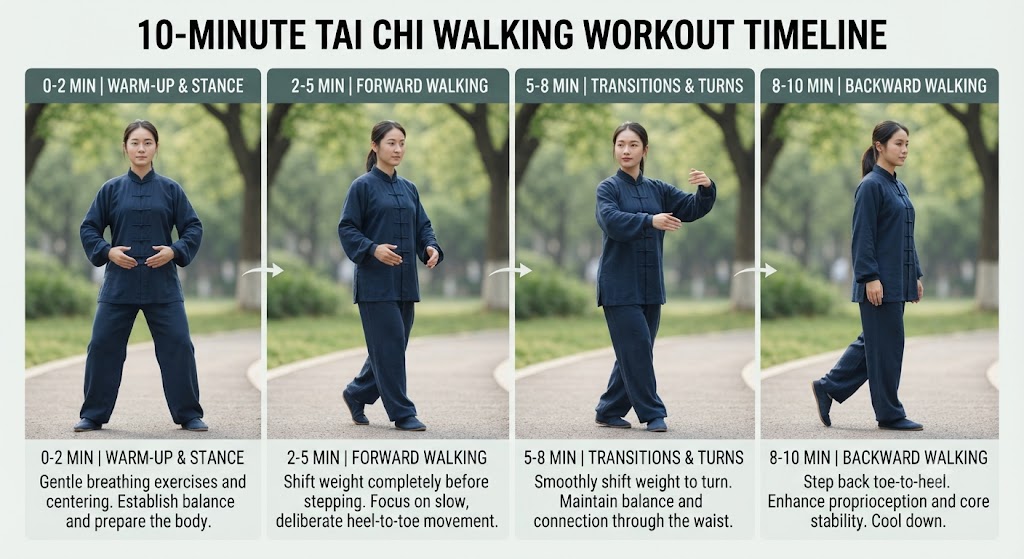
10-Minute Tai Chi Walking Workout
Once five minutes feels comfortable, you can gradually extend your practice:
- 2 minutes: Standing, posture, and breathing.
- 2 minutes: Forward and backward weight shifts without traveling.
- 3 minutes: Slow forward Tai Chi walking.
- 1 minute: Gentle side-stepping.
- 2 minutes: Slow walking and relaxed cool-down.
A 10-minute Tai Chi walking workout does not need to feel exhausting to be useful. The purpose is controlled movement and consistent practice, not maximum intensity.
How Long Should You Do Tai Chi Walking Each Day?
Tai Chi walking can begin with 5 to 10 minutes per session, especially if you are learning the footwork for the first time.
The CDC recommends that adults work toward at least 150 minutes of moderate-intensity physical activity each week, along with muscle-strengthening activity on at least two days. Tai Chi walking may contribute to overall movement, but its intensity varies and it should not automatically be counted as moderate-intensity aerobic exercise. — Source: CDC, 2023.
For example, you might practice for 10 minutes on five days each week before gradually increasing your session length.
Consistency matters more than making every Tai Chi walking session long.
What Are the Benefits of Tai Chi Walking?
A Tai Chi walking workout is a low-impact movement practice that can help develop balance, coordination, body awareness, and mindful movement.
1. Supports Balance and Stability
Balance and stability are among the best-supported areas of Tai Chi research. NCCIH reports evidence that Tai Chi may improve balance and reduce falls in older adults.
The deliberate weight transfers in Tai Chi walking require you to become aware of which leg is supporting your body before you move the opposite foot.
2. Encourages Coordination and Body Awareness
Tai Chi walking combines foot placement, weight transfer, posture, arm movement, and breathing. Practicing these elements together can make you more aware of how your body moves.
A 2024 meta-analysis involving 22 studies found significant improvements in several measures of balance and physical function among older adults. — Source: Frontiers in Medicine, 2024.
3. Provides Gentle Physical Activity
Tai Chi walking offers a way to move without running, jumping, or rapid directional changes. Its slow pace can make it approachable for people who prefer gentler workouts.
However, the intensity can vary depending on how the practice is performed, so it should not automatically be considered a moderate-intensity aerobic workout.
4. Promotes Mindful Movement
Relaxation and mindful movement are central to Tai Chi because the practice combines physical movement with mental focus and controlled breathing.
This can make a Tai Chi walking workout feel different from exercise focused primarily on speed, repetitions, or calorie expenditure.
However, individual experiences vary, and Tai Chi should not be presented as a treatment for medical conditions.
5. Can Complement Other Low-Impact Workouts
Tai Chi walking does not have to replace every other form of exercise. It can be one component of a broader movement routine.
If you want to compare other gentle options, explore barre sculpt workout, vibration plate workout, or NeuroYoga as complementary movement ideas.
For example, someone who finds brisk walking uncomfortable may prefer a short session focused on controlled steps and relaxed movement.
Can Tai Chi Walking Improve Balance and Coordination?
Tai Chi walking can support balance and coordination because its movements repeatedly practice controlled weight transfer, foot placement, posture, and directional changes.
Furthermore, a 2023 review of 24 randomized controlled trials found improvements in measures including the Timed Up and Go test, functional reach, single-leg balance, and gait speed. — Source: Frontiers in Public Health, 2023.
For example, slowly moving your weight onto one leg before stepping with the other requires you to control the transition instead of relying on momentum.
Tai Chi walking turns ordinary stepping into deliberate balance practice.
However, people with significant balance limitations should practice near an appropriate stable support and consider guidance from a qualified professional.
Is Tai Chi Walking a Good Low-Impact Exercise?
Tai Chi walking is generally a low-impact exercise because it uses controlled stepping rather than running, jumping, or rapid changes of direction.
NCCIH describes Tai Chi as a gentle practice that can be adapted while walking, standing, or sitting, making it flexible for different ability levels. — Source: NCCIH, 2026.
For example, you can shorten your steps, reduce the movement range, or practice weight shifting while standing if continuous walking feels difficult.
That said, low-impact does not mean risk-free. Stop if you experience sharp pain, dizziness, chest discomfort, or unusual shortness of breath.
What Are the Different Types of Tai Chi Walking?
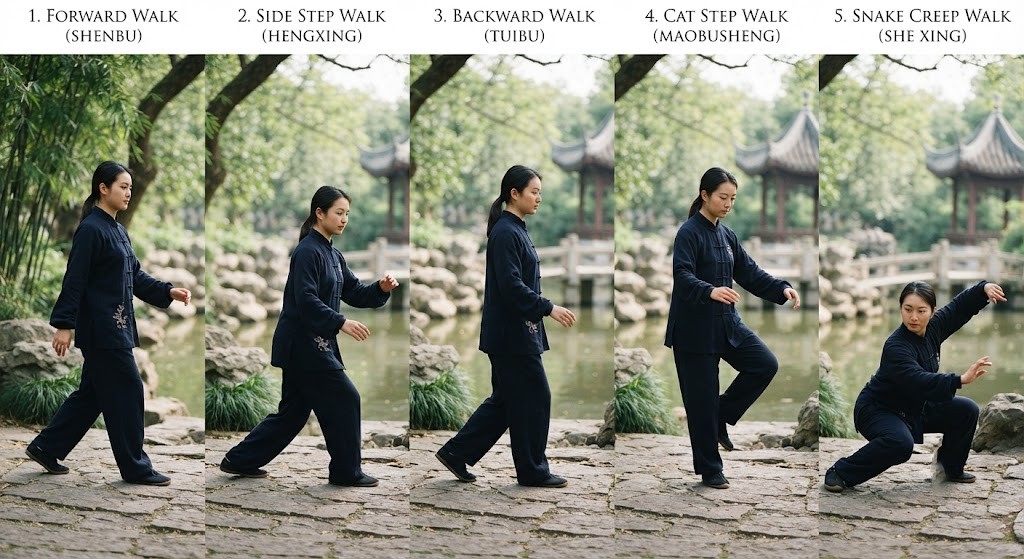
Tai Chi walking variations include forward walking, weight-shifting drills, side-stepping, mindful walking, and more advanced directional patterns.
Forward Tai Chi Walking
Forward Tai Chi walking is the simplest traveling variation for most beginners. Focus on placing each foot deliberately and transferring your weight gradually.
Keep the steps comfortable and avoid turning the movement into ordinary fast-paced walking.
Side-Stepping
Side-stepping adds lateral movement and requires greater attention to foot placement. Keep the steps small and avoid crossing your feet.
Because the movement occurs sideways rather than forward, move slowly enough to maintain control.
Backward Tai Chi Walking
Backward walking is an advanced variation because you cannot easily see the path behind you.
Practice only in a clear area with appropriate support or qualified instruction. Beginners should master forward walking and weight shifting before attempting backward movement.
Weight-Shifting Drills
Weight-shifting drills involve moving your body weight without traveling. They are useful for learning the fundamental sensation of becoming stable on one leg before stepping.
This is also a practical starting point if you are not yet comfortable with continuous walking.
Tai Chi Walking Variations Compared
| Variation | Difficulty | Beginner Guidance |
|---|---|---|
| Weight shifting | Easy | Start here |
| Forward walking | Easy–moderate | Use small steps |
| Side-stepping | Moderate | Keep feet uncrossed |
| Backward walking | Advanced | Use supervision/support |
| Complex directional patterns | Advanced | Learn from an instructor |
What Tools and Settings Can Make Tai Chi Walking Easier?
A Tai Chi walking workout becomes easier to manage when you use a clear surface, comfortable clothing, supportive footwear, and a nearby stable support when necessary.
Choose a Safe Practice Area
First, choose a flat, uncluttered area with enough room to take several slow steps.
Indoors, a clear hallway can work. Outdoors, a smooth pathway may be suitable.
Wear Comfortable Footwear
Choose footwear that feels secure and comfortable. Avoid practicing on slippery surfaces.
Your primary goal is controlled movement, so footwear should allow you to feel stable while stepping.
Keep Stable Support Nearby
A sturdy countertop, railing, or other stable support can provide additional confidence if necessary.
Do not use unstable furniture for balance.
Use a Simple Timer
A timer can help structure a five- or 10-minute Tai Chi walking workout without requiring you to constantly check a clock.
For guided learning, a qualified Tai Chi instructor can help refine posture and footwork. Free instructional resources can also provide demonstrations, but online videos cannot assess your individual balance or movement needs.
A custom illustration showing posture → weight shift → foot lift → foot placement → weight transfer would make the technique easier to understand visually.
What Should Beginners Know Before Trying Tai Chi Walking?
Beginners should treat Tai Chi walking as a skill-based movement practice and progress only when each movement feels controlled and comfortable.
Start with short sessions and avoid trying to imitate advanced demonstrations immediately. Keep your steps smaller than you might expect because control is more important than stride length.
For example, practicing five slow steps with stable footing is more useful for learning than taking 30 rushed steps.
Beginner Tai Chi Walking Checklist
Before starting, make sure you can:
- Choose a clear, stable walking area.
- Wear comfortable, secure footwear.
- Stand with relaxed posture.
- Keep your knees slightly soft.
- Shift your weight gradually.
- Lift the opposite foot only after establishing support.
- Place each step carefully.
- Maintain comfortable breathing.
- Stop if you feel unstable or unusually fatigued.
- Progress gradually rather than rushing into advanced movements.
People with medical conditions, significant balance problems, recent injuries, or concerns about falling should seek appropriate professional guidance before starting a new exercise routine.
If you are exploring gentle movement for specific bone-health considerations, you can also review yoga for osteoporosis, while recognizing that individual exercise choices should be discussed with a qualified healthcare professional.
How Can You Build a Tai Chi Walking Habit?
Building a Tai Chi walking habit works best when you make the practice short, repeatable, and easy to fit into your existing schedule.
First, choose a consistent time, such as after your morning routine or before an evening walk. Second, practice for five minutes rather than waiting for the perfect 30-minute workout.
Third, increase duration gradually when your movements remain comfortable and controlled. You can eventually alternate Tai Chi walking with other routines such as a 3-2-1 workout routine or your regular walking sessions.
Example Weekly Tai Chi Walking Plan
A simple weekly schedule might look like this:
- Monday: 5-minute Tai Chi walking
- Tuesday: Regular walk
- Wednesday: 10-minute Tai Chi walking
- Thursday: Rest or gentle mobility
- Friday: 10-minute Tai Chi walking
- Saturday: Longer relaxed walk
- Sunday: Weekly movement planning
A sustainable movement habit is built through repetition, not intensity.
If your broader goal includes healthy eating and exercise, pair your movement routine with sensible nutrition rather than expecting Tai Chi walking alone to produce dramatic weight loss. Resources such as a high satiety diet plan can provide additional lifestyle context.
How Can You Progress Your Tai Chi Walking Workout?
Progression should come from improving control rather than simply increasing speed.
Once basic forward walking feels comfortable, you can gradually experiment with longer practice sessions, additional weight-shifting drills, or carefully controlled side movements.
A practical progression can look like this:
- Learn the stance: Practice relaxed standing and soft knees.
- Master weight shifting: Move your weight from side to side without traveling.
- Add individual steps: Practice lifting and placing one foot at a time.
- Connect the steps: Move slowly forward while maintaining control.
- Add gentle variations: Introduce side-stepping when ready.
- Increase practice time: Move from short sessions toward longer routines gradually.
- Learn advanced patterns: Consider qualified instruction before attempting backward or complex directional movements.
The important distinction is that more advanced does not necessarily mean faster. A slower, controlled movement can be more appropriate for learning Tai Chi walking technique than a rushed sequence.
Can Tai Chi Walking Be Part of a Broader Workout Routine?
Yes. A Tai Chi walking workout can be incorporated into a broader movement plan rather than treated as a standalone form of exercise.
You might use Tai Chi walking as:
- A gentle movement session on recovery days.
- A mindful alternative to a conventional walk.
- A balance-focused practice.
- A warm-up for other gentle movement.
- A short activity break during the day.
- Part of a weekly low-impact exercise routine.
The CDC recommends that adults work toward at least 150 minutes of moderate-intensity physical activity each week, plus muscle-strengthening activity on at least two days. Because Tai Chi walking intensity varies, consider it one part of your overall activity rather than assuming every session meets moderate-intensity aerobic targets. — Source: CDC, 2023.
Conclusion: Make Tai Chi Walking Part of Your Movement Routine
A Tai Chi walking workout is a slow, deliberate approach to walking that combines weight shifting, careful footwork, relaxed posture, coordinated movement, and mindful breathing.
Research suggests that Tai Chi can support balance and physical function, particularly among older adults, although results vary by program, frequency, and individual circumstances.
You do not need a long workout to begin. Start with five minutes on a stable surface, focus on making every step controlled rather than fast, and gradually increase your practice time as your confidence improves.
Whether you use Tai Chi walking as a standalone mindful movement practice or combine it with regular walking and other low-impact workouts, the central idea remains simple: slow down, stay present, and let consistency turn each step into purposeful movement.
FAQs
What is a Tai Chi walking workout?
A slow, mindful workout combining controlled steps, weight shifting, posture, and breathing.
Can you really lose weight with Tai Chi walking?
A gentle exercise that can support weight management alongside healthy eating and regular activity.
How long should I Tai Chi walk a day?
A simple 5–10 minute practice that can gradually increase with comfort and consistency.
Does the 7-minute Tai Chi workout really work?
A short routine that can provide gentle movement, balance practice, and body awareness.
Is Tai Chi walking good for beginners?
A gentle, beginner-friendly exercise using slow and controlled movements.
Can Tai Chi walking improve balance?
A mindful practice that can help improve balance, coordination, and stability.
Is Tai Chi walking a low-impact workout?
A gentle workout using controlled movements without running or jumping.
Can I do Tai Chi walking at home?
A simple workout that can be practiced in a clear, stable space.
1 thought on “Tai Chi Walking Workout: Improve Balance, Mobility & Mindful Movement”