
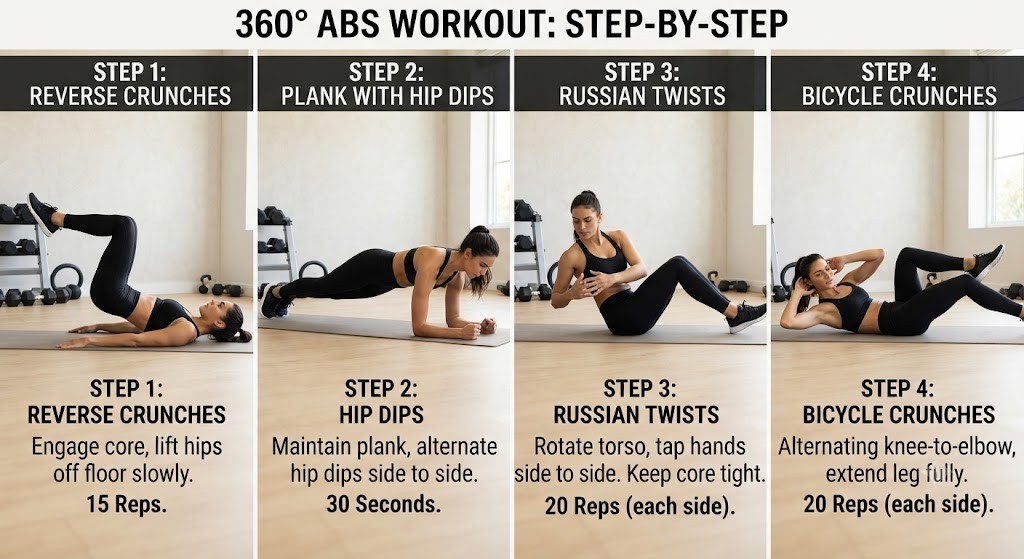
If your ab routine consists mostly of crunches and sit-ups, you may be training only one part of your core. A 360 abs workout takes a more complete approach by challenging your abdominal muscles and supporting core muscles through different movement patterns, directions, and stability demands.
Instead of repeatedly performing the same type of crunch, a 360 abs workout can combine exercises that train flexion, anti-extension, lateral stability, rotation, and anti-rotation. This creates a well-rounded core routine that can be adapted for beginners, home workouts, or more advanced strength training.
In this guide, you’ll learn what a 360 abs workout is, which muscles and movement patterns it targets, the best exercises to include, how to build a 10-minute routine at home, how to make it easier or harder, what equipment can help, and how often to train your core.
What Is a 360 Abs Workout?
A 360 abs workout is a comprehensive core-training routine designed to challenge the abdominal and supporting core muscles through multiple movement directions and stability demands. Rather than focusing primarily on crunching movements, it combines exercises that train flexion, anti-extension, lateral stability, rotation, and anti-rotation.
For example, crunches primarily involve trunk flexion, while a plank challenges you to resist spinal extension. A side plank adds a lateral stability challenge, while controlled rotational exercises train your ability to manage movement around the torso.
Together, these exercises create a broader approach to core training.
A 360 abs workout also does not require an elaborate gym setup. Bodyweight exercises can provide an effective starting point, particularly for beginners. As your strength improves, bands, dumbbells, cables, stability balls, or an ab wheel can be introduced to increase resistance or difficulty.
[Insert image: Diagram showing the five core-training functions—flexion, anti-extension, lateral stability, rotation, and anti-rotation | Alt text: “Understand 360 abs workout core movement patterns”]
How Is a 360 Abs Workout Different From a Traditional Ab Workout?
A 360 abs workout differs from a traditional ab workout because it uses several movement and stabilization patterns instead of relying mainly on crunches or sit-ups.
For example, a traditional abdominal session might contain multiple crunch variations. A 360 routine could instead combine dead bugs, reverse crunches, side planks, bird dogs, and controlled rotational movements.
The objective is not necessarily to make every exercise more difficult or complicated. The goal is balanced core training, with each exercise serving a specific purpose.
For instance, reverse crunches can provide controlled abdominal flexion, side planks can challenge lateral stability, and dead bugs can develop anti-extension control. When combined, these movements expose your core to different demands without requiring a long list of exercises.
Why Is a 360 Abs Workout Effective for Core Strength?
A 360 abs workout can be effective for developing core strength because it trains the trunk to create movement while also resisting unwanted movement in multiple directions. Your abdominal muscles work alongside surrounding muscles to help stabilize your torso during exercise and everyday activities.
Core stability is especially important during movements where the arms or legs are doing most of the visible work. For example, while performing a dumbbell row, your core helps keep your torso stable even though the primary movement comes from your upper body.
This is why core stability extends beyond traditional ab exercises.
Adults are generally advised to perform muscle-strengthening activities on at least two days each week, with major muscle groups including the abdomen. — Source: [CDC, 2023]
For a broader foundation, combine your 360 routine with core strengthening exercises.
What Are the Main Benefits of 360-Degree Core Training?
360-degree core training combines exercises that challenge trunk flexion, anti-extension, lateral stability, rotation, and anti-rotation. This approach can help you train the core through a wider range of movement and stabilization demands.
Some of the potential benefits include:
- Improved trunk control: Your core learns to stabilize your torso under different demands.
- More balanced core training: Different exercises target different functions instead of repeatedly stressing the same movement.
- Better exercise support: Core control can complement exercises such as squats, rows, presses, and carries.
- Greater exercise variety: You can build an effective routine without relying entirely on crunches.
- Flexible programming: Bodyweight movements can be used by beginners, while resistance can be added for more advanced training.
For example, a side plank requires you to maintain alignment while resisting the tendency for your hips and torso to drop. A dead bug, meanwhile, challenges your ability to control your trunk while moving your limbs.
Can a 360 Abs Workout Help Define Your Abs?
A 360 abs workout can strengthen and develop the abdominal muscles, but it cannot selectively remove belly fat from your abdomen.
For example, a 2011 controlled study found that six weeks of abdominal exercise improved abdominal muscular endurance but did not significantly change abdominal body fat or body composition. — Source: [Journal of Strength and Conditioning Research, 2011]
This distinction is important. Building abdominal muscle and reducing abdominal fat are related to different aspects of fitness.
Overall body composition can be influenced by total physical activity, nutrition, genetics, and other factors. A meta-analysis of 43 randomized trials involving 3,552 participants found that aerobic, resistance, and combined exercise were associated with reductions in subcutaneous abdominal fat. — Source: [Sports Medicine, 2021]
Therefore, use a 360 abs workout to build stronger abdominal muscles and improve core control, rather than treating it as a spot-reduction strategy.
For practical nutrition guidance, see nutrition for muscle definition.
Which Muscles Does a 360 Abs Workout Target?
A 360 abs workout can target the rectus abdominis, internal and external obliques, transverse abdominis, and supporting muscles around the trunk and pelvis.
Each muscle group has a different role in movement and stability.
| Core muscle | Main role | Example 360 exercise |
|---|---|---|
| Rectus abdominis | Trunk flexion and abdominal bracing | Reverse crunch |
| External and internal obliques | Rotation and side-to-side stability | Side plank or bicycle crunch |
| Transverse abdominis | Deep abdominal bracing and trunk stability | Dead bug |
| Spinal and pelvic stabilizers | Postural control and resistance to unwanted movement | Bird dog |
| Hip flexor and trunk-supporting muscles | Assist with controlled leg and torso movement | Mountain climber |
What Does the Rectus Abdominis Do?
The rectus abdominis is the long abdominal muscle that runs vertically along the front of the torso. It contributes to trunk flexion and also plays a role in abdominal bracing.
For example, bringing your rib cage toward your pelvis during a controlled reverse crunch challenges the abdominal region.
However, the rectus abdominis is only one part of the core. Training the visible abdominal muscles alone does not constitute complete core training, which is why a 360-degree approach incorporates additional movement and stability patterns.
What Do the Obliques and Transverse Abdominis Do?
The internal and external obliques contribute to trunk rotation, side bending, and resistance against unwanted movement. The transverse abdominis contributes to abdominal bracing and trunk stability.
For example, maintaining a stable torso during a side plank challenges the lateral core without requiring repeated twisting.
For targeted training ideas, explore oblique exercises.
You can also use dead bugs for controlled deep-core work; see the dead bug workout.
What Are the Best Exercises for a 360 Abs Workout?
The best 360 abs exercises are movements that collectively challenge multiple core functions. A balanced exercise selection can include dead bugs, planks, side planks, reverse crunches, bicycle crunches, bird dogs, mountain climbers, hollow-body variations, and controlled rotations.
You do not necessarily need to perform every exercise in one workout. Instead, select movements that collectively cover different training functions.
Which Bodyweight Exercises Should You Include?
Bodyweight exercises are particularly useful for a 360 abs workout because they allow you to focus on positioning, breathing, stability, and control before introducing external resistance.
A practical starting selection includes:
- Dead bug — Perform 6–10 controlled repetitions per side.
- Forearm plank — Hold for 20–40 seconds.
- Side plank — Hold for 15–30 seconds per side.
- Reverse crunch — Perform 8–12 repetitions.
- Bird dog — Perform 6–10 repetitions per side.
- Mountain climber — Perform 20–30 controlled repetitions.
- Bicycle crunch — Perform 8–12 repetitions per side.
Beginners can shorten work periods or perform fewer repetitions while maintaining clean technique.
For a gentler approach, combine these exercises with low-impact workouts.
How Do You Perform These Exercises Correctly?
Proper form is one of the most important parts of an effective 360 abs workout. Controlled movement helps you focus on the intended muscles while reducing unnecessary momentum.
Use these form cues:
- Dead bug: Move slowly and avoid arching your lower back.
- Plank: Keep your ribs controlled and hips aligned with your shoulders.
- Side plank: Stack or stagger your feet and keep your hips lifted.
- Reverse crunch: Curl your pelvis upward rather than swinging your legs.
- Bird dog: Extend opposite limbs without rotating your torso.
- Bicycle crunch: Rotate through the trunk while keeping the movement controlled.
- Mountain climber: Maintain a stable plank position instead of bouncing your hips.
When learning these movements, prioritize control over speed. If an exercise causes sharp or unusual pain, stop performing it and consider professional guidance when needed.
How Do You Do a 360 Abs Workout at Home?
You can perform a 360 abs workout at home with bodyweight exercises and a small amount of floor space. A living-room routine can combine dead bugs, reverse crunches, planks, side planks, and bird dogs without dumbbells, machines, or other specialized equipment.
This makes the 360 abs workout accessible for people who prefer short home sessions or want to add core training to an existing workout program.
What Is a Good 10-Minute 360 Abs Workout for Beginners?
A good 10-minute 360 abs workout for beginners should use manageable work intervals and balanced movement patterns rather than exhausting the same muscle with repeated crunches.
For example, complete five exercises for 40 seconds each with 20 seconds of transition or rest, then repeat the circuit.
10-Minute Beginner 360 Abs Workout
- Dead bug — 40 seconds
- Forearm plank — 40 seconds
- Reverse crunch — 40 seconds
- Side plank — 20 seconds per side
- Bird dog — 40 seconds
- Rest or transition — 20 seconds
- Repeat the circuit once
Before beginning, spend about one minute warming up with gentle trunk rotations, marching, hip movements, and controlled breathing.
Then perform the circuit at a pace that allows you to maintain good technique from beginning to end.
[Insert image: Step-by-step 10-minute 360 abs workout circuit with exercise order and intervals | Alt text: “Follow a 10-minute 360 abs workout at home”]
How Can You Make the Routine Easier?
Beginners can make a 360 abs workout easier by reducing leverage, shortening work periods, or choosing supported exercise variations.
For example, perform a side plank from your knees instead of your feet if maintaining a full side plank causes your hips to drop.
Useful modifications include:
- Perform planks from your knees.
- Bend your knees during dead bugs.
- Reduce each work interval to 20–30 seconds.
- Perform fewer reverse crunches.
- Keep mountain climbers slow rather than fast.
- Use a wall-supported variation when appropriate.
Moreover, quality matters more than speed. A controlled 20-second plank with stable alignment can be more useful than a longer hold performed with poor positioning.
How Do You Modify and Progress a 360 Abs Workout?
Progressive core training means gradually increasing exercise difficulty, resistance, repetitions, hold duration, or movement control as your strength improves.
For example, you might progress from a 20-second plank to a 30-second plank before moving to a more challenging variation.
How Do You Make a 360 Abs Workout Harder?
The simplest way to make a 360 abs workout harder is to increase one training variable at a time. Adding five seconds to a plank, for example, can be more practical than changing every exercise simultaneously.
Progression options include:
- Increase duration: Move from 20-second holds to 30–40 seconds.
- Increase repetitions: Add one or two controlled repetitions per set.
- Increase resistance: Introduce a dumbbell, band, or cable.
- Increase leverage: Move from a bent-knee variation to a longer-lever variation.
- Increase control: Slow the lowering phase of each repetition.
- Increase complexity: Progress toward hollow-body or more demanding rotational movements.
Avoid adding difficulty simply for novelty. Progress should preserve control and technique, rather than turning every set into a race.
How Should Beginners Track Progress?
Beginners can track repetitions, hold duration, resistance, and perceived difficulty. For example, record three sets of 20-second planks in week one and compare them with three sets of 30-second planks several weeks later.
Tracking your workouts provides a measurable way to determine when you are ready to progress.
What Equipment Do You Need for a 360 Abs Workout?
You do not need equipment to perform a 360 abs workout. Bodyweight exercises can train multiple core functions effectively, making them a practical choice for home workouts and beginners.
For example, dead bugs, planks, bird dogs, and reverse crunches require only a comfortable floor surface.
Which Equipment Can Make Core Training More Challenging?
Once bodyweight exercises become easier, equipment can add resistance, leverage, or instability.
Useful options include resistance bands, dumbbells, cable machines, stability balls, and ab wheels.
| Equipment | Useful for | Home alternative |
|---|---|---|
| Resistance band | Rotation and anti-rotation | Towel or bodyweight variation |
| Dumbbell | Loaded core exercises | Bodyweight |
| Cable machine | Controlled rotation and anti-rotation | Resistance band |
| Stability ball | Stability challenges | Floor-based exercise |
| Ab wheel | Advanced anti-extension | Plank |
| Exercise mat | Comfort and grip | Carpet or firm surface |
[Insert image: Home and gym equipment arranged beside corresponding 360 abs exercises | Alt text: “Choose equipment for a 360 abs workout at home or gym”]
First, master bodyweight technique before adding equipment. Then increase resistance only when you can maintain your torso position and breathing throughout the exercise.
How Often Should You Do a 360 Abs Workout?
Most people can incorporate challenging core training several times per week as part of a broader exercise program. However, recovery needs depend on training intensity, exercise selection, and individual experience.
For example, a short core session can complement two or more weekly strength workouts without requiring a separate long abdominal workout every day.
The CDC recommends that adults perform muscle-strengthening activities on at least 2 days per week and work all major muscle groups, including the abdomen. — Source: [CDC, 2025]
Your core also does not operate independently from the rest of your body. Pairing core sessions with a full-body strength workout
Should You Train Your Abs Every Day?
Daily hard abdominal workouts are not necessary for building a stronger core. Like other muscles, the core can benefit from adequate recovery after challenging training.
For example, performing a demanding weighted core session every day may make it harder to maintain exercise quality and control.
Instead, alternate challenging core sessions with lighter movement or rest. Consistency matters more than daily abdominal volume, particularly when your broader training program already includes squats, carries, presses, rows, and other compound movements.
For additional recovery strategies, see workout recovery.
Can a 360 Abs Workout Help You Lose Belly Fat?
A 360 abs workout can strengthen the abdominal muscles, but it does not selectively burn belly fat.
For example, a controlled abdominal-exercise study found improved muscular endurance without significant reductions in abdominal fat after six weeks. — Source: [Journal of Strength and Conditioning Research, 2011]
At the same time, broader physical activity can contribute to changes in abdominal fat. A meta-analysis covering 43 randomized trials and 3,552 participants found significant reductions in subcutaneous abdominal fat with aerobic, resistance, and combined exercise approaches. — Source: [Sports Medicine, 2021]
Moreover, the CDC recommends adults accumulate at least 150 minutes of moderate-intensity aerobic activity per week, or 75 minutes of vigorous activity, alongside muscle-strengthening activity on at least two days. — Source: [CDC, 2023]
Therefore, combine your 360 abs workout with regular physical activity and appropriate nutrition rather than expecting abdominal exercises alone to reveal your abs.
How Can You Build a Consistent 360 Abs Workout Routine?
A consistent core routine starts with manageable sessions, measurable progression, and exercises you can perform with good technique.
Instead of constantly changing your routine, repeat the same basic movements long enough to recognize improvements in control, repetitions, duration, or resistance.
A simple progression can look like this:
- Weeks 1–2: Learn the basic exercises and focus on technique.
- Weeks 3–4: Add repetitions or increase hold times slightly.
- Weeks 5–6: Introduce resistance or harder exercise variations.
- After week 6: Continue progressing one variable at a time.
First, record your starting repetitions and hold times. Then, repeat the exercises consistently enough to identify measurable improvements.
You can also explore different workout types to build a broader training schedule.
[Insert image: Weekly 360 abs workout progression showing beginner, intermediate, and advanced stages | Alt text: “Progress a 360 abs workout from beginner to advanced”]
360 Abs Workout: Beginner Checklist
Before finishing your core session, use this checklist to make sure your workout remains balanced and effective:
- Include more than one core movement pattern.
- Train both movement and stabilization.
- Perform exercises with controlled technique.
- Adjust repetitions or hold times to your ability.
- Stop if you experience sharp or unusual pain.
- Progress gradually rather than changing everything at once.
- Allow adequate recovery between challenging sessions.
- Combine core training with broader strength and physical activity.
- Remember that abdominal exercises alone do not selectively remove belly fat.
Conclusion
A 360 abs workout provides a more comprehensive approach to core training by combining flexion, anti-extension, lateral stability, rotation, and anti-rotation. Instead of relying on endless crunches, you can create a balanced routine using exercises such as dead bugs, planks, side planks, reverse crunches, bird dogs, and controlled rotational movements.
A stronger core and visible abs are also not exactly the same goal. Core training can improve abdominal strength, stability, and control, while overall body composition is influenced by factors including physical activity, nutrition, genetics, and other individual factors.
The best approach is to start with exercises you can perform confidently, focus on proper technique, and gradually increase the challenge as your strength improves. You do not need dozens of abdominal exercises or an elaborate gym setup to create an effective routine.
Your strongest core is built through consistency, control, and progressive training—not endless crunches.
FAQs
What is a 360 abs workout?
A 360 abs workout trains your core through multiple movements, including flexion, stability, rotation, and anti-rotation.
What exercises are included in a 360 abs workout?
Common exercises include planks, dead bugs, reverse crunches, side planks, bird dogs, and bicycle crunches.
Can I do a 360 abs workout at home?
Yes, you can do most 360 abs exercises at home without equipment.
Is a 360 abs workout good for beginners?
Yes, beginners can start with easier variations, shorter intervals, and fewer repetitions.
How often should I do a 360 abs workout?
You can train your abs several times a week while allowing enough time for recovery.
Can a 360 abs workout reduce belly fat?
No, ab exercises strengthen the core but cannot specifically target belly fat.
Does a 360 abs workout build visible abs?
Yes, it can develop your abdominal muscles, while visibility also depends on body composition.
What is the best 10-minute 360 abs workout?
A simple routine can include dead bugs, planks, reverse crunches, side planks, and bird dogs.
What equipment do I need for a 360 abs workout?
You do not need equipment, although bands, dumbbells, and ab wheels can increase difficulty.
Can I do abs every day?
You do not need to train abs every day because your core also needs recovery.
How do I make a 360 abs workout harder?
Increase repetitions, hold times, resistance, or exercise difficulty gradually.
What muscles does a 360 abs workout target?
It targets the rectus abdominis, obliques, transverse abdominis, and supporting core muscles.
What is the no. 1 exercise for abs?
There is no single best ab exercise, but planks, reverse crunches, and dead bugs are effective choices.
What is the 300 AB workout?
The 300 AB workout is a high-volume abdominal routine based on 300 total repetitions.
Did Arnold Schwarzenegger do abs?
Yes, Arnold Schwarzenegger included abdominal exercises in his bodybuilding training.
Is hitting abs 3x a week enough?
Yes, training abs three times a week can be enough with proper recovery and progression.
2 thoughts on “360 Abs Workout: Build a Stronger Core from Every Angle”